OPPO Find N5

Search documents
对话OPPO成蛟:创新是勇敢者的游戏,但OPPO不是「孤勇者」
雷峰网· 2026-03-17 12:07
Core Viewpoint - The article discusses the evolution and challenges of foldable smartphones, particularly focusing on OPPO's journey in overcoming the persistent issue of creases in foldable screens, highlighting their significant investment and technological advancements in this area [2][4][7]. Group 1: OPPO's Journey in Foldable Technology - OPPO has been working on foldable screen technology since 2014, with a dedicated team led by Cheng Jiao, who has been with the company since its early days [5][12]. - The company has invested over 3 billion yuan in research and development for foldable screens, resulting in more than 3,500 technology patents [7]. - OPPO's latest model, the Find N6, aims to tackle the crease issue, which has been a significant barrier in the foldable smartphone market [4][54]. Group 2: Challenges and Innovations - The foldable smartphone industry has faced numerous challenges, particularly with the crease problem, which has led to delays and strategic shifts among major players like Apple and Samsung [2][4]. - OPPO's approach has been characterized by a commitment to solving one major issue with each product iteration, leading to significant advancements in design and functionality [8][28]. - The development of the Find N3 highlighted the limitations of OPPO's internal capabilities, prompting a reevaluation and restructuring of their R&D processes to better support future innovations [27][32]. Group 3: Collaboration and Supply Chain - OPPO has established a collaborative ecosystem termed "Sky Partner," which includes key suppliers like Samsung and Amphenol, to enhance their foldable technology [47][50]. - The company emphasizes a partnership approach with suppliers, viewing their challenges as shared responsibilities, which fosters a collaborative environment for innovation [48][49]. - The integration of various teams within OPPO has improved efficiency and innovation in the development of foldable technology, particularly in addressing the complexities of screen, hinge, and material design [32][41]. Group 4: Future Directions - OPPO plans to continue addressing the crease issue in future models while maintaining the lightweight and thin design achieved in the Find N5 [55][56]. - The company recognizes the importance of battery life and AI technology in future foldable devices, indicating a shift towards enhancing overall user experience [58]. - The commitment to continuous improvement and innovation in foldable technology reflects OPPO's long-term vision for the smartphone market [60][61].


计算机行业观点:IPHONE20周年展望-20260315
SINOLINK SECURITIES· 2026-03-15 07:50
Investment Rating - The report does not explicitly state an investment rating for the industry Core Insights - The 3D printing technology aligns with ESG demands in the consumer electronics industry, enhancing efficiency and supporting high-end upgrades through material utilization and process simplification [2] - The transition from subtractive to additive manufacturing represents a significant efficiency revolution, allowing companies to reduce their environmental footprint while maintaining product performance and aesthetics [10] - The 3D printing process significantly reduces the need for traditional pollution-intensive surface treatments, thus lowering environmental impact [12] Summary by Sections 1. Why Does the Consumer Electronics Industry Need 3D Printing? - The consumer electronics sector faces dual challenges of carbon reduction and resource efficiency, with 3D printing offering a solution through high material utilization rates and the ability to use recycled materials [10] - Traditional CNC processes have a material utilization rate of only 30%-70%, while 3D printing can achieve over 95% [10] - Companies like Apple are utilizing 100% recycled titanium powder in their products, significantly reducing material usage and supporting sustainability goals [10] 2. What Are the Subsequent Steps in 3D Printing? - Post-processing steps such as polishing and grinding are crucial for achieving the quality standards required in consumer electronics [21] - These processes address surface defects inherent in 3D printed parts, ensuring they meet aesthetic and functional requirements [21] - The choice of post-processing techniques varies based on material type and product application, impacting the final product's quality and market acceptance [24] 3. What Recent Signals Indicate Acceleration in the Industry Chain? - The upstream sector is experiencing significant expansion, with advancements in titanium powder production methods leading to cost reductions and increased demand for 3D printing [31] - The introduction of new technologies in the midstream equipment sector is enhancing production efficiency, enabling the manufacturing of complex components [50] - The consumer electronics sector is poised for large-scale adoption of 3D printing, driven by the need for lightweight and durable components in products like foldable smartphones [60] 4. Related Companies - Key companies mentioned include Huazhu High-Tech, Dazhu Laser, Yujing Co., Lens Technology, Feiwo Technology, Yuhuan CNC, Hassen Co., Huichuangda, Yinbang Co., and Bolite [5]

填平折叠缝隙 OPPO Find N6或配无折痕屏幕
Xin Lang Cai Jing· 2026-02-07 14:24
Group 1 - OPPO is committed to addressing user feedback regarding the performance of foldable screen phones, particularly focusing on improving the appearance of creases [1][3] - The company has innovated in foldable screen materials, aiming to provide a better crease-free visual effect, especially when viewed from different angles [3] - The OPPO Find N6 foldable phone is expected to be released after the Spring Festival, likely in March, and will be thinner than its predecessor, the Find N5 [6] Group 2 - The OPPO Find N6 is anticipated to feature the fifth-generation Snapdragon 8 processor, promising improved performance compared to previous models [6]

华为折叠屏国内份额超70%,坐等苹果入局
Guan Cha Zhe Wang· 2026-01-22 09:16
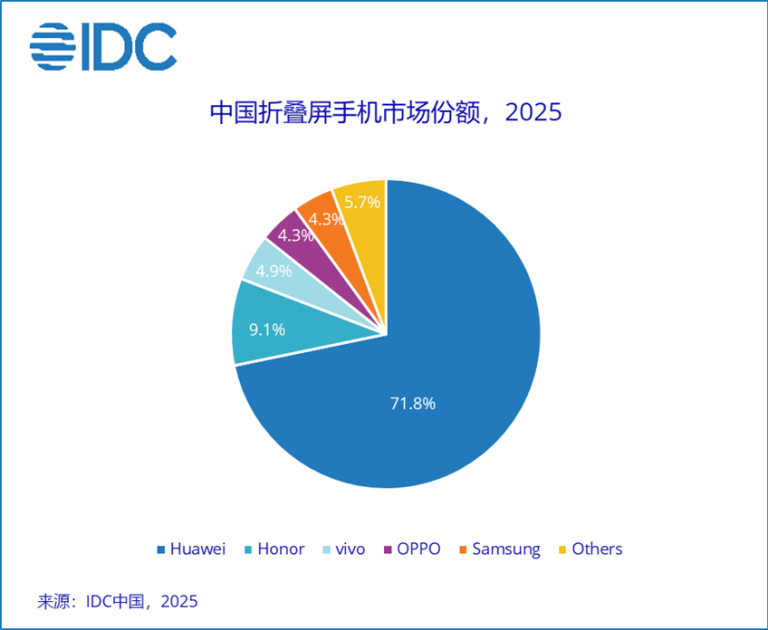
Core Insights - The Chinese foldable smartphone market is projected to see a shipment of approximately 10.01 million units in 2025, reflecting a year-on-year growth of 9.2%, contrasting with a slight decline of 0.6% in the overall smartphone market [1] - Huawei leads the market with a significant share of 71.8%, while other brands like Honor, Vivo, and OPPO have much smaller shares, indicating Huawei's dominant position [1][3] - Despite the emergence of competitive products from other manufacturers, Huawei's comprehensive product lineup and brand strength have solidified its market leadership [4][6] Market Dynamics - The foldable smartphone segment has reached a bottleneck since 2019, with manufacturers struggling to drive sales through hardware improvements alone, leading to a decline in the overall market in Q4 of the previous year [3][4] - Brand strength is increasingly influencing consumer preferences in the high-end market, with Huawei's focus on balanced capabilities and innovative designs contributing to its market share growth of over 20 percentage points in 2025 [4] - The foldable smartphone market still represents only 3.5% of total smartphone shipments in China, prompting some manufacturers to reconsider their strategies in this niche segment [4][6] Technological Innovations - Manufacturers are exploring soft-hard collaboration as a breakthrough direction, with Huawei's MateX7 focusing on AI integration rather than just hardware enhancements [6] - Other brands like OPPO and Vivo are also attempting to bridge compatibility with Apple ecosystems, indicating a trend towards cross-platform functionality [6] Future Outlook - The anticipated entry of Apple's foldable smartphone, expected to be released in the fall of 2026, is generating significant market interest, particularly regarding its potential to enhance hardware and software integration [7][8] - The overall smartphone market in China may face challenges in 2026 due to rising storage costs, which could lead to a noticeable decline in shipments [8]

华为折叠屏国内份额超70%,苹果今年能带来惊喜吗?
Guan Cha Zhe Wang· 2026-01-22 09:12
Core Insights - The Chinese foldable smartphone market is projected to see a shipment of approximately 10.01 million units in 2025, marking a year-on-year growth of 9.2%, contrasting with a slight decline of 0.6% in the overall smartphone market [1] - Huawei leads the market with a significant share of 71.8%, while other brands like Honor, Vivo, and OPPO have much smaller shares, with Xiaomi dropping out of the top five [1][3] - The foldable smartphone segment is experiencing a bottleneck phase, with hardware improvements no longer sufficient to drive significant sales growth, leading to a decline in market performance [3][4] Market Dynamics - Huawei's dominance is attributed to its comprehensive product lineup, including various foldable designs and a focus on balanced capabilities rather than just lightweight models [4] - Other manufacturers have introduced innovative products, such as OPPO's Find N5 and Vivo's lightweight foldable, but these have not significantly challenged Huawei's market position [3][4] - The foldable smartphone market only accounts for 3.5% of total smartphone shipments in China, leading some companies like Xiaomi to reconsider their strategies in this niche [4][6] Technological Innovations - Manufacturers are focusing on soft-hard collaboration to enhance user experience, with Huawei's MateX7 introducing AI capabilities to improve functionality [6] - Competitors like OPPO and Vivo are also exploring compatibility with Apple ecosystems to attract users [6] - The anticipated entry of Apple's foldable phone, expected in 2026, is generating significant market interest, with expectations for superior hardware and software integration [7][9] Future Outlook - The smartphone market is expected to face cost pressures due to rising storage prices, potentially leading to a noticeable decline in shipments in 2026 [9] - The success of Apple's foldable device and its impact on the market remains a key point of interest for industry stakeholders [9]
那些外国博主们,怎么突然开始吹中国手机了???
创业邦· 2026-01-20 03:29
Core Viewpoint - The article discusses the increasing recognition and acceptance of Chinese smartphones in the global market, particularly highlighted by MKBHD's annual smartphone awards, which this year featured several Chinese brands prominently [8][9][11]. Group 1: Recognition of Chinese Smartphones - MKBHD's awards this year included Chinese smartphones such as Xiaomi 17 Pro Max for "Best Large Phone," OnePlus 15 for "Best Battery Life," and OPPO Find X9 Pro for "Best Camera," indicating a shift in perception towards Chinese brands [9][11]. - The article notes that previously, Chinese smartphones were often overlooked in international awards, but recent trends show a growing appreciation for their quality and innovation [8][9]. Group 2: Technological Advancements - Chinese smartphone manufacturers have made significant advancements in hardware design, achieving thinner devices with larger battery capacities through improved internal stacking technology and battery innovations [16][18]. - The use of silicon-carbon anode materials has led to the development of smartphones with batteries exceeding 8000 mAh, showcasing the ability to balance battery size and longevity [20][22]. - Innovations in materials, such as Huawei's Kunlun glass and OPPO's use of 3D-printed titanium alloy in hinges, have enhanced durability and performance in smartphones [22][26]. Group 3: Software and User Experience - The introduction of OPPO's "Starry Compiler" aims to improve the efficiency of Android applications by optimizing the communication between software and hardware, resulting in a smoother user experience [30][31]. - The article highlights the emergence of advanced AI applications in smartphones, such as the "Doubao" phone assistant, which can perform complex tasks and adapt to user needs, indicating a shift towards more intuitive technology [40][42]. Group 4: Market Dynamics - The article emphasizes that the increasing prices of Chinese smartphones in international markets reflect a shift from cost-based purchasing to a recognition of their quality and functionality [11][13]. - The growing acceptance of Chinese smartphones in markets like Australia suggests a broader trend of international consumers valuing performance and innovation over brand origin [13][18].


苹果被曝买国产折叠屏拆解研究,仍难消除折痕
Guan Cha Zhe Wang· 2026-01-13 08:44
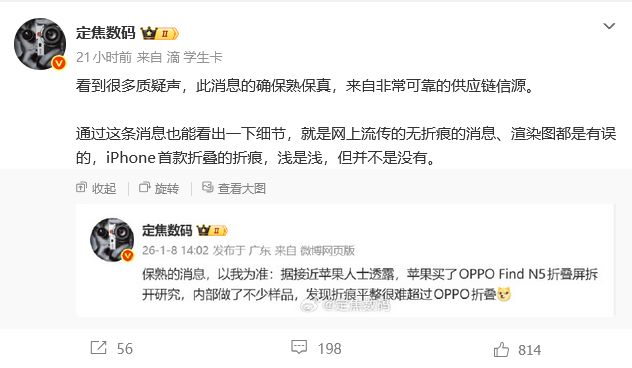
Group 1 - Apple is reportedly developing its first foldable iPhone, tentatively named "iPhone Fold," with a potential release in fall 2026 and a price exceeding $2000 (approximately 14,000 RMB) [3] - The iPhone Fold is expected to feature a book-style design similar to the Galaxy Z Fold 6, with a main screen size of 7.74 inches and an outer screen size of 5.49 inches [3] - Apple is exploring various hinge solutions to eliminate the "crease" issue commonly associated with foldable screens, indicating a strong focus on technological differentiation in the competitive foldable market [5][7] Group 2 - The OPPO Find N5, which Apple has reportedly disassembled for research, is set to be a direct competitor to the iPhone Fold, highlighting the need for Apple to surpass existing hardware standards [5][7] - Market research from Counterpoint Research indicates that global foldable smartphone shipments are expected to grow by 14% year-on-year in Q3 2025, reaching a historical high for the category [8] - Samsung leads the foldable smartphone market with a 64% share in Q3, showing a 32% increase in shipments compared to the previous year, while Huawei and Motorola follow with 15% and 7% market shares, respectively [8]
折叠屏的2025:轻薄化走到尽头,新形态暗流涌动,各路「选手」奔赴新战场
3 6 Ke· 2025-12-25 03:36
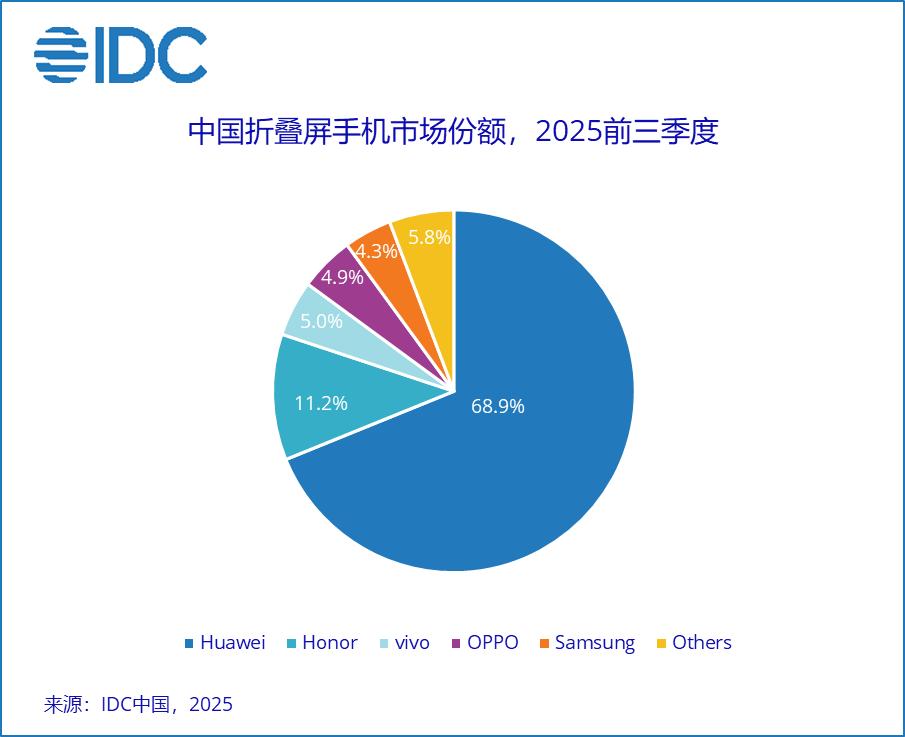
Core Insights - The 2025 foldable smartphone market continues to emphasize thinness and lightness, with models like OPPO Find N5 achieving a thickness of 8.93mm and a weight of 217g, which are now comparable to traditional smartphones [1][4] - Despite a 14% year-on-year decline in Q2, the foldable smartphone market in China rebounded with a 17.8% growth in Q3, largely driven by Huawei, which holds a 68.9% market share [1][4] - The trend towards lightweight designs is leading to compromises in imaging capabilities, which are critical for high-end devices, as manufacturers struggle to balance thinness with performance [3][7] Market Dynamics - The foldable smartphone segment is experiencing a shift towards new form factors, with companies like Huawei and Samsung introducing models that explore different folding mechanisms, such as the tri-fold and wide-fold designs [4][16] - The introduction of new ratios and designs, such as Huawei's Pura X and Samsung's Galaxy Z TriFold, indicates a move away from merely making devices thinner and lighter towards enhancing user experience and functionality [20][24] - Xiaomi's decision to delay the launch of its new foldable device suggests a strategic pause to reassess the market direction amidst the current emphasis on lightweight designs [14][15] Consumer Expectations - As foldable devices become lighter, consumer expectations are shifting closer to those of traditional flagship smartphones, demanding high-quality imaging and performance without compromises [14][25] - The trade-offs made in hardware configurations, such as reduced camera specifications and fewer speaker channels, are becoming more noticeable to consumers, raising questions about the value proposition of foldable devices [11][12] - The success of new form factors, like the Pura X, which achieved significant sales shortly after launch, indicates a willingness among consumers to pay a premium for innovative designs that enhance usability [22][23] Future Outlook - The foldable smartphone market is at a crossroads, where the next phase of competition will focus on redefining user experience rather than just incremental improvements in size and weight [25][26] - Companies are exploring the potential of foldable devices to serve as hybrid devices between smartphones and tablets, suggesting a broader rethinking of what foldable technology can offer [25][26] - The ongoing developments in foldable technology highlight the industry's need to address the unique advantages of foldable devices beyond just being thinner and lighter [25][26]
铂力特(688333):看好3D打印产品在民用领域开拓
Xin Lang Cai Jing· 2025-10-29 06:33
Core Viewpoint - The company reported significant growth in Q3 2025, with revenue reaching 494 million yuan, a year-over-year increase of 120.94%, and a net profit of 79.44 million yuan, reflecting a year-over-year increase of 447.30% [1][2]. Financial Performance - In Q3 2025, the company's revenue grew by 120.94% year-over-year, while net profit increased by 447.30%. This growth is attributed to the expansion into new application areas and increased efforts in the civilian market, particularly in 3D printing customized products [2]. - For the first three quarters of 2025, the company achieved revenue of 1.16 billion yuan, a year-over-year increase of 46.47%, and a net profit of 156 million yuan, reflecting a year-over-year increase of 234.83% [1]. Profitability Improvement - The gross margin for Q3 2025 was 45.24%, up by 12.15 percentage points year-over-year, and the net profit margin was 16.09%, an increase of 26.32 percentage points year-over-year [2]. - The company is experiencing scale effects as military and civilian products gradually enter mass production [2]. Inventory and Capacity Expansion - As of Q3 2025, the company's inventory, prepayments, and contract liabilities were 1.45 billion yuan, 88 million yuan, and 153 million yuan, respectively, representing increases of 75.30%, 94.76%, and 125.30% compared to the beginning of the year. This indicates strong downstream demand and proactive inventory buildup [2]. - The company is actively expanding production capacity, with a new facility expected to be completed by December 2024, which will enhance its mass production capabilities in aerospace and industrial applications [2]. New Market Developments - The company has made significant breakthroughs in emerging fields, including humanoid robots, 3C products, and commercial aerospace. Notable developments include the introduction of advanced sensors at the World Robot Conference and participation in the development of a liquid oxygen-methane engine [3]. Profit Forecast and Valuation - The company maintains its profit forecast, expecting net profits of 281 million yuan, 374 million yuan, and 506 million yuan for 2025-2027, with a compound annual growth rate of 69.25%. Corresponding EPS is projected at 1.02 yuan, 1.36 yuan, and 1.85 yuan [4]. - The company is assigned a valuation of 65 times PE for 2026, with a target price adjusted to 88.40 yuan, reflecting a discount compared to comparable companies due to its established position in the military 3D printing sector [4].

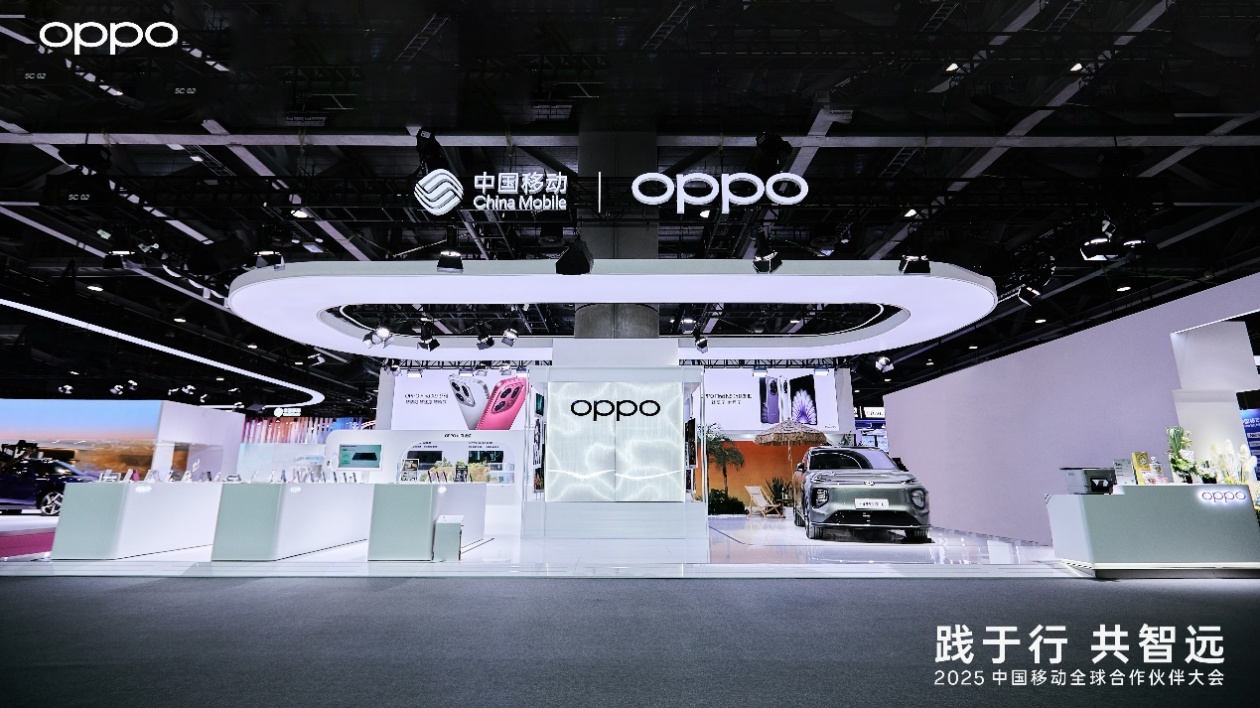
从山海通信到智慧出行:OPPO携多项技术创新成果亮相中国移动全球合作伙伴大会
Huan Qiu Wang· 2025-10-13 02:41
Core Insights - The 2025 China Mobile Global Partner Conference was held in Guangzhou, showcasing OPPO's innovative technologies and products, including the OPPO Find X9 series and various smart devices [1][4] - OPPO received the "Most Popular Smart Terminal Brand" award from China Mobile, highlighting its strong market presence and consumer appeal [1] Group 1: Communication Technology - OPPO introduced the industry-first underwater communication experience with the A6 Pro, demonstrating its advanced "Mountain-Sea Communication" technology that maintains stable voice calls and data transmission even underwater [2] - The "Mountain-Sea Communication" technology features a dual-side low-frequency enhancement antenna architecture and self-developed enhancement chips, enabling efficient network switching in weak signal environments [2][4] - This technology aims to provide seamless communication across various challenging scenarios, including elevators, subways, and remote areas, ensuring connectivity without traditional network signals [2][4] Group 2: Imaging and AI Innovations - OPPO showcased its LUMO imaging technology, which enhances traditional imaging processes to accurately reproduce light and color, appealing to users interested in photography [4] - The OPPO AI section highlighted practical AI applications, such as dual-screen translation and AI note-taking features, aimed at improving user experience and efficiency [4] - Upcoming enhancements in OPPO AI, including AI portrait lighting and voice enhancement, are set to expand its applications in creative and everyday scenarios [4] Group 3: Smart Mobility and Health - OPPO's smart mobility solutions include features like digital car keys and integrated services with automotive partners, enhancing user convenience in vehicle management [7] - The new Watch X2 series was presented, offering comprehensive health monitoring and promoting a healthier lifestyle through its advanced features [7] - In the enterprise sector, OPPO provides integrated mobile office solutions, showcasing its versatility across different market segments [7] Group 4: Strategic Collaboration - OPPO and China Mobile maintain a close partnership, focusing on 5G terminal development, ecosystem collaboration, and digital upgrades, which positions them as leaders in the AI smartphone market [8][11] - The collaboration emphasizes resource integration and value co-creation, aiming to enhance user experiences through advanced connectivity solutions [11] - Both companies are committed to deepening their cooperation in new technology trials and network optimization, ensuring a robust foundation for future advancements in communication technology [11]