PSPDFKit

Search documents
真正的未来,由青年定义 | 创业邦2026「新青年创投榜」调研启动!
创业邦· 2026-03-13 04:11
Core Insights - The article highlights the emergence of young entrepreneurs and investors in the hard technology sector, emphasizing their role in addressing complex problems and driving innovation [2][3]. Group 1: Young Entrepreneurs - Peter Steinberger, an Austrian developer, created PSPDFKit, a PDF rendering tool, which has become a crucial component in thousands of applications globally [2]. - The "35 Under 35 Entrepreneur Pioneers" list by Chuangyebang has consistently recognized that true innovation often occurs in quiet persistence rather than in the spotlight [2]. - By 2025, the average funding for the 30 young entrepreneurs listed reached nearly 400 million, with all having completed at least two rounds of financing, indicating a robust entrepreneurial ecosystem [2]. Group 2: Young Investors - The "40 Under 40 Investors" list features investors with an average age of 37.5 years, with 60% holding partner-level positions, showcasing a young and dynamic investment landscape [3]. - A significant 72.5% of these investors focus on early-stage projects, while 82.5% invest in growth-stage companies, reflecting a commitment to nurturing innovation from the ground up [3]. - Over the past three years, their exit cases have yielded an average return of 11.7 times, underscoring the value of long-term engagement and professional judgment in investment [3]. Group 3: Emerging Trends - The article identifies key areas of innovation led by young entrepreneurs and investors, including AI applications, humanoid robots, automotive chips, commercial aerospace, controllable nuclear fusion, synthetic biology, 6G communication, solid-state batteries, quantum encryption, and brain-computer interfaces [3]. - These sectors are characterized by a shift away from concept financing towards building real barriers through products, technology, and customer trust [3].


龙虾OpenClaw 创始人万字访谈:我感觉到暴风雨要来了
创业家· 2026-03-09 10:27
Core Insights - The article discusses the rapid rise of OpenClaw, an open-source AI agent created by Peter Steinberger, which gained over 180,000 GitHub stars in a short period, marking it as one of the fastest-growing projects in GitHub history [3][16]. - A significant prediction made is that 80% of apps will become obsolete as AI agents like OpenClaw can perform tasks that independent apps currently handle [5]. Development and Features - The initial prototype of OpenClaw was developed in just one hour, integrating WhatsApp with Claude Code CLI, showcasing the potential of AI agents to automate tasks [5][19]. - OpenClaw is capable of self-modifying its code, allowing it to understand its architecture and make adjustments autonomously, which is a significant advancement in AI technology [5][45]. - The development workflow emphasizes using voice input over typing, with short prompts being more effective than long ones, highlighting a shift in how developers interact with AI [5][75]. Naming Controversy - The project faced a naming crisis when Anthropic requested a name change due to confusion with their product Claude, leading to a series of unfortunate events where old accounts and package names were quickly claimed by others [4][48]. - The final name, OpenClaw, was chosen after a stressful period of rebranding, which involved significant community support to secure necessary accounts and domains [5][62]. Community and Impact - OpenClaw has fostered a community where many users, including those with no programming background, have contributed to the project, marking a shift in how individuals engage with software development [5][46]. - The emergence of MoltBook, a social network for AI agents, sparked discussions about the implications of AI in society, with mixed reactions ranging from excitement to fear [5][64]. Security Concerns - The article addresses security issues related to OpenClaw, including potential vulnerabilities due to its open nature and the need for robust security measures as the project evolves [5][70]. - The development team is actively working on improving security protocols and collaborating with security researchers to address vulnerabilities [5][71].

养龙虾,今年最大AI风暴
投资界· 2026-03-06 07:16
Core Insights - The article discusses the emergence of OpenClaw, an AI assistant that acts autonomously, performing tasks such as reading news, sending emails, and even making financial transactions, marking a significant shift in how AI can operate in the workplace [2][4][11] - OpenClaw has rapidly gained popularity, becoming one of the fastest-growing open-source projects on GitHub, leading to increased sales of compatible hardware like the Mac mini [6][11] - The rise of OpenClaw has sparked interest across various sectors, including legal and investment communities, as individuals seek to leverage this technology for efficiency and productivity [7][11] Group 1 - OpenClaw allows users to grant it full access to their computers, enabling it to act as a digital assistant that can execute commands across different applications [4][11] - The creator of OpenClaw, Peter Steinberger, returned from retirement to develop this AI tool, which has been described as a "digital worker" capable of handling tasks without human intervention [8][10] - The technology has led to the formation of a new industry around "raising lobsters," with services emerging to assist users in installing and utilizing OpenClaw [6][11] Group 2 - The article highlights the potential for OpenClaw to revolutionize business operations, suggesting that it could create a new class of digital workers that operate continuously, thus transforming traditional business models [11][12] - Concerns are raised regarding the security and governance of AI agents like OpenClaw, as they require access to sensitive user data, which poses risks [13] - The shift towards AI agents executing tasks autonomously indicates a significant change in the competitive landscape, where individuals can operate as fully equipped digital teams [12][13]

龙虾之父新访谈,OpenClaw内幕全公开!“拦不住滥用,只劝大家别玩火”
猿大侠· 2026-02-28 13:31
来自:量子位 | 公众号 QbitAI 不是,这才加入OpenAI几天啊,龙虾之父 Peter Steinberger 这波发言属实猛了些啊! 在OpenAI的最新访谈中,他聊创业、聊OpenClaw、聊龙虾滥用和安全问题,那叫一个「实诚」。 说实在的啊,我平时连代码都很少看……大多数代码都挺无!聊!的!(Big胆) 而整场对话听下来,有几个判断尤其值得玩味,我帮大家梳理了一下—— 下面这位网友看完这个采访憋不住了,直言:Peter太接地气儿了啊,这到了OpenAI咋适应啊..(doge 以下为本场访谈重点内容实录,围绕核心观点做了摘选整理,部分文字在不改变原意的基础上做了适度删改~ 实诚到什么程度呢?人家Peter可摸着良心说了 Peter创业13年后精力耗尽退隐,结果被 Claude Code 一小时原型直接「打脸」重燃。 Peter直言没法儿阻止大家 滥用 OpenClaw,只能尽可能让大家别自毁前程。 OpenClaw已经有 2000 个PR,有些PR更像是prompt request,代码靠后,意图靠前。 代码不必百分百符合审美 ,关键是方向对,如果真出现性能问题,再专门去优化。 从13年老创业人, ...

OpenClaw 启示录:Agent 的扩散速度取决于入口与社区 | Jinqiu Select
锦秋集· 2026-02-12 12:25
Core Insights - OpenClaw has gained significant traction since its launch in early 2026, achieving high visibility in the global developer community, including over 180,000 stars on GitHub, and leading to the emergence of social experiments like Moltbook, showcasing a new trend in interactive AI agents [3][15] - The creator, Peter Steinberger, emphasizes that the success of OpenClaw is not solely due to technology but rather its community engagement and low entry barriers, allowing users to modify the software easily [6][9] - The project has sparked discussions about the future of AI agents, the redefinition of traditional applications, and the evolution of human-agent interactions, which many entrepreneurs have yet to fully grasp [5][6] Project Origin - The inception of OpenClaw began with Peter's personal need for an AI assistant in April 2024, leading to a series of early experiments that culminated in the project's creation due to frustration over its absence [9][10] - The first working prototype was developed in just one hour, demonstrating the core functionality of interacting with a computer through a chat application [11][12] - The project experienced viral growth after an unexpected feature emerged, showcasing the agent's ability to autonomously handle tasks without prior instruction [12][13] Technical Architecture - OpenClaw's architecture includes several sophisticated components, such as a chat client gateway for decentralized access, a core decision engine, and a skills system for functionality expansion [16][17] - The agent's self-awareness allows it to read and modify its own source code, which is a significant advancement in software engineering [17][18] - The project has faced challenges related to security and brand protection, particularly after its rapid rise in popularity, highlighting the need for integrated security measures [6][27] Community and Social Impact - MoltBook, a social network for AI agents, has emerged as a phenomenon, where agents interact in a Reddit-like environment, leading to discussions that sometimes cause public concern [27][28] - The term "AI psychosis" was coined by Peter to describe the mix of genuine concern and sensationalism surrounding AI developments, reflecting societal fears about AI's role in the digital age [28][29] - OpenClaw represents a balance between freedom and responsibility, as users gain control over their data while also being accountable for its security [30][31] Business Model and Future Outlook - Despite the project's popularity, Peter has chosen to reject significant funding offers, prioritizing the open-source ethos and community engagement over commercial pressures [32][33] - The current financial status shows monthly revenues between $10,000 and $20,000, with ongoing discussions for partnerships with major tech labs, provided the project remains open-source [33][34] - Peter envisions a future where traditional applications may be replaced by AI agents, fundamentally altering the app market landscape [39][40]

OpenClaw全球首个龙虾孵化场,全场癫狂,龙虾手机发布,开发者嗨翻天
3 6 Ke· 2026-02-11 11:37
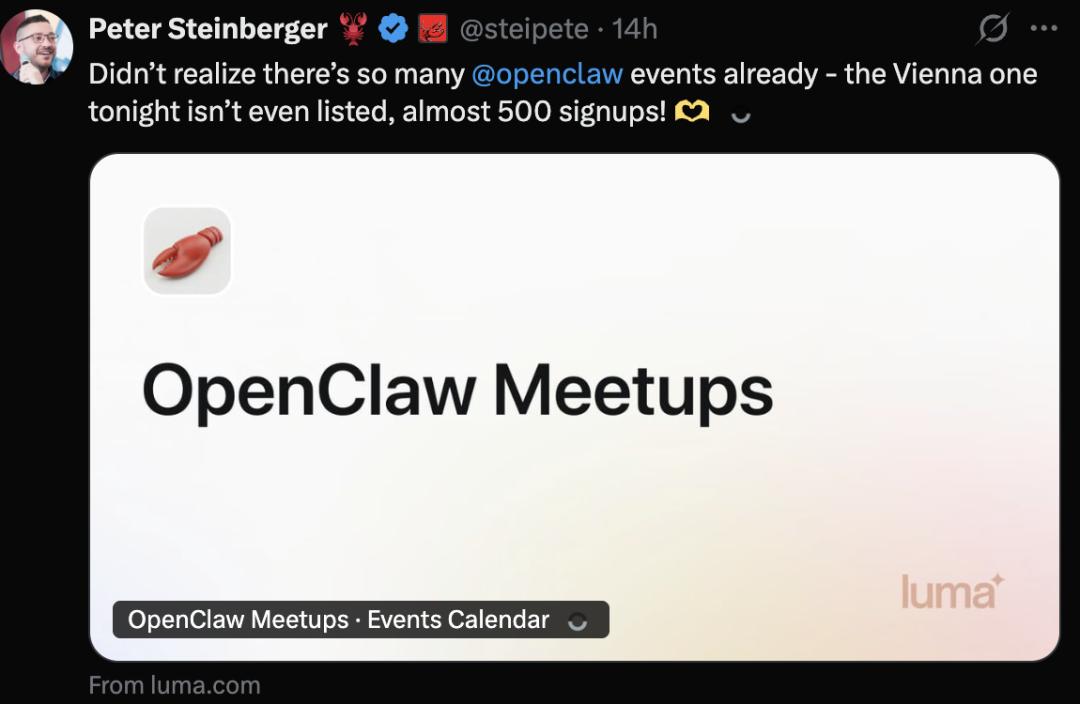
Core Insights - OpenClaw is rapidly evolving and gaining popularity, with significant events such as the recent ClawCon in Vienna, where over 500 developers gathered to discuss advancements in AI technology [3][20][28] - The launch of Clawra, an AI girlfriend based on OpenClaw, has generated considerable buzz, indicating the platform's expanding influence in the AI sector [2] - Peter Steinberger, the founder of OpenClaw, is central to this movement, having returned to the industry after a brief retirement, and is actively engaging with the community [20][23] Group 1: Events and Gatherings - The first offline OpenClaw gathering took place in San Francisco, attracting over 1,000 attendees [1] - The Vienna ClawCon event was marked by a vibrant atmosphere, with the venue reaching full capacity and requiring additional live streaming options [6][9] - Developers showcased various projects and shared experiences related to OpenClaw, highlighting a strong community spirit [28][35] Group 2: Technological Innovations - OpenClaw has introduced a 3D interface that allows for a more immersive interaction with AI, moving beyond traditional text-based communication [37][38] - The ClawPhone, a low-cost device running OpenClaw, has been developed, enabling AI functionalities on affordable hardware [41][44] - Developers have demonstrated the ability to control various devices, including printers, using OpenClaw, showcasing its versatility and potential applications [50][54] Group 3: Community and Culture - The enthusiasm in Vienna reflects a growing belief that the agent economy is not just a future concept but is actively being built [33] - The community around OpenClaw is characterized by a collaborative atmosphere, with developers sharing insights and experiences [28][35] - Steinberger's return and the subsequent events have fostered a sense of belonging among participants, reinforcing the community's commitment to innovation [20][23]
退隐3年后回归,周末写的AI一夜刷屏、一周拿下10万Star增速超Linux,Clawdbot之父首次长谈:如今几乎不看自己发布的代码
AI科技大本营· 2026-02-04 10:07
Core Insights - The article discusses the rapid rise of OpenClaw, a personal AI assistant project developed by Peter Steinberger, which gained significant traction in the developer community within a short period [3][8][10] - The project has undergone several name changes, initially starting as WhatsApp Relay, then Clawdbot, and finally settling on OpenClaw after facing legal challenges [5][10] - Steinberger's development approach leverages AI tools, allowing him to code at a pace comparable to a full team, raising questions about the future of software development and the role of AI in it [11][12] Group 1 - OpenClaw quickly became popular, achieving 100,000 stars on GitHub and 22,000 forks, surpassing established projects like Linux kernel, Vue, and React [1][3] - The project was primarily developed by a single individual, Peter Steinberger, who previously created PSPDFKit, a widely used PDF development tool [8][9] - Steinberger returned to development after a three-year hiatus, utilizing advanced AI models to enhance his coding efficiency, submitting over 600 code changes in January alone [10][12] Group 2 - The article features an interview with Steinberger, where he shares insights on his coding practices and the impact of AI on software engineering [11] - He emphasizes that traditional code review processes are outdated, suggesting that pull requests should be viewed as "prompt requests" in the context of AI-assisted development [12] - Steinberger's experience highlights a shift in software development dynamics, where AI tools enable developers to focus more on architecture and less on mundane coding tasks [56][62] Group 3 - The article outlines Steinberger's journey from creating PSPDFKit to developing OpenClaw, detailing his early experiences with programming and the evolution of his career [19][30] - It discusses the challenges he faced while transitioning from a traditional coding environment to one enhanced by AI, noting the importance of understanding AI's capabilities and limitations [75][78] - Steinberger's perspective on the future of coding suggests a blend of human creativity and AI efficiency, where developers can leverage AI to streamline processes and enhance productivity [62][68]

当AI有了行动的手,就像打开了潘多拉魔盒
新财富· 2026-02-04 08:55
Core Viewpoint - OpenClaw has emerged as a significant player in the AI space, capable of automating up to 90% of human workflows, highlighting a shift from traditional AI assistants to more autonomous digital colleagues [10][12][13]. Group 1: OpenClaw Overview - OpenClaw, previously known as ClawdBot and MoltBot, has gained popularity in the AI community, leading to increased demand for compatible hardware like Mac Mini [3]. - Major cloud providers such as Tencent Cloud and Alibaba Cloud are offering quick deployment options for OpenClaw, indicating a growing market for AI solutions [5]. - OpenClaw is designed to perform various tasks such as managing emails, scheduling, and handling check-ins for flights, all through popular messaging applications [10]. Group 2: Competitive Landscape - Prior to OpenClaw, Anthropic launched Claude Cowork, which focuses on executing tasks rather than just answering questions, marking a transition to a more interactive AI experience [7]. - Another competitor, Jumpshare, introduced a desktop AI agent that operates across applications, emphasizing the need for desktop-level intelligence rather than a single software assistant [8]. Group 3: Technical Capabilities - OpenClaw's success is attributed to its ability to integrate various skills, allowing it to perform complex tasks autonomously without human intervention [10]. - The AI can execute scripts and automate workflows, achieving a high level of autonomy that enables it to complete tasks without continuous human oversight [12][19]. - The combination of coding capabilities and skills allows OpenClaw to automate 90% of workflows, showcasing its potential to revolutionize productivity [12][13]. Group 4: User Adoption and Market Demand - Users are increasingly willing to accept the risks associated with OpenClaw, driven by frustration with traditional chat-based AI that lacks execution capabilities [21]. - The demand for agents that can perform continuous tasks and take responsibility for outcomes is evident, as users seek more than just conversational AI [22]. - The rapid evolution of AI coding capabilities has led to significant advancements in agent technology, with companies like Kimi also making strides in this area [22]. Group 5: Challenges and Ecosystem Limitations - The development of agents is hindered by restrictions imposed by major platforms, which often limit the ability to automate tasks across different applications [23]. - OpenClaw's model circumvents these limitations by operating directly on user machines, allowing for greater autonomy but also raising security concerns [24]. - The competitive landscape suggests that while smaller companies drive innovation, larger firms will likely dominate the market for consumer-facing agent products [24].

全网疯传的 Clawdbot ,真一天能帮你赚 1500 元?
3 6 Ke· 2026-02-03 03:25
Core Insights - Clawdbot, recently rebranded as OpenClaw, has gained significant attention in the AI community for its ability to autonomously manage tasks, transforming user interaction with technology from mere operation to management [1][3][12] - The creator, Peter Steinberg, transitioned from a successful entrepreneur to developing Clawdbot, emphasizing the importance of turning ideas into reality [6][10] - Clawdbot represents a shift in AI capabilities, moving from providing suggestions to executing tasks directly on users' devices, thus redefining the relationship between humans and computers [12][17] Group 1: Product Features - Clawdbot can perform a variety of tasks such as organizing files, sending emails, and executing code based on simple user commands through messaging platforms [3][12] - Unlike traditional AI tools that only provide answers, Clawdbot operates with system-level permissions, allowing it to perform actions directly on the user's computer [12][13] - The product has gained immense popularity, with over 80,000 stars on GitHub and rapid adoption by cloud service providers like Tencent Cloud and Alibaba Cloud [14][16] Group 2: User Experience - Users report significant time savings, with Clawdbot completing tasks while they are away from their computers, such as cleaning up thousands of emails or executing stock strategies [3][12] - The experience of using Clawdbot shifts from being an operator to a manager, as users can delegate tasks and focus on higher-level goals [18][20] - However, there are challenges such as high operational costs and a steep learning curve for average users, which may deter some from fully utilizing the product [20][22][23] Group 3: Security and Risks - Clawdbot's functionality requires granting it extensive permissions, raising concerns about data security and potential misuse of sensitive information [24][25] - The risks associated with Clawdbot's capabilities are significant, as it can access and modify nearly all content on a user's device, which larger companies may avoid due to compliance and risk management issues [25] - The emergence of Clawdbot signals a broader narrative shift in AI from mere conversational abilities to practical execution, prompting discussions about the implications for human roles in the workplace [27]
Clawdbot爆红,会抢走谁的饭碗?
创业邦· 2026-02-01 03:44
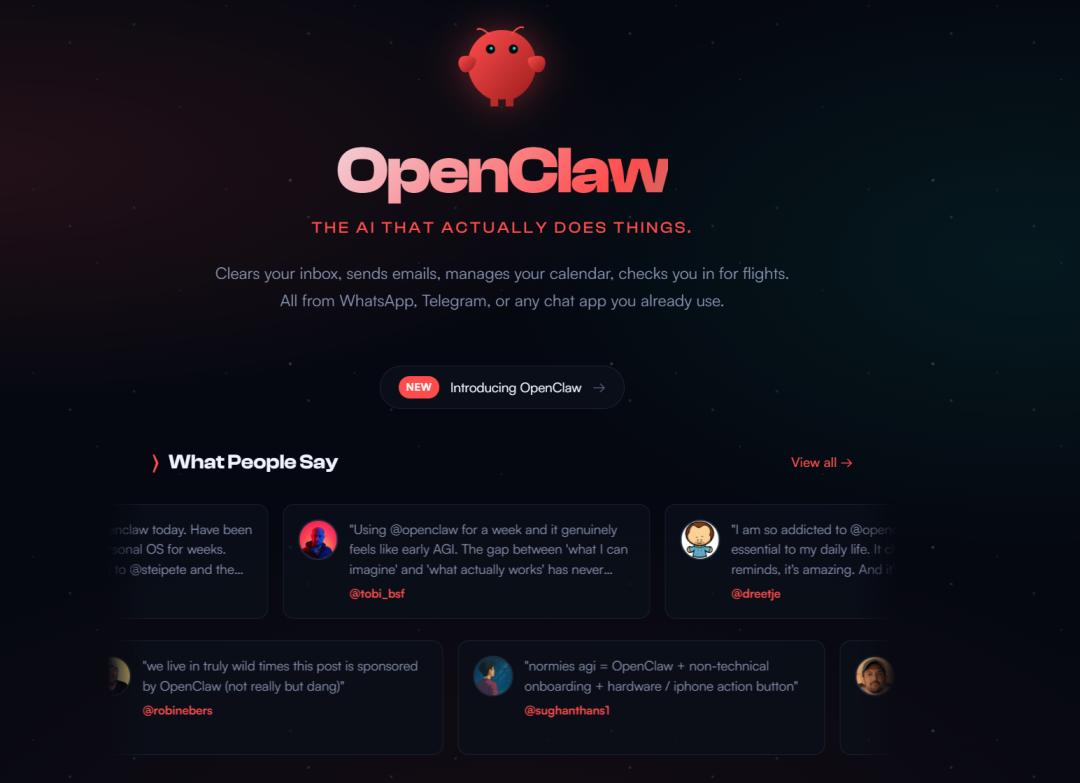
Core Insights - The article discusses the emergence of Clawdbot, a personal AI assistant developed by Peter Steinberger, which has gained significant attention for its capabilities to manage tasks and interact through various messaging apps [5][10][18] - Clawdbot's rapid rise in popularity highlights the potential of individual developers to create impactful technology that challenges traditional software development models [10][21] Group 1: Product Overview - Clawdbot operates as a local AI assistant, capable of managing emails, schedules, and executing scripts, functioning like a "digital butler" [5][10] - The product's architecture includes a local gateway for interaction, a core processing unit for memory and reasoning, and an execution layer for task completion [13][14] - Its open-source nature has led to a surge in community engagement, with developers rapidly creating various applications and use cases for the tool [21][22] Group 2: Market Impact - Clawdbot's success has prompted major tech companies like Tencent Cloud and Alibaba Cloud to launch deployment services, indicating a shift in the market towards more accessible AI tools [19][21] - The product addresses the pain point of cross-device control, allowing users to issue commands through familiar chat applications, thus liberating user interaction with technology [21][24] - The rise of Clawdbot signifies a potential restructuring of the application layer in the tech industry, as traditional software may be simplified or replaced by more integrated AI agents [24][25] Group 3: Security and Risks - The deployment of Clawdbot requires granting high system permissions, raising concerns about security vulnerabilities and potential misuse [10][26] - Users have reported incidents of financial loss due to malicious attacks exploiting the AI's capabilities, highlighting the risks associated with high-privilege AI applications [10][26] - The article emphasizes the need for improved security measures and community collaboration to address the emerging risks associated with such powerful tools [30][31]