
REITs ETF

Search documents
两重两新提前批下达,费率新规正式稿落地:政策双周报(1222-0109)-20260109
Huachuang Securities· 2026-01-09 11:14
1. Report Industry Investment Rating No information about the industry investment rating is provided in the report. 2. Core Viewpoints of the Report - In 2026, "Two Major" projects and "Two New" funds are being gradually allocated, with the scale of the first batch of "Two New" funds narrowing compared to 2025, and the government is promoting economic development through various policies [1][12]. - Fiscal policy maintains an active stance in 2026, ensuring necessary expenditure intensity and increasing the issuance scale of key - term treasury bonds [2]. - Monetary policy aims to achieve an "integrated effect" of incremental and existing policies, with the central bank net - buying treasury bonds and focusing on expanding domestic demand and technological innovation in 2026 [3]. - Financial regulatory authorities have issued formal regulations on fees, relaxed bank EVE indicators, and are exploring innovative financial products [4]. - Real estate policies aim to stabilize the market, with measures such as reducing VAT on second - hand housing transactions and optimizing purchase restrictions in Beijing [5]. 3. Summary by Directory 3.1 Macro - economic Tone - The dates for the 2026 National Two Sessions have been announced. The Fourth Session of the 14th National People's Congress will be held on March 5, 2026, and the Fourth Session of the 14th National Committee of the Chinese People's Political Consultative Conference will be held on March 4, 2026 [11]. - The first batch of 62.5 billion yuan in ultra - long - term special treasury bonds to support consumer goods replacement has been pre - allocated to local areas in 2026, with a smaller scale than in 2025. The policy focuses on optimizing fund allocation and advancing ahead of schedule [12]. - The National Development and Reform Commission has allocated a 295 - billion - yuan pre - approved project list for 2026, including about 220 billion yuan for "Two Major" construction projects and over 75 billion yuan for central budgetary investment [13]. 3.2 Fiscal Policy - In 2026, fiscal policy remains actively oriented, aiming to expand fiscal expenditure, optimize the combination of government bond tools, enhance transfer payment efficiency, and strengthen fiscal - financial coordination [17]. - Seven provinces have repaid 3.342 billion yuan of illegally added government implicit debts, nine regions' state - owned enterprises have returned 1.848 billion yuan of misappropriated agricultural loans, and two provinces and two regions have substantially resolved 170 million yuan of government debts [18]. - In January 2026, the issuance scale of key - term treasury bonds increased compared to the same period last year, with front - loaded policy implementation [19]. 3.3 Monetary Policy - The fourth - quarter monetary policy meeting proposed to achieve an "integrated effect" of incremental and existing policies, and the central bank will continue to deepen interest rate liberalization reform [22]. - The National Foreign Exchange Administration will deepen foreign exchange facilitation reforms and support financial institutions in developing simple and useful exchange - rate hedging products [23]. - In December 2025, the central bank net - bought 50 billion yuan of treasury bonds. Since October 2025, the central bank has restarted bond - buying operations, with purchase amounts of 20 billion yuan, 50 billion yuan, and 50 billion yuan in October, November, and December respectively [3]. - In 2026, monetary policy will focus on expanding domestic demand, technological innovation, and other fields, and its growth rate is expected to exceed that of the total social financing scale [25]. 3.4 Financial Supervision - The formal regulations on fund fees have been issued, and regulators are researching and exploring innovative products such as REITs ETFs [28]. - Regulatory authorities have revised the interest - rate shock amplitude parameters for banks [29]. - Regulators have consulted wealth - management companies on obstacles to A - share investment and policy expectations, and many banks have reduced wealth - management management fees to 0% [29]. - The regulatory authority has issued a notice on bond transaction record - keeping to strengthen supervision [30]. 3.5 Real Estate Policy - The government aims to stabilize the real estate market, control increments, reduce inventories, optimize supply, improve housing quality, and reduce VAT on second - hand housing transactions [33]. - Beijing has further optimized purchase - restriction policies, including relaxing requirements for non - Beijing households and supporting multi - child families [34]. - Vanke's proposal to extend the grace period for a 3.7 - billion - yuan bond was passed, but other extension proposals were not approved [34]. - An article in Qiushi magazine holds a positive view on future real estate policy space [35].
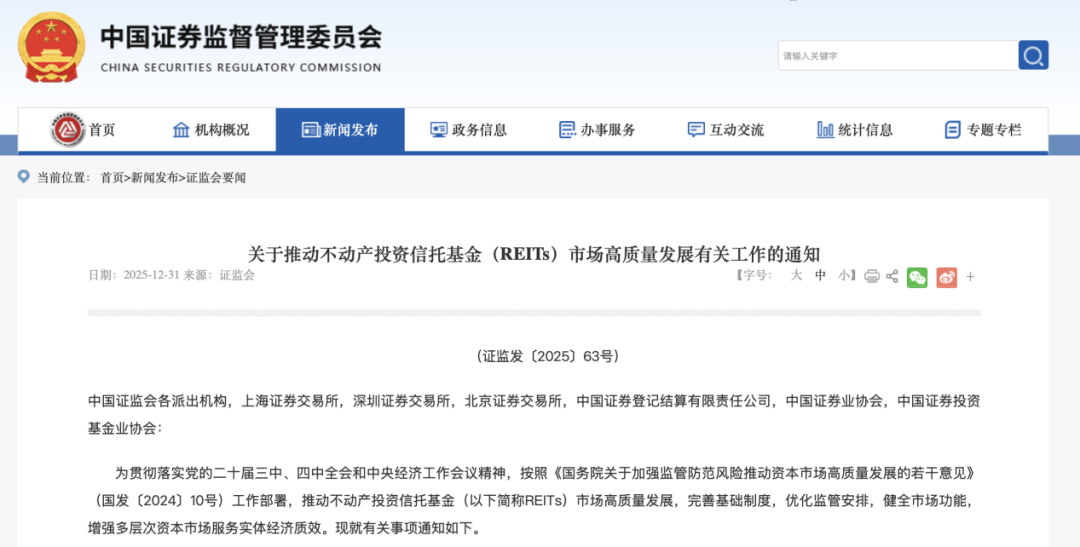
重大新规!证监会、沪深交易所联合发布
Zhong Guo Ji Jin Bao· 2025-12-31 15:03
Core Viewpoint - The China Securities Regulatory Commission (CSRC) has issued a notification to promote the high-quality development of the Real Estate Investment Trusts (REITs) market, signaling favorable policies for the public REITs market in 2025 [1][3]. Group 1: Importance of Commercial Real Estate REITs - The development of commercial real estate REITs is crucial for implementing national policies aimed at revitalizing existing assets and increasing direct financing [3]. - It serves as an effective means to support a new model of real estate development through market mechanisms, enhancing the inclusiveness and adaptability of the capital market [3]. Group 2: Market Vitality and Efficiency - The notification emphasizes the need to stimulate market participants' vitality by clarifying market access arrangements for commercial real estate REITs and enhancing operational efficiency [4]. - It encourages the issuance of REITs for assets with complementary functions and promotes cross-sector asset integration to improve scale effects and risk diversification [4]. Group 3: REITs Market System Construction - The notification calls for continuous enhancement of the supply of quality REITs and the orderly growth of market scale, while improving the expansion and pricing mechanisms [5]. - It supports the inclusion of REITs in public funds and the development of innovative products like REITs ETFs, thereby enriching investment options for investors [5]. Group 4: Regulatory and Risk Management - The notification stresses the establishment of a comprehensive regulatory mechanism covering all aspects of REITs, including due diligence, pricing, and asset management [9]. - It highlights the importance of enhancing information disclosure and monitoring mechanisms to maintain market stability and prevent significant risks [10]. Group 5: REITs Registration and Approval Process - The CSRC plans to optimize the REITs registration process, improving efficiency and ensuring transparency in the approval workflow [7]. - It aims to establish a clear and effective quality control system for the REITs approval process, enhancing the accountability of intermediary institutions [7]. Group 6: Information Disclosure and Investor Protection - The notification focuses on improving the quality of information disclosure, ensuring that investors receive accurate and timely information regarding REITs operations [16][17]. - It aims to protect investors' rights by enhancing the regulatory framework for ongoing information disclosure and ensuring compliance with national policies [16][17].

重大新规!证监会、沪深交易所联合发布
中国基金报· 2025-12-31 14:53
Core Viewpoint - The China Securities Regulatory Commission (CSRC) has issued a notification to promote the high-quality development of the Real Estate Investment Trusts (REITs) market, signaling favorable policies for the public REITs market ahead of significant growth expected in 2025 [1][2]. Group 1: Importance of Commercial Real Estate REITs - The development of commercial real estate REITs is a crucial measure for capital markets to implement national policies aimed at revitalizing existing assets and increasing direct financing [2]. - It is essential for enhancing the health of the REITs market, promoting the functionality of REITs, and improving the inclusiveness and adaptability of capital market systems [2]. Group 2: Market Vitality and Efficiency - The notification emphasizes the need to stimulate market participants' vitality by clarifying market-oriented access arrangements for commercial real estate REITs [3]. - It encourages the issuance of REITs for assets with similar operational characteristics and promotes cross-sector asset integration to enhance scale effects and risk diversification [3]. Group 3: Expansion and Diversification of the REITs Market - The notification aims to increase the supply of quality REITs and promote the orderly growth of market scale and diversity [5]. - It supports stable and well-governed REITs to enhance their asset scale and risk resilience through asset acquisition, expansion, and mergers [5]. Group 4: Regulatory Framework and Market Ecosystem - The notification calls for the establishment of a comprehensive regulatory mechanism covering all aspects of REITs, including due diligence, pricing, listing, and asset management [9]. - It emphasizes the need for improved information disclosure standards to enhance transparency and protect investors' rights [10]. Group 5: REITs Business Rules Revision - The Shanghai and Shenzhen Stock Exchanges have revised the public REITs business rules to enhance the operational framework and ensure a smooth start for commercial real estate REITs [12][14]. - Key revisions include shortening the review period for initial feedback from 30 to 20 working days and introducing new regulatory measures for the approval process [14]. Group 6: Information Disclosure and Investor Protection - The notification highlights the importance of improving information disclosure quality and establishing a robust regulatory framework for ongoing disclosures [16]. - It aims to ensure that the use of recovered funds is transparently reported and that the operational status of commercial real estate is adequately disclosed [16].

证监会:支持符合条件的公募基金将REITs纳入投资范围,研究探索跟踪REITs指数的交易型开放式指数基金等创新产品
Sou Hu Cai Jing· 2025-12-31 09:09
Core Viewpoint - The China Securities Regulatory Commission (CSRC) has announced the launch of a pilot program for Real Estate Investment Trusts (REITs), aiming to enhance the secondary market and diversify investment options for investors [1] Group 1: Market Development - The CSRC emphasizes the need to strengthen the secondary market and enrich the index system covering REITs [1] - Support will be provided for fund managers to develop products linked to relevant indices, including the exploration of REITs ETFs [1] - The initiative aims to broaden the asset allocation choices for investors [1] Group 2: Investment Encouragement - There will be increased efforts to guide various long-term funds, such as insurance funds, social security funds, and pension funds, to enter the market [1] - These funds are expected to act as stabilizers and ballast for the market [1] Group 3: Market Accessibility - The CSRC plans to promote the inclusion of REITs in the Shanghai-Hong Kong Stock Connect, thereby expanding the market's high-level openness [1] Group 4: Research and Investment Focus - The initiative encourages professional investment institutions to enhance their research capabilities regarding REITs [1] - Investors are urged to pay attention to the fundamental value of assets and the importance of long-term investment [1]
证监会:持续加大优质REITs供给 完善REITs扩募制度安排与市场化定价机制
智通财经网· 2025-12-31 09:08
Core Viewpoint - The China Securities Regulatory Commission (CSRC) has issued a notice to promote the high-quality development of the Real Estate Investment Trusts (REITs) market, focusing on expanding the market, enhancing the supply of quality REITs, and improving the regulatory framework to support the growth of the sector [1][3]. Group 1: Development of Commercial Real Estate REITs - The development of commercial real estate REITs is crucial for implementing the central government's policies aimed at revitalizing existing assets and increasing direct financing [4]. - The market entry arrangements for commercial real estate REITs will be clarified to stabilize expectations and enhance efficiency, thereby stimulating market participants [4]. - Financial institutions with robust governance and asset management experience are encouraged to participate in commercial real estate REITs [5]. Group 2: Market System Construction - The notice emphasizes the need to continuously increase the supply of quality REITs and to enrich market operations while ensuring orderly growth [6]. - There is a focus on enhancing the secondary market by developing indices related to REITs and encouraging various funds to include REITs in their investment portfolios [7]. - The establishment of a multi-layered REITs market system is highlighted, along with the need for supportive policies and legislative measures [7]. Group 3: Registration and Approval Mechanism - The notice calls for optimizing the REITs registration and approval process to ensure transparency and efficiency [8]. - A market-oriented standard system for REITs will be developed, focusing on different asset types and their specific disclosure requirements [8]. Group 4: Regulation and Risk Prevention - A comprehensive regulatory mechanism covering all aspects of REITs, including due diligence, pricing, and asset management, is to be established [9]. - The importance of maintaining market stability and enhancing the transparency of information disclosure is emphasized to protect investor interests [10]. - Continuous efforts will be made to ensure that market participants fulfill their responsibilities and adhere to legal and regulatory requirements [10].
证监会:推动商业不动产REITs平稳健康发展
Xin Lang Cai Jing· 2025-12-31 09:03
Core Viewpoint - The China Securities Regulatory Commission (CSRC) is implementing measures to promote the high-quality development of the Real Estate Investment Trusts (REITs) market, enhancing regulatory frameworks and market functions to better serve the real economy [1][12]. Group 1: Promoting Commercial Real Estate REITs - The development of commercial real estate REITs is crucial for revitalizing existing assets and increasing direct financing, aligning with national policy goals [2][13]. - Market access arrangements for commercial real estate REITs will be clarified to stabilize expectations and enhance efficiency, encouraging asset combinations that are complementary and synergistic [2][14]. - Regulatory bodies are tasked with addressing challenges in the development of commercial real estate REITs and ensuring compliance with disclosure and risk management requirements [3][14]. Group 2: Accelerating REITs Market System Construction - Efforts will be made to increase the supply of quality REITs and expand market diversity, with a focus on improving fundraising mechanisms and market pricing [4][15]. - The secondary market for REITs will be strengthened by developing index systems and encouraging long-term funds to enter the market, enhancing investment options for investors [4][15]. - A comprehensive REITs ecosystem will be established, optimizing issuance and trading mechanisms while ensuring compliance with market regulations [5][16]. Group 3: Improving REITs Registration and Review Mechanisms - The review and registration process for REITs will be standardized and made more transparent, enhancing efficiency and accountability [7][18]. - A market-oriented standard system will be developed to address various asset types, ensuring that REITs adhere to regulatory requirements and promote stable expectations [7][18]. Group 4: Strengthening Regulation and Risk Prevention - A comprehensive regulatory framework will be established to cover all aspects of REITs, including due diligence, pricing, and asset management, ensuring quality and governance standards are met [8][19]. - Fund managers and other stakeholders will be held accountable for their responsibilities in managing REITs, with a focus on enhancing operational quality and investor returns [8][20]. - Measures will be taken to improve information disclosure and risk monitoring, ensuring market stability and resilience against potential risks [9][20].