TPU AI芯片

Search documents
?AI基建大爆发 高盛重塑TMT投行版图! 押注“算力时代”的交易洪流
Zhi Tong Cai Jing· 2025-12-17 01:07
Core Insights - The article discusses the significant restructuring of investment banking teams at major firms like Goldman Sachs, Morgan Stanley, and JPMorgan in response to the booming AI infrastructure market, particularly in the TMT (Technology, Media, and Telecommunications) sector [1][2] - Goldman Sachs' recent report indicates a strong demand for AI server clusters, which is expected to continue growing through 2026, alongside robust demand for optical networking equipment and a moderate supply increase in the DRAM storage chip market [1][3] Investment Banking Restructuring - Goldman Sachs is creating a new global infrastructure technology business unit, integrating its telecom and CoreTech teams, led by Yasmine Coupal and Jason Tofsky [1] - Another new unit, focused on global internet and media, will be led by Brandon Watkins and Alekhya Uppalapati, as the firm seeks to capitalize on large-scale investment opportunities in the AI sector [2] AI Infrastructure Demand - The demand for AI servers is projected to remain strong, with significant growth expected in AI ASIC clusters led by Google, outpacing AI GPU shipments, which will also see robust growth [2][3] - Nvidia's Rubin architecture AI GPU clusters are set to begin production in mid-2026, with strong capacity ramp-up anticipated in the latter half of that year [3] Market Predictions - Goldman Sachs' stock strategists predict that the S&P 500 index will reach around 7600 points next year, indicating a potential 10% upside from current levels, driven by widespread AI technology adoption and resilient economic growth [3][4] - The overall earnings per share for S&P 500 companies are expected to jump by 12% next year, with a further 10% increase in 2027, reflecting the positive impact of AI on corporate profitability [3][4] AI Investment Wave - The article highlights that the current wave of investment in AI infrastructure is just beginning, with projections estimating that the total investment could reach between $3 trillion to $4 trillion by 2030, driven by unprecedented demand for AI computing power [4]

AI基建大爆发 高盛重塑TMT投行版图! 押注“算力时代”的交易洪流
Zhi Tong Cai Jing· 2025-12-17 01:01
Core Insights - Major investment banks, including Goldman Sachs, Morgan Stanley, and JPMorgan, are restructuring their TMT investment banking teams to capitalize on the booming AI technology sector [1][2] - Goldman Sachs' recent report indicates strong demand for AI server clusters, expected to continue through 2026, with optical network equipment also showing robust demand [1][3] - The AI infrastructure investment wave is projected to reach $3 trillion to $4 trillion by 2030, driven by unprecedented demand for AI computing power [4] Investment Banking Restructuring - Goldman Sachs is creating a new global infrastructure technology business unit, integrating telecom and CoreTech teams, led by Yasmine Coupal and Jason Tofsky [1][2] - A separate global internet and media team will be led by Brandon Watkins and Alekhya Uppalapati, as part of the restructuring efforts [2] AI Market Dynamics - OpenAI plans to invest approximately $1.4 trillion in building large-scale AI infrastructure to support AI training and inference [2] - Demand for AI ASIC clusters, led by Google, is expected to grow faster than AI GPU shipments, which will also maintain strong growth [2][3] - The DRAM market is experiencing moderate supply growth, with demand significantly outpacing supply, leading to expectations of substantial price increases [3] Stock Market Outlook - Goldman Sachs' stock strategists predict that the S&P 500 index will reach around 7600 points next year, indicating a potential 10% upside from current levels, driven by AI technology adoption and resilient economic growth [3][4] - The overall earnings per share for S&P 500 companies are expected to jump by 12% next year, with a further 10% increase in 2027 [3] AI Infrastructure Investment - The AI infrastructure investment wave is still in its early stages, with significant investments in AI hardware expected to continue [4] - The recent launch of Google's Gemini3 has sparked a new wave of AI applications, further validating the ongoing demand for AI computing infrastructure [4]
太空算力与卫星产业共振开启
GOLDEN SUN SECURITIES· 2025-11-30 13:24
Investment Rating - The report maintains an "Increase" rating for the industry, indicating a positive outlook for investment opportunities in the space computing sector [5]. Core Insights - The emergence of space computing is expected to revolutionize data processing capabilities, with companies like Nvidia and Starcloud leading the charge by deploying AI servers in space [1][9]. - Elon Musk predicts that deploying large-scale AI systems in space will be more cost-effective than on Earth due to the availability of free solar energy and efficient cooling methods [2][14]. - Google's "Project Suncatcher" aims to utilize solar energy in space for scalable computing networks, with plans to launch prototype satellites by 2027 [3][18]. - China's launch of the "Body Computing Constellation" marks a significant milestone as the world's first interconnected space computing satellite constellation, expected to achieve a total computing power of 1000 Peta Operations Per Second (POPS) [4][22]. Summary by Sections Space Computing Developments - Nvidia's Starcloud-1 satellite, equipped with H100 GPUs, is set to operate in low Earth orbit, processing data from Earth observation satellites [1][9]. - Starcloud plans to expand its capabilities with the Starcloud-2 mission, which will include more powerful GPUs and aim for a 40 MW data center in space by the early 2030s [11]. Cost Efficiency and Energy Needs - Musk estimates that future AI computing needs could require between 200 to 300 GW of continuous power, highlighting the limitations of terrestrial energy sources [2][14]. - The report emphasizes that the transition to space-based data centers could alleviate the increasing energy and water demands of traditional data centers [10]. Industry Growth and Investment Opportunities - The report suggests that as AI computing demands rise and rocket launch costs decrease, significant growth in space computing is anticipated, recommending early investment in related companies such as Putian Technology and China Satellite [24].



行业周报:商业航天有望进入高速发展期-20251130
KAIYUAN SECURITIES· 2025-11-30 05:58
Investment Rating - The investment rating for the computer industry is "Positive" (maintained) [1] Core Viewpoints - The commercial aerospace sector is expected to enter a period of rapid development, driven by continuous top-level design and intensive policy support from both domestic and international fronts [4][11] - The National Space Administration of China has launched an action plan for the high-quality and safe development of commercial aerospace from 2025 to 2027, aiming to integrate commercial aerospace into the national aerospace development framework [4][11] - The European Space Agency has approved its highest budget in history, totaling approximately €22.1 billion for the next three years, focusing on key scientific, exploratory, and technological projects [4][11] - Major overseas companies are intensively investing in space computing capabilities, indicating a significant trend in the industry [5][12] Summary by Sections Market Review - During the week of November 24 to November 28, 2025, the CSI 300 index rose by 1.64%, while the computer index increased by 3.08% [3][10] Industry Insights - The 14th Five-Year Plan emphasizes the cultivation and expansion of emerging and future industries, accelerating the development of strategic emerging industry clusters such as aerospace [4][11] - The establishment of a dedicated regulatory body for commercial aerospace in China is expected to enhance the industry's high-quality development and benefit the entire supply chain [4][11] Investment Recommendations - The report recommends companies such as Zhongke Xingtu, Aerospace Hongtu, Putian Technology, and Yaxin Security as beneficiaries of the commercial aerospace growth [6][13]
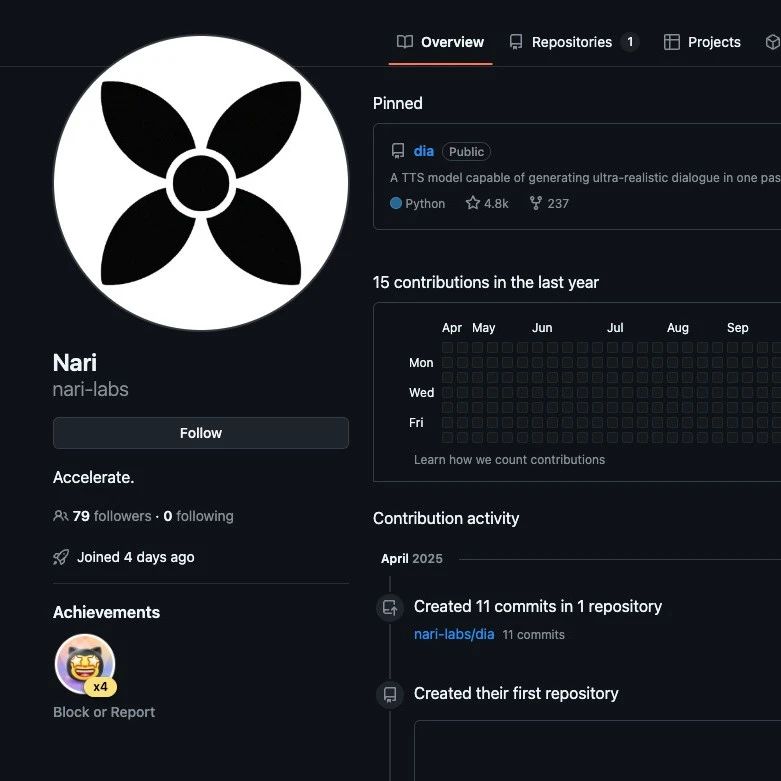
速递|两名本科生3个月打造的AI语音模型,挑战谷歌NotebookLM,16亿参数实现自然对话生成
Z Potentials· 2025-04-23 03:49
Core Insights - The article discusses the emergence of a new AI speech model called Dia, developed by Nari Labs, which aims to rival Google's NotebookLM in generating podcast-style audio clips [1][2]. Group 1: Market Potential and Investment - The market for synthetic voice tools is substantial and continues to grow, with ElevenLabs being a major player alongside challengers like PlayAI and Sesame [1]. - According to PitchBook, startups developing voice AI technology raised over $398 million in venture capital last year [2]. Group 2: Technical Aspects of Dia - Dia has 1.6 billion parameters and can generate dialogue from scripts, allowing users to customize the speaker's tone and insert non-verbal cues like coughs and laughter [2][3]. - The model can be accessed via AI development platforms like Hugging Face and GitHub, and it runs on modern PCs with at least 10GB of VRAM [3]. Group 3: Ethical Concerns and Future Plans - Dia lacks protective measures against misuse, making it easy to create false information or fraudulent recordings [4]. - Nari Labs has not disclosed the data sources used for training Dia, raising concerns about potential copyright infringement [5]. - The company plans to create a synthetic voice platform with social features and intends to release a technical report on Dia, expanding support to languages beyond English [5].