
TorchTPU

Search documents
从“更快”到“更省”:AI下半场,TPU重构算力版图
半导体行业观察· 2026-02-09 01:18
Core Insights - The article emphasizes the shift from "training is king" to "inference is king" in AI, highlighting the importance of specialized architectures like Google's TPU in reducing inference costs and reshaping the AI computing landscape [1][4][11]. Group 1: Evolution of AI Models - Large models undergo a growth process similar to human development, involving pre-training, fine-tuning, and reinforcement learning to align outputs with human preferences [3]. - The infrastructure for training large models requires high computing power, high memory bandwidth, and strong multi-GPU interconnects, with NVIDIA being the dominant player due to its high-performance GPUs and CUDA ecosystem [3]. Group 2: Cost Efficiency in Inference - After training, the commercial value of AI models lies in scalable inference services, where the cost of inference directly impacts profit margins [4]. - The focus has shifted to reducing inference costs while maintaining performance, with Google's TPU v7 reportedly lowering the cost per million tokens by approximately 70% compared to its predecessor [8][10]. Group 3: Competitive Landscape - The competition in AI computing is evolving, with specialized architectures like Google's TPU emerging as strong challengers to NVIDIA's dominance [10][11]. - A significant order from Anthropic for TPUs indicates a shift towards large-scale commercial deployment of ASIC chips, suggesting potential profit improvements of billions annually through reduced inference costs [10]. Group 4: Technological Innovations - Google's TPU architecture is designed for efficiency, focusing on matrix operations and minimizing unnecessary components, which enhances performance and reduces energy consumption [13]. - Innovations such as the unique pulsed array architecture and large on-chip SRAM caches contribute to TPU's advantages in inference scenarios [18]. Group 5: Software and Ecosystem Development - Google is addressing the software ecosystem by making its TPU compatible with popular frameworks like PyTorch, thereby reducing the cost of transitioning from NVIDIA's ecosystem [15][27]. - The collaboration with various tech giants to support open-source projects like OpenXLA aims to create a unified compilation path across different hardware [15][17]. Group 6: Domestic Chip Manufacturers - Domestic chip companies like Yixing Intelligent are developing architectures that align with the trends of specialized computing, focusing on efficiency and cost reduction [20][22]. - Yixing Intelligent's chips support advanced data formats and architectures that enhance performance while reducing storage costs, positioning them competitively in the market [26][27]. Group 7: Future Directions - The industry is transitioning from a focus on raw computing power to optimizing efficiency and cost-effectiveness, marking a significant shift in the competitive landscape [42]. - The emergence of technologies like ELink for high-speed interconnects indicates a broader trend towards integrated AI infrastructure that encompasses hardware, software, and system optimization [38][40].




创业板人工智能ETF南方(159382.SZ)涨1.00%,中际旭创涨1.96%
Jin Rong Jie· 2025-12-30 07:02
Core Viewpoint - The global technology giants, represented by Google, are systematically expanding AI computing power infrastructure through models, chips, and ecosystem initiatives, which provides strong long-term support for the demand for upstream high-speed optical modules [2]. Group 1: AI Computing Power Infrastructure Expansion - The model side is lowering the application threshold for enterprises by launching low-cost, high-performance inference models like Gemini 3 Flash, stimulating the demand for large-scale inference computing power [2]. - On the hardware side, the acceleration of computing cluster deployment is driven by increased orders for self-developed TPUs and collaboration with the industry chain, directly boosting the demand for high-speed internal interconnects in data centers [2]. - The ecosystem side is attracting a broader developer base through initiatives like "TorchTPU," expanding the customer base for computing power services [2]. Group 2: Market Trends and Predictions - The expansion of AI computing infrastructure is expected to lead to a surge in data center traffic, making 800G/1.6T high-speed optical modules essential components [2]. - According to industry research firm LightCounting, the global optical module market is projected to exceed $37 billion by 2029, with 1.6T optical modules expected to enter commercial use in 2025, with initial global demand estimated at 2.5 million to 3.5 million units [2]. - The transition between technology generations is anticipated to concentrate industry value in high-end segments [2]. Group 3: Investment Opportunities - The ChiNext AI ETF (159382.SZ) is highly focused on key segments like optical modules, with the top three constituent stocks accounting for nearly 39% of the index weight, positioning it to benefit directly from hardware upgrades and demand surges driven by AI computing infrastructure [2].

腾讯研究院AI每周关键词Top50
腾讯研究院· 2025-12-20 02:33
Group 1: Core Insights - The article presents a weekly roundup of the top 50 keywords in the AI sector, highlighting significant developments and trends in the industry [2]. - Key players mentioned include Google, Apple, ByteDance, NVIDIA, and OpenAI, indicating a competitive landscape in AI technology and applications [3][4]. Group 2: Chip Developments - Google is advancing its AI chip technology with the introduction of TorchTPU [3]. - Apple is focusing on AI server chips, which may enhance its capabilities in AI applications [3]. Group 3: Model Innovations - Google has launched the Gemini 3 Flash model, while ByteDance introduced Seed1.8, showcasing ongoing innovation in AI models [3]. - Other notable models include MiMo-V2-Flash from Xiaomi and Nemotron 3 from NVIDIA, indicating a diverse range of AI model developments [3]. Group 4: Application Trends - OpenAI is expanding its ecosystem with the ChatGPT application store and various applications like ChatGPT Images and SAM Audio [3][4]. - Companies like Tencent and xAI are also developing unique applications, such as the writing mode and Grok Voice, respectively [3][4]. Group 5: Technological Insights - The article discusses various technological insights, including AI memory systems and recursive self-improvement, which are critical for future AI advancements [4]. - The AI adult content market and AGI predictions are also highlighted, reflecting the broader implications of AI technology [4].





预警、撤资、腰斩…真要崩了?
Ge Long Hui· 2025-12-18 09:26
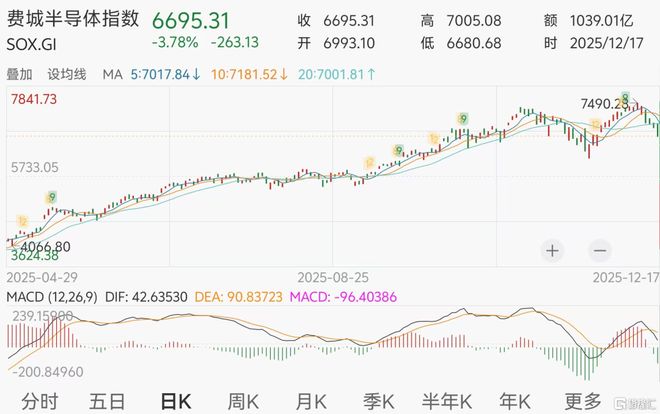
Group 1 - The global market is experiencing unprecedented fragmentation as the year-end approaches, with the AI narrative losing its previous momentum while precious metals like gold and silver remain strong [2][3] - Gold prices surged over 1%, nearing October highs, while silver prices broke through significant thresholds, achieving a year-to-date increase of approximately 130% [2] - Oracle's stock price has plummeted nearly 45% due to project delays and withdrawal of funding from its major partner, Blue Owl, which has significantly impacted the entire AI sector [4][5] Group 2 - The decline in Oracle's stock has dragged down other tech stocks, with Nvidia, Broadcom, and Tesla all experiencing significant losses, and the Philadelphia Semiconductor Index falling below its 50-day moving average [5] - BCA Research warns that the AI-driven bull market in U.S. stocks may fade by 2026, with excessive spending on AI raising concerns about investment returns [7] - Despite the downturn in stock prices, demand for AI remains strong, with companies like Micron and OpenAI continuing to seek substantial funding [8][10] Group 3 - The market is entering a new phase of AI investment, where high capital expenditures are not yet yielding expected returns, leading to concerns about declining return on invested capital (ROIC) [10][11] - The recent surge in A-share market activity is attributed to significant inflows into ETFs, particularly the CSI A500 ETF, which saw a net inflow of 164 billion yuan in a single day [13][19] - Institutional investors, particularly insurance funds, are likely behind the recent buying spree in the CSI A500 ETF, indicating a strategic year-end repositioning [19]


X @外汇交易员
外汇交易员· 2025-12-18 01:52
Strategic Initiative - Google is advancing "TorchTPU," an internal initiative to enhance its AI chip compatibility with PyTorch, aiming to challenge NVIDIA's software ecosystem dominance [1] - The initiative involves close collaboration with Meta, the creator and manager of PyTorch, to reduce inference costs and diversify AI infrastructure [1] - Google is considering open-sourcing parts of the software to accelerate customer adoption [1] - This effort represents a greater organizational and strategic commitment compared to past attempts to support PyTorch [1] Competitive Landscape - The success of TorchTPU would significantly lower the switching costs for enterprises moving from NVIDIA GPUs to alternative solutions [1] - NVIDIA's dominance relies on its CUDA software ecosystem deeply embedded in PyTorch, which has become the default for training and running large AI models [1] - The initiative aims to weaken NVIDIA's long-term dominance in the AI computing market [2] Business Implications - The TorchTPU initiative is a key growth engine for Google's cloud business, as more enterprises seek to adopt Tensor Processing Unit (TPU) chips [1] - The software stack is currently seen as a bottleneck for enterprises adopting TPU chips [1]