Xiaomi 17 Pro

Search documents
小米集团-W:汽车业务驱动增长,季度盈利短期承压-20260325
国投证券(香港)· 2026-03-25 08:24
Investment Rating - The report maintains a "Buy" rating for the company with a target price of HKD 40.8, indicating a potential upside of 24.8% from the recent closing price [7]. Core Insights - The automotive business has become a key growth driver, achieving a revenue of RMB 372 billion in Q4 2025, representing a year-on-year increase of 123.4% and marking the first quarter of operational profitability at RMB 11 billion [1][2]. - Traditional businesses, such as smartphones and AIoT, are facing short-term pressure due to rising core component and storage costs, impacting overall profitability [1][3]. - The internet services segment showed steady growth, with Q4 2025 revenue reaching RMB 99 billion, a 5.9% year-on-year increase, supported by a record high in advertising revenue [3]. - The IoT and lifestyle consumption segment experienced a decline, with Q4 2025 revenue falling by 20.3% due to a weak domestic appliance market [4]. Summary by Relevant Sections Automotive Business - The automotive segment's revenue reached RMB 372 billion, accounting for 31.8% of total revenue, with a gross margin of 22.7%. The average selling price (ASP) of vehicles increased by 6.6% to RMB 249,846 per unit, driven by higher-value model deliveries [2]. - The company aims to deliver 550,000 vehicles in 2026 and plans to invest over RMB 200 billion in R&D over the next five years, with RMB 60 billion allocated to AI initiatives [4]. Smartphone Business - The smartphone segment's global shipments reached 37.7 million units in Q4 2025, a decline of 11.6% year-on-year, attributed to reduced promotional activities in overseas markets. The ASP increased by 10.7% to RMB 1,176.0 due to a higher proportion of premium models sold [3]. Internet Services - Internet services revenue for Q4 2025 was RMB 99 billion, with a gross margin of 76.8%. Advertising revenue reached RMB 78 billion, marking a 10.4% year-on-year increase and providing solid support for overall profitability [3]. IoT and Lifestyle Consumption - The IoT and lifestyle consumption segment reported a revenue of RMB 246 billion in Q4 2025, down 20.3% year-on-year, primarily due to a downturn in the domestic appliance market [4].

小米集团-W(01810):汽车业务驱动增长,季度盈利短期承压
国投证券(香港)· 2026-03-25 08:10
Investment Rating - The report maintains a "Buy" rating for the company with a target price of HKD 40.8, indicating a potential upside of 24.8% from the recent closing price [7]. Core Insights - The automotive business has become a key growth driver, achieving a revenue of RMB 372 billion, a year-on-year increase of 123.4%, and marking the first quarter of operational profitability at RMB 11 billion [1][2]. - Traditional businesses, such as smartphones and IoT, are facing short-term pressures due to rising costs and market competition, impacting overall profitability [3][4]. - The company plans to focus on delivering 550,000 vehicles in 2026 and has committed to significant R&D investments, exceeding RMB 200 billion over the next five years, with RMB 60 billion specifically for AI [4][5]. Summary by Sections Automotive Business - The automotive segment's revenue reached RMB 372 billion, accounting for 31.8% of total revenue, with a gross margin of 22.7% [2]. - The company delivered 145,115 new vehicles in the quarter, a 108.2% increase year-on-year, driven by strong demand and an increase in average selling price (ASP) to RMB 249,846 per vehicle [2]. Smartphone Business - The smartphone segment's global shipments reached 37.7 million units, but faced an 11.6% year-on-year decline due to reduced promotional activities in overseas markets [3]. - The ASP for smartphones increased by 10.7% quarter-on-quarter to RMB 1,176, supported by higher sales of premium models [3]. Internet Services - Internet services revenue for the quarter was RMB 99 billion, a 5.9% year-on-year increase, with a gross margin of 76.8% [3]. - Advertising revenue reached a record high of RMB 78 billion, growing 10.4% year-on-year, providing solid support for overall profitability [3]. IoT and Lifestyle Products - Revenue from the IoT and lifestyle segment declined by 20.3% year-on-year to RMB 246 billion, primarily due to a weak domestic appliance market [4]. Business Outlook - The automotive sector is positioned as the core growth engine for the company, with ambitious delivery targets and substantial R&D investments planned for the coming years [4][5].
朋友圈喊话转行卖车?小米潘九堂澄清:玩笑又被截图
Xin Lang Cai Jing· 2026-02-03 01:32
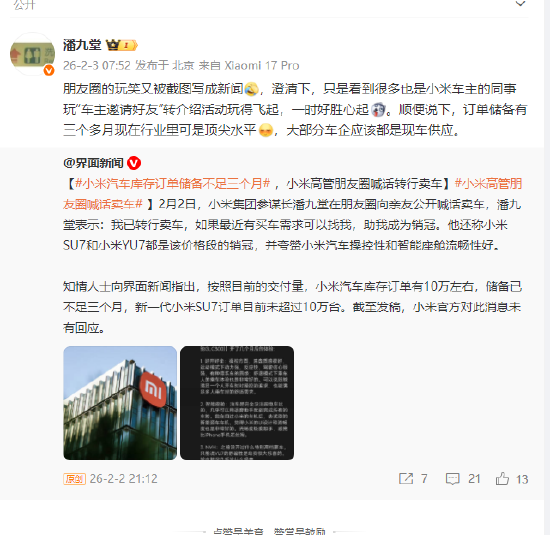
Group 1 - The core message is that Xiaomi's executive, Pan Jiutang, humorously announced his transition to car sales in a social media post, promoting Xiaomi's SU7 and YU7 models as top sellers in their price range [1][3][5] - Pan Jiutang clarified that his post was a joke inspired by colleagues participating in a referral program, and he expressed a competitive spirit [4][5] - Current order reserves for Xiaomi's vehicles are reported to be around 100,000 units, which is considered top-tier in the industry, with a supply duration of less than three months [5]

2025年中国智能手机市场再洗牌:华为重返榜首,苹果、vivo并列第二
Guo Ji Jin Rong Bao· 2026-01-22 10:15
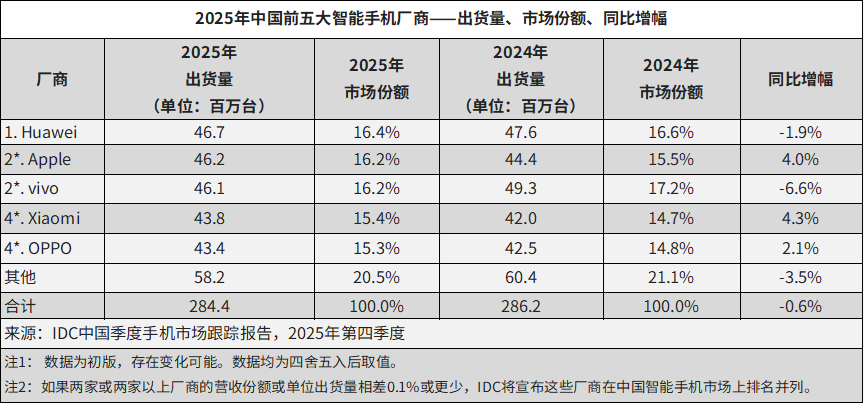
Core Viewpoint - The Chinese smartphone market is projected to see a slight decline in shipments in 2025, with a total of approximately 284 million units, representing a year-on-year decrease of 0.6% [1][2]. Market Overview - The first half of 2025 experienced growth due to the "national subsidy" and the Spring Festival sales peak, but the market showed weakness in the second half due to early demand release, depletion of subsidy funds, and rising costs [1]. - IDC forecasts a more significant decline in shipments for 2026, driven by ongoing cost pressures, particularly from expected increases in storage prices [1]. Market Share and Rankings - Huawei regained the top position in the Chinese smartphone market with shipments of 46.7 million units and a market share of 16.4%, marking its return to the number one spot for the first time since 2020 [1][2]. - Apple and Vivo are tied for second place, with shipments of 46.2 million and 46.1 million units, respectively, both holding a market share of 16.2% [2]. - Xiaomi and OPPO follow in fourth and fifth places, with shipments of approximately 43.8 million and 43.4 million units, respectively, both exceeding 15% market share [1][2]. Year-on-Year Changes - Huawei's shipments decreased by 1.9% compared to 2024, while Vivo experienced a more significant decline of 6.6%, placing it at the bottom among the top manufacturers [3]. - In contrast, Apple, Xiaomi, and OPPO saw slight increases in their shipment volumes, with Apple ending a three-year decline in shipments [3]. - The iPhone 17 Pro Max emerged as the best-selling model, enhancing Apple's position in the high-end market segment [3]. - Xiaomi's strategy to penetrate the high-end market with models like the Xiaomi 17 Pro and Pro Max has resulted in a doubling of its market share in the segment above $600, while maintaining a strong position in the sub-$200 market [3].

雷军:玄戒O1摘小米千万技术大奖,未来五年计划2000亿研发投入
Sou Hu Cai Jing· 2026-01-08 02:38
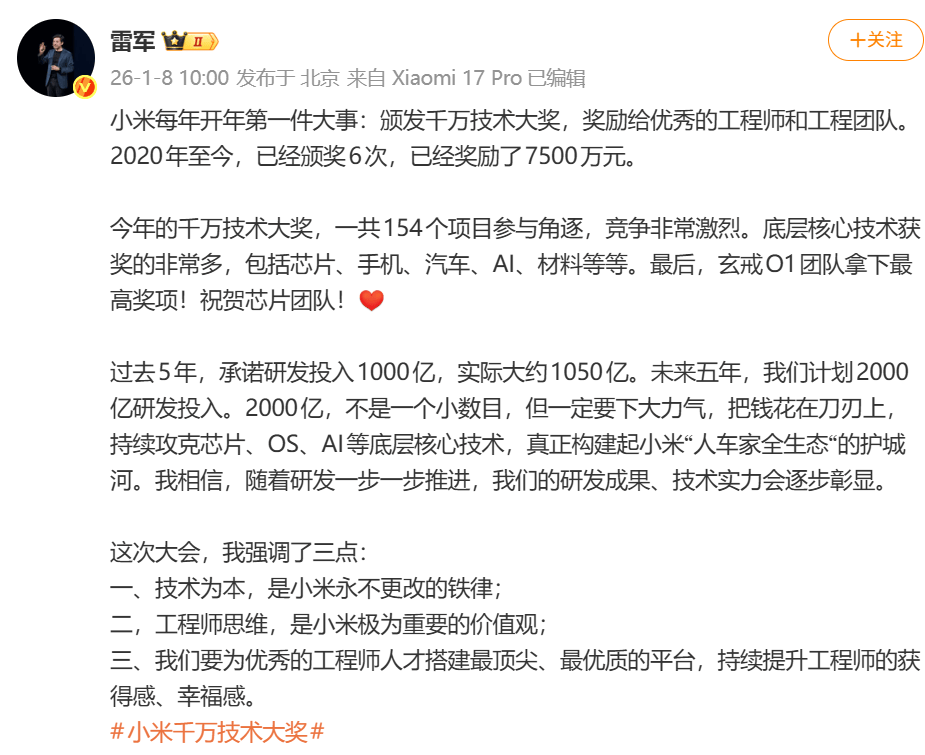
Group 1 - The core message of the news is that Xiaomi has awarded a significant technology prize to recognize outstanding engineering teams, with the O1 team winning the highest award [1][2] - Xiaomi has committed to investing 100 billion yuan in research and development over the past five years, with actual spending around 105 billion yuan, and plans to invest 200 billion yuan in the next five years [1][2] - The technology prize has been awarded six times since 2020, totaling 75 million yuan, with 154 projects competing this year, highlighting the focus on core technologies such as chips, mobile phones, automotive, AI, and materials [2] Group 2 - The company emphasizes three key points: a commitment to technology as a fundamental principle, the importance of an engineering mindset as a core value, and the need to create a top-tier platform for talented engineers to enhance their sense of achievement and happiness [3]
雷军全面回应“营销大师”标签:现在听到营销两个字都有点恶心
Mei Ri Jing Ji Xin Wen· 2026-01-07 22:51
Group 1 - The core message of the news is the launch of the new generation SU7 by Xiaomi, which will see a price increase due to rising costs and enhanced configurations [1][9] - Xiaomi's founder Lei Jun addressed concerns about the marketing strategies, emphasizing the importance of accurate communication and expressing discomfort with the term "marketing" being used negatively [1][4] - The new generation SU7 is expected to feature significant improvements, including enhanced safety, advanced intelligent driving systems, and a luxurious design, with pre-orders starting in January and deliveries expected in April [1][9] Group 2 - Lei Jun mentioned that he personally writes most of his social media posts, often during busy schedules, which may lead to misunderstandings about his online presence [2] - Xiaomi's public relations team has faced challenges recently, and Lei Jun acknowledged their efforts to improve following a negative incident involving KOLs, expressing hope for a second chance [4] - The SU7 has achieved significant sales success, with over 360,000 units delivered in just 21 months, making it one of the best-selling cars in its price range [8]
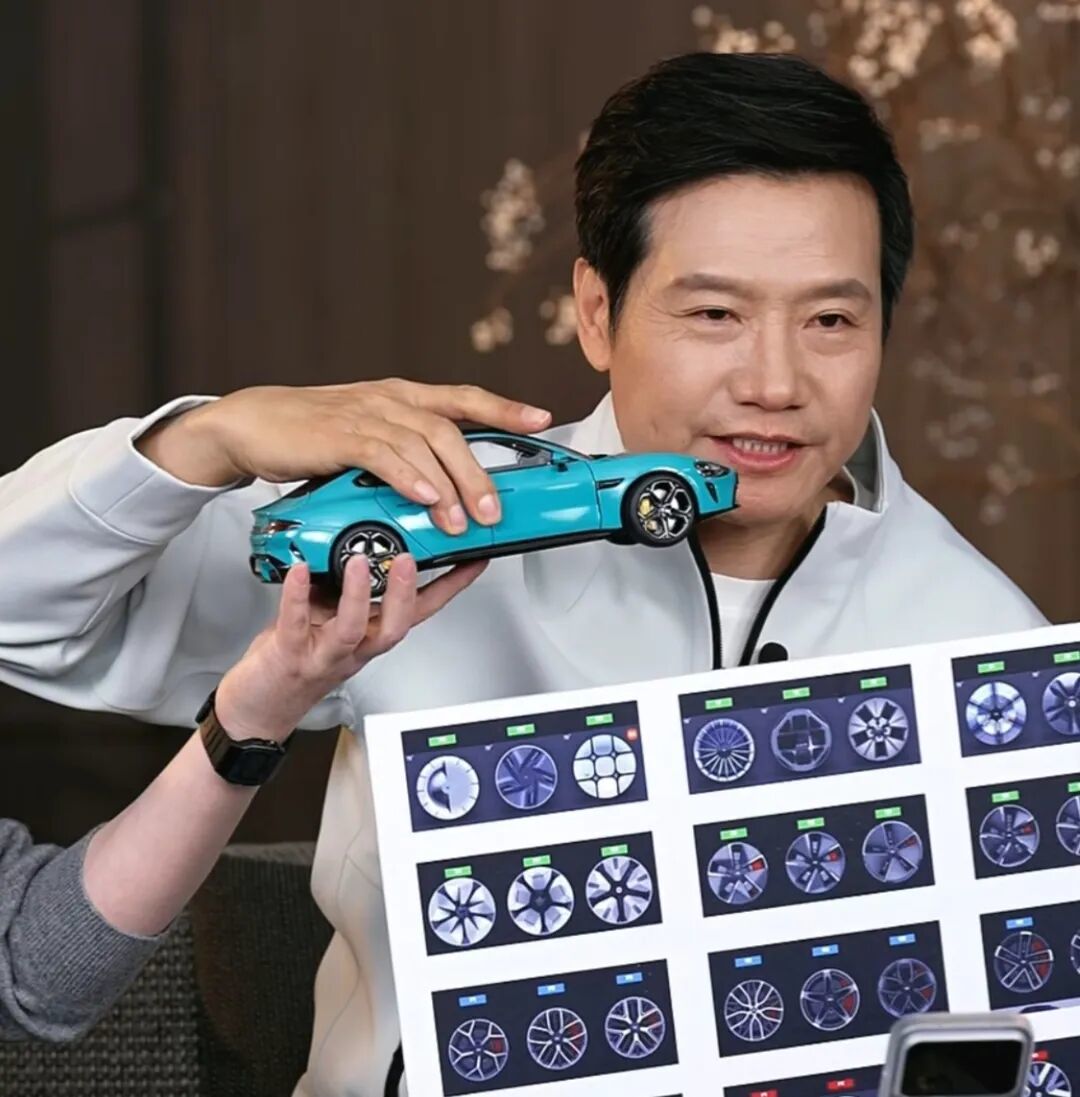
雷军回应“小字营销”
Sou Hu Cai Jing· 2026-01-04 04:31
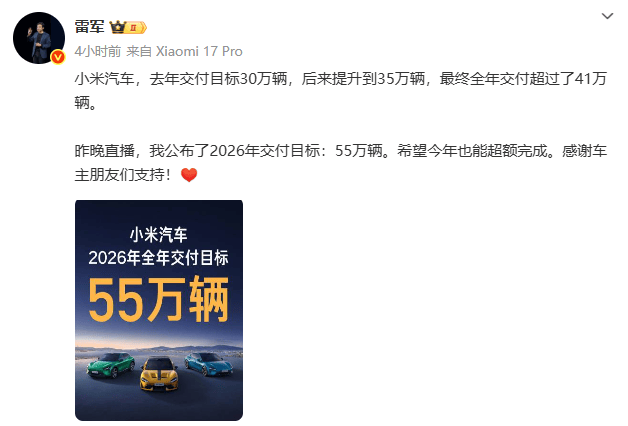
Core Viewpoint - Xiaomi's CEO Lei Jun announced ambitious delivery targets for Xiaomi's electric vehicles, aiming for 410,000 units in 2025 and 550,000 units in 2026, while addressing public concerns during a live stream event [2][3][5]. Group 1: Delivery Targets - In 2025, Xiaomi aims to deliver a total of 410,000 electric vehicles [2]. - For 2026, the delivery target is set at 550,000 units, with an emphasis on not setting targets too high or too low [3]. - The previous year's target was initially 300,000 units, later raised to 350,000, with actual deliveries exceeding 410,000 [5][7]. Group 2: Public Relations and Marketing - Xiaomi's public relations manager responded to criticisms regarding the "Green Belt Warrior" incident, stating it was a deliberate attempt to misrepresent Xiaomi's automotive issues [4]. - Lei Jun addressed the decision to disable comments during live streams, explaining it was to prevent spam attacks that could disrupt the viewing experience for genuine users [4]. - Lei Jun acknowledged the issue of "small print marketing" as a common industry practice that needs to be improved, emphasizing the importance of user perception [4].
雷军回应“小字营销”
财联社· 2026-01-04 03:59
Group 1 - The core message of the article is that Xiaomi's CEO Lei Jun announced ambitious delivery targets for Xiaomi cars, aiming for 410,000 units in 2025 and 550,000 units in 2026 [2][3][4]. Group 2 - In the live stream, Lei Jun emphasized that the company will focus more on automotive development this year, setting a delivery target of 550,000 units for 2026, which is a significant increase from the previous year's target of 300,000 units, later raised to 350,000 units, ultimately achieving over 410,000 units [3][4][6]. - Xiaomi's public relations manager responded to concerns about negative online comments, stating that disabling comments was a measure to prevent spam attacks that could disrupt the viewing experience [4]. - Lei Jun acknowledged the issue of "small print marketing" as a common industry practice that needs to be improved, indicating that Xiaomi will work on enhancing transparency in its marketing strategies [4].

雷军官宣12月31日晚跨年直播,将请工程师现场拆车
Xin Lang Cai Jing· 2025-12-30 06:09
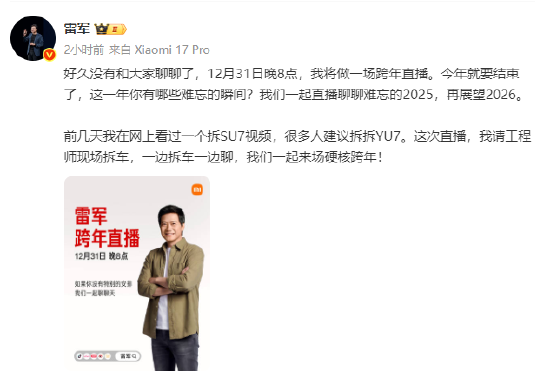
Group 1 - The founder of Xiaomi, Lei Jun, announced a New Year's Eve live stream scheduled for December 31 at 8 PM [1][5][7] - During the live stream, Lei Jun plans to have an engineer disassemble the YU7 vehicle while discussing it, following viewer suggestions after a video of the SU7 disassembly [1][7] - The live stream aims to engage with the audience by reflecting on memorable moments from the past year and looking forward to 2026 [7]
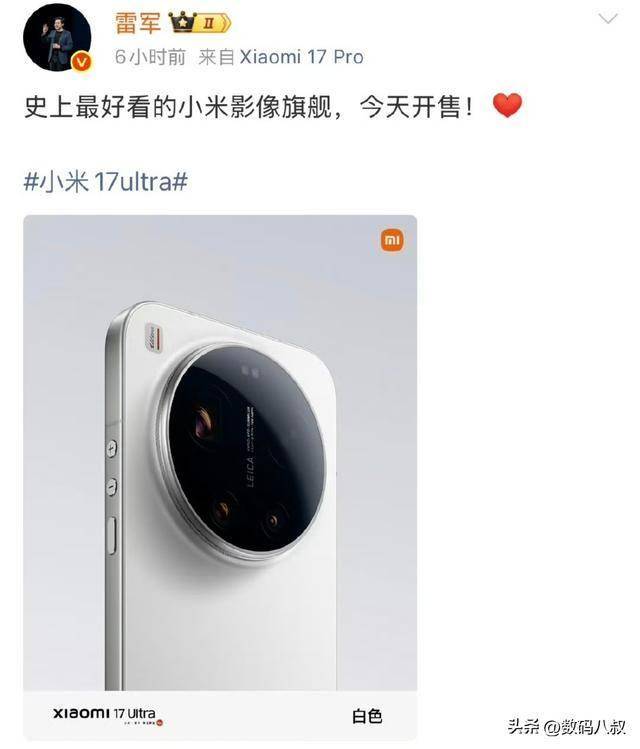
雷军亲自官宣:小米17 Ultra堪称“颜值天花板”的小米影像旗舰手机
Sou Hu Cai Jing· 2025-12-27 12:45
Core Viewpoint - Xiaomi 17 Ultra is positioned as the most aesthetically pleasing imaging flagship, emphasizing design and user experience alongside high-end imaging capabilities [1][11]. Design and Aesthetics - The Xiaomi 17 Ultra features a seamless ceramic body with a matte white finish, showcasing a minimalist design that contrasts with traditional Android flagships known for their heavy "material stacking" [4][11]. - The circular imaging module integrates smoothly with the back panel, creating a classic black-and-white color scheme that enhances its luxurious feel [4][6]. Imaging Capabilities - The device is expected to include a multi-camera setup with a large main sensor, periscope telephoto, and ultra-wide lenses, along with upgraded Leica native dual image quality and master-level tone algorithms [6][8]. - This combination aims to provide high-quality images in various conditions, appealing to photography enthusiasts [6][11]. Performance and Features - Xiaomi 17 Ultra is anticipated to feature the latest Snapdragon 8 Gen 2 processor and a 2K resolution display, enhancing performance and visual experience for users [8][11]. - The device is designed to meet the demands of high-end users by balancing top-tier imaging performance with exceptional aesthetics [11][13]. Market Positioning - The launch of Xiaomi 17 Ultra signifies a new dimension in the competition among Android imaging flagships, focusing on both visual appeal and imaging prowess [11][13]. - The device is positioned as a strong contender in the flagship market for users who prioritize both imaging experience and design quality [13].