
Xiaomi YU7系列

Search documents
小米集团-W:汽车业务驱动增长,季度盈利短期承压-20260325
国投证券(香港)· 2026-03-25 08:24
Investment Rating - The report maintains a "Buy" rating for the company with a target price of HKD 40.8, indicating a potential upside of 24.8% from the recent closing price [7]. Core Insights - The automotive business has become a key growth driver, achieving a revenue of RMB 372 billion in Q4 2025, representing a year-on-year increase of 123.4% and marking the first quarter of operational profitability at RMB 11 billion [1][2]. - Traditional businesses, such as smartphones and AIoT, are facing short-term pressure due to rising core component and storage costs, impacting overall profitability [1][3]. - The internet services segment showed steady growth, with Q4 2025 revenue reaching RMB 99 billion, a 5.9% year-on-year increase, supported by a record high in advertising revenue [3]. - The IoT and lifestyle consumption segment experienced a decline, with Q4 2025 revenue falling by 20.3% due to a weak domestic appliance market [4]. Summary by Relevant Sections Automotive Business - The automotive segment's revenue reached RMB 372 billion, accounting for 31.8% of total revenue, with a gross margin of 22.7%. The average selling price (ASP) of vehicles increased by 6.6% to RMB 249,846 per unit, driven by higher-value model deliveries [2]. - The company aims to deliver 550,000 vehicles in 2026 and plans to invest over RMB 200 billion in R&D over the next five years, with RMB 60 billion allocated to AI initiatives [4]. Smartphone Business - The smartphone segment's global shipments reached 37.7 million units in Q4 2025, a decline of 11.6% year-on-year, attributed to reduced promotional activities in overseas markets. The ASP increased by 10.7% to RMB 1,176.0 due to a higher proportion of premium models sold [3]. Internet Services - Internet services revenue for Q4 2025 was RMB 99 billion, with a gross margin of 76.8%. Advertising revenue reached RMB 78 billion, marking a 10.4% year-on-year increase and providing solid support for overall profitability [3]. IoT and Lifestyle Consumption - The IoT and lifestyle consumption segment reported a revenue of RMB 246 billion in Q4 2025, down 20.3% year-on-year, primarily due to a downturn in the domestic appliance market [4].

小米集团-W(01810):汽车业务驱动增长,季度盈利短期承压
国投证券(香港)· 2026-03-25 08:10
Investment Rating - The report maintains a "Buy" rating for the company with a target price of HKD 40.8, indicating a potential upside of 24.8% from the recent closing price [7]. Core Insights - The automotive business has become a key growth driver, achieving a revenue of RMB 372 billion, a year-on-year increase of 123.4%, and marking the first quarter of operational profitability at RMB 11 billion [1][2]. - Traditional businesses, such as smartphones and IoT, are facing short-term pressures due to rising costs and market competition, impacting overall profitability [3][4]. - The company plans to focus on delivering 550,000 vehicles in 2026 and has committed to significant R&D investments, exceeding RMB 200 billion over the next five years, with RMB 60 billion specifically for AI [4][5]. Summary by Sections Automotive Business - The automotive segment's revenue reached RMB 372 billion, accounting for 31.8% of total revenue, with a gross margin of 22.7% [2]. - The company delivered 145,115 new vehicles in the quarter, a 108.2% increase year-on-year, driven by strong demand and an increase in average selling price (ASP) to RMB 249,846 per vehicle [2]. Smartphone Business - The smartphone segment's global shipments reached 37.7 million units, but faced an 11.6% year-on-year decline due to reduced promotional activities in overseas markets [3]. - The ASP for smartphones increased by 10.7% quarter-on-quarter to RMB 1,176, supported by higher sales of premium models [3]. Internet Services - Internet services revenue for the quarter was RMB 99 billion, a 5.9% year-on-year increase, with a gross margin of 76.8% [3]. - Advertising revenue reached a record high of RMB 78 billion, growing 10.4% year-on-year, providing solid support for overall profitability [3]. IoT and Lifestyle Products - Revenue from the IoT and lifestyle segment declined by 20.3% year-on-year to RMB 246 billion, primarily due to a weak domestic appliance market [4]. Business Outlook - The automotive sector is positioned as the core growth engine for the company, with ambitious delivery targets and substantial R&D investments planned for the coming years [4][5].
雷军低调期,兄弟林斌在小米套现140亿
Xin Lang Cai Jing· 2025-12-29 12:11
Core Viewpoint - Xiaomi's co-founder Lin Bin announced a plan to sell up to $5 billion of B-class ordinary shares annually starting December 2026, totaling a maximum of $20 billion (approximately 140 billion RMB) over four years, raising concerns about market sentiment and stock price pressure [1][2][31]. Group 1: Lin Bin's Share Reduction Plan - Lin Bin's planned share sales are intended to fund the establishment of an investment fund, with the company expressing confidence in its business outlook [1][2]. - The total amount of 20 billion USD represents about 3.5 billion shares, which is approximately 15% of Lin Bin's personal holdings and 1.4% of the total share capital, deemed manageable without triggering dilution of other shareholders' rights [2][31]. - The market reacted negatively to the announcement, with Xiaomi's stock initially dropping 3% before recovering slightly, indicating a short-term emotional impact but not a sustained sell-off [2][31]. Group 2: Market Reactions and Analyst Opinions - Analysts believe that Lin Bin's share reduction could be interpreted as a sign that insiders view the stock price as fully reflecting its value, leading to negative sentiment in the short term [2][38]. - The potential annual supply of $5 billion (approximately 39 billion HKD) represents less than 5% of Xiaomi's daily trading volume, suggesting that if the company continues to buy back shares, it could mitigate liquidity impacts [2][31]. - Concerns about Lin Bin's previous reduction actions, which raised questions about his commitment to the company, have compounded market skepticism regarding the motivations behind the current plan [2][35]. Group 3: Company Performance and Strategic Challenges - Xiaomi's third-quarter revenue for 2025 reached 113.1 billion RMB, a 22.3% year-on-year increase, with significant growth in the electric vehicle segment, which saw a 199.2% increase [55]. - The company is facing challenges in its automotive business, including safety concerns and production capacity issues, which have led to a decline in public trust and brand reputation [38][57]. - Analysts suggest that Xiaomi needs to enhance its public relations strategy and improve product quality and after-sales service to rebuild consumer trust and ensure sustainable brand development [57]. Group 4: Internal Changes and Public Relations Strategy - Xiaomi's public relations head, Wang Hua, has been reassigned to a new role, which may indicate a shift in the company's external communication strategy amid ongoing challenges [43][45]. - The company is expected to focus on aligning its public relations efforts with its strategic goals, particularly in light of recent controversies surrounding its automotive division [45][47]. - The adjustment in leadership is seen as a move to strengthen crisis management capabilities and improve local public relations efforts, especially as the company navigates a complex market environment [47].


小米集团-W(01810):3Q25利润创历史新高,智能电动汽车业务实现盈利
Guoxin Securities· 2025-11-27 14:57
Investment Rating - The investment rating for Xiaomi Group-W (01810.HK) is "Outperform the Market" [6]. Core Insights - In Q3 2025, Xiaomi achieved a record high profit with total revenue of 113.12 billion yuan, representing a year-over-year increase of 22.3% and a quarter-over-quarter decrease of 2.4%. Adjusted net profit reached 11.31 billion yuan, up 80.9% year-over-year and 4.4% quarter-over-quarter. The gross margin improved to 22.9%, an increase of 2.5 percentage points year-over-year and 0.4 percentage points quarter-over-quarter [2][4]. - The smart electric vehicle (EV) business reported its first quarterly profit, generating an operating income of 700 million yuan. In Q3 2025, the company delivered 109,000 new vehicles, with automotive revenue reaching 28.3 billion yuan and a gross margin of 25.5% [2][3]. - The smartphone and AIoT business remained stable, with smartphone revenue of 46 billion yuan and a global shipment of 43.3 million units, maintaining a market share of 13.6%. The newly launched Xiaomi 17 series saw a sales increase of approximately 30% in its first month [3][4]. Summary by Sections Financial Performance - Q3 2025 total revenue was 113.12 billion yuan, with adjusted net profit at 11.31 billion yuan. The gross margin was 22.9% [2][4]. - The company expects net profit for 2025-2027 to be 43 billion, 51.4 billion, and 62.3 billion yuan respectively, with year-over-year growth rates of 82%, 19%, and 21% [4][5]. Business Segments - The smartphone segment generated 46 billion yuan in revenue, while the IoT and lifestyle products segment brought in 27.6 billion yuan, with a gross margin of 23.9% [3][4]. - The smart EV segment achieved a revenue of 28.3 billion yuan, with a gross margin of 25.5% [2][3]. Research and Development - R&D expenses reached 9.1 billion yuan in Q3 2025, reflecting a year-over-year increase of 52.1%. The company continues to invest heavily in core technologies to enhance its ecosystem [3][4].
热搜第一!雷军最新发声
Zhong Guo Ji Jin Bao· 2025-11-20 06:11
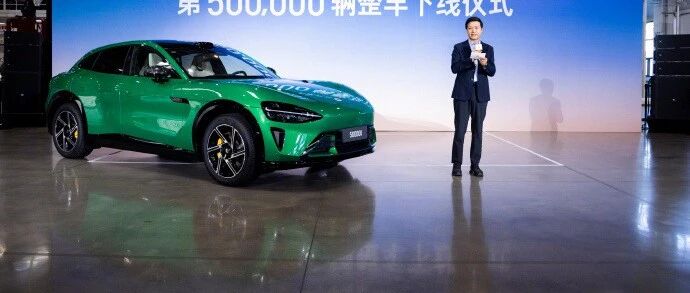
Core Points - Xiaomi has officially rolled out its 500,000th vehicle, marking a significant milestone in its automotive journey [1][3] - The company aims to deliver over 400,000 vehicles in 2025, indicating a shift towards large-scale production and consumer acceptance [3][11] Group 1: Milestone Achievement - The 500,000th vehicle was produced in just 1 year and 7 months, showcasing Xiaomi's rapid growth in the automotive sector [4][8] - CEO Lei Jun emphasized the importance of this milestone for Xiaomi, stating it signifies a new starting point for the company [9] Group 2: Financial Performance - In Q3 2025, Xiaomi's revenue from its smart electric vehicle and AI segments reached 29 billion CNY, with 28.3 billion CNY coming from electric vehicles alone [11] - The company delivered 108,796 new vehicles in Q3 2025, setting a new historical record [11] Group 3: Future Plans and Challenges - Xiaomi plans to maintain a focus on safety and delivery, while also enhancing technological innovation and integrating AI with smart manufacturing [9][12] - The company anticipates challenges in 2026 due to reduced purchase tax subsidies and increased competition in the automotive industry [11]

热搜第一!雷军最新发声
中国基金报· 2025-11-20 06:05
Core Viewpoint - Xiaomi has officially rolled out its 500,000th vehicle, marking a significant milestone in its automotive journey, showcasing its capabilities in R&D, manufacturing, sales, delivery, and service [2][4][7]. Group 1: Milestone Achievement - The 500,000th vehicle was produced at Xiaomi's super factory in Beijing, indicating the company's entry into a new phase of scale [2]. - Xiaomi's founder Lei Jun expressed gratitude towards users, suppliers, and government support, emphasizing the achievement as a new starting point for the company [7]. Group 2: Future Plans and Commitments - Xiaomi aims to deliver over 400,000 vehicles in 2025, with a focus on safety, delivery, technological innovation, and the integration of AI and smart manufacturing [2][7]. - Lei Jun reiterated the importance of safety in vehicle design, addressing previous controversies regarding the company's priorities [7]. Group 3: Financial Performance - In Q3 2025, Xiaomi's revenue from its smart electric vehicle and AI segment reached 29 billion yuan, with the electric vehicle segment contributing 28.3 billion yuan [9]. - The company delivered 108,796 vehicles in Q3 2025, achieving a historical high, and plans to meet its annual delivery target of 350,000 vehicles [9][10]. Group 4: Market Position and Challenges - Xiaomi's YU7 series ranked first in the SUV sales chart in mainland China as of October 2025, with a growing presence in 402 sales outlets across 119 cities [9]. - The company anticipates challenges in 2026 due to reduced purchase tax subsidies and increased competition in the automotive industry [9].
小米Q3营收1131亿,经调净利大增超80%!汽车业务实现单季盈利
Ge Long Hui· 2025-11-19 20:15
Core Insights - Xiaomi Group reported a total revenue of 113.1 billion yuan for Q3 2025, representing a year-on-year growth of 22.3%, exceeding the expected 112.5 billion yuan [2] - The group's operating profit for Q3 was 15.11 billion yuan, surpassing the forecast of 10.72 billion yuan, while net profit reached 12.27 billion yuan, exceeding the expected 9.62 billion yuan [2] - Adjusted net profit hit a record high of 11.3 billion yuan, marking an 80.9% year-on-year increase, against an expectation of 10.05 billion yuan [2] Revenue Breakdown - The "Mobile × AIoT" segment generated revenue of 84.1 billion yuan in Q3 2025, showing a year-on-year increase of 1.6% [2] - The "Smart Electric Vehicles and AI Innovation" segment achieved revenue of 29 billion yuan, a historical high with a year-on-year growth of 199.2% [2] - For the first time, the smart electric vehicle and AI innovation segment reported a quarterly operating profit of 700 million yuan, indicating a shift from loss to profit in Xiaomi's automotive business [2] Profitability Metrics - The gross margin for Q3 was 22.9%, an increase of 2.5 percentage points year-on-year, exceeding the forecast of 22.7% [2] - The gross margin for the automotive business rose to 25.5%, attributed to a decrease in core component costs, lower unit manufacturing costs due to economies of scale, and an increased delivery proportion of the Xiaomi YU7 series with a higher average selling price (ASP) [3] - The ASP for the automotive segment increased from 253,700 yuan to 260,100 yuan, reflecting the product structure upgrade [3]
小米Q3经调整净利润同比大增80.9%创新高,电动汽车及AI等创新业务首次实现单季经营盈利
美股IPO· 2025-11-18 10:16
Core Viewpoint - Xiaomi's Q3 performance exceeded market expectations, with significant growth in revenue and net profit, marking a pivotal shift in its electric vehicle and AI business towards profitability [6][4]. Financial Performance - Total revenue for Q3 reached 1,131.2 billion RMB, a year-on-year increase of 22.3% but a slight quarter-on-quarter decline of 2.4% [2][4]. - Adjusted net profit was 113.1 billion RMB, a historical high, reflecting an 80.9% year-on-year growth [2][4]. - Gross margin improved to 22.9%, up 2.5 percentage points year-on-year [2]. - Cumulative revenue for the first three quarters was 3,404 billion RMB, representing a 32.5% year-on-year increase [2]. Automotive Business - Q3 revenue from the automotive sector was 283 billion RMB, showing a remarkable year-on-year growth of 197.9% and a 33.8% increase in delivery volume to 108,800 units, setting a new record [9][1]. - The automotive business achieved an operating profit of 7.00 billion RMB, marking its first profitable quarter [5][11]. - The gross margin for the automotive business rose to 25.5%, attributed to lower core component costs, reduced unit manufacturing costs due to scale effects, and an increased delivery share of the higher ASP Xiaomi YU7 series [12]. Research and Development - R&D expenditure in Q3 was 91 billion RMB, a 52.1% increase year-on-year, with a total of 235 billion RMB for the first three quarters [13]. - The number of R&D personnel reached a record high of 24,871 [13]. - Capital expenditure was 53.8 billion RMB, significantly exceeding the forecast of 20 billion RMB, indicating a strong commitment to innovation in electric vehicles and AI [14].
小米Q3经调整净利润同比大增80.9%创新高,电动汽车及AI等创新业务首次实现单季经营盈利 | 财报见闻
Sou Hu Cai Jing· 2025-11-18 09:57
Core Viewpoint - Xiaomi Group's Q3 performance exceeded market expectations, with significant year-on-year net profit growth and the electric vehicle and AI innovation businesses achieving operational profitability for the first time in a single quarter [1][4]. Financial Performance - Q3 total revenue reached 113.12 billion RMB, a year-on-year increase of 22.3% but a quarter-on-quarter decrease of 2.4% [2][3]. - Adjusted net profit was 11.31 billion RMB, marking a historical high with a year-on-year growth of 80.9% [2][3]. - Gross margin stood at 22.9%, up 2.5 percentage points year-on-year [2]. - Cumulative revenue for the first three quarters was 340.4 billion RMB, reflecting a year-on-year increase of 32.5% [2]. Core Business Progress - Smartphone shipments totaled 43.3 million units, marking nine consecutive quarters of year-on-year growth, with a global market share of 13.6%, maintaining a top-three ranking for 21 consecutive quarters [5]. - The electric vehicle and AI innovation business achieved operational profitability for the first time, generating 700 million RMB in profit, with a record delivery volume of 108,800 units [5][9]. - The AIoT platform connected devices surpassed 1 billion, reaching 1.036 billion, with monthly active users at 742 million [5]. - Internet services revenue hit a record high of 9.4 billion RMB, growing 10.8% year-on-year [5]. Automotive Business - Q3 revenue from the automotive business was 28.3 billion RMB, a year-on-year increase of 197.9%, with delivery volume up 33.8% from Q2, reaching a historical high [7][9]. - The automotive business achieved a gross margin of 25.5%, leading among new energy vehicle companies, attributed to lower core component costs, reduced unit manufacturing costs, and an increased share of higher average selling price (ASP) models [10]. Increased R&D Investment - Q3 R&D expenditure was 9.1 billion RMB, a year-on-year increase of 52.1%, with cumulative spending for the first three quarters at 23.5 billion RMB and a record number of R&D personnel at 24,871 [11]. - Capital expenditure was 5.38 billion RMB, significantly exceeding the expected 2 billion RMB [11]. - Xiaomi's strategic investments in AI and electric vehicles reflect a long-term commitment to enhancing technological competitiveness [11].

小米集团-W(01810):营收增长带动利润上扬,业务升级亟待契机
Waton Financial· 2025-11-11 12:34
Investment Rating - The investment rating for the company is "Hold" [1]. Core Views - The company is expected to maintain double-digit revenue growth over the next three years, with profit growth outpacing revenue growth. The projected P/E ratios for 2025, 2026, and 2027 are 24.17, 18.11, and 14.82 respectively, indicating a positive outlook for overall performance [3][12]. Financial Performance - In the first half of 2025, the company reported revenue of 227.25 billion RMB, a 38.2% increase from 164.39 billion RMB in the same period last year. The second quarter revenue reached 116 billion RMB, a 30.5% year-on-year growth, marking a historical high [12][13]. - The net profit for the first half of 2025 was 11.9 billion RMB, reflecting a 134.2% increase year-on-year. Adjusted net profit was 10.8 billion RMB, up 75.4% [12][13]. - The gross margin for the second quarter was 22.7%, an increase of 5.5 percentage points year-on-year, driven by higher-margin businesses and improved production efficiency [13][14]. Business Development - The "Mobile × AIoT" segment generated revenue of 94.7 billion RMB in the second quarter, a 14.8% increase, accounting for 81.6% of total revenue. The IoT and lifestyle products segment saw revenue growth of 44.7% [15][17]. - The smart electric vehicle segment reported revenue of 21.3 billion RMB with a gross margin of 26.4%, indicating simultaneous growth in scale and profitability [18]. - The company’s R&D expenditure in the first half of 2025 was 14.475 billion RMB, a 41.2% increase, focusing on smart vehicle technology and AI model development [23]. Future Development and Summary - The company has successfully implemented its "people, vehicle, home ecosystem" strategy, enhancing user data and service integration across devices. The global layout leverages "China R&D + Global Manufacturing + Regional Delivery" advantages [24].