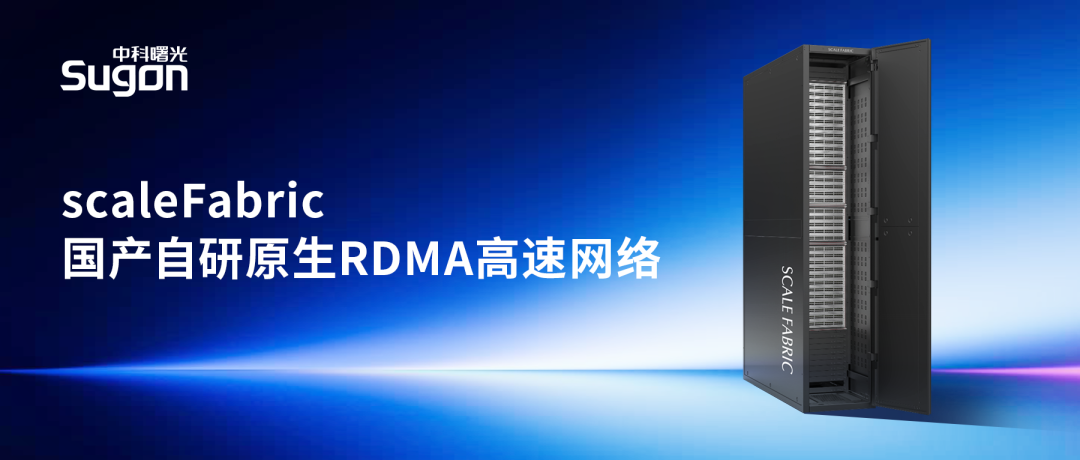
scaleFabric

Search documents
应对 英伟达第二次“卡脖子”,中国正补齐关键短板
Guan Cha Zhe Wang· 2026-03-16 04:56
Core Insights - The AI era is facing a critical challenge with the shortage of high-speed interconnect networks, which is essential for the efficient operation of large-scale computing clusters [1][10] - Domestic companies are making strides in developing their own computing chips, but the core technology for high-speed interconnects remains dominated by Nvidia, posing a significant risk to the industry [1][10] Group 1: Industry Challenges - The transition from GPU to high-speed interconnects is becoming a new bottleneck as the scale of computing clusters increases from thousands to tens of thousands of nodes [1][4] - The communication time in distributed training can account for 30-50% of the total time, indicating that a significant portion of the investment in computing power is wasted on data transfer rather than computation [4][5] - The demand for high-speed networks has increased by 10 to 20 times as servers now require multiple network cards to support GPU-centric architectures [6] Group 2: Technological Landscape - There are two main technological routes in the high-speed network domain: RoCE and InfiniBand, with the latter being the preferred choice for high-performance computing due to its superior performance metrics [7][10] - InfiniBand networks are used in approximately 60% of the world's high-performance computing systems, and they are almost standard in the largest AI training clusters [10] Group 3: Domestic Developments - In response to the challenges posed by the dominance of foreign technology, companies like Zhongke Shuguang have developed their own high-speed network solutions, such as the scaleFabric, which is fully self-developed [2][11] - The decision to pursue a fully self-developed InfiniBand system was driven by the inadequacy of available commercial IPs and open-source solutions to meet the performance and reliability requirements for large-scale clusters [12]



海光信息:中科曙光scaleFabric国产原生RDMA高速网络首发,智算基础设施自主化加速-20260315
Soochow Securities· 2026-03-15 07:20
Investment Rating - The investment rating for the company is "Buy" (maintained) [1] Core Views - The company has achieved a breakthrough in RDMA high-speed networking with the launch of its first fully self-developed 400G lossless high-speed network product, scaleFabric, which fills a gap in the domestic data center high-speed network field [2] - The scaleFabric400 series network products are fully self-developed, covering everything from the underlying 112G SerDes IP and hardware devices to upper-layer management software, and they match or exceed some specifications of NVIDIA's NDR [2] - The company has successfully developed a domestic InfiniBand-like RDMA high-speed network, addressing the core demands of high bandwidth, low latency, and lossless transmission for large-scale cluster networking [3] - The scaleFabric product is compatible with existing InfiniBand application ecosystems, allowing seamless migration of applications without code modification, and supports large-scale expansion capabilities [3] - The product has been deployed in a national supercomputing internet core node, validating its stability and performance in large-scale cluster environments [10] Financial Projections - The company forecasts total revenue to grow from 6,012 million RMB in 2023 to 28,840 million RMB by 2027, with a compound annual growth rate (CAGR) of approximately 40.23% [1] - The net profit attributable to the parent company is projected to increase from 1,263 million RMB in 2023 to 6,506 million RMB in 2027, reflecting a CAGR of approximately 57.84% [1] - The earnings per share (EPS) is expected to rise from 0.54 RMB in 2023 to 2.80 RMB in 2027 [1] - The price-to-earnings (P/E) ratio is projected to decrease from 433.78 in 2023 to 84.22 by 2027, indicating an improving valuation as earnings grow [1]

海光信息(688041):中科曙光scaleFabric国产原生RDMA高速网络首发,智算基础设施自主化加速
Soochow Securities· 2026-03-15 07:02
Investment Rating - The investment rating for the company is "Buy" (maintained) [1] Core Insights - The company has achieved a breakthrough in RDMA high-speed networking with the launch of its first fully self-developed 400G lossless high-speed network product, scaleFabric, which fills a gap in the domestic data center high-speed network field [2] - The scaleFabric400 series network products are fully self-developed, matching and even surpassing some specifications of NVIDIA's NDR, addressing key challenges in large-scale computing clusters [3] - The scaleFabric network supports over 100,000 cards in a single subnet and can achieve deployments of up to one million cards, catering to the exponential growth in AI computing power [3][10] - The company has a complete product matrix in the A-share GPU sector, with its CPU and DCU products positioned to benefit from the accelerating domestic computing infrastructure construction [10] Financial Projections - Total revenue is projected to grow from 6,012 million RMB in 2023 to 28,840 million RMB by 2027, with a compound annual growth rate (CAGR) of approximately 40.23% [1] - Net profit attributable to the parent company is expected to increase from 1,263 million RMB in 2023 to 6,506 million RMB in 2027, reflecting a CAGR of about 57.84% [1] - The earnings per share (EPS) is forecasted to rise from 0.54 RMB in 2023 to 2.80 RMB in 2027 [1] Market Data - The closing price of the company's stock is 235.74 RMB, with a market capitalization of approximately 547,939.46 million RMB [6] - The price-to-earnings (P/E) ratio is projected to decrease from 433.78 in 2023 to 84.22 by 2027, indicating an improving valuation as earnings grow [1][11]
国产RDMA技术实现突破,助力超节点加速落地
Western Securities· 2026-03-15 02:36
Investment Rating - The industry investment rating is "Overweight" and has been maintained from the previous rating [5]. Core Insights - The breakthrough in domestic RDMA technology is expected to enhance the certainty of the deployment of domestic supernodes in 2026, which is a critical year for this development [3]. - The scaleFabric 400 network card and switch meet the performance requirements for high bandwidth and low latency networks needed for large-scale AI training clusters [2]. - The integration of RDMA technology with high-performance domestic network cards and adaptive congestion control algorithms is anticipated to improve the collaborative efficiency of domestic AI computing chips [3]. Summary by Sections Industry Overview - RDMA technology addresses data transmission delays and CPU consumption issues in large-scale parallel computing, becoming a fundamental technology for AI computing infrastructure [1]. - The scaleFabric network, launched by Zhongke Shuguang, represents a significant advancement in domestic RDMA technology, designed for ultra-large-scale intelligent computing clusters [1]. Technical Specifications - The scaleFabric 400 network card features a PCIe 5.0 interface with a port bandwidth of 400 Gbps and an end-to-end communication latency as low as 0.9 microseconds [2]. - The scaleFabric 400 switch has a single-port bandwidth of 800 Gbps and a total switching capacity of 64 Tbps, with a switching latency of approximately 260 nanoseconds [2]. Market Implications - The report suggests that companies with strong technological foundations in the industry are likely to experience significant and flexible growth as the demand for AI computing infrastructure increases [3]. - Recommended companies to watch include Zhongke Shuguang, Cambricon, Haiguang Information, and others involved in AI chips and interconnection technology [3].
21观公司|中科曙光高管剧透:国产网络与英伟达关键指标掰手腕
2 1 Shi Ji Jing Ji Bao Dao· 2026-03-13 09:36
Core Viewpoint - The efficiency bottleneck in large model training is shifting from chip computing power to network interconnectivity, with the launch of the scaleFabric 400G lossless high-speed network product by Zhongke Shuguang marking a significant technological breakthrough in the high-end RDMA field in China [2][3]. Group 1: Technological Advancements - Zhongke Shuguang's scaleFabric system features an end-to-end latency as low as 0.9 microseconds and can support a theoretical maximum of 114,000 card clusters, which is 2.33 times the scale of traditional InfiniBand [2][3][4]. - The product has been operational for over 10 months at the National Supercomputing Internet core node in Zhengzhou, supporting a 30,000 card intelligent computing cluster for real large model training tasks [2][7]. - The system's performance is comparable to NVIDIA's CX7, with a single port bandwidth of 800 Gbps and a total switching capacity of 64 Tbps [4][5]. Group 2: Market Dynamics - The demand for high-speed networks is expected to grow significantly, with port usage increasing by 10 to 20 times as the industry transitions from CPU to GPU architectures [3][13]. - Zhongke Shuguang aims to achieve domestic substitution for InfiniBand technology, targeting a significant market share in the high-speed network sector [13][14]. - The company emphasizes the importance of an open ecosystem to break NVIDIA's dominance, focusing on compatibility with various computing chips and fostering collaboration with domestic partners [10][11]. Group 3: Future Outlook - The market for high-speed networks is projected to be vast, with significant interest from sectors such as scientific engineering and artificial intelligence training [14]. - Zhongke Shuguang is preparing for large-scale deployment while ensuring product stability and performance through extensive real-world testing [14][15]. - The integration of AI and intelligent agents into supercomputing systems is expected to enhance user experience, making computing resources more accessible and efficient for solving real-world problems [15].
中科曙光高管剧透:国产网络与英伟达关键指标掰手腕
2 1 Shi Ji Jing Ji Bao Dao· 2026-03-13 09:31
Core Viewpoint - The article highlights the significant technological advancement made by Zhongke Shuguang in the high-end RDMA network sector, marking a shift from "catching up" to "running alongside" in China's intelligent computing infrastructure, particularly in high-speed networking [1][7]. Group 1: Technological Breakthroughs - Zhongke Shuguang has launched the scaleFabric, a fully self-developed 400G lossless high-speed network product, achieving a low end-to-end latency of 0.9 microseconds and supporting a theoretical maximum of 114,000 card cluster deployments [1][3]. - The scaleFabric system has been operational for over 10 months at the National Supercomputing Internet core node in Zhengzhou, successfully supporting a 30,000 card intelligent computing cluster [6][10]. - The product's core technology indicators include a link fault recovery time of less than 1 millisecond and a single subnet interconnection scale 2.33 times that of traditional InfiniBand [3][4]. Group 2: Market Dynamics - The demand for high-speed networks is driven by the increasing number of network ports required as cluster sizes grow from thousands to tens of thousands of cards, leading to a 10 to 20 times increase in network usage [3][10]. - The current market is dominated by NVIDIA, particularly through its InfiniBand technology, which has established a closed-loop ecosystem that poses a challenge for competitors [7][10]. - Zhongke Shuguang aims to provide a more open and adaptable network solution that can integrate with various domestic computing chips, thereby reducing dependency on a single vendor [10][12]. Group 3: Strategic Positioning - Zhongke Shuguang's strategy involves inheriting the open aspects of InfiniBand while attempting to break the commercial binding within NVIDIA's ecosystem [9][12]. - The company plans to establish a working group under the Guanghe organization to create relevant standards and enhance ecosystem adaptability through user feedback [9][12]. - The anticipated market for high-speed networks is substantial, with a focus on scientific engineering computing and AI training, indicating numerous potential deployment opportunities [12][10].

部分指标赶超英伟达!国产首款400G原生RDMA问世
Shang Hai Zheng Quan Bao· 2026-03-12 14:24
Group 1 - The core viewpoint of the article highlights the breakthrough in domestic RDMA technology with the launch of the scaleFabric, a native lossless RDMA high-speed network by Zhongke Shuguang, which competes with Nvidia's NDR technology [2][4] - The scaleFabric400 series network products have been validated in a nearly 10,000-card scale environment and have been running stably for over 10 months, filling a technological gap in domestic high-speed interconnects for clusters [2][8] - The performance specifications of the scaleFabric400 include a port bandwidth of 400Gbps, end-to-end communication latency as low as 0.9 microseconds, and a switch with a single port bandwidth of 800Gbps, supporting a total switching capacity of 64Tbps [6][8] Group 2 - The product features a credit-based lossless flow control mechanism that mitigates congestion and packet loss risks, with a link failure recovery time of less than 1 millisecond, supporting nearly 10,000-card clusters [8][11] - Compared to Nvidia's NDR, the scaleFabric400 offers a 25% increase in switch port density, a 100% increase in maximum QP number supported by network cards, and a maximum interconnect scale that is 2.33 times that of traditional IB [8][10] - The deployment of the scaleFabric network is already operational in Zhengzhou, supporting a national-level AI computing network base with a total scale of 30,000 cards [9][10] Group 3 - Zhongke Shuguang has developed a complete computing power foundation through long-term technological accumulation in high-performance computing, storage, and networking, enabling a collaborative development of "computing-storage-network" [13] - The successful implementation of the native RDMA network signifies the formation of an independent technological path in intelligent computing interconnects in China, addressing a critical component of the country's computing infrastructure [13] - The high-performance network industry ecosystem surrounding the native RDMA technology is accelerating its formation as the product is applied in ultra-large-scale intelligent computing clusters [13]
【财闻联播】华工科技,首次拿下A股成交额冠军!超139亿元,这家公司签下海外大单
券商中国· 2026-03-12 11:54
Macro Dynamics - The National Industrial Information Security Development Research Center issued a risk warning regarding the application of OpenClaw in the industrial sector, highlighting potential security risks such as unauthorized access and information leakage due to inadequate control measures [2] Aerospace Products - Multiple new aerospace products were showcased at the 2026 Shanghai Commercial Aerospace Conference, including a rollable flexible solar wing, which is a key energy supply component for satellites, promising enhanced performance and longevity [3] Financial Institutions - Agricultural Bank reported a balance of 7.92 trillion yuan in loans to private enterprises as of the end of February 2026, with 8.58 million clients, and a balance of 4.13 trillion yuan in loans to small and micro enterprises [7] Market Data - The Shanghai Composite Index fell by 0.1%, while the coal and chemical sectors showed strength, with several stocks reaching their daily limit [9] - The financing balance of the two markets increased by 54.22 billion yuan, with the Shanghai Stock Exchange reporting a balance of 13,359.8 billion yuan [12] Company Dynamics - China Electric Power Construction signed an EPC contract worth approximately 139.62 billion yuan for a solar-storage project in Abu Dhabi, with a total installed capacity of 2.1 GW and 7.75 GWh [13][14] - Boss Electric launched the world's first AI cooking glasses at AWE 2026, integrating AI technology to assist users in cooking processes [15] - Inspur announced the release of its first self-developed 400G lossless high-speed network, scaleFabric, marking a significant advancement in domestic data center technology [16] - *ST Chang Pharmaceutical received a decision for stock delisting from the Shenzhen Stock Exchange, with trading set to resume on March 20, 2026 [17] - Aishi Technology completed a $300 million Series C financing round, marking the largest single financing in China's video generation sector to date [18] - Li Auto is considering a share buyback of its Hong Kong stock, with discussions ongoing regarding the proportion and total amount [19]



特写|万卡集群的“神经枢纽”
Xin Lang Cai Jing· 2026-01-20 13:40
Core Insights - The article discusses the rapid evolution of AI computing clusters towards scales of tens of thousands and hundreds of thousands of nodes, emphasizing the critical role of high-speed interconnect networks in efficiently releasing computing power [1][7] - It highlights the launch of scaleFabric by Zhongke Shuguang, which is the first native lossless RDMA high-speed network in China, addressing key industry challenges and providing a stable network foundation for large-scale clusters [1][7] Performance and Technical Strength - scaleFabric aligns its bandwidth and latency metrics with international mainstream products, achieving a port density of 80 ports at 400G, which is a 25% improvement over similar products, thus supporting the scalability of the scaleX ten-thousand-node super cluster [3][9] - The technology employs credit flow control and link layer retransmission mechanisms consistent with InfiniBand (IB), ensuring true lossless transmission and making it more suitable for large-scale intelligent computing scenarios compared to RoCE networks [3][9] Ecosystem Compatibility and Expansion - scaleFabric offers native RDMA verbs interfaces, fully compatible with existing IB application ecosystems, allowing seamless migration of applications like parallel computing and large model training without code modifications [4][10] - It surpasses the five-thousand-node limitation of the IB protocol, supporting over ten thousand nodes in a single subnet and enabling million-node cluster deployments through multi-track technology, which meets the exponential growth demands of AI computing power [4][10] Innovation and Cost Efficiency - In response to the high-end SerDes IP bottleneck, Shuguang has developed a self-researched 112G PAM4 high-speed SerDes IP to ensure signal reliability in complex environments [6][12] - The company has also created a millisecond-level link fault routing recovery technology that maintains recovery time regardless of network scale, enhancing cluster availability to 99.99% [6][12] - The networking cost of scaleFabric is approximately 30% lower than that of IB, breaking the high-cost constraints of high-end networks, and its launch fills a technological gap in China's native RDMA networks while promoting the domestic replacement of IB networks [6][12]