
Ke Ji Ri Bao

Search documents
“槽控大脑”让铝电解打壳下料不卡堵
Ke Ji Ri Bao· 2025-11-12 23:48
Core Viewpoint - The aluminum electrolysis industry has made significant advancements with the development of intelligent shelling and material control technology, addressing the long-standing "jamming" issue that has plagued the sector globally [1][2]. Group 1: Technology Development - The research team led by the Guiyang Aluminum-Magnesium Design and Research Institute has developed a comprehensive technology route combining mechanism research, intelligent identification, automatic processing, and dynamic early warning [1]. - The non-contact jamming identification technology achieves an accuracy rate of over 95% by analyzing the "air pressure fingerprint" during the shelling process [1]. - The team has also created a frequency conversion shelling control model and intelligent linkage strategy to dynamically adjust the action intensity and feeding rhythm based on working conditions [1]. Group 2: Efficiency and Economic Impact - The new system can improve current efficiency in aluminum electrolysis production by 0.3% and reduce direct current consumption by 30 to 50 kilowatt-hours per ton of aluminum [2]. - Maintenance costs for the equipment have decreased by nearly 30% [2]. - In a specific application at Inner Mongolia Huayun New Materials Co., a single electrolysis cell saves over 50,000 kilowatt-hours annually, contributing to an estimated annual energy savings of approximately 400 million kilowatt-hours across applications, equivalent to a reduction of 236,400 tons of CO2 emissions [2]. - The technology is projected to generate direct economic benefits exceeding 370 million yuan for the applying enterprises [2].
我科学家在金属中发现“负能界面”
Ke Ji Ri Bao· 2025-11-12 23:46
12日,记者从辽宁材料实验室获悉,该实验室与中国科学院金属研究所联合研究团队近日取得重大技术 突破。研究人员在金属中发现"负能界面",成功实现亚纳米结构合金强化,使材料强度逼近理论极限的 同时,显著提升弹性模量。这种极限尺度稳定界面能够改变晶格的原子键合状态,从而大幅度提升性 能,为下一代高性能金属材料的设计开辟了全新维度。这一发现标志着金属材料的结构调控进入到亚纳 米尺度,相关成果近日在国际期刊《科学》上发表。 (文章来源:科技日报) 辽宁材料实验室党委副书记、副主任李秀艳在接受科技日报记者专访时介绍,卢柯研究员团队长期致力 于金属材料结构调控与性能突破研究。2018年,该团队首次发现,当纳米金属的晶粒小于70纳米时,晶 界能量下降,结构稳定性不降反升,这颠覆了传统"纳米晶粒越小越不稳定"的认知。2020年,团队进一 步探索晶粒尺寸极限,将纯铜晶粒细化至4—5纳米时,发现材料转变为一种新结构,晶界呈现三维周期 性极小面特征,将其命名为"受限晶体"。在最新研究中,团队聚焦尺度更小的界面结构(平均0.7纳米/3 —4原子层)。 "我们通过电化学沉积结合非晶化方法,发现在Ni-Mo合金中存在一种过剩能为负的界面。 ...
钙钛矿叠层LED外量子效率突破45%
Ke Ji Ri Bao· 2025-11-12 23:45
记者12日从南京工业大学获悉,由中国科学院院士、柔性电子全国重点实验室主任黄维领衔的科研团 队,成功构建全钙钛矿叠层发光二极管(LED)器件,并创新性地提出利用层间光子循环效应来提升钙 钛矿LED的光提取效率,使钙钛矿叠层LED的外量子效率突破45%,刷新该领域世界纪录,为开发高性 能钙钛矿LED开辟了全新途径。该成果11日发表于国际学术期刊《自然》。 随着市场对高品质显示和照明需求的不断提升,开发兼具高亮度、低成本及柔性化特征的新型LED技术 已成为世界科技前沿的研究热点。 然而,当前叠层钙钛矿LED的外量子效率仍不足10%,甚至远低于单结器件,严重制约其商业化进程。 此次研究中,团队通过优化连接层结构,实现了叠层器件中高效的电荷注入与平衡。论文共同通讯作 者、柔性电子全国重点实验室教授王建浦介绍:"更为重要的是,我们通过调控钙钛矿发光层的微纳结 构,创新性地提出利用叠层器件中独特的层间光子循环效应的策略,即一个发光单元产生的光子可被另 一钙钛矿层重新吸收并再次发射,从而突破了传统光提取效率的限制,实现'1+1>2'的效果。" (文章来源:科技日报) 论文共同通讯作者、南京工业大学柔性电子(未来技术)学院教 ...
人工智能模型工厂赋能“千行百业”
Ke Ji Ri Bao· 2025-11-12 23:45
外观酷似一只巨大的方盒,坐落在工业园区云集的山东济南经十东路;内部的数据车间、模型车间、集 成车间等依序分布……近日,记者探访国内首个人工智能模型工厂——浪潮人工智能模型工厂,这里通 过九大单元、75道工序、180套工具的加工训练,将数据加工成模型。 在业内人士看来,人工智能产品生产实现工厂化,是人工智能大潮的汇聚成势。今年8月,国务院发布 《关于深入实施"人工智能+"行动的意见》,提出加快实施"人工智能+"科学技术、产业发展、消费提 质、民生福祉、治理能力、全球合作等六大重点行动,标志着人工智能技术赋能千行百业步入全面加速 阶段,迎来前所未有的发展爆发期。 如何顺势而为,细看这座工厂,就能初见端倪。"硬件、软件、云计算服务,三轮驱动,三者兼备。"浪 潮集团执行总裁、总工程师肖雪把浪潮人工智能模型工厂拔得头筹的主要原因归结于"系统性优势"。 在肖雪看来,工厂实现的是"集约",不仅要算力、算法集约,还要人力、安全集约。如此才能将工厂打 造为发展人工智能产业的基础设施。 视线转移到工厂之外,就能感受"未来已来"。 走进工厂,记者看到,上千台服务器24小时运转不停,为模型生产提供算力支持;调优工具、标引工具 等几十 ...

高校如何在专业调整中“追新固本”
Ke Ji Ri Bao· 2025-11-12 22:31
Core Points - The Ministry of Education has shifted the discipline and major adjustment cycle from once every ten years to annual updates, with over 20% of disciplines adjusted in the past two years, highlighting the dynamic nature of higher education in response to market demands [1][3][4] - The adjustment aims to better align higher education with national strategic needs and the evolving requirements of technological and industrial changes [2][3] - New majors such as Intelligent Molecular Engineering and Carbon Neutral Science and Engineering have been added, reflecting the influence of national strategy and market demand [3][4] Group 1 - The adjustment cycle for academic disciplines has been significantly shortened to allow for quicker responses to national strategic needs and technological advancements [2] - In the past decade, nearly 19,966 new undergraduate majors have been registered, with an average annual adjustment rate of about 5% for the total number of majors, indicating unprecedented adjustment intensity and frequency [4] - The new adjustment model requires a "pre-approval" principle, ensuring that new majors are backed by thorough research and expert evaluations before being established [5][6] Group 2 - The quality of talent cultivation is a critical concern as the speed of discipline updates increases, necessitating strict quality control measures for newly established majors [5][6] - Experts emphasize the importance of maintaining traditional disciplines while integrating new majors, advocating for a balanced approach that leverages existing strengths to support new developments [7][8] - Institutions are encouraged to develop new majors that align with their traditional strengths and emerging technologies, ensuring that new programs are not merely trends but are built on solid foundations [8][9]
具身智能双臂机器人高空清障
Ke Ji Ri Bao· 2025-11-12 11:52
(文章来源:科技日报) 12日,由国网浙江省电力有限公司自主研发的特高压线路具身智能双臂机器人,在浙江湖州开展首次清 障作业。作业过程中,机器人通过灵巧手等模块化末端执行器,快速清除飘挂在特高压上的细小易飘 物。据介绍,其单臂采用6自由度仿人构型,负载能力超过5公斤,工作半径为0.9米,可灵活适应不同 作业任务需求。此外,机器人可在300米外受到远程控制,开展毫米级精细操作,重复定位精度高达 ±0.5毫米。 ...

国内首座三塔四跨“O”形矮塔斜拉桥通车
Ke Ji Ri Bao· 2025-11-12 09:31
Core Points - The Yili River Third Bridge, the first three-tower four-span "O" shape cable-stayed bridge in China, officially opened on November 11, marking a significant breakthrough in bridge structure design and contributing to the Belt and Road Initiative and high-quality development in Xinjiang [1][2] - The bridge spans 2028 meters in length and 23.5 meters in width, designed for a dual four-lane highway standard with a speed limit of 60 km/h [1] - The main bridge features a unique design with a main span of 492 meters and a central tower height of 51 meters, constructed using C50 concrete and "O" shape steel structures [1] Project Details - The bridge connects the Horgos Economic Development Zone in Yining to the north and the northern side of the Chabuchar Yili River National Wetland Park to the south, significantly reducing travel time from 1.5 hours to several minutes [2] - It links key areas such as Horgos City, Yining City, Chabuchar County, and Zhaosu County, facilitating the transportation of specialty agricultural products and tourism development [2] - The project involved the manufacturing, installation, and coating of approximately 4532 tons of steel structures, with significant challenges in construction due to complex design and environmental factors [1]
“凤凰”携风雨逼近,专家表示——11月仍有台风生成并非罕见,不能掉以轻心
Ke Ji Ri Bao· 2025-11-12 07:56
Core Viewpoint - The 26th typhoon "Phoenix" is expected to make landfall in the southwestern coast of Taiwan on the afternoon to night of November 12, following significant damage caused in the Philippines after its landfall on November 9 [1][2]. Group 1: Typhoon Characteristics - Typhoons can still form and be active in November, which is not unusual, as the Northwest Pacific and South China Sea are the only regions globally where typhoons can occur year-round [1]. - The period from April to December is the main time for typhoons to make landfall [1]. - Historical data shows that from 2001 to 2024, there have been eight years with the occurrence of double typhoons in November [1]. Group 2: Typhoon Intensity and Impact - Generally, typhoons in November may be weaker due to cooler weather, but this is not always the case; warmer sea temperatures can still lead to the formation of strong or even super typhoons [1]. - The 2013 Typhoon "Haiyan" was a notable example, causing catastrophic impacts in the Philippines and Vietnam, with over 6,300 deaths in the Philippines and economic losses exceeding $2 billion [2]. Group 3: Typhoon Path and Forecast - The predicted path of "Phoenix" shows a northwest turn, then a shift to the northeast, influenced by the subtropical high and the southwest wind trough in South China [2]. - The typhoon is expected to bring strong winds and heavy rainfall to eastern and southern coastal areas of China, particularly in southeastern Fujian and eastern Taiwan, with warnings for potential geological disasters and urban flooding [3]. Group 4: Future Typhoon Activity - Current monitoring indicates that there is a low likelihood of additional typhoons forming in the Northwest Pacific and South China Sea in the near future, aside from "Phoenix" [4].
【科技日报】捕碳于海 变废为宝
Ke Ji Ri Bao· 2025-11-12 06:28
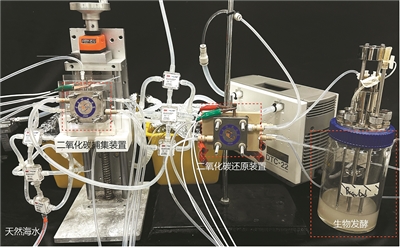
Core Insights - The article discusses the development of an "artificial ocean carbon cycling system" that captures CO2 from seawater and converts it into valuable chemical products, addressing both ocean acidification and carbon neutrality goals [1][4]. Group 1: Carbon Capture Technology - The research focuses on efficient carbon capture from seawater, overcoming challenges such as membrane swelling and electrode contamination that limit traditional methods to less than 10 hours of continuous operation [2]. - A new electrochemical carbon capture device was designed, achieving over 500 hours of stable operation with a CO2 capture efficiency exceeding 70%, and a cost of approximately $229.9 per ton of CO2 captured, which is significantly lower than current industry standards [4]. Group 2: Bioconversion of Captured CO2 - The research team developed a "microbial cell factory" that utilizes formic acid, derived from captured CO2, to produce biodegradable plastic monomers such as succinic acid and lactic acid [5]. - Stable carbon isotope labeling experiments confirmed that the carbon atoms in succinic acid originated from the initially captured CO2, demonstrating the system's potential for sustainable material production [5]. Group 3: Future Industrial Applications - The research team aims to create an integrated "green factory" that continuously captures CO2 from seawater and converts it into green plastic materials, showcasing the industrial potential of the system [6]. - The system could produce a diverse range of products, including biodegradable straws, packaging materials, and environmentally friendly detergents, contributing to the reduction of ocean acidification and promoting a circular economy [6].

同济大学正全力打造一所面向未来的科技中学
Ke Ji Ri Bao· 2025-11-12 04:55
11月12日,同济大学党委常委、副校长许学军在教育部新闻发布会上透露,当前同济大学正全力打造一 所面向未来的科技中学。 "我们在筹建过程中,正是按照这样一种体系化的设计,从课程、师资到空间做到大学和中学的充分衔 接和融合。"许学军说。 许学军表示,《关于加强中小学科技教育的意见》提出,要依托高校探索建立大中小科技教育共同体, 为科技教育提供人才与组织支撑。大学要在课程建设上发挥"引领"作用。充分发挥学科优势与科研积 累,将前沿学术成果转化为中小学科技教育可理解、可实施的指导方案,帮助中小学教师更新教育理 念、优化课程设计。大学要在师资培育上发挥"赋能"作用。通过"国家优秀中小学教师培养计划"、中小 学科技教师高级研修班等项目,定向培养高素质科技教育师资,系统提升他们的学科知识储备、科学素 养与教学能力。探索建立"双聘"机制,鼓励大学教师到中小学担任科技教育导师或兼职教师,提升中小 学科技教育质量。大学要在资源共享上发挥"贯通"作用。主动将优质通识课程、教授科普讲座等转化为 线上资源,加大帮扶和支教力度,服务和支援教育资源薄弱地区,让偏远地区共享高质量科技教育资 源。 (文章来源:科技日报) ...