
2 1 Shi Ji Jing Ji Bao Dao

Search documents
迪威尔:2025年净利润同比增长43.68%
2 1 Shi Ji Jing Ji Bao Dao· 2026-02-27 07:43
Core Viewpoint - The company reported a revenue of 1.207 billion yuan for the fiscal year 2025, reflecting a year-on-year growth of 7.43% [1] - The net profit attributable to shareholders reached 123 million yuan, marking a significant year-on-year increase of 43.68% [1] - Basic earnings per share were reported at 0.63 yuan, which is a 43.18% increase compared to the previous year [1] Financial Performance - Revenue for the year was 1.207 billion yuan, up 7.43% year-on-year [1] - Net profit attributable to shareholders was 123 million yuan, showing a growth of 43.68% year-on-year [1] - Basic earnings per share stood at 0.63 yuan, an increase of 43.18% year-on-year [1]

艾罗能源:2025年净利润同比减少43.16%
2 1 Shi Ji Jing Ji Bao Dao· 2026-02-27 07:42
Core Viewpoint - Airo Energy reported its 2025 annual performance, showing a significant increase in revenue but a notable decline in net profit and earnings per share [1] Financial Performance - The company achieved an operating revenue of 4.082 billion yuan, representing a year-on-year growth of 32.84% [1] - The net profit attributable to shareholders of the listed company was 116 million yuan, reflecting a year-on-year decrease of 43.16% [1] - The basic earnings per share were 0.72 yuan, which is a decrease of 43.31% compared to the previous year [1]

天奈科技:2025年净利润同比减少5.75%
2 1 Shi Ji Jing Ji Bao Dao· 2026-02-27 07:42
南财智讯2月27日电,天奈科技发布2025年度业绩快报,报告期内公司实现营业收入12.99亿元,同比下 降10.29%;归属于上市公司股东的净利润2.36亿元,同比下降5.75%;基本每股收益0.66元,同比下降 9.59%。 ...

慧辰股份:2025年净亏损4148.43万元
2 1 Shi Ji Jing Ji Bao Dao· 2026-02-27 07:42
Core Viewpoint - Huichen Co., Ltd. reported its 2025 annual performance, showing a revenue increase and a reduction in net loss compared to the previous year [1] Group 1: Financial Performance - The company achieved an operating revenue of 505 million yuan, representing a year-on-year growth of 13.74% [1] - The net profit attributable to shareholders of the listed company was a loss of 41.48 million yuan, which reflects a year-on-year reduction in loss by 22.31% [1] - The basic earnings per share were -0.56 yuan, indicating a year-on-year improvement of 23.06% [1]

昱能科技:2025年净亏损1.31亿元
2 1 Shi Ji Jing Ji Bao Dao· 2026-02-27 07:39
Group 1 - The core point of the article is that YN Technology reported a significant decline in its financial performance for the fiscal year 2025, with a notable drop in both revenue and net profit [1] Group 2 - The company achieved an operating revenue of 1.153 billion yuan, representing a year-on-year decrease of 34.87% [1] - The net profit attributable to shareholders was -131 million yuan, indicating a loss compared to the previous year [1] - The basic earnings per share were -0.84 yuan, reflecting a year-on-year decline of 193.28% [1]

A股收评:沪指低开高走涨0.39%,有色、电力板块掀涨停潮
2 1 Shi Ji Jing Ji Bao Dao· 2026-02-27 07:35
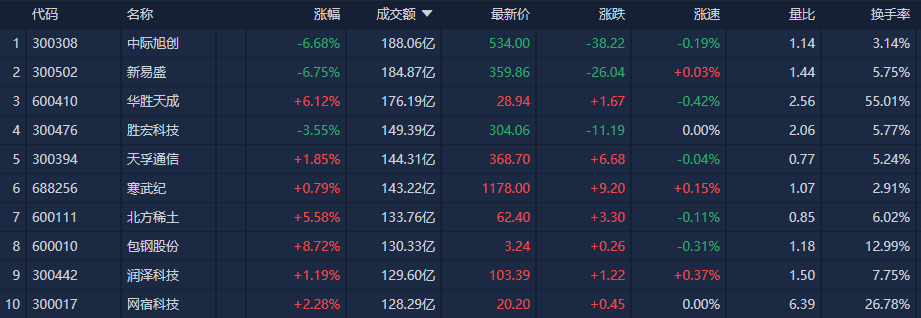
Market Overview - The A-share market showed mixed performance with the Shanghai Composite Index rising by 0.39%, while the Shenzhen Component Index fell by 0.06%, and the ChiNext Index decreased by 1.04% [1] Sector Performance - Over 3,200 stocks in the market experienced gains, with notable increases in sectors such as rare earths, non-ferrous metals, small metals, electricity, coal, steel, gas, computing power leasing, photovoltaic equipment, cultivated diamonds, education, and diversified finance [2] - The rare earth and small metal prices have been on the rise recently, leading to significant gains in related sectors, with companies like Zhangyuan Tungsten, Yunnan Zhenyi, Xianglu Tungsten, and Northern Rare Earth reaching historical highs [2] Notable Stocks - Electric power stocks showed strong performance in the afternoon, with companies like Jiawei New Energy hitting the 20% daily limit, alongside nearly 10 other stocks such as Fuling Power and Mindong Power also reaching their limits [3] - The computing power leasing sector also performed well, with stocks like Yuntian Lifei and Tuo Wei Information hitting their daily limits [4] - Other sectors such as steel, coal, and cultivated diamonds also saw upward movements during the trading session [5] Declining Sectors - The paper, PCB, CPO, storage chip, engineering machinery, and airport shipping sectors experienced the largest declines [6] - Stocks in the PCB and CPO sectors, along with other computing hardware stocks, saw corrections, with companies like Xinyisheng, Zhongji Xuchuang, and Yuanjie Technology dropping over 5% during the session [7] Trading Volume - The total market trading volume exceeded 2.5 trillion yuan [8] - The highest trading volume was recorded for Zhongji Xuchuang at 18.806 billion yuan, followed by Xinyisheng, Huasheng Tiancheng, Shenghong Technology, and Tianfu Communication [8]

欧洲头部数据中心运营商再度提价,低费率云计算ETF华夏(516630)涨超1.3%,云天励飞20cm涨停
2 1 Shi Ji Jing Ji Bao Dao· 2026-02-27 06:52
Group 1 - The core viewpoint of the news highlights the strong performance of the computing power leasing sector, with significant price increases announced by Hetzner, a major data center operator, affecting cloud services and dedicated servers across Europe, the US, and Singapore [1][2] - Hetzner's price adjustments, effective from April 1, will see cloud service prices in Germany and Finland rise by 30% to 38%, while dedicated vCPU cloud server prices in the US will increase by approximately 30% [1] - The report from Zhongyin Securities indicates that rising computing power prices signal supply bottlenecks, suggesting that the computing power industry chain is likely to continue benefiting from these trends [1] Group 2 - Citic Securities notes that the explosive growth of tokens reflects an exponential increase in AI inference demand, with domestic computing power expected to gradually dominate the infrastructure layer due to cost advantages and an improving ecosystem [2] - The Huaxia Cloud Computing ETF (516630) focuses on domestic AI hardware and software, with a combined weight of 84.3% in computer software, cloud services, and computer equipment [3] - The Huaxia AI ETF (159381) has a balanced layout between hardware and AI software applications, with the top ten holdings including major companies in the sector, and a total fund size nearing 2 billion [3]


废电器回收新规3月1日实施!智能机器人的“后半生”有归处
2 1 Shi Ji Jing Ji Bao Dao· 2026-02-27 06:44
Core Viewpoint - The newly revised "Technical Specification for Pollution Control in the Treatment of Waste Electrical and Electronic Products" (HJ527-2026) will be implemented on March 1, 2026, expanding the scope of waste electrical and electronic products to include various new categories such as smart devices and medical service equipment [2][3]. Group 1: Overview of the New Technical Specification - The new specification includes pollution control and environmental management requirements for the storage, dismantling, and disposal of waste electrical products, applicable to enterprises engaged in waste electrical product treatment [3]. - It aims to enhance resource recycling standards, broaden the coverage of management objects, and clarify pollution control requirements at each stage of waste electrical product recovery and treatment [4]. Group 2: Historical Context and Need for Revision - China is the world's largest manufacturer and consumer of electrical and electronic products, with the annual regulated dismantling volume of waste products increasing from over 10 million units in 2012 to approximately 100 million units by 2025 [3]. - The previous version of the specification, issued in 2010, had limitations in terms of regulatory alignment, coverage of waste product categories, and comprehensive technical requirements, necessitating the revision to meet the growing challenges of waste electrical product management [3][4]. Group 3: Future Directions and Enforcement - The Ministry of Ecology and Environment will ensure that treatment enterprises fulfill their responsibilities and continuously improve pollution prevention facilities for waste electrical product recovery and treatment [4]. - There will be ongoing monitoring of the implementation of the new specification, addressing emerging issues in the waste electrical product recovery process, and enhancing public participation and social supervision to combat illegal disposal practices [4].

瑞幸净利暴跌39%
2 1 Shi Ji Jing Ji Bao Dao· 2026-02-27 06:33
外卖大战正在深刻地改造咖啡市场。 比如,该公司继续扩张。截至去年四季度,瑞幸门店总数达到31048家,其中自营20144家,联营10744 家。当季,瑞幸的自营门店收入为95.47亿元,同比增长32.0%;同店销售增长率为1.2%,较2024年同期 的-3.4%有所改善。 还需看到,外卖大战也影响着库迪。 从2026年2月1日开始,库迪咖啡放弃全场9.9元,仅在特价专区保留3—7款产品延续该低价。背后原因 之一便是,强势外卖平台之下,库迪自身渠道的9.9元特价收效已有限。库迪大部分客流还是来自外 卖,而外卖平台从未落实全场低价。 这在某种程度上意味着,库迪失去了产品的完整定价权。 2026年2月26日晚,瑞幸发布业绩。财报显示,在2025年第四季度,瑞幸营收同比增长32.9%至127.77亿 元,净利润同比下滑39%至5.18亿元。 而瑞幸净利润下滑背后,便是外卖大战的影响。 瑞幸咖啡联合创始人、首席执行官郭谨一在业绩会上表示,外卖平台补贴力度在行业淡季明显收缩,外 卖占比虽环比有所下降,但仍处在较高水平。 具体到财务数据上,在去年第四季度,瑞幸运营费用占净收入的比例同比提升4.1个百分点,这主要由 于外卖订 ...

MSCI中国指数成份股盘后调整 长飞光纤光缆等4只新成份股走强
2 1 Shi Ji Jing Ji Bao Dao· 2026-02-27 06:13
南方财经2月27日电,截至发稿,长飞光纤光缆涨6%(早盘一度跌8%),小马智行-W涨6%,商汤-W 涨4%,禾赛-W涨3%。消息面上,MSCI于2月11日公布了2026年2月指数季度审议结果,纳入以上四只 港股,调整将于今日收盘后正式生效。 ...