
Ren Min Ri Bao

Search documents
洞藏锦绣六百年(传承之光)
Ren Min Ri Bao· 2026-01-24 09:15
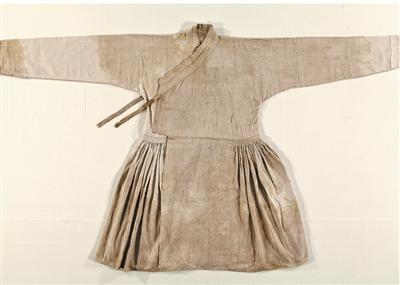
Core Viewpoint - The discovery of a collection of valuable textiles from the Yuan Dynasty, buried for over 600 years in the "Pigeon Cave" of Hebei, highlights the rich cultural and historical significance of these artifacts, showcasing the craftsmanship and aesthetic values of the era [4][5][6]. Group 1: Discovery and Significance - A total of 67 artifacts, including textiles and documents, were unearthed from the Pigeon Cave, dating back to the late Yuan Dynasty (1341-1368) [4]. - The artifacts are believed to have been hidden by their owner to escape war, providing a unique glimpse into the daily life and culture of the time [4][5]. - The exhibition "Weaving Mountains and Rivers" at the Beijing Grand Canal Museum showcases these restored textiles, emphasizing their historical and artistic value [4]. Group 2: Textile Characteristics - The "white cotton waist-narrow sleeve pleated robe" is a rare cotton garment from ancient times, measuring 121 cm in length, designed for practicality in horseback riding [4][5]. - The robe features a refined design with a "tight upper and loose lower" structure, reflecting the practical needs of nomadic lifestyles [4][5]. - Other notable artifacts include embroidered knee pads, which combine natural imagery with daily life aesthetics, showcasing the artistic expression of the Yuan Dynasty [5][6]. Group 3: Cultural Exchange and Craftsmanship - The textiles reflect a blend of Mongolian and Han Chinese influences, illustrating the multicultural fabric of Yuan Dynasty society [6][7]. - The use of gold thread in textiles and the introduction of foreign weaving techniques signify the era's material culture exchange [7]. - The intricate designs, such as the "brown ground phoenix and peony pattern," highlight the artistic sophistication and craftsmanship of the period [7]. Group 4: Restoration Efforts - The restoration of these fragile textiles began in 2006, involving meticulous scientific methods to address issues like decay and discoloration [8][9]. - The restoration team employed advanced techniques, including microscopic sewing methods, to ensure the integrity of the original artifacts [9]. - This effort not only preserves the artifacts but also honors the craftsmanship and cultural heritage of the Yuan Dynasty [9].

提升人居环境,农家有了新面貌
Ren Min Ri Bao· 2026-01-24 07:28
"十五五"规划建议提出,持续整治提升农村人居环境,以钉钉子精神解决好农村改厕、垃圾围村等问 题。整洁有序的村容村貌、舒适宜人的生活环境,不仅是村民们的殷切期盼,更是乡村全面振兴的应有 之义。近日,记者前往云南、黑龙江、江西等地,探访农村人居环境改善成果。 ——编 者 人居环境舒适度是衡量乡村发展质量的重要标尺。从厕所革命到垃圾整治,再到闲置空间改造,各地农 村瞄准村民关切,因地制宜改善人居环境,提升村民生活幸福感。 云南景谷县: 把"方便"事办成村民的舒心事 云南省普洱市景谷傣族彝族自治县凤山镇平寨村的村民查世忠说,早些年上厕所真让人脑壳疼。院子外 有一个用木板搭成的公共旱厕,冬天,风从板缝钻进来;夏天,蚊子追着人叮,腿上咬的都是包。 "旱厕味道大、条件差,老人和小孩用着实在危险。"平寨村党总支书记王德强说。 改变始于2018年。景谷县启动农村"厕所革命",计划改造全县10个乡镇154个行政村(社区)的农村户 厕。消息传来,查世忠犹豫了:"改了不好用咋办?粪肥没了还咋种地?" "群众有顾虑,我们就得找对策。"景谷县农业农村和科学技术局技术员黄华介绍,景谷地形复杂,一套 固定的方案行不通。景谷县组建10支技术队 ...
北方白瓷的岁月之歌
Ren Min Ri Bao· 2026-01-24 06:16
Core Viewpoint - The "North White - White Porcelain and National Integration Special Exhibition" showcases over 200 white porcelain treasures, highlighting the development and rich connotations of northern white porcelain through historical dynasties and kiln connections [1][2] Group 1: Historical Development - Northern China is the birthplace of white porcelain, which has evolved from the north to the rest of China and the world, embodying the brilliance of Chinese civilization [1] - The exhibition presents the complete lifecycle of northern white porcelain, divided into four units: Southern and Northern Integration, Harmonious Coexistence, and Global Influence, reflecting different developmental stages [1][2] - The emergence of white porcelain began in the late Northern Dynasties, matured during the Sui Dynasty, flourished in the Song, Liao, Xia, and Jin Dynasties, and declined in the Yuan Dynasty [1][2] Group 2: Technological Innovations - Northern craftsmen innovated porcelain-making techniques during the production of celadon, leading to the emergence of white porcelain [1] - Key advancements included the use of double glazing techniques in Zibo, Shandong, and improvements in glaze formulas in Hebei, which reduced iron content [1] Group 3: Flourishing and Decline - The Song, Liao, and Jin Dynasties marked the peak of northern white porcelain, with numerous kilns like Ding, Longquan, and Hejin showcasing vibrant interactions among artisans and techniques [2] - The Yuan Dynasty saw a general decline in northern white porcelain, yet the Huo Zhou kiln thrived, producing fine white porcelain with intricate designs and various forms [2] Group 4: Cultural Significance - National integration played a crucial role in the development of northern white porcelain, serving as an important medium for cultural exchange [2] - The exhibition aims to enhance public understanding of northern white porcelain, fostering appreciation for porcelain culture and strengthening national identity [2]
洞藏锦绣六百年
Ren Min Ri Bao· 2026-01-24 06:16
Core Viewpoint - The discovery of 67 pieces of valuable artifacts from the Yuan Dynasty in the "Pigeon Cave" of Hebei's Longhua County has garnered significant attention, showcasing the rich textile culture and craftsmanship of the era [1][3]. Group 1: Artifacts and Their Significance - The artifacts include rare cotton garments, such as a "white cotton waist-narrow sleeve pleated robe," which reflects the practical design suited for horseback riding, indicating the lifestyle of nomadic cultures [1][2]. - The collection features exquisite embroidery items, including "green dark flower brocade knee pads" and "white dark flower brocade knee pads," which are among the few surviving examples from the Yuan Dynasty, highlighting the blend of natural imagery and daily life aesthetics [2][3]. - The textiles also include various "bannai" half-finished products and remnants, providing a unique historical perspective that contrasts with the ceremonial completeness of burial artifacts, thus revealing a more authentic glimpse into everyday life during that period [2][3]. Group 2: Cultural Exchange and Craftsmanship - The artifacts reflect the cultural exchange during the Yuan Dynasty, showcasing both Mongolian and Han Chinese clothing styles, which illustrates the era's multi-ethnic integration [3][4]. - The use of gold thread in textiles, a trend during the Yuan Dynasty, signifies the influence of foreign craftsmanship, with materials like "green cloud pattern gold brocade" representing the sophisticated weaving techniques of the time [3][4]. - The intricate patterns on the textiles, primarily based on Han Chinese themes, demonstrate a transition in weaving techniques from the Song Dynasty to the Ming and Qing Dynasties, marking an important evolution in textile craftsmanship [4]. Group 3: Restoration Efforts - The restoration of these artifacts, initiated by the National Cultural Heritage Administration in 2006, involves meticulous scientific methods to address issues like decay, pollution, and severe damage [4][5]. - The restoration process employs advanced techniques, combining traditional sewing methods with modern technology, ensuring that the repairs maintain the original characteristics of the artifacts [5]. - The successful restoration of these textiles not only preserves their historical value but also celebrates the craftsmanship of the Yuan Dynasty, providing a vivid representation of the era's social landscape [5].
不需要火箭就可直达,太空电梯离我们还有多远?
Ren Min Ri Bao· 2026-01-24 03:47
为了让碳纳米管早日从实验室走向太空,中国科学家一直在探索。清华大学化学工程系反应工程团队长 期从事碳纳米管材料的可控制备与应用研究,努力攻坚材料难题。 首先是突破长度极限。实际制备中,碳纳米管长度通常只有几十微米,且内部存在大量结构缺陷,实际 强度远低于理论值。2013年,研究团队通过提高催化剂活性概率,成功制备出单根长度超过半米的碳纳 米管,为超长碳纳米管的规模化制备奠定了基础。 早在1895年,就有科学家提出建造直达太空的"天梯"。这一设想提出已逾百年,似乎仍停留在想象阶 段,原因何在?问题的关键,在于找到足够强韧的缆绳材料。 太空电梯缆绳必须同时承受巨大的重力和离心力作用,对材料的抗拉强度要求极高。有没有既轻又强 的"超级材料"呢?1991年,科学家发现了碳纳米管,这给太空电梯研究带来了曙光。 碳纳米管是由碳原子按六边形蜂窝状结构排列而成的中空管状材料,直径只有几纳米到几十纳米。别看 身形纤细,它是人类发现的力学性能最优的材料之一:理论上,单壁碳纳米管的抗拉强度可超过100吉 帕,是最好钢材的数百倍;其杨氏模量(衡量材料刚性的指标)高达1太帕,极难被拉伸变形。更难得 的是,其密度仅为钢的1/4左右,单位 ...
大数据观察|冬日消费 创意满满
Ren Min Ri Bao· 2026-01-24 03:17
Core Insights - The integration of ice and snow consumption with winter demand is creating a significant consumption boom in China, with diverse new experiences emerging in various regions [1][2] Group 1: Ice and Snow Tourism - Jilin Province is enhancing its ice and snow tourism offerings, with over 800 events planned this winter and a focus on family, cultural, and recreational tourism products [4] - The province received 8.11 million domestic tourists during the New Year holiday, generating a total expenditure of 9.1 billion yuan, with a 45.1% year-on-year increase in revenue for monitored scenic spots [4] - Tourists are increasingly engaging in activities such as skiing and ice sculpture viewing, with Jilin's tourism strategy focusing on a comprehensive product system catering to various skill levels [3][4] Group 2: Multi-Experience Tourism - In Jiangsu's Nanjing, the combination of hot springs and wildlife experiences is attracting families, with the local tourism area reporting over 1.5 billion yuan in annual revenue and a peak daily visitor count of nearly 20,000 [6] - The region is set to host over 6,800 promotional consumption events by 2025, indicating a strong push towards enhancing consumer experiences [6] Group 3: Culinary Innovations - In Chengdu, the unique "flower field hot pot" experience is gaining popularity, allowing diners to enjoy hot pot amidst blooming canola flowers, with the flower variety cultivated to bloom earlier [7] - The city's restaurant industry is projected to reach 142.58 billion yuan in revenue by 2025, reflecting a 5.2% year-on-year growth, driven by innovative dining experiences that blend food with entertainment [8]
人民币对美元汇率中间价升破“7”汇率预计将继续双向浮动、保持弹性
Ren Min Ri Bao· 2026-01-24 02:09
Core Viewpoint - The People's Bank of China announced a rise in the RMB exchange rate against the USD, reaching 6.9929, the highest since May 2023, indicating a strengthening trend influenced by various internal and external factors [1] Group 1: Exchange Rate Movement - The central parity rate of the RMB against the USD was set at 6.9929, an increase of 90 basis points from the previous day's rate of 7.0019 [1] - Both offshore and onshore RMB appreciated against the USD, with projections indicating that by the end of 2025, both rates may break the "7" mark [1] Group 2: Economic Factors - The strengthening of the RMB is attributed to a combination of market supply and demand, policy guidance, and external environmental factors [1] - The Deputy Governor of the People's Bank of China highlighted the robust long-term economic fundamentals of China, including a large market size, complete industrial chain, and accelerating technological and industrial innovation [1] Group 3: Future Outlook - The RMB exchange rate is expected to continue to fluctuate in both directions, maintaining elasticity amid complex external conditions, including uncertainties in interest rate adjustments by major economies and ongoing geopolitical tensions [1]
2025年我国共授权发明专利97.2万件 人工智能专利有效量居全球前列
Ren Min Ri Bao· 2026-01-24 02:09
1月23日,国务院新闻办举行新闻发布会,介绍2025年知识产权工作进展。2025年,我国共授权发明专 利97.2万件,受理PCT国际专利申请7.8万件,注册商标420.6万件。截至2025年底,我国国内发明专利 有效量达532万件,每万人口高价值发明专利拥有量达到16件。 信息技术管理方法、计算机技术、医学技术等领域有效发明专利增速最快 创新质量持续提升,重点区域创新活跃。国家知识产权局副局长芮文彪介绍,在国内有效发明专利中, 信息技术管理方法、计算机技术、医学技术等领域的有效发明专利增速最快,人工智能专利有效量居全 球前列。截至2025年底,长三角地区、京津冀地区和广东省的发明专利有效量分别为173.4万件、91.6万 件和89.9万件,合计约占国内总量的2/3。 截至2025年底,我国国内高价值发明专利拥有量达到229.2万件,占国内有效发明专利比重达到43.1%, 较"十三五"末提高2.9个百分点。 "战略性新兴产业的国内有效发明专利达到153.4万件,28万家企业拥有176.4万件高价值发明专利,成为 创造高价值发明专利的'主力军'。"国家知识产权局战略规划司司长梁心新认为,我国专利结构正在向 优转变 ...
【人民日报】提升人居环境,农家有了新面貌
Ren Min Ri Bao· 2026-01-24 01:07
"十五五"规划建议提出,持续整治提升农村人居环境,以钉钉子精神解决好农村改厕、垃圾围村等 问题。整洁有序的村容村貌、舒适宜人的生活环境,不仅是村民们的殷切期盼,更是乡村全面振兴的应 有之义。近日,记者前往云南、黑龙江、江西等地,探访农村人居环境改善成果。 ——编 者 人居环境舒适度是衡量乡村发展质量的重要标尺。从厕所革命到垃圾整治,再到闲置空间改造,各 地农村瞄准村民关切,因地制宜改善人居环境,提升村民生活幸福感。 云南景谷县:把"方便"事办成村民的舒心事 云南省普洱市景谷傣族彝族自治县凤山镇平寨村的村民查世忠说,早些年上厕所真让人脑壳疼。院 子外有一个用木板搭成的公共旱厕,冬天,风从板缝钻进来;夏天,蚊子追着人叮,腿上咬的都是包。 "旱厕味道大、条件差,老人和小孩用着实在危险。"平寨村党总支书记王德强说。 改变始于2018年。景谷县启动农村"厕所革命",计划改造全县10个乡镇154个行政村(社区)的农 村户厕。消息传来,查世忠犹豫了:"改了不好用咋办?粪肥没了还咋种地?" "群众有顾虑,我们就得找对策。"景谷县农业农村和科学技术局技术员黄华介绍,景谷地形复杂, 一套固定的方案行不通。景谷县组建10支技术队伍 ...
张家界武陵源年接待入境游客首破100万
Ren Min Ri Bao· 2026-01-24 01:01
Core Insights - The Wulingyuan District of Zhangjiajie is projected to receive 1.0076 million inbound tourists in 2025, marking a 25.05% year-on-year increase, with visitors from 183 countries and regions, establishing a historical high for the area [1] - The region is becoming a significant window for global perceptions of "Beautiful China," benefiting from the expansion of its "visa-free" travel network and the allure of the "Avatar" film series filming locations [1] Group 1: Tourism Growth and Development - The inbound tourism market in Wulingyuan is experiencing sustained growth, with a notable increase in foreign tourists from countries such as South Korea, Russia, Italy, Canada, France, Germany, and Thailand [1] - The district is focusing on upgrading its products and services to transition from simple sightseeing to deeper cultural immersion, with new attractions and events being introduced throughout the year [1] Group 2: Night Economy and Visitor Experience - A high-quality night economy zone has been developed along the Suoxi River, featuring a variety of attractions including drone light shows, night markets, and local handicrafts, enhancing the nighttime experience for visitors [2] - The Zhangjiajie National Forest Park is improving its service quality through regular foreign language training for staff and implementing multilingual signage, along with advanced smart guiding systems for better visitor navigation [2] Group 3: Strategic Initiatives and Future Plans - The Wulingyuan District aims to enhance its tourism offerings by focusing on smart, international, and human-centered services, targeting Southeast Asian and European markets with customized high-end products [3] - The district is committed to transforming inbound tourism from broad coverage to in-depth cultivation, striving to establish itself as a world-class tourist destination [3]