Zhong Guo Ji Jin Bao

Search documents
基金发行“开门红” ,“春播”聚焦“固收+”、FOF等
Zhong Guo Ji Jin Bao· 2026-01-18 12:36
Core Insights - The A-share market has shown strong performance at the beginning of 2026, leading to a "good start" for public fund issuance, with many funds selling out in one day [1][2] - The strong demand for equity assets is supported by a combination of policy, regulatory, and funding factors, which are expected to keep fund issuance active [2] Fund Issuance Highlights - As of January 16, 2026, 82 new funds have been launched, with 25 funds announcing early closure and 6 funds selling out in one day [2] - Key factors driving this trend include favorable policies from the "14th Five-Year Plan," regulatory adjustments to reduce investment costs, and a low-interest-rate environment prompting a shift of funds from deposits to equity funds [2] Focus on "Fixed Income+" and FOF Products - FOF products have seen significant interest, with notable funds like Guangfa Yueying and Wanjia Qitai raising over 32 billion and nearly 21 billion respectively in under two days [3] - The new funds are focusing on themes such as technology, innovation, and semiconductors, with over 20 funds incorporating these themes in their names [3] Strategic Directions for Fund Companies - Fund companies are adopting a "precise layout + diversified adaptation" strategy, focusing on five key areas: manufacturing, information industry, materials industry, energy, and space industry [3] - The market is expected to see a rapid issuance pace, with many products having short fundraising periods of two weeks or less [4] Market Trends and Investor Behavior - The 2026 fund issuance market is characterized by a shift away from "blockbuster" funds towards quicker capital deployment to align with market trends [4] - New investors, particularly those with limited experience, are increasingly turning to public funds as traditional investment yields decline, leading to a cautious approach regarding risk exposure [4]
券商开年密集发债,重资本业务扩张需求激增
Zhong Guo Ji Jin Bao· 2026-01-18 12:35
Group 1 - The core viewpoint of the article highlights a significant surge in bond issuance by securities firms at the beginning of 2026, driven by a strong A-share market and an increase in capital demand, with a total issuance of 119.52 billion yuan, representing a year-on-year growth of 71.87% [1][2] - The bond issuance is characterized by diversification, with both traditional leading firms like China Galaxy and internet brokers like East Money participating, and various types of products being issued, including conventional corporate bonds and perpetual subordinated bonds [2][3] - The bond issuance trend is a continuation from 2025, where the total issuance exceeded 1.89 trillion yuan, with both the number and scale of bonds issued showing over 44% year-on-year growth [3] Group 2 - The increase in bond issuance is attributed to a combination of business transformation, policy guidance, and a low-cost environment, with firms transitioning from traditional channel businesses to capital-intensive models [4][5] - The active A-share market has led to a growing demand for capital-intensive business expansion, prompting firms to leverage debt financing to seize profit opportunities [4][6] - The current low interest rate environment has made bond issuance an attractive option for firms to refinance high-interest debt and optimize financial structures, thereby enhancing profit margins for future business expansion [4][6] Group 3 - The regulatory environment has positively influenced the expansion of financing channels, with securities firms being included in the issuance of technology innovation bonds, aligning fundraising with national strategic goals [5][6] - The bond issuance trend is expected to continue in the short to medium term, as long as market activity remains robust, sustaining the demand for capital [6][7] - The competitive landscape is shifting towards a "stronger gets stronger" dynamic, where leading firms are better positioned to capitalize on low-cost debt financing, potentially widening the gap between them and smaller firms [7][8]





罕现“双零费率”,银行理财需高质量揽客
Zhong Guo Ji Jin Bao· 2026-01-18 12:35
Core Viewpoint - The banking wealth management market is experiencing a "fee reduction wave" with the rare occurrence of "double zero rates" for investment management and sales service fees, driven by factors such as "deposit migration" and the "New Year marketing push" [1][2]. Group 1: Fee Reduction Trends - The banking wealth management market has seen significant fee reductions, with examples including Ningyin Wealth Management offering zero sales service fees and eight products with zero floating management fees [2]. - Some products from China Zhongyuan Bank have also adjusted both investment management and sales service fees to 0.00% per year, sparking discussions in the industry despite the products being terminated shortly after [2]. - The fee reduction trend is attributed to the continuous decline in deposit rates, prompting banks to attract funds through more appealing wealth management products [2][3]. Group 2: Implications of Fee Reductions - Fee reductions can rapidly increase scale and market share for wealth management companies, but over-reliance on price competition may erode overall industry profits and weaken long-term research and innovation capabilities [3]. - The challenge lies in balancing customer satisfaction with the sustainable development of the company, as excessive focus on low fees could lead to "low fee, low efficiency" scenarios that harm brand reputation [3]. Group 3: Future Strategies for Wealth Management Companies - With limited further fee reduction space, wealth management companies are encouraged to optimize product structures and diversify fee mechanisms to enhance competitiveness [4]. - Companies should explore various types of wealth management products, such as "low volatility + stable return" themes and "fixed income +" enhanced products, while also considering flexible management fees based on holding periods [4]. - Leading wealth management firms are increasingly collaborating with local commercial banks to penetrate county and lower-tier markets, expanding customer reach and reducing acquisition costs [4]. Group 4: Importance of Research and Reputation - Continuous improvement in research capabilities is essential for wealth management companies to build a positive reputation and maintain scale in a competitive environment [5].
“难以解释”:业绩暴增,股价微涨......
Zhong Guo Ji Jin Bao· 2026-01-18 11:53
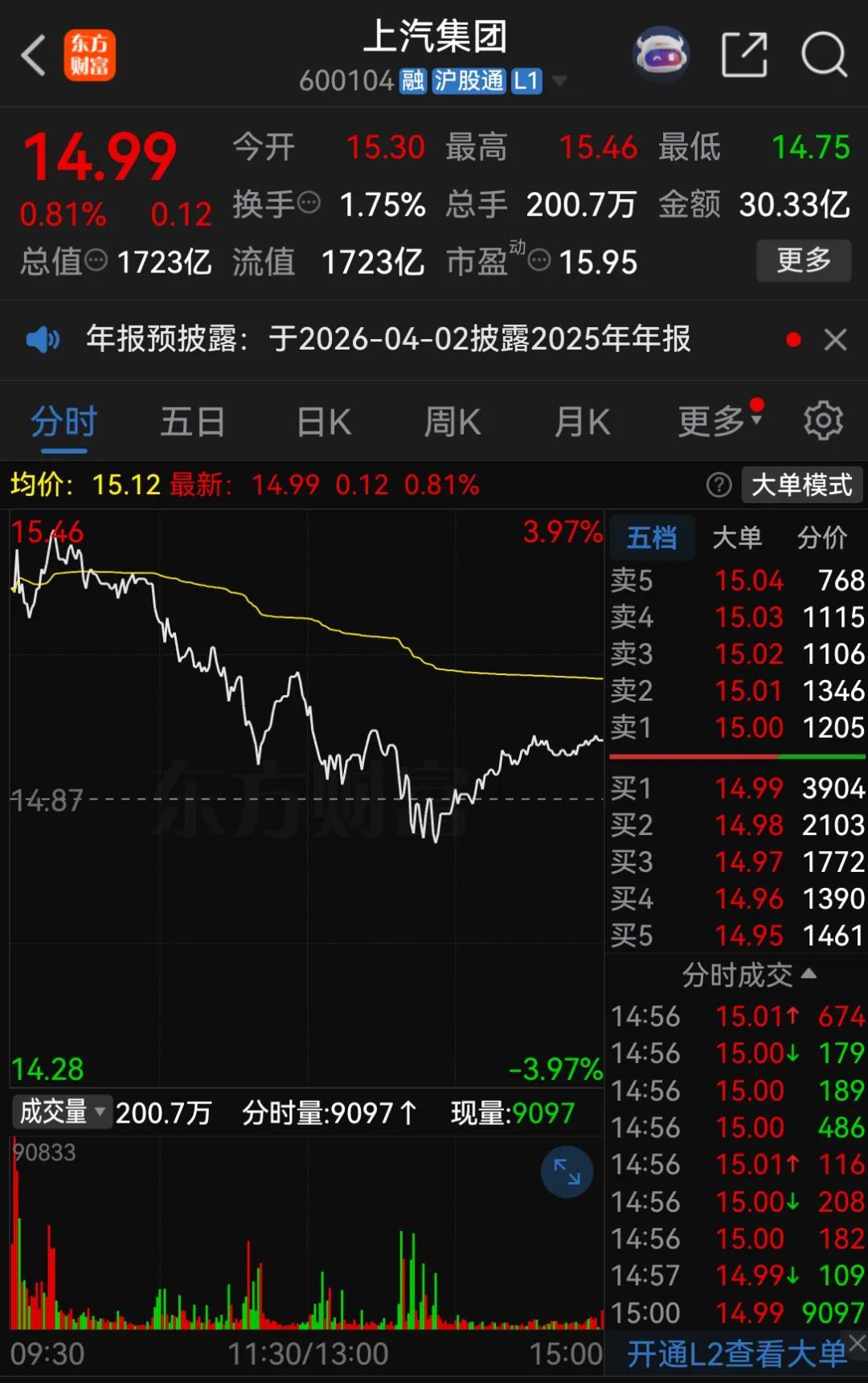
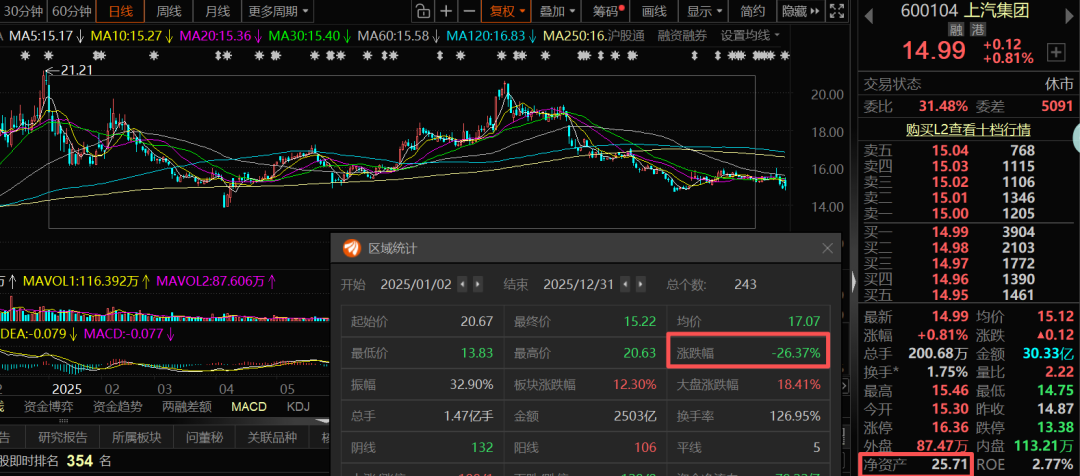
Core Viewpoint - SAIC Motor Corporation has announced an impressive profit forecast for 2025, expecting a year-on-year increase in net profit attributable to shareholders of 438% to 558%, indicating a potential undervaluation in the capital market [2] Group 1: Company Performance and Market Position - As of January 16, 2026, SAIC Motor's market capitalization stands at 172.3 billion yuan, ranking first among state-controlled listed automotive companies, yet significantly lower than BYD's market cap of 874 billion yuan [2] - The company has faced a mismatch between its market value and performance, a common issue among several listed automotive companies [2] - SAIC Motor's stock price has dropped by 26.37% in 2025, raising concerns among investors regarding its market value management [4] Group 2: Valuation and Market Management - SAIC Motor is currently in a "broken net" state, with a closing price of 14.99 yuan per share, which is below its latest audited net asset value of 25.71 yuan per share [4][6] - The company has implemented three rounds of share repurchase plans, totaling 4.747 billion yuan, but the effectiveness of these measures has been questioned [13][14] - The company is required to disclose its valuation enhancement plan due to its long-term "broken net" status, as per regulatory guidelines [6][9] Group 3: Industry Context and Challenges - The automotive industry is experiencing rapid transformation towards new energy and smart technologies, increasing competition and investment difficulty [17] - Many listed automotive companies are perceived to be undervalued in the capital market, with most having market capitalizations below 200 billion yuan [16] - The industry is expected to take five years to clarify its basic structure and ten years to reach a stable state [18]


“难以解释”!业绩暴增,股价微涨
Zhong Guo Ji Jin Bao· 2026-01-18 11:31
Core Viewpoint - SAIC Motor Corporation has announced a significant increase in expected net profit for 2025, projecting a year-on-year growth of 438% to 558%, yet its stock price remains under pressure, reflecting a mismatch between market valuation and performance [2][3]. Group 1: Company Performance and Market Reaction - On January 15, SAIC Motor released an impressive earnings forecast, leading to a brief stock price increase of over 3% on January 16, but it closed with only a 0.81% gain, still trading below its net asset value [1][2]. - As of January 16, SAIC Motor's market capitalization stood at 172.3 billion yuan, significantly lower than BYD's 874 billion yuan, highlighting a substantial valuation gap among leading automotive companies [3][8]. - The company is currently in a "broken net" state, with its stock price at 14.99 yuan per share, below the latest audited net asset value of 25.71 yuan per share [7][8]. Group 2: Investor Concerns and Market Management - Investors have raised questions regarding SAIC Motor's market value management, expressing skepticism about the effectiveness of its strategies [4][11]. - The company has not announced any share repurchase plans since the release of its 2025 valuation enhancement plan, which is a key measure for market value management [12][13]. - Despite having executed three rounds of share repurchase plans totaling 4.747 billion yuan, the results have been deemed unsatisfactory [14][13]. Group 3: Industry Context and Challenges - The automotive industry is facing intense competition and rapid transformation towards new energy and smart technologies, complicating investment prospects [19][20]. - Many listed automotive companies are struggling with market valuations below 200 billion yuan, with only a few like BYD and Great Wall Motors exceeding this threshold [18]. - The market is characterized by a high number of listed automotive companies, which diminishes individual company visibility compared to global players like Tesla [20]. Group 4: Strategic Focus and Future Outlook - Industry experts emphasize the importance of improving operational quality as a core aspect of market value management, rather than relying solely on share buybacks or short-term market trends [22][29]. - Companies are encouraged to focus on developing standout products to enhance their market valuation directly, as seen with NIO's recent successful model launches [24][29]. - The consensus among industry leaders is that the automotive sector is entering a critical phase, with a clearer picture of market dynamics expected in the next five years [21].
“难以解释”!业绩暴增,股价微涨......
Zhong Guo Ji Jin Bao· 2026-01-18 11:08
Core Viewpoint - SAIC Motor Corporation has announced a significant profit forecast for 2025, expecting a year-on-year increase in net profit attributable to shareholders of 438% to 558%, yet its stock price remains undervalued and in a state of net asset deficit [4][10]. Group 1: Company Performance and Market Position - As of January 16, 2026, SAIC Motor's market capitalization stands at 172.3 billion RMB, ranking first among state-owned listed automotive companies, but significantly lower than BYD's market cap of 874 billion RMB [5][6]. - The company's price-to-earnings ratio is 15.95, and its price-to-book ratio is 0.58, indicating a valuation below industry averages [6][11]. - Despite a strong profit forecast, SAIC Motor's stock has declined by 26.37% in 2025, and it remains in a "broken net" state, with a closing price of 14.99 RMB per share, below its net asset value of 25.71 RMB per share [8][10]. Group 2: Market Challenges and Investor Sentiment - Many investors have expressed concerns regarding SAIC Motor's market value management, questioning whether the company's strategies are effective or merely superficial [8][12]. - The automotive industry is facing intense competition and rapid transformation towards new energy and smart technologies, which complicates investment prospects [21][22]. - There is a perception among industry executives that their companies are undervalued in the market, with most listed automotive companies having market caps below 200 billion RMB [20]. Group 3: Value Management and Strategic Initiatives - The company has previously implemented three rounds of share repurchase plans totaling 4.747 billion RMB, but the effectiveness of these measures has been questioned [16][18]. - According to the regulatory guidelines, companies in a long-term net asset deficit must disclose their valuation enhancement plans, which SAIC Motor has committed to improving [10][12]. - The focus on operational quality and the development of popular vehicle models is seen as crucial for enhancing market value, rather than relying solely on share buybacks [24][26].
上汽集团业绩大幅预增后股价微涨,上市车企集体遭遇市值烦恼
Zhong Guo Ji Jin Bao· 2026-01-18 11:06
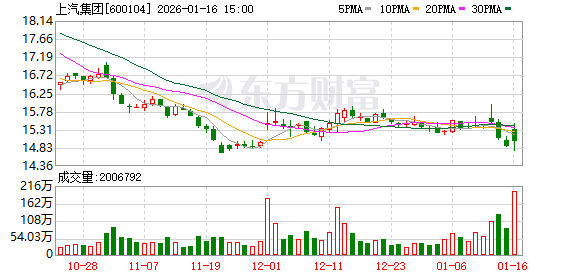
Core Viewpoint - SAIC Motor Corporation has announced a significant profit forecast for 2025, expecting a year-on-year increase in net profit attributable to shareholders of 438% to 558%, yet its stock price remains undervalued and in a state of net asset deficit [4][8]. Group 1: Company Performance - On January 15, SAIC Motor released a profit forecast that surprised the market, but its stock price only rose by 0.81% on January 16, indicating a mismatch between market valuation and company performance [4][6]. - As of January 16, 2026, SAIC Motor's market capitalization was 172.3 billion yuan, significantly lower than BYD's 874 billion yuan, highlighting the valuation gap among leading automotive companies [4][5]. Group 2: Market Valuation Issues - Many listed automotive companies, including SAIC Motor, are facing challenges with market capitalization that does not reflect their performance, leading to calls for a re-evaluation of their value in the capital market [4][10]. - SAIC Motor's price-to-earnings ratio is 15.95, and its price-to-book ratio is 0.58, both of which are below industry averages, indicating a potential undervaluation [5][8]. Group 3: Shareholder Concerns - Investors have been actively inquiring about SAIC Motor's market value management strategies, questioning whether the company is effectively addressing its valuation issues [10][11]. - Despite previous share buyback plans totaling 4.747 billion yuan, the effectiveness of these measures has been questioned, as the company remains in a state of net asset deficit [11][12]. Group 4: Industry Context - The automotive industry is undergoing rapid transformation towards electrification and smart technology, which increases competition and investment challenges, contributing to the undervaluation of many companies [14][15]. - The market is saturated with numerous listed automotive companies, making it difficult for individual firms to stand out and achieve premium valuations [14][15].

聂卫平同志逝世,中央有关领导同志以不同方式表示哀悼并向其亲属表示慰问
Zhong Guo Ji Jin Bao· 2026-01-18 10:01
聂卫平同志逝世后,中央有关领导同志以不同方式表示哀悼并向其亲属表示慰问。 聂卫平,河北深州人,1952年8月出生于辽宁沈阳。1977年至1978年任黑龙江省体工队围棋运动员。 1978年后,历任国家围棋队运动员、总教练等。1982年被国家体委授予围棋九段,1988年被授予"棋 圣"称号。曾兼任中国围棋协会副主席、中国棋院技术顾问等职务。 (原标题:聂卫平同志逝世,中央有关领导同志以不同方式表示哀悼并向其亲属表示慰问) 来源:新华社 我国著名围棋大师,第六届全国政协委员,第七届、八届全国政协常委,民盟中央原常委,中国围棋协 会名誉主席,国家围棋队原总教练,中国共产党的优秀党员聂卫平同志,因病于2026年1月14日在北京 逝世,享年74岁。 聂卫平同志1984年4月加入中国民主同盟,1986年2月加入中国共产党。长期从事围棋竞技、教练和推广 工作,曾6次获得全国个人赛冠军,率领中国队在中日围棋擂台赛取得三连胜等优异成绩,为我国围棋 事业发展作出重要贡献。曾荣获全国五一劳动奖章、全国劳动模范、全国体育运动荣誉奖章、全国十佳 运动员称号等。 ...
大消息!最新发布
Zhong Guo Ji Jin Bao· 2026-01-18 09:00
Core Viewpoint - The China Securities Regulatory Commission (CSRC) has released a draft for public consultation on the "Supervision and Management Measures for Derivative Transactions (Trial)" aimed at regulating derivative trading, enhancing market transparency, protecting legal rights, and promoting the service of the real economy while mitigating financial risks [1][3]. Summary by Relevant Sections Regulatory Framework - The draft specifies that it applies to derivative trading venues and institutions regulated by the CSRC, excluding the interbank derivative market and OTC markets organized by banks and insurance institutions [3][4]. - It encourages the use of derivatives for risk management and resource allocation, while limiting excessive speculation [3][4]. Principles and Compliance - Participants in derivative trading must adhere to principles of fairness, voluntariness, compensation, and good faith, prohibiting market manipulation, insider trading, and other illegal activities [3][4]. - The CSRC will implement a prudent regulatory approach and enhance monitoring systems for derivative markets [3][4]. Contract Development and Trading Rules - The draft outlines conditions for developing derivative contracts, emphasizing fair market pricing and liquidity [4]. - Derivative trading institutions are prohibited from using advertising or public solicitation to promote derivative contracts, unless otherwise specified by the CSRC [4]. Risk Management and Monitoring - Derivative transactions must include performance guarantees, such as margin requirements, and institutions must manage these guarantees safely and transparently [4][5]. - The draft establishes standards for the suitability of traders, requiring institutions to understand their clients thoroughly [4][5]. Regulatory Oversight - The CSRC will conduct supervision and inspections of derivative market infrastructure and institutions, ensuring compliance with the established rules [5][6]. - The draft emphasizes the importance of unified regulatory standards for securities and futures institutions engaging in derivative trading [6][7]. Market Development and Future Outlook - The draft reflects the government's commitment to the healthy development of the futures and derivatives market, aligning with the "Futures and Derivatives Law" and promoting risk prevention [6][7]. - Experts believe that the implementation of the draft will lead to a more standardized, transparent, and institutionalized domestic derivative market, supporting high-quality development in the capital market [7].
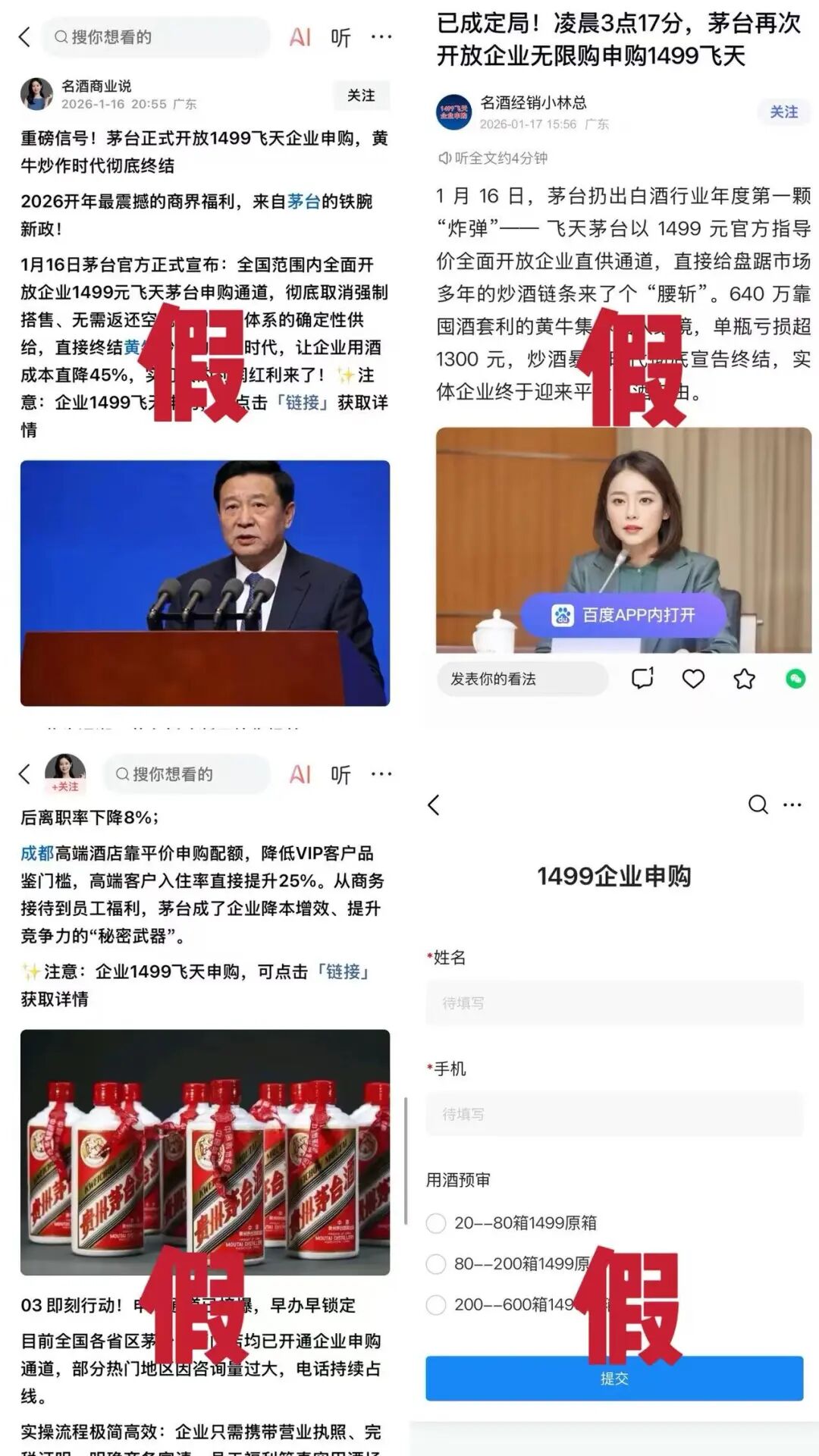
茅台紧急打假
Zhong Guo Ji Jin Bao· 2026-01-18 07:07
AI 0斤 Q搜你想看的 名酒商业说 026-1-16 20:55 广东 关注 重磅信号!茅台正式开放1499飞天企业申购,黄 牛炒作时代彻底终结 2026开年最震撼的商界福利,来自茅台的铁腕 新政! 1月16日茅台官方正式宣布:全国范围内全面开 放企业1499元飞天茅台申购通道,彻底取消强制 搭售、无需返还空 给,直接终结黄省 成本直降45%, 受 意:企业1499飞元 情 体系的确定性供 时代,让企业用酒 红利来了! + 注 气击「链接」获取详 Q 搜你想看的 Al 0斤 后离职率下降8%; 成都高端酒店靠平价申购配额,降低VIP客户品 鉴门槛,高端客户入住率直接提升25%。从商务 接待到员工福利,茅台成了企业降本增效、提升 竞争力的"秘密武器"。 十注意:企业1499飞天申购,可点击「链接」 获取详情 已成定局!凌晨3点17分,茅台再次 开放企业无限购申购1499飞天 名酒经销小林总 2026-01-17 15:56 广东 1499企业申购 *姓名 待填写 *手机 得填写 用酒预审 Q ··· 关注 c1) 听全文约4分钟 1 月 16 日,茅台扔出白酒行业年度第一颗 "炸弹" -- 飞天茅台以 149 ...