
Guo Ji Jin Rong Bao

Search documents
第三方支付“进与退”
Guo Ji Jin Rong Bao· 2025-12-26 16:20
Group 1 - The payment industry is entering a long-term licensing era by 2025, with a shift towards a focus on financial infrastructure attributes, leading to a more regulated environment where capital strength, corporate governance, and compliance capabilities are critical for payment institutions [1] - The domestic third-party payment industry has reached a peak in overall growth, with both transaction scale and user frequency entering a plateau phase, resulting in a shift from incremental expansion to stock competition [1] - By 2026, the number of payment licenses is expected to continue to decline slowly, with smaller institutions lacking sustainable business models likely to exit the market [1] Group 2 - As of December 26, 11 payment licenses have been revoked this year, totaling 107 licenses since the inception of the licensing system, leaving 164 licensed payment institutions [2] - The People's Bank of China has been actively revoking licenses, with a notable increase in the number of revocations from 2015 to 2024, indicating ongoing structural adjustments within the third-party payment sector [2][3] - The pressure for structural adjustment is particularly focused on prepaid card institutions, which face shrinking application scenarios and rising compliance costs [3] Group 3 - Internet platforms are increasingly acquiring payment licenses as they recognize the importance of payment systems in building commercial ecosystems and reducing transaction costs [4][6] - Companies like Xiaohongshu and Tongcheng Group have recently acquired payment licenses, indicating a trend of internet firms consolidating payment capabilities [5][6] - The acquisition of payment licenses is seen as a strategic move to enhance compliance and facilitate future growth in e-commerce and financial services [6] Group 4 - Cross-border payment is emerging as a new growth area for payment institutions, with several players obtaining domestic payment licenses to facilitate international transactions [7][8] - Companies like Newland and Lakala have reported significant growth in cross-border payment volumes, indicating a shift in focus towards international markets [8] - Smaller institutions are expected to emphasize local compliance and operational capabilities in their overseas expansions, rather than merely replicating domestic models [9]
34万亿银行理财“增与降”
Guo Ji Jin Rong Bao· 2025-12-26 16:00
Core Insights - The bank wealth management market in China has reached a record high of approximately 34 trillion yuan, driven by a shift in investor preferences towards more stable investment options amid declining deposit rates [1][2][10] - There is a notable trend of increasing risk appetite among investors, with a growing proportion of aggressive investors, indicating a structural change in investment preferences [5][6] Market Size and Performance - As of the end of Q3 2025, the total number of wealth management products in the market reached 43,900, with a total scale of 32.13 trillion yuan, reflecting a year-on-year increase of 9.42% [2] - The average performance benchmark for newly issued wealth management products has decreased by 30 basis points since the beginning of the year, with expectations that it will stabilize around 2.0% in the future [2][3] Investor Behavior and Preferences - Investors are increasingly favoring wealth management products over traditional bank deposits due to lower interest rates, with a significant shift towards products that offer a balance of stability and moderate returns [1][3] - The proportion of aggressive investors has risen to 6.1% in the first half of 2025, while conservative and stable investors have decreased, indicating a gradual increase in risk tolerance [5][6] Product Trends - The "fixed income plus" products have gained popularity, with their market share exceeding 50% as of November 2025, reflecting a shift from pure debt products to those that enhance returns through equity exposure [5][6][7] - Wealth management companies have become the dominant players in the market, with their products accounting for 91.13% of the total market scale, indicating a significant consolidation within the industry [7][9] Future Outlook - The bank wealth management market is expected to maintain steady growth, with projections suggesting a scale of approximately 38 trillion yuan by the end of 2026, driven by continued shifts in asset allocation from deposits to wealth management products [10][11] - The industry is anticipated to evolve towards a more customer-centric approach, focusing on comprehensive asset allocation services rather than just product sales, as financial literacy among residents increases [11]
第三方支付“进与退”|回顾展望
Guo Ji Jin Rong Bao· 2025-12-26 16:00
Industry Overview - The payment industry is entering a long-term licensing era by 2025, with a focus on its financial infrastructure attributes, shifting regulatory emphasis from cyclical reviews to institutionalized governance [1] - The domestic third-party payment industry has reached a peak in overall growth, with both transaction scale and user frequency entering a plateau phase, leading to a shift from incremental expansion to stock competition [1] - The number of payment licenses is expected to decline slowly in 2026, with smaller payment institutions lacking sustainable operational capabilities likely to exit the market [1] License Cancellation - As of December 26, 2023, the central bank has disclosed the cancellation of 11 payment licenses this year, totaling 107 licenses since the first issuance in May 2011, leaving 164 licensed payment institutions [2] - The cancellation trend has been consistent, with annual license cancellations varying from 1 to 23 over the past years [2] Structural Adjustments - The pressure to reduce the number of payment institutions may extend to bank card acquiring licenses, with many institutions lacking technical or merchant service capabilities facing limited survival space [3] - The focus of market clearing pressure is primarily on prepaid card institutions, which are experiencing a contraction in application scenarios and facing rising compliance and operational costs [3] Internet Platforms Acquiring Licenses - Internet platforms are increasingly acquiring payment licenses as they view them as essential infrastructure for building commercial ecosystems, reducing payment channel costs, and enhancing user data for future financial services [4][7] - Companies like Xiaohongshu, Tongcheng Group, and 58.com have recently acquired payment licenses to strengthen their market positions [6] Cross-Border Payment Opportunities - Cross-border payments are becoming a new focal point for growth in the domestic third-party payment market, with various players obtaining payment licenses in China [8] - Companies like Payoneer and PingPong have successfully acquired overseas licenses, indicating a trend towards international expansion [9][10] - The cross-border payment sector is expected to be a significant growth engine for many payment institutions, with substantial increases in transaction volumes reported [9][10] Future Directions - By 2026, the focus on international expansion will continue, but companies will need to adjust their strategies to include local compliance and partnerships with local wallets or banks [11] - Smaller institutions are encouraged to focus on niche markets such as cross-border education payments and overseas remittances rather than broad expansion [11]
12月147个游戏版号发放,腾讯乐元素多款游戏过审
Guo Ji Jin Rong Bao· 2025-12-26 15:30
Core Insights - The article highlights the approval of 147 new game licenses in December, including Tencent's "QQ Classic Farm" and Le Element's "Silver City" [1] Group 1: Game License Approvals - A total of 147 game licenses were issued in December, indicating a significant increase in regulatory activity within the gaming industry [1] - Notable approvals include Tencent's "QQ Classic Farm" and Le Element's "Silver City," which are expected to contribute positively to their respective companies' revenue streams [1] Group 2: Industry Implications - The issuance of new game licenses suggests a potential recovery in the gaming sector, which has faced regulatory challenges in recent years [1] - The approval of popular titles may enhance user engagement and drive growth for the companies involved, reflecting a more favorable regulatory environment [1]
年终奖怎么投资?多家银行放出专属理财“大招”
Guo Ji Jin Rong Bao· 2025-12-26 15:25
Group 1 - The core viewpoint of the articles highlights that banks are launching "year-end bonus wealth management" plans to cater to the needs of employees receiving year-end bonuses, focusing on stable and low-risk investment products [1][2][3] - Several banks, including Postal Savings Bank, China Construction Bank, and Bank of Communications, are offering "one-stop" wealth management solutions that include deposits, investments, and insurance products [1][2] - The recommended investment products are primarily low-risk (PR1) or medium-low risk (PR2), with a focus on meeting customer needs and enhancing customer loyalty in a competitive market [2][3] Group 2 - This year, banks are incorporating various insurance products into their year-end wealth management plans, with some banks prioritizing conservative and stable insurance options alongside traditional investment products [3][4] - The overall trend in year-end wealth management plans is towards low volatility and stability, with higher risk products being less common [4] - Experts suggest that investors should analyze their financial situation, risk tolerance, and future funding needs to create a tailored investment plan that balances risk and return [4][5] Group 3 - For short-term funds, it is recommended to choose highly liquid cash management products, while medium-term funds can be allocated to low-risk fixed income products [5] - Long-term investments may include rights-based financial products, with diversification through funds being encouraged to achieve long-term return goals [5][6] - The global economic uncertainty is expected to persist, and the wealth management market is projected to continue expanding, necessitating investor education on asset allocation and investment strategies [6]



张江高科:控股股东减持1%股份
Guo Ji Jin Rong Bao· 2025-12-26 14:26
张江高科公告,公司控股股东上海张江有限公司通过集中竞价交易方式减持公司股份1548.68万股,占 公司总股本的1%。此次权益变动后,张江集团持股比例由49.75%下降至48.75%。减持股份来源均为通 过集中竞价交易取得的非特定股份,符合相关法律法规和部门规章的规定。本次权益变动不会导致公司 控股股东或实际控制人发生变化,也不会对公司治理结构及持续经营产生重大影响。张江高科将继续督 促信息披露义务人严格执行股份变动相关规定,并及时履行信息披露义务。 ...

襄阳轴承:长江产业集团通过三环集团和襄轴集团间接控制公司股份比例达到45.03%
Guo Ji Jin Rong Bao· 2025-12-26 14:21
襄阳轴承公告,根据相关司法判决执行情况,三环集团69.979%的股权返还给湖北省国资委,29.991% 的股权返还给长江汽车,返还股权已于2025年12月26日办理完毕工商变更登记。湖北省国资委将其持有 的三环集团64.599%的股权无偿划转至长江产业集团,划转完成后长江产业集团通过三环集团和襄轴集 团间接控制公司股份比例达到45.03%,公司的实际控制人仍为湖北省国资委。 ...

奕瑞科技:全资子公司增资扩股引入战略投资人 增资资金将用于硅基OLED微显示背板项目
Guo Ji Jin Rong Bao· 2025-12-26 14:09
Group 1 - The core announcement is about the capital increase and share expansion of Yirui Hefei, a wholly-owned subsidiary of Yirui Technology, which will introduce strategic investor Jianrui No. 1 Fund [1] - Jianrui No. 1 Fund plans to invest 500 million yuan in cash to subscribe for an additional registered capital of 455 million yuan, with the remaining 45.45 million yuan allocated to the capital reserve of Yirui Hefei [1] - After the capital increase, the registered capital of Yirui Hefei will rise from 1.6 billion yuan to 2.055 billion yuan, with Jianrui No. 1 Fund holding 22.12% of the shares and Yirui Technology retaining 77.88% [1] Group 2 - The capital increase will not constitute a related party transaction or a major asset restructuring, and it has been approved by the board of directors [1] - The funds raised from this capital increase will be used for the silicon-based OLED micro-display backplane project, which has a total investment not exceeding 1.8 billion yuan [1]

金银疯涨,贵金属“赢麻了”!
Guo Ji Jin Rong Bao· 2025-12-26 14:07
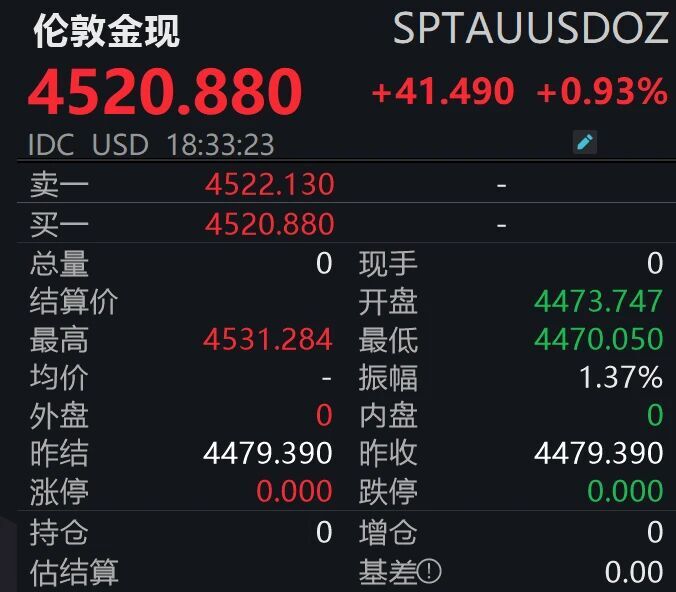
Core Viewpoint - The precious metals market continues its fervent trend, with both gold and silver prices reaching historical highs on December 26, 2025, driven by strong investment demand and structural supply issues in the silver market [1][3][8]. Group 1: Market Performance - As of the report, spot gold in London rose by 0.93% to approximately $4,520 per ounce, with an intraday high of $4,531.284, marking a historical first [1][2]. - Spot silver surged nearly 5% to $75.389 per ounce, with an intraday peak of $75.515, reflecting a year-to-date increase of nearly 150% [1][2]. - COMEX gold futures increased by 1.05% to $4,550.3 per ounce, reaching a record high of $4,561.6 during the day [3][4]. - COMEX silver futures reported at $75.05 per ounce, with a maximum of $75.495, showing a year-to-date rise close to 160% [3][4]. Group 2: Market Drivers - The primary driving force behind gold's rise has shifted from central bank purchases to investment demand, while the silver market faces structural squeezes due to tight global inventories and increased industrial demand [7][8]. - The macroeconomic environment, including a 10% decline in the US dollar index and the Federal Reserve's resumption of rate cuts, has provided core support for the rise in precious metals [8]. - The outlook for 2026 suggests that precious metals will maintain a challenging upward trend due to the politicalization of the Federal Reserve, declining dollar credit, and a crisis in the silver spot market [8][9]. Group 3: Market Sentiment and Risks - The overall sentiment in the precious metals market remains bullish, with strong performance exceeding most institutional expectations [9]. - Factors contributing to this global precious metals rally include concerns over dollar credit, ongoing central bank gold purchases, geopolitical risk premiums, and structural supply-demand imbalances [9]. - Future upward trends may face challenges from unexpected improvements in the US economy or significant adjustments in monetary policy [9].

英国有望超日本,重回前五大经济体?专家发出警告→
Guo Ji Jin Rong Bao· 2025-12-26 14:05
Core Insights - The global economic landscape is shifting, with the UK projected to surpass Japan and reclaim its position as the fifth-largest economy by the end of the next decade [1][6]. Economic Outlook for the UK - The UK's GDP is expected to grow from under $4 trillion in 2025 to approximately $6.8 trillion by 2040, driven by productivity improvements and a service-led economy [2]. - Key sectors contributing to this growth include financial services, legal and professional services, healthcare, education, and technology [2]. - The UK's flexible labor market and strong institutional framework are seen as critical factors supporting its relatively strong performance among developed economies [2]. Challenges and Structural Issues - Future growth will depend on effective policy execution, particularly in infrastructure, skills development, and innovation [3]. - The UK faces structural constraints such as high public debt, fiscal tightening, and slower population growth compared to emerging markets [3][4]. - Despite the projected improvement in global standing, economists caution that becoming the fifth-largest economy does not guarantee higher living standards or reduced inequality [3]. Global Economic Reconfiguration - Japan is expected to drop to sixth place due to slowing economic growth, while France and Germany are also projected to have weak growth prospects, solidifying the UK's position [6]. - The US and China will maintain their status as the first and second largest economies, with China's GDP projected to approach $48 trillion and the US around $53 trillion by 2040 [6]. - Emerging economies like India are forecasted to rise significantly, with India potentially becoming the third-largest economy by 2040 [6]. Quality of Growth and Living Standards - The report emphasizes the importance of focusing on quality growth rather than just GDP rankings, as economic expansion does not necessarily translate to improved living standards [8]. - The UK’s per capita GDP ranking may decline from 19th to 21st, indicating that economic growth may not lead to higher personal income or more affordable living costs [7]. - Global economic growth is facing new downward pressures, with trade tensions and rising costs impacting ordinary households [7][8].