
Qian Zhan Wang

Search documents
攻克核心痛点!中国3D打印技术获颠覆性突破,固化提速5万倍【附3D打印行业市场分析】
Qian Zhan Wang· 2025-12-02 02:58
Core Insights - 3D printing technology, also known as additive manufacturing, is revolutionizing various industries by enabling the production of complex structures and personalized products at unprecedented speeds [2][3] - A significant breakthrough in 3D printing has been achieved by a research team led by Professor Wu Dezhi from Xiamen University, introducing "laser in-situ induced direct writing" technology, which reduces the curing time of thermosetting materials from 48 hours to 0.25 seconds, enhancing efficiency by 50,000 times [3][9] - This innovation addresses critical challenges in the application of thermosetting materials in flexible electronics and biomedical fields, paving the way for industrialization and practical applications in advanced technologies [3][11] Industry Development - China's 3D printing industry has formed a spatial development pattern with three main regions: the Bohai Rim, the Yangtze River Delta, and the Pearl River Delta, with key provinces like Shaanxi, Hubei, and Hunan emerging as technology centers [4][5] - The industry is characterized by a significant concentration of performance among leading companies, with top firms like Plater and Xianlin Sanwei achieving annual revenues exceeding 100 million and maintaining gross margins above 40% [7] - The market for 3D printing equipment in China is projected to exceed 120 billion yuan by 2029, with a compound annual growth rate of 19.5% from 2025 to 2029, indicating a golden period of growth for the industry [8] Technological Impact - The new "laser in-situ induced direct writing" technology not only solves the curing challenges of thermosetting materials but also enhances the manufacturing capabilities for flexible electronics and biomedical scaffolds [9][11] - This technology is expected to facilitate the rapid production of smart soft robots and precision formation of organ chips, contributing to the low-cost mass production of personalized medical devices [11] - The advancement represents a significant step for China in the global 3D printing competition, enhancing the country's ability to transition from a manufacturing powerhouse to a leader in intelligent manufacturing [11]


2025年中国液压行业财务指标分析 行业营收规模稳步增长【组图】
Qian Zhan Wang· 2025-12-01 08:15
Core Insights - The Chinese hydraulic industry is experiencing a growth trend in revenue, with an average revenue of 2.677 billion in 2024, and a notable growth rate of 22.3% in 2021, stabilizing around 5% in recent years [1][3] Revenue Changes - From 2019 to 2024, the average revenue of listed companies in the Chinese hydraulic industry is projected to grow, reaching 2.677 billion in 2024 [1] - The industry saw a significant growth rate of 22.3% in 2021, with more recent growth rates stabilizing around 5% [1] Profitability - The average sales gross margin for the hydraulic industry is on a downward trend, decreasing from 32.3% in 2020 to 25.4% in 2024, with a slight recovery to 25.7% in the first half of 2025 [3] - Challenges such as intensified market competition and fluctuations in raw material prices are contributing to the pressure on cost control, impacting gross margins [3] - The advancement of domestic high-end hydraulic product replacements is helping some companies enhance their technical advantages and product value, providing support for margin stabilization [3] Inventory Turnover - The average inventory turnover rate for the hydraulic industry showed a gradual decline from 3.39 times in 2020 to 3.00 times in 2022, stabilizing at 3.00 times in 2023, with a slight recovery to 3.13 times in 2024 [4] - A significant drop to 1.47 times is expected in the first half of 2025, indicating potential challenges in inventory management [4] Accounts Receivable Turnover - The average accounts receivable turnover rate increased slightly from 4.97 times in 2020 to 5.07 times in 2021, but then declined to 4.14 times in 2022 and further to 3.69 times in 2023, with a projected decrease to 3.41 times in 2024 [8] - This trend reflects initial success in market expansion and accounts receivable management, but increased competition may lead to relaxed credit policies and slower collection speeds [8] Debt Management - The average asset-liability ratio for the hydraulic industry has been on a downward trend, decreasing from 39.9% in 2020 to 37.5% in 2023, with a slight increase to 37.8% in 2024, and a return to 37.3% in the first half of 2025 [10] - This trend indicates ongoing efforts to optimize capital structure and reduce debt levels, despite temporary increases due to business expansion and financing needs [10]


硬刚英伟达?英特尔前CEO警告:量子技术重大突破将击破AI产业泡沫,GPU十年内开始被取代【附量子信息产业分析】
Qian Zhan Wang· 2025-12-01 07:42
Group 1: Core Insights - Pat Gelsinger, former CEO of Intel, warns that the rapid expansion of the AI industry may face a bubble burst due to significant breakthroughs in quantum technology, predicting that quantum computers will become mainstream within two years [2] - Gelsinger believes that the currently dominant GPU chips will be replaced within ten years, marking a pivotal shift in computing technology [2] - Quantum information technology is seen as a disruptive innovation that challenges the limits of classical computing, offering exponential advantages in fields like cryptography, materials simulation, and artificial intelligence [3] Group 2: National Strategies and Developments - Major countries are competing for dominance in quantum technology, with the U.S. accelerating its efforts through the National Quantum Initiative, while the EU has launched the Quantum Flagship program [3] - China has prioritized quantum information as a key technology direction, with plans to achieve global leadership in quantum communication and practical breakthroughs in quantum computing by 2030 [3][10] - The "14th Five-Year Plan" and the "15th Five-Year Plan" in China emphasize the importance of quantum technology alongside AI, 6G, and biomanufacturing [3] Group 3: Industry Structure and Ecosystem - Chinese quantum enterprises are characterized by a deep integration of research-driven initiatives and state-owned enterprise support, with many companies emerging from top research institutions [4][5] - Major state-owned enterprises and research institutes collaborate with top universities and returning overseas talent to form a robust support system for quantum technology development [5] - The landscape is dominated by a "national team leading, private enterprises following" model, allowing for sustained investment in cutting-edge fields [8] Group 4: Market Potential and Growth - The global quantum computing market, including hardware, software, and services, was valued at $1.1 billion in 2022 and is projected to grow to approximately $7.6 billion by 2027, with a compound annual growth rate of 79.72% from 2022 to 2030 [11] - The commercial launch of quantum computing is anticipated around 2030, with market demand expected to exceed $100 billion [11] Group 5: Challenges Ahead - Despite promising advancements, the commercialization of quantum computing remains a long-term endeavor, requiring substantial investment, high-level talent, and advanced equipment [13] - Ongoing challenges include achieving stable qubits and quantum error correction, necessitating increased R&D investment and international collaboration [13]



逼近45%!全国门急诊流感样病例阳性率攀升,预计12月中上旬多省将迎来高峰【附甲流特效药行业市场分析】
Qian Zhan Wang· 2025-12-01 03:59
Core Insights - The flu positivity rate in China has approached 45%, indicating an overall epidemic level, with some provinces reaching high epidemic levels [2] - The predominant circulating strain is the H3N2 subtype, accounting for over 95% of cases, leading to increased demand for antiviral medications [2] - The sales of antiviral drugs have surged, with a reported increase of over 150% in northern cities like Shenyang and Changchun, and a 63% rise in testing orders on e-commerce platforms [2] Antiviral Drugs Overview - There are six types of antiviral drugs for influenza A in China: Baloxavir, Peramivir, Oseltamivir, Zanamivir, Rimantadine, and Onradivir [3] - Baloxavir is the first small molecule RNA polymerase inhibitor approved for clinical trials in China [3] Market Dynamics - As of March 2024, 66 companies in China have received 106 approvals for antiviral drugs, with Oseltamivir accounting for approximately 70% of the approvals [9] - The market is largely dominated by foreign companies holding core patents, with only a few domestic companies like Zhongsheng Pharmaceutical having original research capabilities [6][8] Impact on Schools - Schools have become significant sites for flu transmission, with a notable increase in reported outbreaks in childcare institutions and schools, particularly among children aged 5-14 [12]

投资杭州 | 一文看懂杭州市高端装备发展现状与投资机会前瞻(附高端装备产业现状、空间布局、投资机会分析等)
Qian Zhan Wang· 2025-11-30 02:18
Group 1 - Hangzhou is transforming from "policy dividends" to "industry dividends," focusing on technological innovation to drive high-end and intelligent industrial upgrades [1][4] - The city has introduced multiple supportive policies for the high-end equipment industry, including measures to accelerate high-quality development in July 2023 [1][10] - Hangzhou has become a global core area for high-end equipment, attracting capital and technology due to its precise, systematic, and forward-looking policy dividends [1][4] Group 2 - By August 2025, various districts in Hangzhou, including Longhua, Longgang, Baoan, Nanshan, and Futian, have implemented a series of industry policies to promote high-end equipment development, primarily through financial subsidies [2] - The high-end equipment industry chain in Hangzhou has rapidly expanded, forming a competitive industrial cluster that injects strong momentum into the city's economic and social development [4][5] Group 3 - Hangzhou has established a complete industrial system covering upstream, midstream, and downstream sectors, with a strong presence of AI suppliers, chip companies, and sensor manufacturers [5][10] - The city is a leading area for high-end equipment development, with significant growth in industry scale, reporting an added value of 1,760 billion yuan in 2023, a 4.7% increase year-on-year [10][12] Group 4 - The number of high-end equipment enterprises in Hangzhou reached 569 by 2024, forming a complete industrial chain from the foundational layer to application layer [14][16] - Key districts such as Xiaoshan, Binjiang, and Lin'an are leading in high-end equipment development, with Xiaoshan achieving a cluster output value of 901 billion yuan from January to November 2024, a 9.6% year-on-year increase [12][19] Group 5 - The financing landscape for Hangzhou's high-end equipment industry is active, with a significant number of early-stage investments indicating strong growth potential [24][26] - Financing is concentrated in districts like Xiaoshan, Yuhang, and Qiantang, with Xiaoshan being the most active area for high-end equipment financing [26] Group 6 - Each district in Hangzhou has developed strategic plans for the high-end equipment industry, highlighting significant market potential and investment value [28][30] - The city has established several industrial clusters, such as the Xiaoshan Yiqiao High-end Equipment Manufacturing Industrial Park, enhancing industry concentration and providing quality industrial space [30][21]

2025年长三角地区北斗导航行业发展现状分析 北斗产业集群规模较大【组图】
Qian Zhan Wang· 2025-11-29 04:08
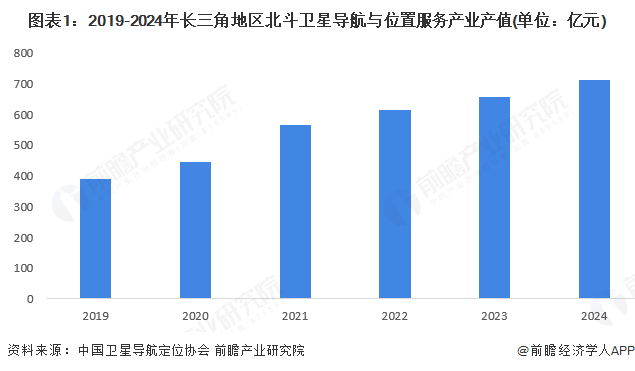
Core Insights - The comprehensive output value of the Beidou navigation and positioning service industry in the Yangtze River Delta exceeds 70 billion yuan in 2024, with a year-on-year growth of 8.4% [1][2] - The Yangtze River Delta ranks third in the national comprehensive output value of the navigation and positioning service industry, accounting for over 15% of the total national output [2][4] Industry Overview - The Beidou navigation and positioning service industry in the Yangtze River Delta has shown an upward trend from 2019 to 2024, with the output value projected to surpass 70 billion yuan by 2024 [1] - The region has cultivated representative companies in the Beidou navigation industry, including Huace Navigation and Tianyin Electromechanical, with revenue exceeding 500 million yuan in the first half of 2025 [5] Regional Development - As of October 27, 2025, there are 10 Beidou-related industrial parks in the Yangtze River Delta, with 5 located in Shanghai and 5 in Jiangsu [6] - The Yangtze River Delta has implemented various policies to promote the development of the Beidou navigation industry, focusing on applications in shipping, aerospace, and surveying [10]
理想汽车CEO李想:未来10年,最有价值的机器人是汽车【附智能网联汽车产业市场分析】
Qian Zhan Wang· 2025-11-28 11:26
Core Insights - The CEO of Li Auto, Li Xiang, stated that the most valuable products in the next decade will be cars with autonomous and proactive capabilities, defining the ultimate form of cars as "embodied intelligent products" or automotive robots [2] - The smart connected vehicle sector has become the core track for the global automotive industry's transformation, integrating cutting-edge technologies such as AI, 5G, big data, and cloud computing, and driving a complete industry chain reconstruction [2] - The market penetration rate of L2-level vehicles in China's passenger car market has increased from 23.5% in 2021 to 42.4% in the first half of 2023, indicating a shift from technology validation to large-scale commercialization [3] Industry Overview - The focus of technological innovation in China's new energy vehicle industry is accelerating towards emerging technologies such as AI, autonomous driving, vehicle networking, and cloud computing [4] - Emerging electric vehicle manufacturers like Li Auto, Tesla, BYD, NIO, and Xpeng are continuously innovating in the smart connected vehicle field, offering high-performance and intelligent electric vehicles [7] - The market size of China's smart connected vehicle industry reached 958.3 billion yuan in 2023, with optimistic expectations for significant growth driven by technology and policy support, potentially exceeding 2 trillion yuan by 2029 [12][13]



投资苏州丨一文看懂苏州市具身智能产业发展现状与投资机会前瞻(附具身智能产业现状、空间布局、投资机会分析等)
Qian Zhan Wang· 2025-11-28 04:13
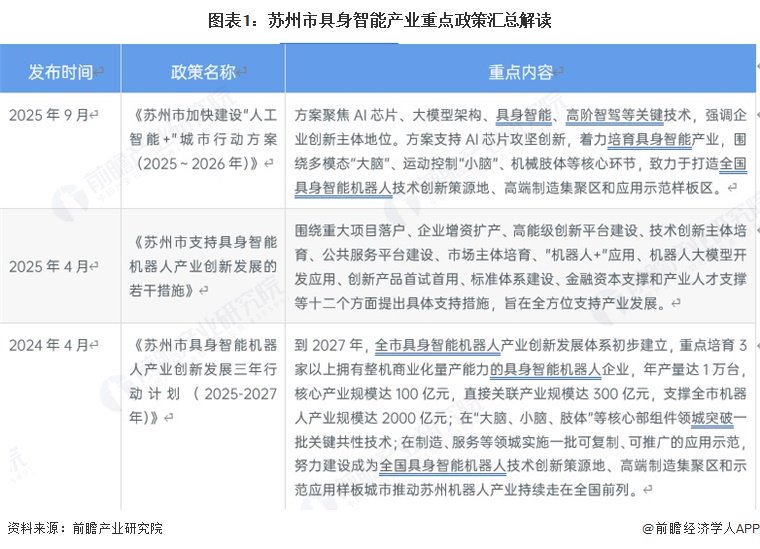
Group 1: Policy Environment - Suzhou has established a systematic policy framework for the embodied intelligence industry, with a "Three-Year Action Plan" targeting a scale of 100 billion and key technological breakthroughs [1] - The "Several Measures" provide comprehensive support from technology research and development to application promotion, elevating it to a city-level strategy in the "Artificial Intelligence + City Action Plan" [1] - The policy environment showcases a clear path from industrial planning to ecological construction [1] Group 2: Regional Policy Distribution - Suzhou has formed a clear regional division of labor in the embodied intelligence industry, with Suzhou Industrial Park as the core source, focusing on complete machines, key technologies, and core components [2] - Wuzhong District emphasizes the cultivation of application ecosystems through platform construction, scenario opening, and financial subsidies [2] - Both regions collaboratively build a coordinated development pattern from technology research to market application [2] Group 3: Industry Chain Overview - The embodied intelligence industry chain includes core hardware such as actuators, sensors, control interactions, and power systems, as well as software systems like artificial intelligence and operating systems [5] - In Suzhou, the distribution of enterprises shows a relative concentration in the software system segment, while core hardware and operating systems have fewer enterprises, indicating a need for further ecological improvement [5] Group 4: Industry Development Scale - The "Suzhou Embodied Intelligent Robot Industry Innovation Development Three-Year Action Plan (2025-2027)" states that by 2027, the core industry scale of 10 billion will support the total robot industry scale of 200 billion, indicating that embodied intelligent robots will account for 5% of the total robot output value [9] - In 2024, the output value of Suzhou's embodied intelligent robots is expected to be approximately 1% of the total robot output value, equating to about 1.4 billion [9] Group 5: Enterprise Layout Analysis - Suzhou has gathered over 600 core enterprises related to the robot industry chain, with 273 large-scale industrial enterprises, including over 80 core manufacturers of embodied intelligent robots [14] - The industry chain is complete, covering core components, body manufacturing, system integration, and intelligent applications, with a highly concentrated layout in Suzhou Industrial Park and Wuzhong District [15] Group 6: Financing Analysis - In 2025, Suzhou's embodied intelligence sector saw at least 10 financing events, with LeXiang Technology leading with nearly 400 million RMB in cumulative financing [21] - Wu Zhong District led with 6 financing events, while Suzhou Industrial Park and Huqiu District contributed 2 and 1 events, respectively, indicating a multi-regional collaborative financing ecosystem [23] Group 7: Investment Opportunities - Suzhou's industrial planning indicates that Suzhou Industrial Park aims to create a comprehensive innovation and manufacturing hub with a target output value of 15 billion, while Wuzhong District focuses on supporting platform construction and market-driven growth [25] - The industry has established a comprehensive policy support system, a relatively complete industrial chain foundation, and an active innovation ecosystem, providing diverse investment opportunities in technology breakthroughs, results transformation, and application scenarios [28]
前瞻全球产业早报:中国科学院工业人工智能研究所成立
Qian Zhan Wang· 2025-11-27 23:26
Group 1: Economic Policies and Infrastructure Development - The National Development and Reform Commission (NDRC) has allocated 700 billion yuan and 800 billion yuan in special bonds for "hard investment" projects in the last two years, supporting 1465 and 1459 projects respectively, reflecting strategic and forward-looking planning [2] - The NDRC plans to enhance parking facilities and upgrade existing infrastructure, with over 3.4 million new parking spaces added during the 14th Five-Year Plan period, and a total of 18.645 million electric vehicle charging points as of October, marking a 54% year-on-year increase [3] - The Ministry of Industry and Information Technology (MIIT) aims to cultivate three trillion-level consumption sectors and ten hundred-billion-level consumption hotspots by 2027, based on comprehensive assessments of consumption trends and technological changes [4] Group 2: Technological Advancements and Innovations - The first clinical brain-computer interface (BCI) surgery in China was successfully completed, marking a significant step in the clinical application of BCI technology, with the procedure priced at 6,552 yuan per operation [6] - The establishment of the Industrial Artificial Intelligence Research Institute by the Chinese Academy of Sciences aims to drive innovation in industrial AI, focusing on the entire chain from top-level design to implementation [7] - Li Xiang, CEO of Li Auto, emphasized that the most valuable robots in the next decade will be cars equipped with autonomous capabilities, highlighting the need for vehicles to possess complete sensory and decision-making abilities [8] Group 3: Corporate Developments and Market Reactions - Anta Sports has been rumored to be considering a bid for Puma, with potential collaboration with a private equity firm, although the company has refrained from commenting on market speculation [10] - The resignation of Zong Fuli from her positions at Wahaha Group has been noted, with her retaining a 29.40% stake in the company [11] - SuperX announced a stock repurchase plan authorized by its board, allowing for the repurchase of up to 20 million USD in common stock over the next year [16]
前瞻全球产业早报:中国开源AI模型市场首超美国
Qian Zhan Wang· 2025-11-27 12:07
Group 1 - The Ministry of Industry and Information Technology and five other departments aim to optimize the supply structure of consumer goods by 2027, creating three trillion-level consumption fields and ten hundred-billion-level consumption hotspots [2] - By 2030, a high-quality development pattern characterized by positive interaction between supply and consumption is expected to be established, with a steady increase in the contribution of consumption to economic growth [2] Group 2 - Guangdong Province plans to incorporate mergers and acquisitions and asset revitalization into the performance evaluation system of state-owned enterprises, aiming to enhance asset securitization levels [3] - The province encourages listed state-owned enterprises to utilize various financing tools for industry chain integration and mergers, thereby strengthening and optimizing their operations [3] Group 3 - China's open-source AI model market has surpassed that of the United States, with Chinese-developed models accounting for 17% of total downloads, compared to 15.8% for American companies [3] Group 4 - The medical device market in China is projected to reach 1.22 trillion yuan by 2025, with the number of production enterprises exceeding 33,000 by the end of 2024, marking a 27.8% increase from the end of the 13th Five-Year Plan [4] - A new regulation on mobile power supplies is expected to lead to the exit of nearly 70% of existing production capacity due to stringent technical requirements [4] Group 5 - Ideal Auto reported a net loss of 624 million yuan in Q3 2025, with total revenue of 27.4 billion yuan, a decrease of 36.2% year-on-year [5] - The total vehicle delivery volume in Q3 2025 was 93,211 units, reflecting a 39% year-on-year decline [5] Group 6 - South Korea plans to establish a "Korea-US Strategic Investment Company" to manage a special fund for $350 billion in investments in the U.S. [6] - SoftBank Group has completed the acquisition of Ampere Computing, making it a wholly-owned subsidiary [6] Group 7 - OpenAI anticipates that by 2030, there will be at least 220 million paid subscribers for ChatGPT, representing 8.5% of its approximately 2.6 billion weekly active users [7] Group 8 - Apple is expected to surpass Samsung as the world's largest smartphone manufacturer this year, with projected iPhone shipments reaching a record 255 million units, a 10% year-on-year increase [8] Group 9 - SK Telecom and Samsung have signed a memorandum of understanding to jointly develop AI-driven wireless access network technology for the next generation of 6G networks [9] Group 10 - NVIDIA has responded to concerns about its AI chip dominance, asserting that its GPUs remain a generation ahead of competitors and are the only ones capable of supporting all AI models across various computing scenarios [10]