Qian Zhan Wang

Search documents
前瞻全球产业早报:阿里发布编程平台Qoder
Qian Zhan Wang· 2025-08-25 11:59
Group 1 - Ride-hailing platforms such as Didi Chuxing, T3, and Cao Cao have announced a reduction in commission rates to improve driver rights [2] - Starbucks is expected to receive a non-binding acquisition offer for its China business within two weeks [3] - South Africa will launch its first new underground gold mine in 15 years, with West Wits Mining planning to start production next year [4] Group 2 - NIO's founder Li Bin stated that the pricing range for NIO vehicles aligns with the average prices of Mercedes-Benz, BMW, and Audi [5] - Yonghui Supermarket reported a revenue of 29.948 billion yuan for the first half of the year, a year-on-year decline of 20.73%, and a net loss of 241 million yuan [6][7] - Alibaba launched the Qoder programming platform, which can search 100,000 code files and significantly reduce development time for e-commerce websites [8] Group 3 - Bilibili achieved a total revenue of 7.34 billion yuan in the second quarter, marking a 20% year-on-year increase, and reported its first half-year profit since its IPO [10] - The South Korean government plans to increase R&D spending to a record 25.1 billion USD by 2026 [10] Group 4 - OpenAI announced plans to establish its first corporate office in India later this year [11] - Tesla raised the price of its Cyberbeast model from 99,990 USD to 114,990 USD, an increase of 15,000 USD [12] - Morgan Stanley predicts that OPEC may reduce production again in early 2026 due to expected oversupply in the oil market [13] Group 5 - Meta and Google have signed a six-year cloud agreement valued at over 10 billion USD [14][15] - OpenAI's Chief People Officer will leave the company to pursue personal goals related to the transition to general artificial intelligence [16] - Nvidia has joined the FugakuNEXT supercomputer project in Japan [16]





2025年中国土壤修复行业区域发展情况 江苏省在土壤修复行业更具竞争力【组图】
Qian Zhan Wang· 2025-08-25 08:10
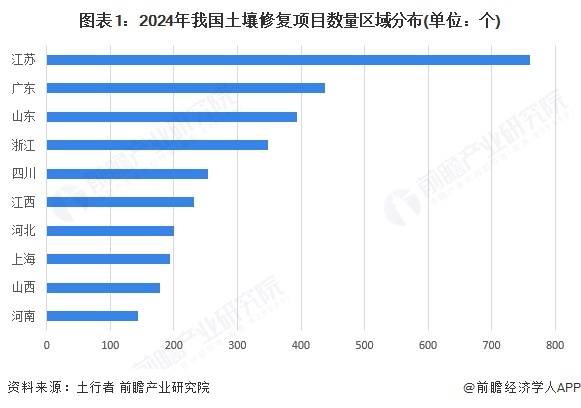
Group 1 - The core viewpoint of the article highlights the significant growth and scale of soil remediation projects in China, particularly in Jiangsu province, which leads in both project quantity and contract value for 2024 [1][2] - In 2024, Jiangsu province has 760 soil remediation projects, accounting for 16.3% of the total annual projects, with a total contract value of approximately 2.128 billion yuan, reflecting a 15% year-on-year increase [1] - The second-ranking province, Guangdong, has around 437 projects, representing 9.37% of the total projects for 2024 [1] Group 2 - Jiangsu province leads in contract value for soil remediation projects in 2024, with approximately 2.128 billion yuan, which constitutes 19.51% of the total annual contract value, showing a 25% increase from the previous year [2] - Guangdong province's contract value is about 999.7 million yuan, making up 9.14% of the total, with a year-on-year growth of 7%, rising from fifth to second place [2] Group 3 - For 2025, the Ministry of Finance has allocated significant funding for soil pollution prevention, with Hunan province receiving 587 million yuan, which is 19.0% of the total budget [4] - The funding for Hunan is aimed at addressing severe heavy metal pollution issues due to historical mining practices, with Guangxi and Yunnan following with budgets of 270 million yuan and 290 million yuan, respectively [4] Group 4 - In terms of the distribution of qualified soil pollution risk management and remediation companies, Jiangsu province has 974 qualified firms, including 77 large enterprises with registered capital over 50 million yuan [7] - Other provinces with a high number of firms include Shandong, Guangdong, and Hebei, each exceeding 800 qualified companies [7]
【干货】2024年粉末冶金产业链全景梳理及区域热力地图
Qian Zhan Wang· 2025-08-25 06:11
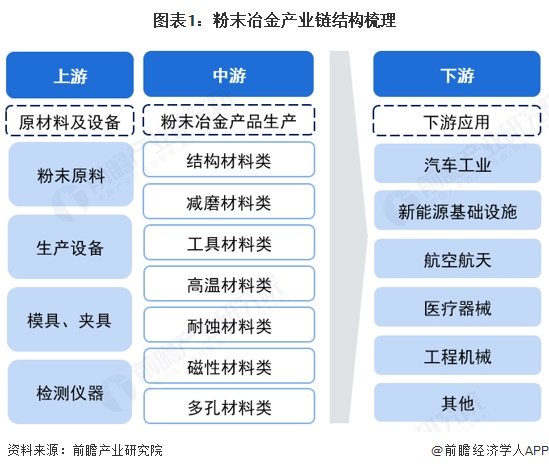
Core Insights - The powder metallurgy industry is experiencing significant growth due to increasing demand for non-ferrous metal powder materials such as nickel, copper, cobalt, and alloy powders, which are widely used in various sectors including home appliances, motorcycles, electric tools, and the automotive industry [1][3]. Industry Chain Overview - The powder metallurgy industry chain consists of three main segments: upstream (raw materials and equipment), midstream (production of powder metallurgy products), and downstream (applications in automotive, new energy infrastructure, aerospace, medical devices, and engineering machinery) [1]. - The industry is characterized as a typical intermediate processing manufacturing sector [1]. Leading Companies - Key players in the upstream raw materials segment include Yuyuan New Materials, Srey New Materials, and Boqian New Materials. Midstream companies include Antai Technology and Dongmu Co., Ltd. Notably, Antai Technology has the capability to produce both midstream and upstream products, indicating a trend towards industry chain integration [3]. Regional Distribution - The majority of powder metallurgy companies in China are concentrated in Hebei Province, with significant presence also in Shandong, Jiangsu, and Zhejiang provinces [5]. - The eastern region of China, particularly the Yangtze River Delta centered in Zhejiang Province, hosts a wide distribution of representative powder metallurgy enterprises [7]. Investment Trends - Recent investments in the powder metallurgy sector focus on capacity expansion and exploration of emerging fields. For instance, Shanxi Dongmu Magnetic Electric plans to invest in a new project for magnetic-sensitive materials with a capacity of 60,000 tons by 2025, targeting applications in new energy vehicle motors and IoT devices [10][12]. - Jinli Permanent Magnet aims to reach a production capacity of 38,000 tons for high-performance rare earth permanent magnet materials by 2024, with plans for an additional 40,000 tons by 2025 [10][12]. - Jiuling Technology is investing in a production line for high-precision parts, targeting the new energy vehicle sector, with equipment installation expected to be completed by the end of 2024 [10][12].
2025年中国人工智能代理行业趋势与预测分析 技术风暴席卷下的万亿江湖与合规暗战【组图】
Qian Zhan Wang· 2025-08-25 04:12
Core Insights - The Chinese AI agent industry is expected to experience explosive growth with a compound annual growth rate (CAGR) of 72.7%, reaching a market size of 852 billion yuan by 2028, and potentially exceeding 2.1 trillion yuan by 2030, driven by technological breakthroughs and deepening application scenarios [1][13][15] Industry Development Trends - The evolution of AI agents in China is characterized by a transition from "model monopoly" to "universal Agent," with advancements in foundational models, architectural innovation, and efficiency optimization driving the industry [1][2] - The breakthrough in foundational models is propelled by the rise of large model capabilities and the trend towards open-source, facilitating a shift from monopolistic control to widespread accessibility [1][2] - Multi-modal fusion technology is expanding the boundaries of models, enabling AI agents to evolve from single-text interactions to multi-sensory perceptions [1][2] Architectural Innovations - The Mixture-of-Agents (MoA) architecture has become an industry standard, integrating general models, specialized scene models, toolchain platforms, and data flywheels, achieving a 15% higher accuracy in specific tasks compared to general models [2] - The Mixture-of-Experts (MoE) architecture reduces computing power consumption by 60%, enhancing system performance through distributed expert networks [2] Product Trends - The AI agent product matrix in China is forming a collaborative development of "general-purpose + vertical" products, catering to diverse market demands [4] - General-purpose products focus on broad scene coverage and the ability to execute complex tasks, while vertical products emphasize deep exploration of specific fields [4] Market Segmentation - The B-end market prioritizes customization capabilities, with AI agent platforms supporting low-code/no-code development and private customization [6] - The C-end market emphasizes standardized experiences, with products aimed at enhancing user efficiency and emotional satisfaction [6] Application Trends - AI agents are penetrating multiple industries, with high application maturity and value release in finance, healthcare, and government sectors [7] - In finance, AI agents have significantly improved efficiency in credit approval processes, reducing processing times from 48 hours to 15 minutes and increasing accuracy to 95% [8] Policy and Governance - The governance framework for AI agents in China aims to balance development and safety, establishing a multi-level legal governance system to mitigate potential risks [9][12] - Challenges in the governance system include traditional governance adaptability, responsibility identification, data governance issues, and compliance challenges for enterprises operating internationally [10][12] Market Growth Drivers - The continuous decline in computing costs is a key driver for the AI agent market, with predictions indicating a reduction to one-tenth of 2024 costs by 2028 [13] - Support from policies for intelligent computing infrastructure is further accelerating technology deployment and market penetration [13]
【行业深度】洞察2025:中国火锅行业竞争格局(附竞争梯队、企业竞争力评价等)
Qian Zhan Wang· 2025-08-25 02:18
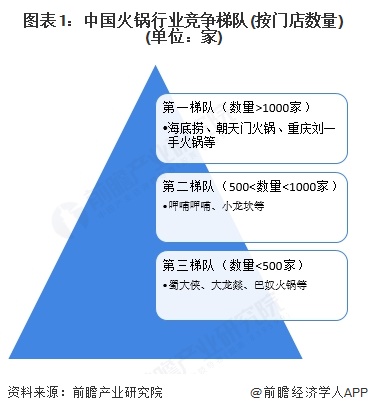
Group 1 - The core viewpoint of the article highlights the competitive landscape of the Chinese hot pot industry, detailing the market structure and key players [1][11]. - The first tier of hot pot companies includes those with over 1,000 stores, such as Haidilao and Chongqing Chao Tian Men, while the second tier includes brands like Xia Bo Xia Bo and Xiao Long Kan with 500-1,000 stores [1][4]. - The hot pot industry is characterized by various regional styles, with Sichuan and Chongqing hot pot being the mainstream, while new trends like Guizhou sour soup and Yunnan sour soup are gaining popularity [3][11]. Group 2 - The 2025 Top 100 Hot Pot Enterprises list, released by the China Hotel Association, shows that Sichuan and Chongqing brands dominate, with 7 out of the top 10 companies from these regions [4][5]. - The leading companies in the hot pot industry, based on a comprehensive index that includes operational and consumer evaluation metrics, are Haidilao, Chongqing Chao Tian Men, and Xia Bo Xia Bo [5][8]. - The hot pot market is experiencing robust growth, attracting numerous entrants due to its relatively low entry barriers and stable demand, with a significant portion of consumers being price-sensitive [11][12]. Group 3 - The competitive environment of the hot pot industry can be analyzed using Porter's Five Forces model, indicating a high level of competition among existing players and significant bargaining power for consumers [12]. - The supply chain for hot pot businesses is diverse, allowing companies to lower procurement costs due to the abundance of suppliers for ingredients and seasonings [11]. - The hot pot industry maintains a strong consumer base due to its unique dining experience and flavor profiles, which are difficult to replace with other dining options [11].

2024年中国环保设备行业市场发展现状 水污染防治和大气污染防治设备占据了绝大部分市场【组图】
Qian Zhan Wang· 2025-08-24 03:12
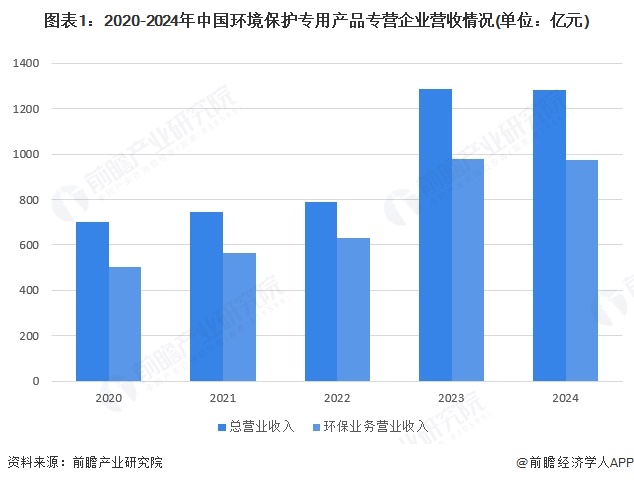
Core Insights - The revenue scale of China's environmental protection product specialized enterprises is projected to reach 1283 billion yuan in 2024, with a steady growth trend observed from 2020 to 2023 [2][3] Group 1: Revenue Growth - The operating revenue of China's environmental protection product enterprises was 1285 billion yuan in 2023, with the environmental business revenue at 978 billion yuan [2] - The estimated total operating revenue for specialized environmental protection equipment enterprises in 2024 is approximately 1283 billion yuan, with environmental business revenue around 975 billion yuan [2] Group 2: Demand Structure - The demand structure of the environmental protection equipment industry is dominated by water pollution prevention and air pollution control equipment, which occupy the majority of the market share [4] - The main categories of environmental protection equipment include water pollution control equipment, air pollution control equipment, solid waste treatment and resource recovery equipment, soil and groundwater remediation equipment, and noise and vibration control equipment [4] Group 3: Investment Trends - From 2015 to 2023, the total investment in industrial pollution control in China showed an overall declining trend, with a rebound in 2023 to 36.24 billion yuan, reflecting a year-on-year increase of 26.8% [7] - The estimated total investment in industrial pollution control for 2024 is approximately 355 billion yuan [7] - The shift in demand reflects a transition from end-of-pipe treatment to source prevention, with a growing preference for comprehensive solutions over single equipment purchases [7] Group 4: Supply and Demand Analysis - The supply-demand situation indicates that representative enterprises in the environmental equipment market are experiencing a supply shortage, with companies like Qingda Environmental maintaining a production-sales rate around 100% [9] - Many products from companies such as Fida Environmental and Zhongjian Huaneng have production-sales rates exceeding 100%, indicating strong demand [9] - The average production-sales rate of representative enterprises in the environmental equipment sector has shown an increasing trend, exceeding 100% from 2021 to 2024, with 2024 projected at 101.0% [10]
【投资视角】启示2025:中国医疗美容行业投融资及兼并重组分析(附投融资事件、产业基金和兼并重组等)
Qian Zhan Wang· 2025-08-24 01:13
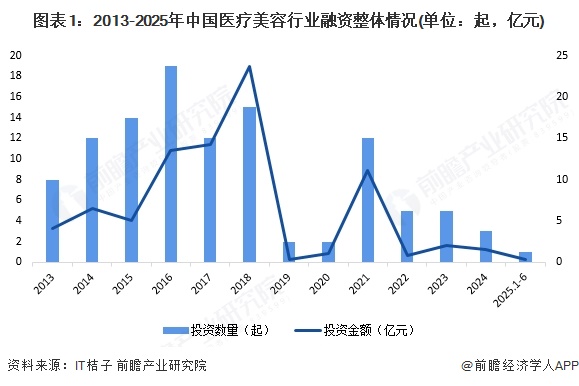
Group 1 - The core viewpoint of the article highlights the fluctuating investment and financing trends in China's medical beauty industry, with a peak in 2016 and a decline thereafter [1][17] - Investment events peaked in 2016 with 19 occurrences and an investment amount of 1.353 billion RMB, while the highest investment amount was recorded in 2018 at 2.374 billion RMB [1] - By 2024, only 3 investment events occurred with a total investment of 150 million RMB, and as of June 5, 2025, only 1 event with an investment of 30 million RMB was reported [1] Group 2 - The majority of investment rounds in the medical beauty industry are concentrated in early stages, particularly angel and A-round financing [2] - The industry encompasses various fields such as medical beauty raw materials, equipment, and service platforms, indicating strong innovation and technical barriers [2] Group 3 - Investment activities are primarily concentrated in Beijing and Guangdong, with 49 and 23 financing events respectively, followed by Sichuan and Shanghai with 12 and 9 events [4] - The focus on these regions is attributed to the concentration of resources and opportunities in the medical beauty sector [4] Group 4 - The investment direction is primarily focused on the construction of medical beauty platforms [6] Group 5 - The main investment entities in the medical beauty industry are capital organizations, accounting for 73% of the total, while industrial entities like Gree Electric and Xiaomi Group make up 27% [5] Group 6 - There are few industry investment funds specifically targeting medical beauty, with only 2 private funds identified [13] Group 7 - Recent years have seen a trend of horizontal acquisitions among midstream enterprises in the medical beauty industry as a means to expand scale [15] - Notable acquisition events include 康哲药业 acquiring 旭俐医疗 with a 100% stake and 新氧 acquiring 奇致激光 [16] Group 8 - Overall, the investment and financing landscape in China's medical beauty industry has shown fluctuations, with a concentration of activities in Beijing and Guangdong, primarily driven by capital investment institutions [17]





前瞻全球产业早报:中国月度用电量破万亿大关
Qian Zhan Wang· 2025-08-22 12:48
Group 1: Electricity Consumption in China - China's total electricity consumption reached 1.02 trillion kilowatt-hours in July, marking a historic milestone and the first time any country has surpassed this threshold [2] - This figure represents an 8.6% year-on-year increase and has doubled compared to ten years ago, equivalent to the annual electricity consumption of ASEAN countries [2] - The share of renewable energy sources, including wind, solar, and biomass, has significantly increased, accounting for nearly one-quarter of the total consumption, indicating a rapid pace of green energy transition in China [2] Group 2: Hainan Free Trade Port - The implementation of the cross-border asset management pilot program in Hainan Free Trade Port began on August 21, allowing global institutions and qualified foreign individual investors to participate [3] - The investment products available include private asset management products, publicly offered securities investment funds, and insurance asset management products, with an initial pilot scale capped at 10 billion yuan [3] Group 3: Technology Companies Recognition - Three companies from the "Hangzhou Six Little Dragons," namely DeepSeek, Yushu Technology, and Yundongchu Technology, were included in the 2025 "Fortune" China Technology 50 list [4] Group 4: Economic Growth in Hubei - Hubei Province has achieved its "14th Five-Year Plan" economic growth target a year ahead of schedule, with its economic total surpassing 6 trillion yuan [5] - The province's share of the central region's economy increased from 19.5% at the end of the "13th Five-Year Plan" to an expected 20.9% by 2024, enhancing its regional collaborative strength [5] Group 5: AI and Robotics Developments - WeRide launched an end-to-end assisted driving solution in collaboration with Bosch, with plans for mass production by 2025 [7] - Zhiyuan Robotics initiated its first entrepreneurial acceleration plan focused on embodied intelligence, aiming to incubate over 50 high-potential early-stage projects and create a trillion-level industrial ecosystem within three years [7] Group 6: Market Movements and Investments - WanTai Biologics announced that its nine-valent HPV vaccine has received the batch release certificate, marking its official market entry and potential new revenue stream [8] - Intel is reportedly seeking additional funding through discounted placements while SoftBank has announced a $2 billion investment in Intel, which is expected to make it the fifth-largest shareholder [14]
2025年中国超硬材料行业政策发展分析—政策驱动“产学研”是解决卡脖子的关键要素
Qian Zhan Wang· 2025-08-22 05:09
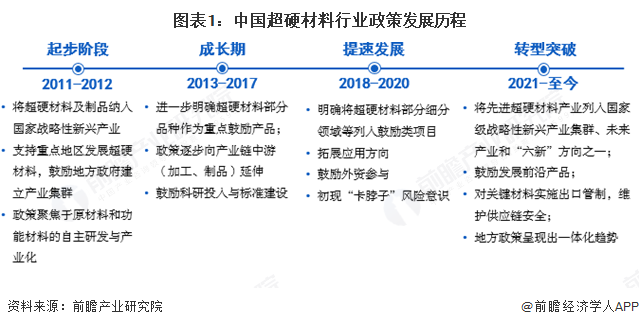
Core Viewpoint - The new export control policy in 2024 marks a new stage of technological protection for the industry, shifting the policy focus from scale expansion to the construction of an innovation ecosystem through collaboration between industry, academia, and research [1]. Policy Evolution and Development Planning - The development of superhard materials in China can be divided into four stages: initiation, growth, accelerated development, and transformation breakthrough. The initiation phase began with the inclusion of superhard materials in the national strategic emerging industries during the "12th Five-Year Plan" in 2012. The growth phase was marked by the clear distinction of superhard materials in "Made in China 2025," which emphasized the need to overcome high-performance diamond and cubic boron nitride (CBN) preparation technologies. The accelerated development phase saw the emergence of "bottleneck" risk awareness from 2018 to 2020, leading to multiple regulations and guidelines that clarified the project's status and encouraged development. Since the "14th Five-Year Plan" in 2021, the industry has entered a transformation breakthrough phase, aiming to overcome high-end production technology challenges with the help of the existing upstream supply chain [2][3]. Differentiated Development Pattern Led by Henan - Henan Province has prioritized the development of the superhard materials industry, implementing policies such as "Six New Breakthroughs in Manufacturing" and "High-end Materials Cluster Construction Action Plan." The province focuses on high-end products like gem-grade and functional diamonds, supporting enterprises in increasing technological innovation and R&D investment. Comprehensive measures, including the establishment of national and provincial innovation platforms, collaboration among leading enterprises, and financial subsidies, are enhancing the overall industry chain cooperation level. Henan aims to transition from "quantity leading" to "quality leading" and "high-end application breakthroughs," solidifying its core position in the superhard materials industry both nationally and globally [5]. Industry Development Goals and Strategies - By 2025, the goal is to form a trillion-level industry chain and establish the world's largest superhard materials R&D and production base, cultivating a national-level industry cluster and striving for an internationally leading industry chain. The industry is expected to upgrade from traditional manufacturing to high-end, intelligent, and green production, promoting vertical extension (from raw materials to end products) and horizontal expansion (cross-industry integration with 5G, chips, medical, and biological fields) [6]. Innovation-Driven Strategy Upgrade - In recent years, Henan has emphasized technological innovation and high-end breakthroughs in the superhard materials industry, focusing on composite superhard materials, high-end diamond products, and polycrystalline diamond composites. The province is increasing policy and financial support, promoting technological breakthroughs and the transformation of results. Additionally, Henan is facilitating deep integration of superhard materials with high-value industries such as chip manufacturing, 5G communication, and biomedical fields, enhancing the innovation ecosystem and strengthening intellectual property protection and standard system construction [7]. Funding-Driven Market Ecosystem Integration - In response to rapid global technological advancements and the trend of high-quality industrial development, Henan's superhard materials industry policy will further deepen towards intelligent manufacturing, digital transformation, and green low-carbon directions. Future focus areas include intelligent equipment and automation production, cross-industry applications of superhard materials in new energy, semiconductors, and healthcare, as well as the promotion of green low-carbon processes. The policy is expected to strongly promote international cooperation and standardization, supporting leading enterprises in participating in international rule-making and integrating into the "Belt and Road" industrial network [9]. Policy Support Trends - The policy content is shifting from broad industry scale support to precise technological breakthroughs and support for high-end segments of the industry chain, emphasizing the construction of an industrial ecosystem. The government-led industry support is gradually integrating market mechanisms, encouraging social capital participation in the construction of the innovation ecosystem. Future policies will highlight the deep integration of intelligent manufacturing, digital transformation, and low-carbon green manufacturing with the superhard materials industry, promoting cross-industry innovation with cutting-edge technologies [10].


【行业深度】洞察2025:全球及中国大直径功能聚合物单丝市场规模及竞争格局(附市场规模、竞争格局等)
Qian Zhan Wang· 2025-08-21 11:15
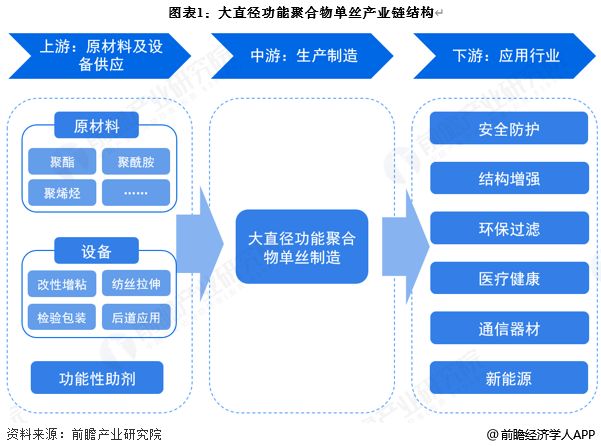
转自:前瞻产业研究院 本文核心数据:全球及中国大直径功能聚合物单丝销售额;全球及中国大直径功能聚合物单丝企业市占 率等 一、大直径功能聚合物单丝概述 大直径功能聚合物单丝是指具有高强度、高导电、抗老化、阻燃、耐磨、耐高温等功能,直径0.08~ 5.0mm的单根化学纤维。产品类型包括聚酯、聚酰胺、聚烯烃等高强度单丝,耐高温、导电、高耐磨等 高功能单丝,钓鱼线、网球线、羽毛球线等特种线材,生物可降解、循环再生等绿色单丝。 大直径功能聚合物单丝产业链上游主要为原材料,包括聚酯、聚烯烃等,相关设备,包括改性增粘设 备、纺丝拉伸设备以及功能性助剂等供应商;中游主要为大直径功能聚合物单丝制造商;下游为安全防 护、结构增强、环保过滤、医疗健康、通信器材等应用领域。 二、全球大直径功能聚合物单丝市场分析 1、全球单丝市场规模 单丝具有较高的耐磨性、良好的弹性、耐腐蚀性等优良的特质,在渔业、工业、消费品、医疗等领域广 泛使用。随着近年来全球经济的不断回暖,单丝下游应用领域市场规模不断扩大,拉动单丝消费量持续 上升,促使全球单丝市场规模逐年增加。 根据国际知名调研机构Lucintel发布的《2023-2028年全球单丝市场调查报 ...