Ju Chao Zi Xun

Search documents
创世纪1-9月净利润同比增长72.56%,拟向实控人募资5.5亿元补流
Ju Chao Zi Xun· 2025-10-27 02:30
Core Insights - The company reported significant growth in revenue and net profit for Q3 2025, with a notable improvement in operating cash flow, and is progressing with various capital management initiatives [2][3] Financial Performance - For Q3 2025, the company achieved a revenue of 1.384 billion yuan, a 14% increase year-on-year; net profit attributable to shareholders was 114.74 million yuan, a staggering increase of 164.38%; and net profit excluding non-recurring items was 122.68 million yuan, up 196.21% [2][4] - Year-to-date, the company reported a cumulative revenue of 3.826 billion yuan, a 16.8% increase; net profit attributable to shareholders reached 348 million yuan, a 72.56% increase; and net profit excluding non-recurring items was 341 million yuan, up 106.81% [3][4] - The basic and diluted earnings per share for Q3 were both 0.07 yuan, reflecting a 133.33% increase, while the weighted average return on equity was 2.14%, up 1.29 percentage points year-on-year [2][4] Cash Flow and Asset Management - The net cash flow from operating activities for the year-to-date was 178 million yuan, a significant improvement of 167.95% compared to the previous year [3][4] - As of the end of the reporting period, total assets reached 11.547 billion yuan, an 8.84% increase from the previous year, and equity attributable to shareholders was 5.428 billion yuan, up 7.16% [4] Capital Structure Optimization - The company plans to issue up to 101 million shares to its actual controller, raising no more than 550 million yuan to supplement working capital and repay bank loans, which will enhance capital strength [5] - The Shenzhen high-end CNC machine tool industrial base project has seen its total investment adjusted from 600 million yuan to 542 million yuan, optimizing costs while maintaining project quality and capacity [5][6]


A股存储新贵:香农芯创背靠SK海力士,发力企业级SSD市场
Ju Chao Zi Xun· 2025-10-26 16:01
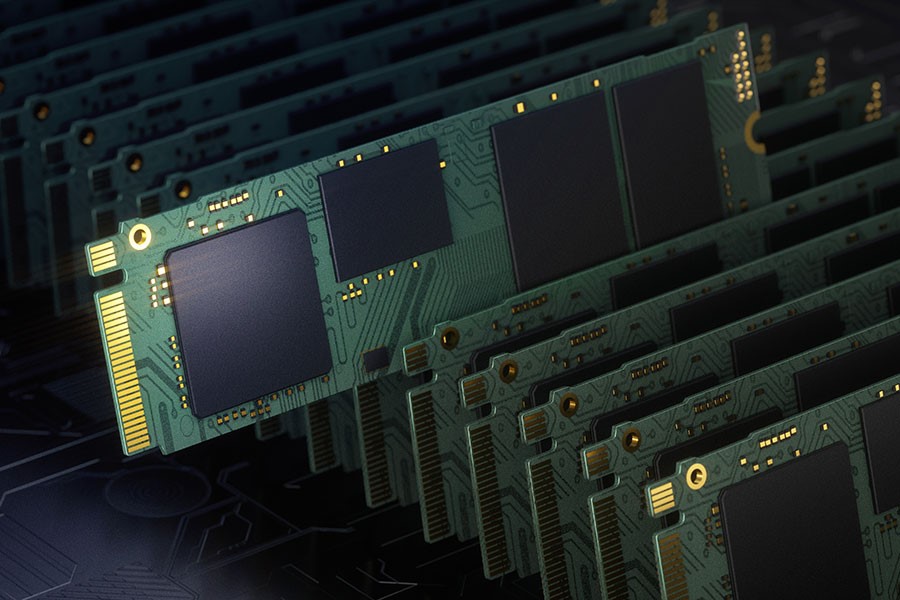
Group 1: Market Dynamics - Samsung Electronics and SK Hynix announced a 30% price increase for DRAM and NAND flash memory in Q4, driven by surging AI demand, entering a "super price increase cycle" for storage products [2] - Despite the price hike, storage module manufacturers may struggle to secure memory wafers, leading to a situation where high prices do not guarantee availability [2] - The current market conditions emphasize the importance of inventory for module manufacturers and the capability to access upstream resources [2] Group 2: Company Performance - Xiangnon Chip Innovation reported Q3 2025 revenue of 9.276 billion yuan, a 6.58% year-on-year increase, marking a record high for quarterly revenue; however, net profit decreased by 3.11% to 202 million yuan [4] - For the first three quarters of 2025, the company achieved cumulative revenue of 26.4 billion yuan, a 59.9% increase year-on-year, while net profit fell by 1.36% to 359 million yuan [4] - In 2024, the company recorded total revenue of 24.271 billion yuan, a 115.4% increase, but net profit declined by 30.08% to 264 million yuan [6] Group 3: Strategic Developments - Xiangnon Chip Innovation, formerly known as Julong Technology, has transformed into a key distributor for SK Hynix and MTK, with over 90% of its procurement from these suppliers [5] - The company has significantly increased its inventory from 669 million yuan in 2021 to 2.858 billion yuan in 2024, positioning itself well for the current storage industry upcycle [7] - The establishment of a joint venture, Haipu Storage, with SK Hynix and other partners aims to penetrate the enterprise SSD market, with products already in the production phase and expected to start mass shipments in 2025 [8] Group 4: Business Model and Vision - Xiangnon Chip Innovation aims to be an organizer and enabler within the semiconductor supply chain, developing a dual business model that integrates distribution and self-developed products [9] - The synergy between the chip distribution and self-developed product businesses enhances the company's capabilities in channels, research and development, service, and supply chain management [9]

和远气体前三季度净利润5770.37万元
Ju Chao Zi Xun· 2025-10-26 14:40
Core Viewpoint - The company reported a slight increase in total revenue for the first three quarters of 2025, but a decline in net profit and non-recurring net profit, indicating challenges despite strategic advancements in the electronic specialty gas sector [1] Financial Performance - Total revenue for the first three quarters reached 1.232 billion yuan, representing a year-on-year growth of 3.32% [1] - Net profit attributable to shareholders was 57.7037 million yuan, showing a year-on-year decrease of 1.86% [1] - Non-recurring net profit was 40.2372 million yuan, down 17.58% year-on-year [1] Strategic Developments - The company has made significant progress in its strategic transformation towards electronic specialty gases, with all planned products in the Pengjiang electronic specialty gas industrial park completed [1] - Products such as electronic-grade high-purity hydrogen and high-purity carbon monoxide have begun mass production and sales [1] - The company is set to stabilize production of electronic-grade hydrogen chloride, chlorine, and carbonyl sulfide in the second half of the year, while also initiating customer certification for the semiconductor sector [1] Product Portfolio - The company has established a comprehensive product system consisting of five series of electronic specialty gases: silicon-based, fluorine-based, ammonia-based, chlorine-based, and carbon-based [1] - These products are widely used in industries such as integrated circuits, display panels, LEDs, and solar cells, playing crucial roles in key processes like lithography, etching, and film deposition [1] Market Positioning - The two electronic specialty gas industrial parks are strategically located in Central China, near the Yangtze River, providing convenient service to major economic regions such as the Yangtze River Delta, Pearl River Delta, and Chengdu-Chongqing [1] - The company anticipates a broad market outlook for its products, driven by the growing domestic demand for domestic substitutes in electronic specialty gases [1]
三利谱前三季度净利润4499.4万元,同比下降30.5%
Ju Chao Zi Xun· 2025-10-26 14:34
Core Insights - The company reported a total revenue of 2.643 billion yuan for the first three quarters of 2025, representing a year-on-year increase of 41.09% [1] - The net profit attributable to shareholders decreased by 30.50% to 44.994 million yuan, while the net profit excluding non-recurring items fell by 48.49% to 37.8064 million yuan [1] Financial Performance - In Q3 2025, the company achieved a revenue of 963 million yuan, up 39.6% year-on-year [1] - The net profit for Q3 was 705,000 yuan, down 24.8% compared to the same period last year [1] - The net profit excluding non-recurring items for Q3 was 259,000 yuan, reflecting a significant decline of 70.6% year-on-year [1] Business Operations - The company operates primarily in the optoelectronic technology sector, focusing on the research, production, and sales of polarizers and related products [1] - The newly launched Hefei Sanlipu Phase II TFT-LCD polarizer production line is still in the ramp-up phase and has not yet achieved profitability [1] Cost and Expenses - The company faced increased financial expenses and higher market development costs, contributing to the decline in net profit [1] - Financial expenses rose by 52.25 million yuan compared to the same period last year, mainly due to the appreciation of the yen and increased bank loans [1] - Sales, management, and R&D expenses also increased, impacting overall profitability [1] Asset Growth - Despite the decline in net profit, the company's total assets and equity attributable to shareholders increased by 20.70% and 0.80%, respectively, compared to the end of the previous year [1]

奥普光电前三季度净利润3805万元
Ju Chao Zi Xun· 2025-10-26 14:22
Group 1 - The core viewpoint of the articles highlights that Aopu Optoelectronics reported a decline in revenue and net profit for the first three quarters of 2025, with total revenue at 510 million yuan, down 2.38% year-on-year, and net profit attributable to shareholders at 38.05 million yuan, down 16.18% year-on-year [1][2] - Aopu Optoelectronics specializes in the research, production, and sales of optoelectronic measurement and control instruments, new medical instruments, optical materials, and grating encoders, with key products including optoelectronic theodolite optical-mechanical subsystems and aerospace camera optical-mechanical subsystems [1][2] - The company signed a technology transfer contract with the Changchun Institute of Optics, Fine Mechanics and Physics, which is a controlling shareholder holding 42.40% of Aopu Optoelectronics, to license technology in the field of high-precision integrated system assembly and adjustment for a fee of 2 million yuan [1][2] Group 2 - Aopu Optoelectronics identifies optoelectronic tracking and aiming devices, such as various types of theodolites, as one of its main products, possessing technical advantages in mechanical and optical parts processing, component assembly, and optical-mechanical component adjustment [2] - The company acknowledges existing technical deficiencies in optical-mechanical-electrical integration and complete machine testing, and aims to address these issues through the introduction of relevant technologies to enhance its integrated manufacturing and mass production capabilities [2]

铜冠铜箔前三季度净利润6272.43万元,同比增长162.49%
Ju Chao Zi Xun· 2025-10-26 14:15
Core Viewpoint - The report highlights significant growth in both revenue and net profit for the company in the third quarter of 2025, driven by strong demand in the copper foil industry, particularly in AI server substrates and high-value lithium battery copper foils [1] Financial Performance - In Q3 2025, the company reported revenue of 1.737 billion yuan, a year-on-year increase of 51.34% [1] - Net profit for Q3 2025 reached 27.77 million yuan, reflecting a year-on-year growth of 166.77% [1] - For the first three quarters of 2025, total revenue was 4.735 billion yuan, up 47.13% year-on-year [1] - Net profit for the first three quarters was 62.72 million yuan, showing a year-on-year increase of 162.49% [1] Industry Trends - The copper foil industry is experiencing diversified growth, with a surge in demand for HVLP copper foil as a substrate for AI servers [1] - Competition in lithium battery copper foil is shifting towards high-value products such as 4.5μm and 5μm foils [1] - Companies in the industry are actively restructuring their product offerings to focus on high-value markets to enhance profitability [1] Production and Market Position - The company produced over 35,078 tons of copper foil during the reporting period, with steady growth in the production of lithium battery copper foils measuring 5μm and below [1] - There is a supply-demand imbalance for high-frequency, high-speed substrate copper foils, with their production now exceeding 30% of the total PCB copper foil output [1] - The production of high-end HVLP copper foil has accelerated, surpassing the total production level for the entire year of 2024 in the first half of 2025 [1] - The company has established long-term partnerships with well-known enterprises in both PCB copper foil and lithium battery copper foil sectors, obtaining supplier certifications from these companies [1]
国务院关于金融工作情况的报告:继续聚焦科技创新等重点方向 推进金融支持重点产业提质升级
Ju Chao Zi Xun· 2025-10-26 08:57
Group 1 - The report emphasizes the importance of financial services for the real economy, aiming to provide high-quality financial services [1][2] - From November 2024 to September 2025, 98 companies in the A-share market conducted initial public offerings (IPOs), raising 91.8 billion yuan, with 86% being private enterprises and 92% in strategic emerging industries [1] - By the end of September 2025, loans in technology, green, inclusive, elderly care, and digital economy sectors grew by 11.8%, 22.9%, 11.2%, 58.2%, and 12.9% year-on-year, all significantly exceeding the overall loan growth rate [1] Group 2 - The report outlines a focus on enhancing financial services in key areas such as technological innovation, consumer stimulation, small and micro enterprises, and stabilizing foreign trade [2] - It calls for the implementation of a moderately loose monetary policy to support the ongoing economic recovery and to create a conducive monetary and financial environment [2] - The report highlights the need for improved financial regulation, emphasizing the enhancement of regulatory effectiveness and the protection of financial consumers and investors' rights [2]
先锋电子回应股票交易异动:公司生产经营正常 无应披露而未披露的重大事项
Ju Chao Zi Xun· 2025-10-26 08:52
Core Viewpoint - The stock of Pioneer Electronics experienced an abnormal trading fluctuation, with a cumulative decline of over 20% in closing prices over three consecutive trading days from October 22 to 24, 2025 [1] Summary by Relevant Sections - **Company Disclosure** - Pioneer Electronics confirmed that there are no corrections or supplements needed for previously disclosed information [1] - The company did not find any recent media reports that could have significantly impacted its stock price [1] - The company's production and operational conditions remain normal, with no significant changes in the internal or external business environment [1] - The company, its controlling shareholders, and actual controllers have no undisclosed significant matters related to the company [1] - During the period of abnormal stock trading, the controlling shareholders and actual controllers did not engage in buying or selling the company's stock [1] - **Board Confirmation** - The board of directors confirmed that there are no undisclosed matters that should be disclosed according to the Shenzhen Stock Exchange's listing rules, nor any related plans, discussions, intentions, or agreements [1] - The board is not aware of any undisclosed matters that could significantly affect the trading price of the company's stock and its derivatives [1]

37亿元!国资主导国产IC载板公司安捷利美维46%股权挂牌转让
Ju Chao Zi Xun· 2025-10-25 07:53
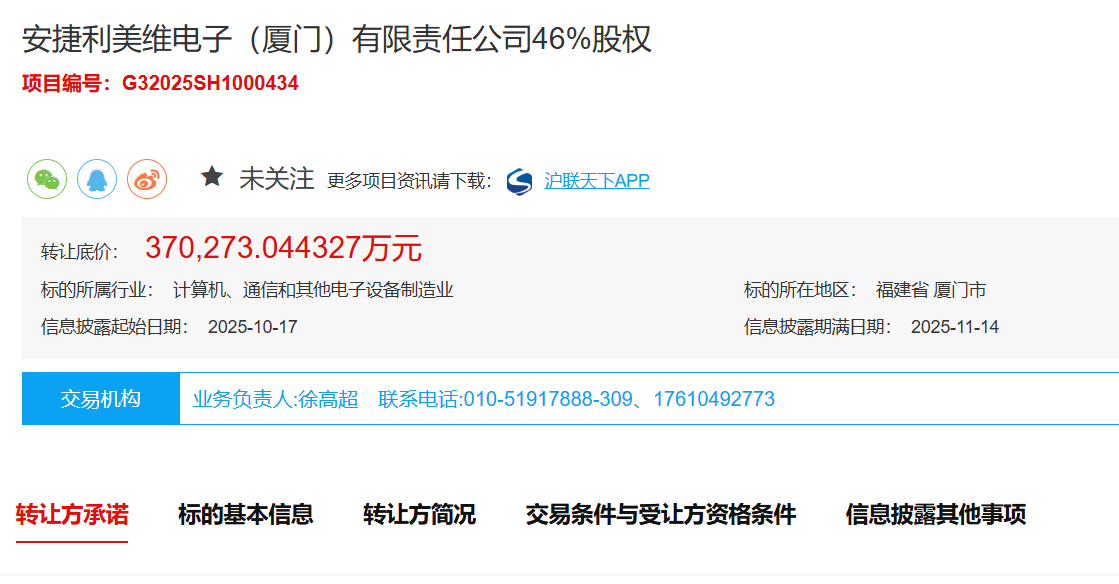
Core Insights - The transfer of 46% equity in Anjieli Mewei Electronics (Xiamen) Co., Ltd. is a strategic move by state-owned shareholders to consolidate resources in the high-end electronic manufacturing sector, attracting significant industry attention [1][6] Group 1: Equity Transfer Details - The equity transfer involves three major state-owned shareholders: Meizhi Investment (Xiamen) Co., Ltd. (53% ownership, transferring 12.41%), Xiamen Semiconductor Investment Group Co., Ltd. (40% ownership, transferring 27.59%), and Anjieli (Panyu) Electronic Industrial Co., Ltd. (6% ownership, transferring 100%) [2][3] - The transfer price is set at approximately 3.703 billion yuan, reflecting market recognition of the asset quality and development potential of Anjieli Mewei [4] Group 2: Company Overview - Anjieli Mewei, established on December 30, 2019, is a state-controlled medium-sized enterprise with a registered capital of 4.5 billion yuan [3][4] - The company operates in the electronic manufacturing sector, specializing in FCBGA packaging substrates, HDI boards, and other high-density electronic circuit solutions, with production bases in Xiamen, Shanghai, Suzhou, Guangzhou, Fuzhou, and Thailand [4] Group 3: Financial Performance - In 2024, Anjieli Mewei reported revenues of 7.917 billion yuan and a net profit of 414 million yuan, with total assets amounting to 15.974 billion yuan [5] - For the first three quarters of 2025, the company achieved revenues of 6.316 billion yuan and a net profit of 106 million yuan, with total assets increasing to 16.607 billion yuan [5] Group 4: Strategic Implications - The large-scale equity transfer led by state capital signals a strategic intent to integrate resources within the electronic manufacturing industry, particularly in critical areas of the semiconductor and electronic circuit sectors [6] - The outcome of this equity transfer will serve as an important indicator of capital trends and future dynamics in the electronic manufacturing industry [6]
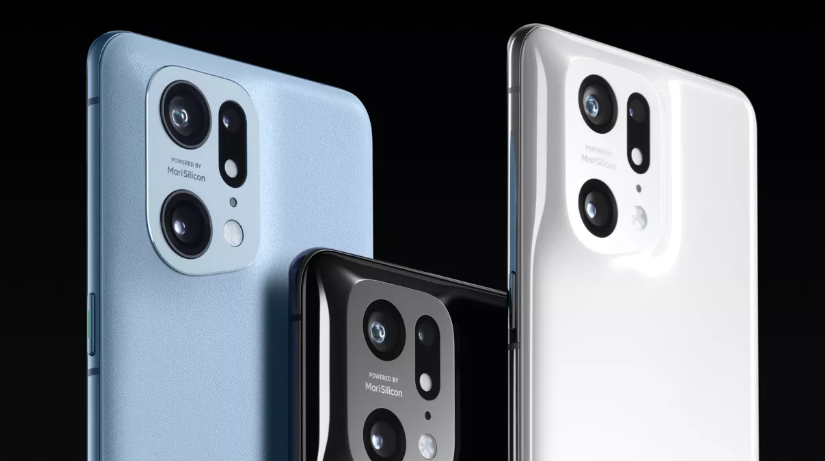
OPPO回应“屏幕绿线”问题:购机4年内免费换屏
Ju Chao Zi Xun· 2025-10-25 07:35
Core Viewpoint - OPPO has responded to the "green line" issue affecting its smartphones by offering free screen replacements for devices purchased within four years and discounted replacement options for devices older than four years, aiming to address consumer concerns and uphold brand responsibility [1][3]. Group 1: Issue Overview - The "green line" issue, characterized by vertical green or purple lines appearing on screens without external impact, has been reported by numerous OPPO and OnePlus users since the second half of this year [3]. - Affected models include OPPO Find X2, X3, X5 series, OPPO Reno 5, 6, 9 series, and OnePlus 8, 9, 10, 11, and Ace series, primarily released between 2019 and 2023 [3]. - Complaints have surged, particularly from users whose devices showed issues just after the warranty period, leading to dissatisfaction with OPPO's after-sales policy [3]. Group 2: Company Response - In response to growing public pressure, OPPO announced on October 24 that it would provide free screen replacements for devices purchased within four years and discounted options for those older than four years [3]. - This policy is seen as a direct response to consumer demands, aiming to bridge the gap between standard warranty periods and the exposure of potential product defects [3]. Group 3: Market Context - The "green line" incident occurs amid intense competition in the smartphone market, with major brands like Apple, Xiaomi, vivo, and Honor launching new products since September [4]. - OPPO recently launched its flagship OPPO Find X9 series, which features the first domestic eSIM functionality, making the timing of the quality issue particularly critical [4]. - According to QuestMobile, OPPO has a high brand loyalty rate, with 45% of users opting for brand upgrades, making the resolution of the "green line" crisis vital for maintaining its market position [4]. - Market research from Omdia and IDC indicates that the sales gap among the top five smartphone manufacturers in China is within 6 million units, highlighting the competitive landscape [4].