
Zhong Guo Dian Li Bao

Search documents
陕西电力用电信息采集系统 实现全栈国产化改造
Zhong Guo Dian Li Bao· 2025-12-15 02:55
同时,针对营销业务特性开展11项技术攻关,优化分布式计算策略,提升业务适配度及数据写入性能。 创新实施"冷热数据独立迁移+高并发多切片迁移"组合方案,调优迁移工具,大幅提升迁移速率。改造 过程中,首创数据库查询自动在线转化等技术,填补了国内业务在线动态适配技术的空白。(雷婧婷 施文) 责任编辑:于彤彤 为响应国家信息安全和数据自主可控号召,落实国企数字化系统国产化替代任务。12月5日,国网陕西 省电力有限公司新一代用电信息采集系统(以下简称"采集2.0"系统)完成国产高斯数据库单轨割接上 线,标志着陕西电力成功建成了首套服务器、操作系统、数据库全栈国产化的"采集2.0"系统,打响了 国家电网有限公司采集系统全国产化的"第一枪"。 面对采集业务时效性强、并发量高、数据量大且无国产化改造经验的严峻形势,以及国产服务器与操作 系统不匹配、国产数据库高并发写入响应迟缓、海量数据迁移速率低等关键技术难题,陕西电力营销、 数字化专业协同,组织国网陕西营销服务中心联合国网陕西信通公司及南瑞集团、华为公司等单位组建 技术团队,深入论证、反复验证,选用华为鲲鹏ARM架构服务器与麒麟信安V3操作系统,全力攻克源 码级编译难题,完 ...
国家电投经营管理部解读集中式新能源市场报价新规
Zhong Guo Dian Li Bao· 2025-12-15 01:12
一、出台背景:新能源入市交易面临结构性难题 集中报价机制赋能新能源市场化转型 ——《关于优化集中式新能源发电企业市场报价的通知(试行)》解读 国家电力投资集团有限公司经营管理部副总监 蒋艳丽 国家发展改革委、国家能源局近日印发的《关于优化集中式新能源发电企业市场报价的通知(试行)》 (以下简称《通知》),是我国电力市场化改革进程中一项重要创新。该文件立足于新能源发展的实际 特点,针对当前市场化交易中存在的突出问题,提出了集中式新能源发电企业参与市场报价的优化方 案。这一机制的建立,不仅有助于提升新能源企业的市场竞争力,更是构建新型电力系统、推动能源绿 色转型的关键举措,对促进新能源产业高质量发展具有重要意义。 一是明确集中装机规模。参与集中报价的新能源发电企业,原则上集中后的总装机规模不应超过所在省 (区、市)电力市场单个最大燃煤发电厂装机规模(不含特高压输电通道配套电源)。煤机是当前电力 市场中最常见的定价机组,以燃煤发电厂装机作为参照,既确保了新能源企业能够形成适度规模,又避 免了新能源市场力的过度集中。 二是明确经营主体范围。《通知》明确,原则上仅允许同一集团(同一母公司、同一控股股东、同一实 际控制人 ...
北京电力交易中心解读集中式新能源市场报价新规
Zhong Guo Dian Li Bao· 2025-12-15 01:05
宽约束、严监管 更好规范新能源发电全量入市 ——《关于优化集中式新能源发电企业市场报价的通知(试行)》解读 一是明确集中报价的定义与适应范围。新能源发电集中报价特指同一集团内、同一省(区、市)的集中 式新能源发电企业在同一固定场所参与电能量市场交易的行为,禁止跨集团、跨省集中报价。适用范围 包括电力现货市场正式运行和连续结算试运行地区的中长期电能量集中交易和现货电能量交易。 三、政策落地有关思考 规范市场交易行为,是有效防范市场运营风险、有力维护公平竞争秩序的重要举措。近期,国家发展改 革委、国家能源局印发《关于优化集中式新能源发电企业市场报价的通知》(以下简称"通知"),首次 明确了集中式新能源发电企业集中报价的定义边界与行为准则,对推动形成规则清晰、竞争有序、监管 有力的新能源全面入市新格局具有重要意义。 一、政策出台的背景与意义 《通知》深入贯彻落实党中央、国务院关于电力市场化改革与绿色低碳转型的决策部署,更好落实新能 源全面入市要求,针对新能源发电企业资源分布离散、场站位置偏远、交易能力较弱的客观特点,允许 同一集团内、同省域的新能源发电企业在固定场所集中进行报价。《通知》兼顾行业健康发展与电力市 场 ...
全国统一电力市场建设取得重要阶段性成效
Zhong Guo Dian Li Bao· 2025-12-15 01:04
Core Insights - 2025 is a pivotal year for achieving the "14th Five-Year Plan" goals and transitioning to the "15th Five-Year Plan," marking significant progress in the national unified electricity market system [1] Group 1: Market Development - China's electricity market transaction scale has reached the largest globally, with market transaction electricity accounting for 63.4% of total electricity consumption, and renewable energy market transactions making up 57% [1] - The establishment of a normalized trading mechanism across grid operating areas has been largely achieved, enhancing the optimization of electricity resource allocation [1] - The electricity traded under this mechanism has exceeded 22 billion kilowatt-hours, demonstrating improved inter-grid electricity support [1] Group 2: Spot Market Operations - The spot market has been fully operational, achieving comprehensive coverage of all electricity market categories, with 28 provinces conducting continuous spot trading [2] - Inter-provincial spot market transactions reached 331.4 billion kilowatt-hours from January to October, accounting for 14.8% of total spot electricity [2] - The Southern regional electricity market has transitioned to continuous operation, marking a significant breakthrough in regional economic collaboration [2] Group 3: Regulatory Framework - A basic national unified rules system has been established, facilitating the integration and resource allocation across the electricity market [3] - The foundational rule system, including mid-term, spot, and ancillary service rules, has been developed to support the standardized operation of the national unified electricity market [3] - The construction of a unified electricity market is crucial for deepening electricity system reforms and supporting high-quality economic development [3] Group 4: Energy Security and Green Transition - During peak summer demand, cross-regional transmission capacity reached a maximum of 151 million kilowatts, significantly improving energy supply stability [4] - Green electricity trading has seen an annual growth rate of nearly 180%, with over 13.5 billion green certificates traded, supporting the development of renewable energy [4] - The market has contributed to lowering energy costs, with industrial and commercial electricity prices remaining competitive internationally [5] Group 5: Resource Allocation Efficiency - From January to October 2025, cross-provincial and cross-regional trading volume reached 1.3 trillion kilowatt-hours, growing by 12.5% year-on-year [5] - The Southern regional electricity market has become the largest unified clearing electricity spot market globally, effectively addressing the mismatch between resource-rich areas and load centers [5] - The ongoing development of the electricity market system is expected to enhance the resilience of the electricity system and accelerate the green transition [5]
龙源电力、国能江苏公司解读集中式新能源市场报价新规
Zhong Guo Dian Li Bao· 2025-12-14 08:17
Core Viewpoint - The article discusses the significance of the "Notice on Optimizing Market Quotation for Centralized Renewable Energy Power Generation Enterprises (Trial)" issued by the National Energy Administration, emphasizing its role in addressing market challenges and promoting high-quality energy development during the ongoing energy transition [1]. Group 1: Market Order and Fair Competition - The efficient operation of the electricity market relies on a fair and orderly competitive environment, which is increasingly challenged as renewable energy transitions from policy support to market dominance [2]. - The policy establishes a market order prevention system to address issues like collusion and price manipulation, ensuring compliance with the Anti-Monopoly Law of the People's Republic of China [2]. - It sets clear boundaries for centralized pricing, allowing only enterprises within the same group and province to participate, thus preventing the formation of price alliances across different groups [2]. Group 2: Price Order and Transparency - The policy introduces a dual mechanism of "warning + transparency" to regulate pricing, requiring trading institutions to establish price warning intervals to monitor abnormal pricing behaviors [3]. - It mandates full transparency in the quotation process, addressing information asymmetry and ensuring that pricing reflects fair, legal, and honest principles [3]. - This combination of technical controls and procedural norms aims to stabilize market prices, ensuring they accurately reflect costs and supply-demand relationships [3]. Group 3: Efficiency and Process Optimization - The growth of the renewable energy sector necessitates an efficient trading mechanism, as centralized renewable enterprises often face challenges due to their small scale and dispersed nature [4]. - The policy allows multiple entities within the same group to aggregate for centralized pricing, optimizing processes and reducing transaction costs while enhancing market efficiency [4]. - This reform approach respects the operational characteristics of renewable energy enterprises and aligns with the goal of optimizing resource allocation in the unified national electricity market [4]. Group 4: Technological Empowerment and Digital Regulation - The shift to digital regulation is essential as the variety and frequency of electricity trading increase, necessitating a more precise and real-time regulatory approach [6]. - The policy emphasizes the development of a digital regulatory platform to monitor centralized pricing behaviors, enabling real-time tracking and analysis of trading anomalies [6]. - This technological empowerment enhances regulatory efficiency and reduces costs, allowing for comprehensive lifecycle management of market behaviors [6]. Group 5: Modernization of Governance - The implementation of digital regulation reflects a modernization of governance capabilities in the electricity market, facilitating precise control over provincial transactions and laying the groundwork for regional and national market coordination [7]. - The article highlights the three-dimensional institutional innovations of the policy, which create a supportive system for the entry of renewable energy into the market, addressing current market challenges and contributing to the construction of a new power system [7][8].



17亿千瓦新能源如何破局“单打独斗”?
Zhong Guo Dian Li Bao· 2025-12-12 07:16
Core Viewpoint - The introduction of a new policy by the National Development and Reform Commission and the National Energy Administration marks a significant shift in the participation of renewable energy in the electricity market, allowing for "consolidated bidding" instead of the previous "individual bidding" approach [2][4]. Group 1: Policy Implementation - The new policy allows renewable energy plants within the same group and province to consolidate their market participation, addressing operational pain points and reducing transaction costs [2][4]. - The policy sets strict eligibility criteria for consolidated bidding and imposes a scale limit to prevent regional market dominance, ensuring fair competition [2][4]. - The policy aims to provide a clear framework for renewable energy enterprises, facilitating a transition from high-speed growth to high-quality development [2][4]. Group 2: Market Structure Optimization - As of October 2025, China's cumulative installed capacity for wind and solar power is projected to reach 1.73 billion kilowatts, transitioning renewable energy from a supplementary role to a primary one in the electricity system [4]. - The traditional bidding model has become inadequate for the dispersed nature of renewable energy, creating an asymmetric competitive landscape that hinders market participation [4][5]. - The new policy establishes a clear set of rules and guidelines to prevent monopolistic practices while promoting collaborative strategies among renewable energy enterprises [5][6]. Group 3: Operational Efficiency - The shift to consolidated bidding is expected to transform the cost center of trading into a value engine by allowing resource integration and unified strategies [8][9]. - The policy reduces the need for dedicated trading personnel for each renewable site, lowering operational costs and enhancing market negotiation capabilities [8][9]. - By enabling a unified trading strategy, the policy allows for better risk management and market analysis, improving overall operational efficiency [9][10]. Group 4: Energy Transition Support - The policy is a crucial step in restructuring the electricity market, promoting multi-energy collaboration and enhancing system efficiency [10][11]. - It lays the groundwork for a unified national electricity market, addressing supply-demand imbalances caused by regional resource disparities [11][12]. - The implementation of this policy is expected to stimulate market vitality and innovation in renewable energy, supporting the transition to a low-carbon economy [12][13].
中广核电力总裁调整
Zhong Guo Dian Li Bao· 2025-12-12 03:36
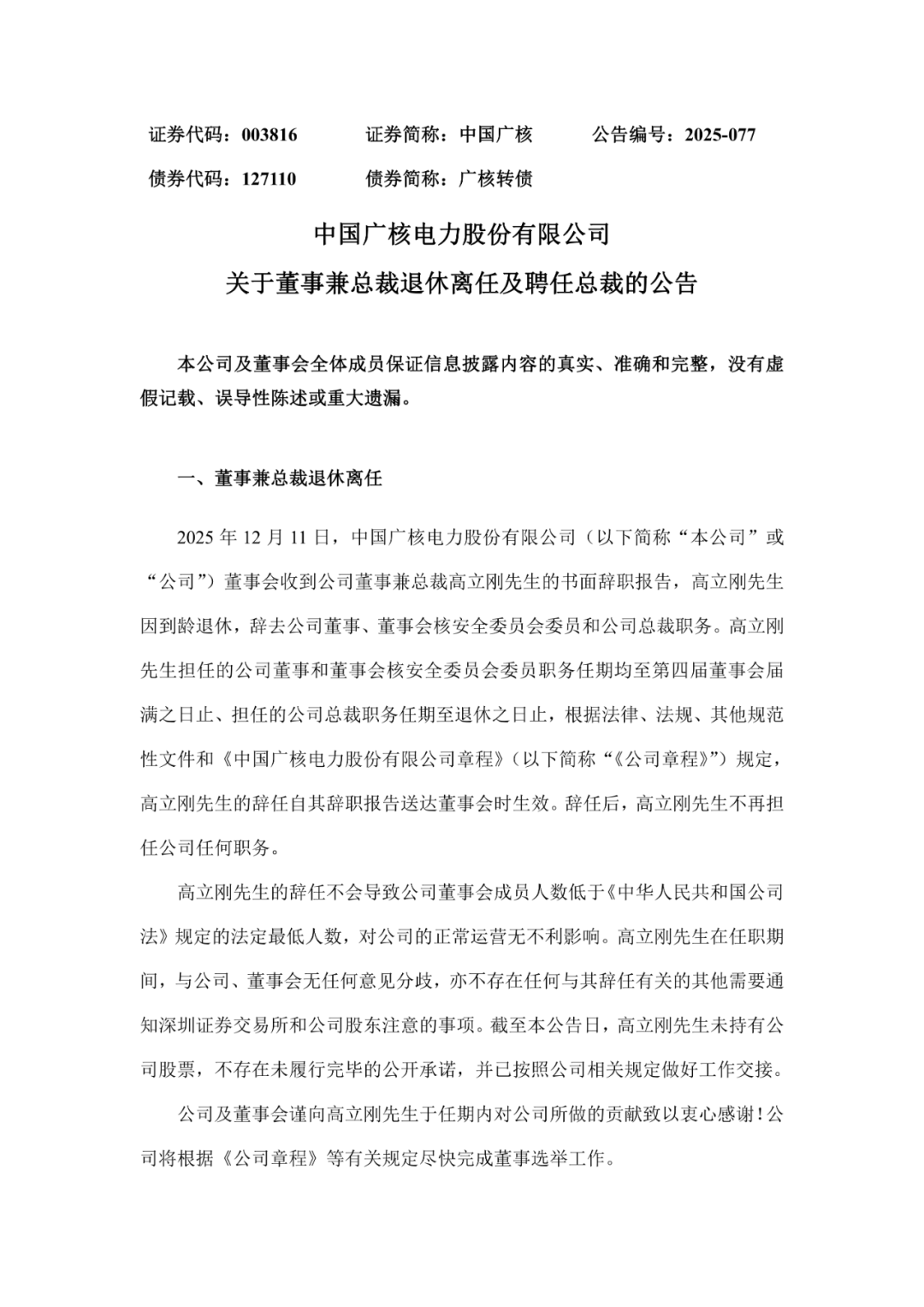
Core Points - China General Nuclear Power Corporation (CGN) appointed Mr. Pang Songtao as the new president, effective from December 11, 2025, until December 31, 2027, following the retirement of Mr. Gao Ligang due to age [1][5][7] - Mr. Gao Ligang submitted his resignation as a director and president, which took effect immediately upon delivery of his resignation report to the board [5][6] - Mr. Pang Songtao has over 30 years of experience in the nuclear power industry, having held various leadership positions within CGN and its subsidiaries [2][7] Group 1: Retirement of the Previous President - Mr. Gao Ligang's resignation was due to reaching retirement age, and he will no longer hold any position within the company after his resignation [5][6] - His departure will not affect the board's compliance with the minimum member requirements as per Chinese company law [5] Group 2: Appointment of the New President - The board approved the appointment of Mr. Pang Songtao as president after a nomination process, with his term set until the end of 2027 [1][7] - Mr. Pang's extensive background in the nuclear sector includes roles such as Vice General Manager of CGN Nuclear Power Operations and General Manager of CGN Research Institute [2][7]
广西首个电碳计量应用项目落地
Zhong Guo Dian Li Bao· 2025-12-12 01:41
Core Viewpoint - The successful installation of electric carbon metering devices in key user locations in Nanning marks the official launch of Guangxi's first electric carbon metering project, filling a practical gap in the region and promoting green energy development and public welfare [1] Group 1: Project Implementation - The Nanning Power Supply Bureau completed the installation of electric carbon metering devices at 10 key user sites, including the Nanning International Convention and Exhibition Center and the Wuxiang Energy Comprehensive Charging Station [1] - The project aligns with the national strategy for green and low-carbon energy transition, focusing on supporting government green management and assisting enterprises in their green transformation [1] Group 2: Technical Achievements - The project achieved precise carbon measurement for a total electricity consumption of 15.138 million kilowatt-hours across the pilot enterprises, establishing a direct mapping channel between electricity data and carbon emissions [1] - This initiative provides an efficient and accurate solution for carbon accounting, enhancing the capability for real-time monitoring of carbon emissions across various sectors [1] Group 3: Impact on Policy and Business - The diverse pilot users include large public venues, new energy infrastructure, rural zero-carbon demonstrations, and key industrial enterprises, covering critical areas such as urban services, transportation, rural revitalization, and industrial development [1] - The project's success will provide authoritative data for government departments to understand carbon emissions and assist in formulating regional green development policies and energy planning [1] - It also supports enterprises in applying for Guangxi green electricity certificates, contributing to cost reduction and efficiency improvement [1]
“十五五”小众能源十大看点:分布式天然气、生物质能、地热供暖……
Zhong Guo Dian Li Bao· 2025-12-11 06:23
Core Viewpoint - Niche energy sources in China, including distributed natural gas, biomass energy, geothermal energy, and ocean energy, are gaining strategic importance in the context of the "dual carbon" goals and the critical period of the 14th Five-Year Plan, potentially becoming significant supplements to mainstream energy sources and supporting energy security and ecological protection [1] Group 1: Distributed Natural Gas - Distributed natural gas can provide multi-energy supply with a comprehensive energy utilization rate exceeding 70%, but its development is constrained by high costs and dependence on external sources [3] - The cost of gas-electricity integration ranges from 0.59 to 0.72 yuan per kilowatt-hour, significantly higher than mainstream energy sources [3] - Policy incentives, such as the revised "Natural Gas Utilization Management Measures" and the peak production plan for gas peak-shaving power stations, are expected to drive the growth of distributed natural gas [3] Group 2: Biomass Energy - Biomass energy, derived from organic waste, has a low utilization rate of 11.8% in China, but is expected to accelerate development due to renewable energy replacement actions [5] - By the end of 2024, biomass power generation capacity is projected to reach 45.99 million kilowatts, with an annual generation exceeding 208.3 billion kilowatt-hours [5] - The development of biomass energy should focus on integrating it into renewable energy strategies and expanding applications in hydrogen production and cellulose ethanol [5] Group 3: Biomass Power Generation - Biomass power generation includes agricultural, forestry, and waste biomass, with installed capacities of 17.09 million kilowatts, 27.38 million kilowatts, and 2.52 million kilowatts respectively by 2024 [7] - The sector faces challenges such as subsidy reductions, unstable fuel supply chains, and low efficiency [7] - Solutions include promoting new technologies, standardizing operations, and exploring new profit models [7] Group 4: Biomass Co-firing - Biomass co-firing is identified as a key method for reducing carbon emissions in coal power plants, with projects demonstrating significant CO2 reduction [10] - The annual biomass resource generation in China exceeds 9 billion tons, and a 60% recovery rate could meet energy needs [10] - The integration of biomass energy with carbon capture technology is recognized as a core path to carbon neutrality [10] Group 5: Geothermal Heating - Geothermal heating is positioned as a crucial clean heating solution for northern cities, with a projected heating area of nearly 900 million square meters by 2025 [12] - Currently, 95% of heating relies on fossil fuels, contributing to significant carbon emissions [12] - Geothermal energy can be integrated with other renewable sources to create demonstration projects that reduce dependency on single resources [12] Group 6: Geothermal Power Generation - China's geothermal power generation capacity is currently only 61.47 megawatts, ranking 19th globally [14] - The development is hindered by economic factors, resource concentration in less developed areas, and inadequate policies [14] - To catch up, efforts should focus on technology breakthroughs, cost reduction, and policy improvements [14] Group 7: Hot Dry Rock Power Generation - Hot dry rock resources in China are substantial, with a potential to meet energy needs for 4,000 years [16] - The technology is still in the early stages of commercialization, facing challenges in extraction and cost [16] - If breakthroughs are achieved during the 14th Five-Year Plan, hot dry rock power could become a disruptive energy source [16] Group 8: Ocean Energy - Ocean energy, including tidal and wave energy, has a potential development capacity of 650 million kilowatts [18] - Recent advancements have positioned China as a leader in ocean energy technology [18] - The sector is still in the demonstration phase, with high costs and technical challenges to overcome [18] Group 9: Integrated Development - The integration of ocean energy with other sectors, such as desalination and offshore oil and gas platforms, is being promoted [21] - Successful pilot projects have demonstrated the potential for cost reduction and resource efficiency [21] - The focus during the 14th Five-Year Plan should be on developing large-scale demonstration projects to drive industry growth [21] Group 10: Combustible Ice - Combustible ice resources in the South China Sea are equivalent to 65 billion tons of oil, with potential for over 130 years of supply [23] - The main challenges include high extraction costs and ecological protection [23] - A technological breakthrough in extraction could significantly enhance the prospects for combustible ice as a marine energy source [23]
电投产融即将问鼎“核电第三极”
Zhong Guo Dian Li Bao· 2025-12-10 09:55
Core Viewpoint - The restructuring of State Power Investment Corporation's financial and nuclear power assets marks a significant step towards transforming into a focused nuclear power platform, aligning with national energy transition goals [1][3][6]. Group 1: Restructuring Details - State Power Investment Corporation plans to exchange its 100% stake in State Power Investment Capital Holdings for a 100% stake in State Power Nuclear Energy, valued at 553.94 billion yuan, with a cash difference of 402.85 billion yuan to be paid through the issuance of shares at 3.36 yuan per share [3][4]. - The total number of shares to be issued is 11.99 billion, with State Power Nuclear receiving 7.58 billion shares and China Life Insurance receiving 4.41 billion shares [3][4]. - The company will also raise up to 5 billion yuan from no more than 35 specific investors to fund the construction of units 3 and 4 of the Shandong Haiyang Nuclear Power Station [3]. Group 2: Strategic Focus Shift - The restructuring signifies a shift from a dual business model of "energy + finance" to a clear focus on nuclear power integration, responding to national clean energy development strategies [6][10]. - The decision to divest financial operations and concentrate on nuclear power is driven by both strategic positioning and regulatory pressures, enhancing operational efficiency within the nuclear sector [6][10]. - Performance compensation agreements have been established, with commitments for net profits of no less than 3.375 billion yuan, 3 billion yuan, and 3.587 billion yuan for the years 2025 to 2027, ensuring shareholder interests are protected [7]. Group 3: Nuclear Power Development - As of September 2023, State Power Investment Corporation operates and is constructing eight nuclear power units, with a total installed capacity of approximately 18.81 million kilowatts [9]. - The Shandong Haiyang Nuclear Power Station is a key project, with units 1 and 2 having generated over 130 billion kilowatt-hours, while units 3 and 4 are in the installation phase and expected to be operational by 2027 [9]. - The restructuring is expected to facilitate the aggregation of quality resources towards advantageous industries, further supporting the company's commitment to carbon neutrality goals [9][10].
