
Zhong Guo Dian Li Bao

Search documents
百亿重组落地,电投能源将去向何方?
Zhong Guo Dian Li Bao· 2025-11-18 04:19
Core Viewpoint - The restructuring of Inner Mongolia Electric Power Investment Co., Ltd. (Electric Power Investment) has been successfully completed, increasing its market value from 40 billion to 60 billion yuan, and reinforcing its strategic position within the State Power Investment Corporation [1][2]. Group 1: Restructuring Details - The restructuring plan was announced on April 30, with the formal disclosure of the draft on November 14, involving the acquisition of 100% equity of Baiyin Hwa Coal Power Co., Ltd. for 11.149 billion yuan [2][3]. - The transaction will reduce the largest shareholder's stake from 55.77% to 43.24%, while the Inner Mongolia Energy Company will become the second-largest shareholder with a 22.46% stake [2][3]. - The share issuance price is set at 14.77 yuan per share, with 649 million shares to be issued, representing 22.46% of the total share capital post-transaction [2][3]. Group 2: Financial Impact - The net asset value of Baiyin Hwa Coal Power is assessed at 10.998 billion yuan, with a 46% appreciation over its book value [3]. - Post-transaction, Electric Power Investment's total assets will increase from 54.979 billion yuan to 80.079 billion yuan, while total liabilities will rise from 14.989 billion yuan to 33.318 billion yuan, leading to an increase in the debt-to-asset ratio from 27.26% to 41.61% [3][4]. - The company reported a revenue of 22.403 billion yuan for the first three quarters, a year-on-year increase of 2.72%, but a net profit decline of 6.40% [3][4]. Group 3: Performance Commitments - The restructuring includes performance commitments, ensuring that Baiyin Hwa Coal Power achieves a cumulative net profit of no less than 1.663 billion yuan during the commitment period [4]. - If the transaction is completed by 2026, the profit commitments for the subsequent years are specified, with adjustments if the transaction is delayed [4]. Group 4: Strategic Advantages - The acquisition will enhance Electric Power Investment's coal production capacity from 48 million tons to 63 million tons, a 31.3% increase, and strengthen its "coal-electricity-aluminum" synergy [6][7]. - Baiyin Hwa Coal Power's operations align with Electric Power Investment's business focus, contributing significantly to its revenue and profit margins [7]. - Analysts predict that the acquisition will increase Electric Power Investment's annual net profit by approximately 1.867 billion yuan, enhancing its competitive edge in the industry [6][7]. Group 5: Market Reaction and Valuation - Following the announcement of the asset restructuring, Electric Power Investment's stock price has risen over 62%, adding more than 20 billion yuan to its market capitalization [7][8]. - Current estimates suggest that the intrinsic value of Electric Power Investment could reach 94.375 billion yuan, indicating potential for further market recognition and valuation increase [8].

渝黔等5项电力灵活互济工程获核准
Zhong Guo Dian Li Bao· 2025-11-18 03:27
Core Points - The approval of five back-to-back projects by the National Development and Reform Commission (NDRC) will enhance inter-provincial power support and provide reliable electricity for economic development [1][2] - The total investment for these projects is 24.4 billion yuan, which includes the construction of five 3 million kilowatt flexible direct current converter stations and 1,227 kilometers of 500 kV access system lines [1] - The projects are part of the "14th Five-Year" electricity development plan and are expected to be operational before the summer peak in 2027 [1][2] Group 1 - The five approved projects include the Chongqing-Guizhou, Hunan-Guangdong, Hunan-Guizhou, Fujian-Jiangxi, and Anhui-Hubei projects [1] - The State Grid Corporation of China and the Southern Power Grid Company are leading the construction of these projects, ensuring effective collaboration and coordination [2] - The projects aim to improve the safety, reliability, and economic efficiency of the power system while supporting the construction of a unified national electricity market [3] Group 2 - The National Energy Administration has emphasized the acceleration of project planning and construction, with the State Grid Company taking a proactive role in organizing and coordinating efforts [2] - A joint working group has been established between the State Grid and Southern Power Grid to enhance technical and management collaboration for the projects [2] - The focus is on high standards and quality in the construction process, ensuring timely completion and operational readiness [3]
内蒙古电力集团与南方电网签署“柔性直流技术”合作协议
Zhong Guo Dian Li Bao· 2025-11-18 03:27
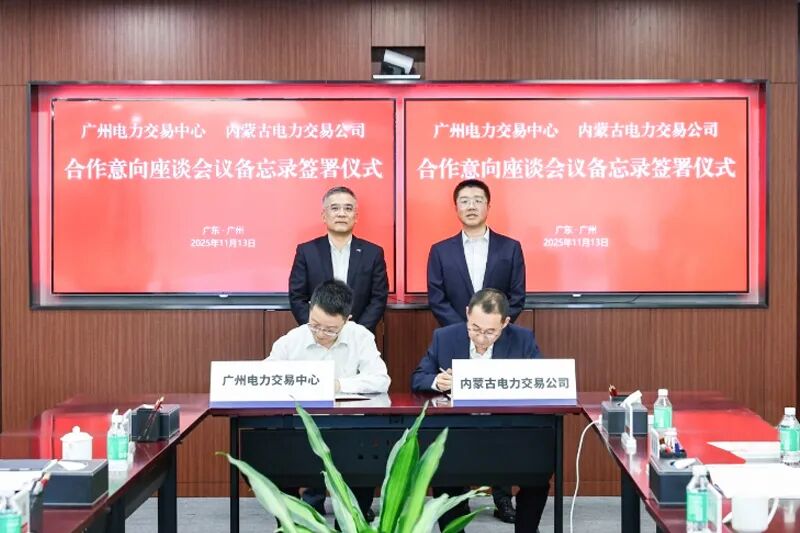
在粤期间,张晓虎一行分别到南方电网数研院、产业发展集团、能源研究院、综合能源公司、广东电网公司、广 州电力交易中心、国家新型储能创新中心,就能源政策研究、电网规划建设、电力交易外送、生产智能运检、新 兴产业发展及新型储能、零碳园区、虚拟电厂、数智转型等方面,与南方电网有关单位座谈交流并实地调研。内 蒙古电力交易公司与广州电力交易中心就绿电绿证跨区交易、市场体系建设研究、干部人才培养锻炼签署合作备 忘录;内蒙古电力经研院与广东电网规划研究中心签署"柔性直流技术"合作协议。 来源:内蒙古电力集团 内蒙古电力集团党委副书记、总经理张晓虎带队赴南方电网公司调研交流 近日,内蒙古电力集团党委副书记、总经理张晓虎带队,赴中国南方电网公司调研,与南方电网公司董事、总经 理、党组副书记钱朝阳举行会谈,双方就进一步深化战略合作进行深入交流。 钱朝阳欢迎张晓虎一行到访,感谢内蒙古电力集团长期以来对南方电网公司的支持。钱朝阳表示,南方电网公司 深入学习贯彻党的二十届四中全会精神,加快建设新型能源体系和新型电力系统,全面融入全国统一电力市场建 设。南方电网公司与内蒙古电力集团合作基础深厚,展望"十五五",希望双方加大交流合作力度,立 ...

月均产煤量超5000万吨,国家能源集团多举措保障冬季能源稳定供应
Zhong Guo Dian Li Bao· 2025-11-18 01:57
Group 1 - The company is enhancing energy supply security in response to increased winter energy demand through capacity improvement and transportation optimization [1] - The company aims to maintain stable high coal production, with coal supply reaching nearly 100 million tons in October, a year-on-year increase of 2.2% [3] - The company has strengthened railway and port coordination, achieving an average daily loading of 1.07 million tons of coal in October, maintaining a high level for the same period [3] Group 2 - The company adheres to the principle of "coal determines electricity, heat determines electricity," with electricity generation increasing by 5% year-on-year in October [3] - New power generation units at the Zhejiang Beilun power plant have been put into operation, significantly reducing coal consumption for power supply [3] - The company has successfully delivered over 1.2 billion kilowatt-hours of clean electricity from the Ningxia Tengger photovoltaic base to Hunan, showcasing the collaborative role of diverse energy sources in winter supply [3] Group 3 - In heating services, the company has focused on the eastern and northeastern regions, with 64% of heating units operational by November 10 [4] - Liaoning Thermal Company commenced heating three days ahead of schedule, covering 200,000 households [4] - The company has implemented network upgrades in Heilongjiang to address heating issues in certain areas, effectively enhancing winter energy supply for residents [4]

月均产煤量超5000万吨,国家能源集团的保供底气在这儿
Zhong Guo Dian Li Bao· 2025-11-17 08:43
秋意散尽,朔风渐起,凛冽寒意悄然来袭。从漠河的林海雪原到江南的烟雨街巷,从蒙东的辽阔草原到 川蜀的丘陵盆地,千家万户对温暖的期盼,正转化为能源保供战场上最紧迫的号角。在这寒冬时节,国 家能源集团各条保供战线上却处处是一片热火朝天的景象。井巷深处,机械轰鸣不绝于耳;运输动脉, 奔涌铁流川流不息;电厂厂区,机组运行昼夜不停,这冲天斗志与拳拳之心交融共鸣,化作源源不断的 暖流,涌向千家万户、点亮烟火人间。 进入冬季,面对严峻神圣的保供职责,国家能源集团锚定"保民生、保安全、保稳定"核心目标,深入发 挥一体化保供能力,充分释放优质产能,坚持"以煤定电、以热定电",全力以赴保产量、保供应、保民 生,以高度的政治责任感和使命感扛起保障迎峰度冬用能需求重任,守护人民群众温暖过冬。今年前10 个月,国家能源集团月均产煤量超5000万吨。 保产量,筑牢能源保供产能支撑 面对保供重任,国家能源集团将保持煤炭稳产高产作为首要任务,重点强化煤炭资源组织,加大外采和 储备力度。10月以来,已向全国供应商品煤近亿吨,同比增长2.2%,蒙东东北等关键区域稳步提升库 存,全力保障资源充足。联动运输环节,通过精细化管理深挖产能、筑牢运输防线, ...
南方电网广东电网公司:从“人工评分”到“AI考评”
Zhong Guo Dian Li Bao· 2025-11-17 06:41
Core Insights - The Southern Power Grid Guangdong Electric Power Company has developed a remote intelligent evaluation system supported by digital and intelligent technologies, marking a significant shift from manual on-site scoring to AI-driven remote automatic scoring, enhancing fairness and efficiency in skill evaluation [1][2] Group 1: AI Integration in Skill Assessment - The traditional skill assessment in the power industry relied on on-site evaluators, which was subject to subjective influences. The Guangdong Electric Power R&D team has integrated advanced technologies such as voice recognition, computer vision, and deep learning to create an AI algorithm base for skill assessments [2] - The AI system has achieved an accuracy rate of over 85% in scoring pilot test questions after extensive data collection and training, addressing concerns about evaluators missing operational details during assessments [2] Group 2: One-Stop Service System - The intelligent evaluation system is developed on the internal power grid management platform, providing customized interfaces for different roles and achieving seamless integration with existing evaluation systems for a complete online management process [3] - The system can support simultaneous online examinations for 10 positions and generates real-time results, significantly improving efficiency compared to traditional methods that required extensive coordination [3] - A dual-track model of "AI scoring + manual review" is employed, where AI quickly scores objective evaluation items while experienced evaluators review key aspects, reducing overall assessment time by 30% [3] Group 3: Comprehensive Talent Development - The intelligent evaluation system extends its value beyond assessment to encompass teaching and practice, introducing a model of "intelligent internal trainers + intelligent evaluators" in training programs [4] - The system monitors practice sessions in real-time and provides corrective feedback, generating personalized analysis reports to identify individual weaknesses [4] - The innovative application of this system has received multiple accolades, including the "Digital Technology Innovation Application Award" from the State-owned Assets Supervision and Administration Commission, exemplifying the integration of digital transformation and skill talent development in the power industry [4]
重庆首用双臂带电机器人搭接引流线
Zhong Guo Dian Li Bao· 2025-11-17 06:39
Core Insights - The introduction of the RJ1300 dual-arm collaborative power distribution robot marks a significant advancement in the use of robotics for live-line work in Chongqing, enhancing operational efficiency and safety [1][2] Group 1: Technology and Innovation - The RJ1300 robot incorporates advanced technologies such as multi-sensor fusion for intelligent perception, visual servo-based intelligent planning, and data-driven learning for autonomous upgrades, ensuring high voltage safety and electromagnetic compatibility [1] - The robot achieved a "zero electric shock" safety standard, providing complete physical isolation between operators and high voltage environments, which is a critical breakthrough in safety technology [2] Group 2: Operational Efficiency - The robot completed the live-line connection task for three wires in just 35 minutes, reducing the time taken by 35 minutes compared to manual operations, demonstrating a significant improvement in efficiency [1] - Overall, the efficiency of operations using the RJ1300 robot is reported to be over 40% higher than traditional manual methods, alongside a notable increase in work quality [2] Group 3: Future Developments - Chongqing Electric Power plans to expand the application of dual-arm power distribution robots across various scenarios and simultaneously develop specialized talent for intelligent live-line operations, aiming for a transition towards "fewer personnel and unmanned" operations [2]

西藏首用绝缘脚手架进行配网带电作业
Zhong Guo Dian Li Bao· 2025-11-17 06:39
近日,在西藏日喀则市昂仁县卡尔琼村,国网西藏电力有限公司首次采用绝缘脚手架技术,于海拔4300 米的10千伏昂府141线成功完成一、二次融合断路器安装、接火及绝缘子绑扎消缺作业,刷新了全国配 网同类作业的最高海拔纪录,为高原复杂地形配网运维开辟了创新路径。 西藏地区地形崎岖复杂,草原、山区等区域普遍存在绝缘斗臂车难以进入的痛点。为破解这一难题,公 司运检专业团队创新性地将绝缘脚手架技术应用于高海拔配网作业。该设备具备组装灵活、适配性强等 优势,成功突破了特种作业车辆的通行限制,破解了高海拔偏远区域带电作业难题。 本次作业创新采用"属地+带电"协同流水线作业模式,实现专业化分工与高效联动:由属地县公司负责 下层绝缘脚手架的搭建及基础设备安装,带电作业人员同步推进上层脚手架搭建与开关接入操作。这 种"搭建前置、作业同步、点位循环"的运作机制,既大幅提升了作业效率,更实现了多重效果:一是拓 展了高海拔复杂地形带电作业场景,打破传统模式地形桎梏;二是减少特种车辆出动频次,降低高原山 路运输交通安全风险;三是优化人力资源配置,充分释放团队作战效能,达成安全与效率的双重提升。 据介绍,该创新作业模式的成功应用有望将高原地 ...
全力构建新型电力系统——“十四五”山东电网发展综述
Zhong Guo Dian Li Bao· 2025-11-17 03:13
投运"五交四直一环网",形成全国最大省域交直流混联电网;提速建设全国首个省域特高压"双环网", 打造能源输送"坚强骨架";新能源装机达1.24亿千瓦,领跑省级电网绿色转型……"十四五"期间,国网 山东省电力公司(以下简称"山东电力")深入践行绿水青山就是金山银山理念,坚定当好新型电力系统 建设主力军,积极推进"外电入鲁",为山东产业升级、能源转型和经济社会高质量发展注入强劲动力。 "十四五"期间,山东电网发展建设呈现"大规模、高强度"特征,建成投运特高压直流工程1项,新增换 流容量800万千瓦、输电线路141.4千米(含接地极线路);35千伏及以上工程1043项,新增变电容量 11018.75万千瓦。 面对繁重的电网建设任务,山东电力深入贯彻基建"六精四化"管理思路,在国网系统打造首家基建"六 精四化"创新基地,积极开展"BIM+"技术攻关,自支撑组合大钢模板等一批新技术、新工法在国网系统 推广应用。编制发布国内首套《智慧工地建设规范》,多项工程(成果)获评国家电网公司、中电建 协、中施企协"智慧工地"及优秀案例。 经过多年的发展建设,山东电网500千伏电网形成"六横四纵"环网结构,220千伏变电站实现县域全 ...
国家电投上市公司拟重大资产重组!
Zhong Guo Dian Li Bao· 2025-11-16 22:17
Industry News - The "Regulations on Planning, Construction, and Operation Management of Oil and Natural Gas Infrastructure" will take effect on January 1, 2026, after being approved on October 28, 2025 [4] - In October 2025, the industrial power generation reached 800.2 billion kilowatt-hours, a year-on-year increase of 7.9%, accelerating by 6.4 percentage points compared to September [4] - The cumulative industrial power generation from January to October 2025 was 8,062.5 billion kilowatt-hours, with a year-on-year growth of 2.3% [4] Corporate News - The Central Environmental Protection Inspection Team will conduct inspections on China Huadian, State Energy Group, and China Coal [4] - State Power Investment Corporation's A-share listed company, Power Investment Energy, plans a major asset restructuring to acquire 100% equity of Baiyinhua Coal Power for 11.149 billion yuan, which is expected to significantly enhance its revenue and profit scale [4] Local News - Beijing has added 696 megawatts of heating capacity for the winter heating season, with smart heating covering nearly 100 million square meters [7] - All venues in the Shenzhen competition area of the 15th National Games will use green electricity, reducing carbon emissions by approximately 50,000 tons [7] International News - South Korean President Lee Jae-myung apologized for the Ulsan power plant collapse, which resulted in the deaths of seven workers [9] - Russia's Lukoil is seeking new buyers for its overseas assets as U.S. sanctions are set to take effect on November 21 [9] - Ukrainian President Zelensky announced a comprehensive reform of state-owned energy companies, including financial audits and management restructuring [10]
