
Zhong Guo Dian Li Bao

Search documents
贵州统调装机容量破8000万千瓦
Zhong Guo Dian Li Bao· 2025-09-05 08:52
Group 1 - The total installed capacity of Guizhou's power grid has surpassed 80 million kilowatts, reaching 81.707 million kilowatts, marking a significant milestone in the development of the energy sector in Guizhou [1] - The installed capacity breakdown includes 38.5% from thermal power, 21.6% from hydropower, and 39.9% from renewable energy sources, indicating a shift towards a more diversified energy mix [1] - Guizhou has made substantial progress in upgrading and transforming its energy industry, transitioning from a traditional "water-fire mutual assistance" model to a multi-energy complementary model including wind and solar [1] Group 2 - As of August 27, the coal stock for thermal power in Guizhou reached 13.41 million tons, a year-on-year increase of 46.3%, with an available supply duration of 82.6 days, setting a historical record [2] - The addition of 660,000 kilowatts of new thermal power units has brought the total installed capacity of thermal power to 31.44 million kilowatts [2] - The "coal-for-water" strategy has been effectively implemented to ensure sufficient coal supply and maintain high operational levels of thermal power units, preparing for peak winter demand [2]
能源高质量发展专家谈⑦ | 远方不再“遥远” 高质量充电基础设施体系为人民群众绿色出行保驾护航
Zhong Guo Dian Li Bao· 2025-09-05 07:49
Core Viewpoint - The development of charging infrastructure during the "14th Five-Year Plan" period has significantly supported the rapid growth of the new energy vehicle industry in China, establishing a comprehensive charging network and enhancing the overall market competitiveness [1][2]. Group 1: Achievements in Charging Infrastructure Development - The "14th Five-Year Plan" has marked a critical period for the large-scale development of charging infrastructure, with the number of charging facilities reaching 16.1 million by June 2025, which is 9.5 times that of the end of the "13th Five-Year Plan" [4]. - The total charging volume for new energy vehicles reached 54.923 billion kWh in the first half of 2025, with an increase of 870% compared to the 2020 baseline [4]. - A wide-ranging charging network has been established, with 97% of county towns and 80% of rural towns equipped with public charging facilities, significantly alleviating "charging anxiety" for users [4]. Group 2: Policy Framework and Support - A series of policies have been introduced to guide the development of the charging industry, including the inclusion of charging stations in national long-term bond funding support [3]. - The establishment of a three-tier monitoring platform for charging facilities at the national, provincial, and municipal levels has been accelerated, enhancing data statistics and operational analysis [3]. Group 3: Industry Ecosystem and Market Dynamics - The charging industry has seen active participation from various sectors, including traditional power, telecommunications, and new entrants from automotive, oil, and logistics industries, with over 600,000 existing charging enterprises [6]. - The market environment has become increasingly open, with private enterprises accounting for over 80% of the market, fostering a diverse industrial structure [6]. Group 4: Technological Advancements and Standards - The average power of newly added direct current charging guns increased from 73.90 kW at the end of 2021 to 98.51 kW by June 2025, indicating a trend towards higher power charging facilities [7]. - A total of 67 national, industry, and group standards have been released over the past five years, including the ChaoJi standard, which promotes the progress of high-power charging in China [7]. Group 5: Future Development Goals - By the end of the "15th Five-Year Plan," it is expected that the number of new energy vehicles in China will exceed 100 million, with charging facilities reaching over 50 million [12]. - The focus will be on enhancing the quality and coverage of the charging network, particularly in urban and rural areas, to meet the growing demand for electric vehicle charging [12].
零碳园区建设需政企协同
Zhong Guo Dian Li Bao· 2025-09-05 07:28
Core Viewpoint - The construction of zero-carbon parks is transitioning from conceptual exploration to standardized development, driven by intensified climate change and the implementation of dual carbon strategies [1] Policy Framework - A multi-level policy system has been established, with national, provincial, and local policies providing clear guidance for zero-carbon transformation [2] - The national notice on zero-carbon park construction marks the entry into a standardized phase, focusing on funding mechanisms, technical support, and evaluation systems [2] Provincial Initiatives - Provinces are developing localized zero-carbon park policies based on their resource endowments and industrial foundations, with Jiangsu and Zhejiang setting specific quantitative targets for energy consumption and resource utilization [3] Local Implementation - Cities are focusing on actionable policies with quantifiable goals, such as Wuxi's three-year action plan aiming to establish multiple zero-carbon parks and factories by 2027 [4] - Hangzhou's implementation opinions emphasize a combined approach of policy, market, and technology to support carbon neutrality [4] Case Studies - Suzhou Industrial Park aims for over 30% renewable energy by 2025 and a 50% reduction in carbon intensity compared to 2020 [5] - Shanghai's Taopu Smart City plans to achieve 100% renewable energy supply by 2030, targeting an 80% reduction in carbon emissions [5] Impact on Power Grid Operations - Zero-carbon parks enhance renewable energy consumption, improve grid flexibility, and increase resilience against disasters through microgrid capabilities [7] - The integration of distributed energy resources optimizes load characteristics and enhances the economic and stable operation of the grid [7] Recommendations for Development - Emphasizing the role of power companies in technological innovation and demonstration projects to support zero-carbon park construction [8] - Advocating for policy support and financial incentives to lower operational costs and encourage enterprise participation [8] - Strengthening service optimization and capacity building through comprehensive support and training programs [9]
甘肃新能源月发电量连续半年超80亿千瓦时
Zhong Guo Dian Li Bao· 2025-09-05 07:27
Core Insights - Gansu Province's cumulative renewable energy generation reached 651.13 billion kilowatt-hours (kWh) from January to August, accounting for 39.62% of total power generation, with an expectation to exceed 1,000 billion kWh by 2025 [1] - In August, Gansu's renewable energy generation hit 81 billion kWh, marking the sixth consecutive month above 80 billion kWh, with July's output reaching a record high of 95.99 billion kWh [1] - Gansu Electric Power Company has implemented various measures to support large-scale and high-quality integration of renewable energy, including enhancing peak regulation capabilities and developing a robust inter-regional transmission network [1] Renewable Energy Development - The province's peak regulation capacity has improved, with 4 units of 300,000 kW thermal power decoupled for peak shaving, achieving a peak regulation depth of 33% [1] - The cascade hydropower peak regulation capacity increased by 20% to 4.09 million kW [1] - A "UHV DC + AC interconnection" framework has been established for power transmission, with the "Long Electric into Shandong" project delivering 81.77 billion kWh in its first four months of operation [1] Market Innovations - Gansu has introduced a market-oriented model combining energy storage, frequency regulation, and peak shaving, achieving 2.3 million kW of peak shaving through bilateral trading [1] - The province has also engaged in high-frequency inter-provincial trading, with midday export volumes reaching three times that of evening peak loads [1] External Trade Performance - In the first three quarters, Gansu organized external electricity trading totaling 209.2 billion kWh, reflecting an 18.1% year-on-year increase and a 43.2% quarter-on-quarter increase [2] - The province has developed a multi-decision model for source-storage coordination, implementing intelligent scheduling to enhance the efficiency of renewable energy and storage control [2]
中哈敲定多项大型能源协议!中核集团、中国石油、中国能建、三一集团参与
Zhong Guo Dian Li Bao· 2025-09-04 09:20
Group 1 - The core focus of the meetings was on deepening cooperation in energy sectors, including nuclear energy, renewable energy, and oil and gas processing between Kazakhstan and Chinese companies [1][2] - Kazakhstan President Tokayev expressed confidence in the successful advancement of joint projects, particularly in the nuclear sector, including the construction of a second nuclear power plant in Kazakhstan [2] - Specific cooperation agreements were reached, including a 300 MW solar project in Turkestan, a 160 MW steam turbine project in Aqtau, and a urea project in Aktobe [3] Group 2 - The meetings resulted in over 70 commercial agreements signed during the 8th China-Kazakhstan Entrepreneurs Committee meeting, with a total value exceeding $15 billion, covering key areas such as energy, infrastructure, high technology, and agriculture [3] - The discussions highlighted a new energy cooperation framework based on mutual trust and strategic vision, with Chinese partners showing a clear willingness to invest in Kazakhstan's energy security projects [3] - The modernization of the Chimkent refinery, with an annual processing capacity of 12 million tons, was emphasized as a significant project during the discussions with China National Petroleum Corporation [2]

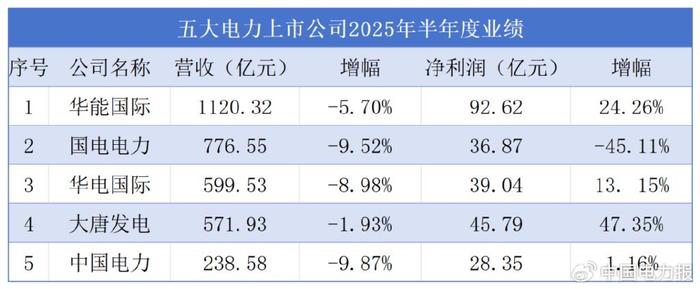
差异明显,五大发电核心上市公司营收最高1120亿、最低238亿!
Zhong Guo Dian Li Bao· 2025-09-04 09:08
| | | | 五大电力上市公司2025年半年度业绩 | | | | --- | --- | --- | --- | --- | --- | | 序号 | 公司名称 | 营收(亿元) | 增幅 | 净利润(亿元) | 增幅 | | 1 | 华能国际 | 1120. 32 | -5. 70% | 92. 62 | 24. 26% | | N | 国电电力 | 776. 55 | -9. 52% | 36. 87 | -45.11% | | 3 | 华电国际 | 599. 53 | -8. 98% | 39. 04 | 13. 15% | | 4 | 大唐发电 | 571. 93 | -1. 93% | 45. 79 | 47. 35% | | 5 | 中国电力 | 238. 58 | -9. 87% | 28. 35 | Co . 16% - 15 | 按降序排列,华能国际、国电电力、华电国际、大唐发电、中国电力等5家公司上半年营业收入依次为 1120.32亿元、776.55亿元、599.53亿元、571.93亿元、238.58亿元。5家公司上半年营业收入增幅均同比 下降,最大降幅为中国电力,同比下降9.87% ...

云南昆明供电构建“1+2+N”二次立体智能运维体系
Zhong Guo Dian Li Bao· 2025-09-04 09:05
9月1日,南方电网云南昆明供电局自主创新构建的"1+2+N"二次立体智能运维体系再获行业认可,其品 牌业务"出口压板电位测量替代""远程技术监督"获评云南电网公司典型示范项目,成为电力行业智能化 运维标杆。 据了解,昆明供电局自主创新构建"1+2+N"二次立体智能运维体系,以"平台筑基、数据驱动、业务协 同"为核心,通过技术与业务深度融合,打造国内首创的电力运维新模式,显著提升设备可靠性与运维 效率。"1"即保信主站二次智能运维管控平台,作为中枢系统整合运维数据与业务流程。"2"指保信子 站、外信子站两个现场运行数据与环境数据采集载体,实现设备状态实时感知。"N"包含多个现场智能 采集终端,比如出口压板监测、N600电流监测、直流可靠性等,形成"调度端—厂站端—设备端"三级 联动架构。 为夯实基础,该局成立云南电网首个二次远程运维班,以110千伏石虎关变电站为试点,通过部署智能 感知技术,逐步在昆明电网推广智能终端应用,实现35千伏及以上变电站保信子站全覆盖,220千伏及 以上出口压板监测全覆盖。 今年以来,该局累计开展出口压板电位测量替代206次,二次远程技术监督发现问题633项,远程作业监 督查处不规范操 ...
常州供电首用声波定位仪精准探测地下管道
Zhong Guo Dian Li Bao· 2025-09-04 08:59
Core Insights - The article highlights the successful application of gas PE pipeline acoustic positioning technology by the State Grid Jiangsu Changzhou Power Supply Company for underground cable safety detection, marking a first in Jiangsu's power system [1] Group 1: Technology Application - The gas PE pipeline acoustic positioning instrument can detect up to 10 meters deep with a positioning accuracy of 10 centimeters, significantly improving upon traditional electromagnetic detection methods [1] - This technology effectively addresses the challenges of detecting non-metallic pipelines, making it particularly suitable for complex urban underground networks [1] Group 2: Collaboration and Data Management - The Changzhou Power Supply Company collaborated with the Changzhou Gas Company and a surveying institute to conduct a special alignment, utilizing a "data sharing + on-site verification" model to compare pipeline data in 19 key areas [1] - The detection focused on three suspected high-risk intersection sections, collecting 18 effective data points and establishing a three-dimensional database of gas pipelines around cable channels [1] Group 3: Safety Improvement - The application of this technology has enhanced the precision of underground pipeline safety management by 80%, providing a scientific basis for future operational and maintenance decisions [1]
东北首座具备周调节能力抽蓄电站开工
Zhong Guo Dian Li Bao· 2025-09-04 08:34
Group 1 - The HeLong Pumped Storage Power Station marks the construction of the first pumped storage power station in Northeast China with weekly regulation capabilities, indicating a new phase in the project [1] - The total investment for the HeLong Pumped Storage Power Station is 11.6 billion yuan, with an installed capacity of 1.8 million kilowatts, featuring six units of 300,000 kilowatts each [1] - The project is designed to flexibly adjust power generation according to the fluctuations in electricity demand, reducing reliance on thermal power for peak regulation and lowering overall operational costs [1] Group 2 - As a key project under the "Medium and Long-term Development Plan for Pumped Storage (2021-2035)", the HeLong Pumped Storage Power Station is expected to boost employment, local industry development, and increase fiscal revenue in Jilin Province [2] - The project will enhance the safety and stability of the Jilin power grid, optimize the energy structure, and contribute to energy conservation and emission reduction, with an estimated annual reduction of 4.25 million tons of CO2 and 14,000 tons of SO2 [2] - The investment by China South-to-North Water Diversion Group in the HeLong Pumped Storage Power Station aligns with the strategic cooperation framework with Jilin Province and supports national water, ecological, and energy security [2]
昆柳龙直流工程满负荷运行创新高
Zhong Guo Dian Li Bao· 2025-09-04 08:34
Core Insights - The Kunliulong DC project has achieved a record operational duration of 1,681 hours at full load during the peak summer period, showcasing its exceptional power supply capability [1] - The project is recognized as a significant advancement in flexible DC technology, with 19 world-first achievements that enhance voltage levels, transmission capacity, and reliability [1] - The project has facilitated the successful application of several domestically developed technologies, reducing reliance on foreign components and enhancing China's leadership in flexible DC technology [2] Group 1 - The Kunliulong DC project has operated for a total of 5,636.49 hours at full load since its commissioning, contributing to the high-quality development of the Guangdong-Hong Kong-Macao Greater Bay Area [1] - The project integrates ultra-high voltage flexible DC with long-distance overhead lines, breaking the convention of using only cable transmission for flexible DC, thus opening new pathways for renewable energy consumption [1] - The project has developed the world's shortest delay and most control objects in its ultra-high voltage flexible DC transmission control system, ensuring stable power transmission [1] Group 2 - The Kunliulong DC project has successfully validated and tested a number of domestically produced major autonomous technology equipment, including the domestically developed 6.5 kV/3000 A IGBT module [2] - The project has achieved large-scale application of 17 domestically produced first sets of equipment, including the ±800 kV quantum current sensor and high-voltage DC valve cooling system main pump seal [2] - The project exemplifies the technological demonstration effect of the Southern Power Grid, reinforcing China's position in the flexible DC field [2]