
Guo Jia Tong Ji Ju

Search documents
10月份制造业采购经理指数有所回落 非制造业商务活动指数略有回升
Guo Jia Tong Ji Ju· 2025-10-31 02:32
Group 1: Manufacturing PMI Insights - In October, the manufacturing PMI decreased to 49.0%, down 0.8 percentage points from the previous month, indicating a slowdown in production activities [1][2] - Both production index and new orders index fell to 49.7% and 48.8%, respectively, reflecting a decline in manufacturing production and market demand [2] - Large enterprises maintained a PMI above the critical point, with indices at 50.9% for production and 50.1% for new orders, indicating sustained demand in this segment [2][3] Group 2: Non-Manufacturing PMI Insights - The non-manufacturing business activity index rose to 50.1%, up 0.1 percentage points from the previous month, indicating a slight expansion in the sector [4] - The service industry business activity index increased to 50.2%, with significant growth in sectors closely related to consumer travel, such as rail and air transport, which saw indices above 60.0% [4] - The construction industry business activity index slightly decreased to 49.1%, but the business activity expectation index improved to 56.0%, suggesting a positive outlook for future market conditions [4] Group 3: Composite PMI Insights - The composite PMI output index stood at 50.0%, indicating overall stability in production and business activities across sectors [5] - The manufacturing production index and non-manufacturing business activity index were recorded at 49.7% and 50.1%, respectively, contributing to the composite index's position at the critical point [5]
10月份制造业采购经理指数为49.0% 专家解读
Guo Jia Tong Ji Ju· 2025-10-31 02:03
Group 1: Manufacturing PMI Analysis - In October, the manufacturing PMI decreased to 49.0%, down 0.8 percentage points from the previous month, indicating a slowdown in production activities [1][2] - Both production index and new orders index fell to 49.7% and 48.8%, respectively, reflecting a decline in manufacturing production and market demand [2] - Large enterprises maintained a PMI above the critical point, with indices at 50.9% for production and 50.1% for new orders, indicating sustained demand in this segment [2] Group 2: Key Industry Performance - High-tech manufacturing, equipment manufacturing, and consumer goods industries continued to expand, with PMIs of 50.5%, 50.2%, and 50.1%, respectively, significantly above the overall manufacturing level [3] - Conversely, high-energy-consuming industries saw a PMI of 47.3%, indicating a decline in economic activity [3] - Market expectations remain optimistic, with a production and business activity expectation index of 52.8%, suggesting confidence among manufacturers [3] Group 3: Non-Manufacturing PMI Insights - The non-manufacturing business activity index rose to 50.1%, up 0.1 percentage points, indicating a slight recovery in this sector [4] - The service industry business activity index increased to 50.2%, with sectors like rail transport and accommodation showing strong activity levels due to holiday effects [4] - The construction industry business activity index fell to 49.1%, indicating a slight decline, but the business activity expectation index improved to 56.0%, reflecting better future outlooks [4] Group 4: Composite PMI Overview - The composite PMI output index stood at 50.0%, indicating overall stability in production and business activities across sectors [5] - The manufacturing production index and non-manufacturing business activity index were recorded at 49.7% and 50.1%, respectively, contributing to the composite index's position at the critical point [5]
国家统计局服务业调查中心首席统计师霍丽慧解读2025年10月中国采购经理指数
Guo Jia Tong Ji Ju· 2025-10-31 01:52
Group 1: Manufacturing PMI Insights - In October, the Manufacturing Purchasing Managers' Index (PMI) decreased to 49.0%, down 0.8 percentage points from the previous month, indicating a slowdown in manufacturing activity [2][3] - The production index and new orders index were reported at 49.7% and 48.8%, respectively, reflecting declines of 2.2 and 0.9 percentage points, suggesting weakened production and market demand [3] - Large enterprises maintained a PMI above the critical point, with large, medium, and small enterprises reporting PMIs of 49.9%, 48.7%, and 47.1%, respectively, indicating varying levels of economic activity [3] Group 2: Non-Manufacturing PMI Insights - The Non-Manufacturing Business Activity Index rose to 50.1%, an increase of 0.1 percentage points, indicating a slight expansion in the non-manufacturing sector [5] - The service sector's business activity index reached 50.2%, with significant growth in sectors closely related to consumer travel, such as rail and air transport, which exceeded 60.0% [5] - The construction sector's business activity index fell to 49.1%, down 0.2 percentage points, indicating a slight decline in construction activity, although the business activity expectation index improved to 56.0% [5] Group 3: Composite PMI Insights - The Composite PMI Output Index stood at 50.0%, indicating overall stability in production and business activities across sectors [7] - The manufacturing production index and non-manufacturing business activity index contributed to the composite index, reported at 49.7% and 50.1%, respectively [7]
国家统计局解读2025年10月中国采购经理指数
Guo Jia Tong Ji Ju· 2025-10-31 01:49
Group 1: Manufacturing PMI Insights - In October, the Manufacturing Purchasing Managers' Index (PMI) decreased to 49.0%, down 0.8 percentage points from the previous month, indicating a slowdown in manufacturing activity [1][2] - Both production index and new orders index fell to 49.7% and 48.8%, respectively, reflecting a decline in production and market demand [2] - Large enterprises maintained a PMI above the critical point, with indices at 50.9% for production and 50.1% for new orders, indicating sustained demand in this segment [2][3] Group 2: Non-Manufacturing PMI Insights - The Non-Manufacturing Business Activity Index rose to 50.1%, up 0.1 percentage points from the previous month, indicating expansion in the non-manufacturing sector [1][4] - The service sector's business activity index increased to 50.2%, with significant growth in sectors closely related to consumer travel, such as rail and air transport, which exceeded 60.0% [4] - The construction sector's business activity index slightly declined to 49.1%, but the business activity expectation index improved to 56.0%, suggesting a positive outlook for future market development [4] Group 3: Comprehensive PMI Insights - The Comprehensive PMI Output Index stood at 50.0%, indicating overall stability in production and business activities across sectors [1][5] - The manufacturing production index and non-manufacturing business activity index were recorded at 49.7% and 50.1%, respectively, contributing to the comprehensive index's position at the critical point [5]
2025年10月中国采购经理指数运行情况
Guo Jia Tong Ji Ju· 2025-10-31 01:33
Group 1: Manufacturing PMI Overview - In October, the Manufacturing Purchasing Managers' Index (PMI) was 49.0%, a decrease of 0.8 percentage points from the previous month, indicating a decline in manufacturing activity [2][30] - The PMI for large, medium, and small enterprises was 49.9%, 48.7%, and 47.1% respectively, all below the critical point [4] - The production index was 49.7%, down 2.2 percentage points, suggesting a slowdown in manufacturing production [5] - The new orders index was 48.8%, a decrease of 0.9 percentage points, indicating a drop in market demand [6] - The raw materials inventory index was 47.3%, down 1.2 percentage points, showing a continued reduction in inventory levels [7] - The employment index was 48.3%, a slight decrease of 0.2 percentage points, reflecting a minor decline in employment levels in manufacturing [8] Group 2: Non-Manufacturing PMI Overview - In October, the Non-Manufacturing Business Activity Index was 50.1%, an increase of 0.1 percentage points, indicating expansion in the non-manufacturing sector [18] - The construction industry business activity index was 49.1%, down 0.2 percentage points, while the service industry index was 50.2%, up 0.1 percentage points [20] - The new orders index for non-manufacturing was 46.0%, unchanged from the previous month, indicating weak market demand [22] - The input prices index was 49.4%, up 0.4 percentage points, suggesting a narrowing decline in input prices for non-manufacturing enterprises [22] - The sales prices index was 47.8%, an increase of 0.5 percentage points, indicating that sales prices remained below the previous month [22] - The employment index for non-manufacturing was 45.2%, up 0.2 percentage points, indicating slight improvement in employment conditions [22] Group 3: Comprehensive PMI Overview - The Comprehensive PMI Output Index was 50.0%, a decrease of 0.6 percentage points, indicating overall stability in production and business activities across sectors [30]

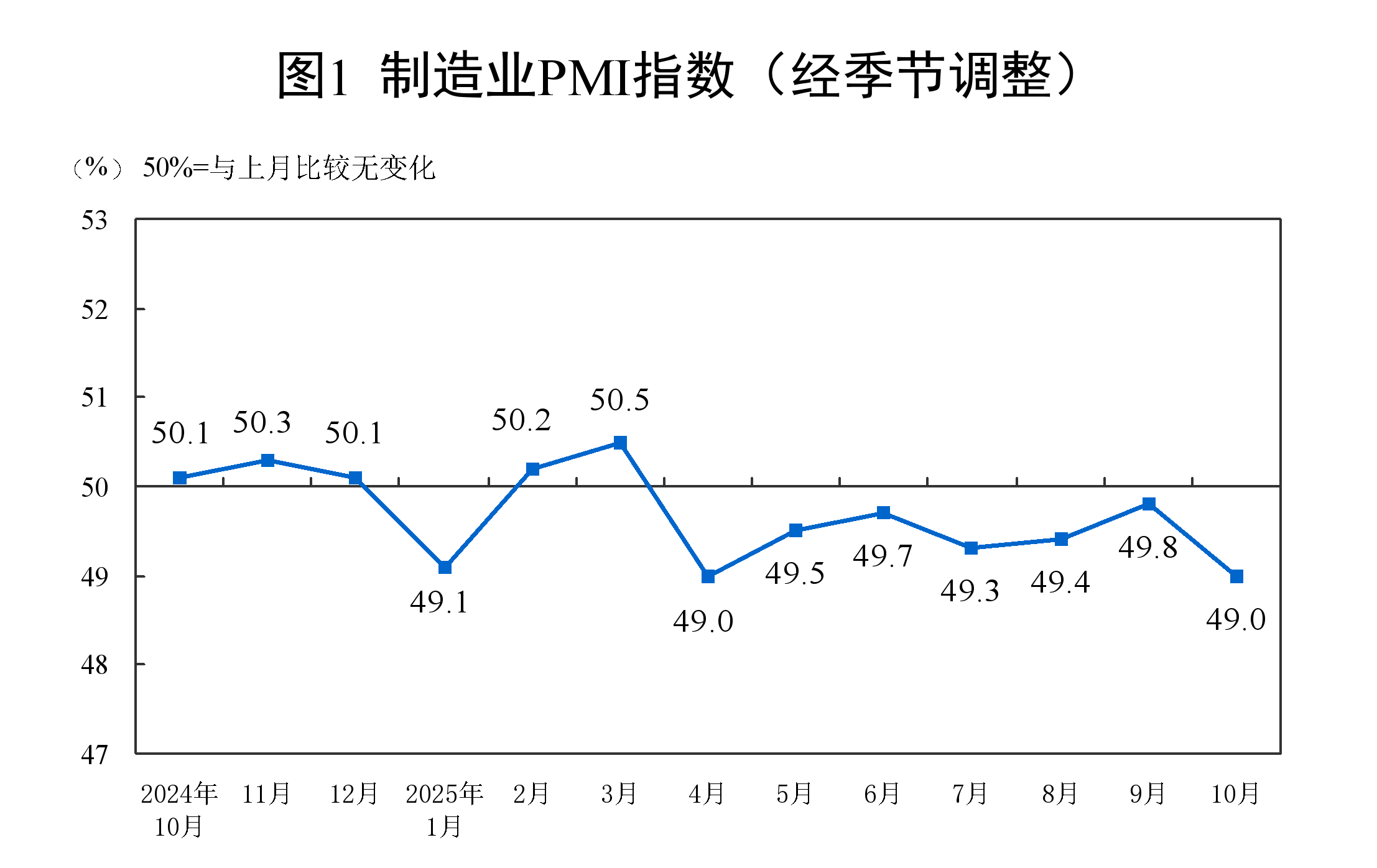
国家统计局:10月官方制造业PMI为49%
Guo Jia Tong Ji Ju· 2025-10-31 01:32
Core Viewpoint - The official manufacturing PMI for October is reported at 49%, indicating a contraction in the manufacturing sector [1] Group 1 - The manufacturing PMI has decreased to 49%, which is below the neutral level of 50, suggesting a decline in manufacturing activity [1] - A PMI reading below 50 typically signals a contraction in the manufacturing sector, reflecting potential challenges for companies operating in this space [1]
2025年前三季度全国规模以上文化及相关产业企业营业收入增长7.9%
Guo Jia Tong Ji Ju· 2025-10-30 01:36
Core Insights - The cultural enterprises in China achieved a total operating income of 1,095.89 billion yuan in the first three quarters of 2025, reflecting a year-on-year growth of 7.9% [1][2] - The 16 sub-sectors characterized by new cultural business models generated an income of 488.60 billion yuan, growing by 14.1%, which is 6.2 percentage points higher than the overall growth rate of cultural enterprises [1][2] Revenue Breakdown - By industry type, the cultural manufacturing sector reported an income of 307.66 billion yuan, up 2.3%; the cultural wholesale and retail sector reached 181.97 billion yuan, growing by 5.5%; and the cultural services sector generated 606.26 billion yuan, increasing by 11.9% [1][2][4] - In terms of core and related cultural fields, the core cultural sector earned 742.16 billion yuan, with an increase of 11.5%, while the related cultural sector achieved 353.73 billion yuan, growing by 1.2% [1][2][5] Industry Performance - The news information services sector generated 150.80 billion yuan, growing by 11.6%; content creation and production reached 256.25 billion yuan, increasing by 14.0%; and creative design services earned 192.85 billion yuan, up 13.2% [2][5] - The cultural investment and operation sector reported 4.05 billion yuan, with a growth of 3.6%, while cultural auxiliary production and intermediary services saw a decline of 2.2%, earning 117.18 billion yuan [2][5] Regional Analysis - Eastern region cultural enterprises achieved an income of 875.61 billion yuan, growing by 8.2%; the central region reported 122.23 billion yuan, up 6.4%; the western region reached 88.63 billion yuan, increasing by 8.7%; and the northeastern region earned 9.43 billion yuan, with a growth of 1.8% [2][5][6] Profit and Asset Overview - The total profit of cultural enterprises amounted to 909.3 billion yuan, reflecting a year-on-year increase of 14.2%, with an operating income profit margin of 8.30%, up by 0.45 percentage points [2][6] - By the end of the third quarter, total assets of cultural enterprises reached 2,242.27 billion yuan, growing by 8.4% compared to the previous year [2][6]
2024年中国创新指数稳步增长
Guo Jia Tong Ji Ju· 2025-10-30 01:01
Core Insights - The 2024 China Innovation Index reached 174.2, reflecting a 5.3% increase from 2023, indicating a steady growth trend in the country's innovation environment [1] Group 1: Innovation Environment Improvement - The innovation environment index for 2024 is 186.0, up 4.9% from the previous year, with all five evaluation indicators showing growth [2] - The proportion of science and engineering graduates among the eligible population increased by 10.8%, continuing a three-year trend of double-digit growth [2] - In 2024, the number of science, engineering, agriculture, and medical graduates reached 3.145 million, an increase of 172,000 from the previous year, accounting for 50.7% of the eligible population [2] - The number of enterprises benefiting from tax deduction policies for R&D expenses reached 137,000, an increase of 14,000, representing an 11.1% growth [2] Group 2: Increased Innovation Investment - The innovation investment index for 2024 is 162.6, reflecting a 5.1% increase, with all four evaluation indicators showing growth [3] - Basic research funding reached 250.09 billion yuan, a 10.7% increase, marking a two-digit growth trend [3] - Enterprises contributed 77.1% to the growth of national R&D funding, solidifying their role as the main driver of R&D expenditure [3] - R&D expenditure for large industrial enterprises was 2,254.77 billion yuan, up 7.5% from the previous year [3] Group 3: Rapid Growth in Innovation Output - The innovation output index for 2024 is 215.8, the fastest-growing among the four fields, with all four evaluation indicators showing growth [4] - The number of invention patents granted reached 1.045 million, a 13.5% increase, while the total number of valid invention patents reached 4.682 million, up 16.6% [4] - High-value invention patents accounted for 42.2% of valid patents, an increase of 0.7 percentage points from the previous year [4] - The technology market saw 994,000 contracts with a total transaction value of 6.8 trillion yuan, reflecting a 5.1% and 11.2% increase, respectively [4] Group 4: Steady Improvement in Innovation Effectiveness - The innovation effectiveness index for 2024 is 132.4, up 1.9%, with five evaluation indicators showing mixed results [5] - Labor productivity increased to 173,898 yuan per person, a 4.9% rise, enhancing the internal driving force for economic growth [5] Group 5: New Economic Drivers - The value added by the "three new" economies reached 24.3 trillion yuan, a 6.7% increase, surpassing the GDP growth rate by 2.5 percentage points [6] - New product sales revenue for large industrial enterprises reached 35.5 trillion yuan, a 3.9% increase, accounting for 25.4% of total revenue [6]
1-9月全国煤炭开采和洗选业营业收入下降20.0%
Guo Jia Tong Ji Ju· 2025-10-29 08:21
Core Insights - In the first nine months, the total profit of industrial enterprises above designated size reached 53,732 billion yuan, a year-on-year increase of 3.2% [1] - The profit distribution among different types of enterprises shows a decline in state-owned enterprises, while private and foreign-invested enterprises experienced growth [1] Group 1: Profit Analysis - State-owned enterprises achieved a total profit of 17,021.8 billion yuan, a year-on-year decrease of 0.3% [1] - Joint-stock enterprises reported a profit of 39,923.5 billion yuan, an increase of 2.8% [1] - Foreign and Hong Kong, Macao, and Taiwan-invested enterprises made a profit of 13,509.7 billion yuan, growing by 4.9% [1] - Private enterprises realized a profit of 15,131.7 billion yuan, up by 5.1% [1] Group 2: Revenue and Cost - The total operating revenue of industrial enterprises above designated size was 10.208 trillion yuan, reflecting a year-on-year growth of 2.4% [2] - Operating costs amounted to 8.734 trillion yuan, increasing by 2.6% [2] - The operating profit margin was 5.26%, which is an increase of 0.04 percentage points year-on-year [2] Group 3: Mining Industry Performance - The mining industry reported a total profit of 6,369.2 billion yuan, a significant year-on-year decline of 29.3% [2] - Coal mining and washing industry profits fell to 2,246.4 billion yuan, down by 51.1% [2] - The mining industry's operating revenue was 38,174.6 billion yuan, a decrease of 12.5% year-on-year [2] Group 4: Financial Ratios and Metrics - The asset total for industrial enterprises was 186.27 trillion yuan, a year-on-year increase of 5.0% [2] - The total liabilities reached 107.96 trillion yuan, growing by 5.2% [2] - The equity totaled 78.31 trillion yuan, up by 4.7% [2] - The asset-liability ratio stood at 58.0%, an increase of 0.1 percentage points year-on-year [2] Group 5: Efficiency Metrics - The cost per 100 yuan of operating revenue was 85.56 yuan, an increase of 0.18 yuan year-on-year [3] - The average revenue per 100 yuan of assets was 74.7 yuan, a decrease of 1.9 yuan year-on-year [3] - The average collection period for accounts receivable was 69.2 days, an increase of 3.3 days year-on-year [3]
国家统计局社科文司统计师林梅解读2024年中国创新指数
Guo Jia Tong Ji Ju· 2025-10-29 01:47
Core Insights - The 2024 China Innovation Index reached 174.2, reflecting a 5.3% increase from 2023, indicating a steady growth trend in the country's innovation environment [2] Group 1: Innovation Environment Improvement - The innovation environment index for 2024 is 186.0, up 4.9% from the previous year, with all five evaluation indicators showing growth [3] - The proportion of science and engineering graduates among the eligible population increased by 10.8%, continuing a three-year trend of double-digit growth [3] - In 2024, the number of science, engineering, agriculture, and medical graduates reached 3.145 million, an increase of 172,000 from the previous year, accounting for 50.7% of the eligible population [3] - The number of enterprises benefiting from tax incentives for R&D increased to 137,000, up 11.1% from the previous year [3] Group 2: Increased Innovation Investment - The innovation investment index for 2024 is 162.6, a 5.1% increase from the previous year, with all four evaluation indicators showing growth [4] - Basic research funding reached 250.09 billion yuan, a 10.7% increase, marking a historical high of 6.88% of total R&D expenditure [4] - Enterprises contributed 77.1% to the growth of total R&D expenditure, with industrial enterprises' R&D spending at 2,254.77 billion yuan, up 7.5% [4] Group 3: Rapid Growth in Innovation Output - The innovation output index for 2024 is 215.8, the fastest-growing sector with an 8.1% increase [5] - The number of invention patents granted reached 1.045 million, a 13.5% increase, with valid invention patents totaling 4.682 million, up 16.6% [5] - The number of high-value invention patents reached 1.978 million, accounting for 42.2% of valid patents, an increase of 0.7 percentage points from the previous year [5] - The technology market saw 994,000 contracts with a total transaction value of 6.8 trillion yuan, reflecting a 5.1% and 11.2% increase, respectively [5] Group 4: Steady Improvement in Innovation Effectiveness - The innovation effectiveness index for 2024 is 132.4, a 1.9% increase, with five evaluation indicators showing mixed results [7] - Labor productivity increased to 173,898 yuan per person, a 4.9% rise, enhancing the internal driving force for economic growth [7] - The value added by the "three new" economy reached 24.3 trillion yuan, a 6.7% increase, surpassing the GDP growth rate by 2.5 percentage points [7] - New product sales revenue for large industrial enterprises reached 35.5 trillion yuan, a 3.9% increase, accounting for 25.4% of total revenue [7]