Canalys

Search documents
2025年第二季度,印度PC市场同比增长6%,联想增幅最大,小米在平板电脑市场超越联想,跃居第三
Canalys· 2025-09-15 05:32
Core Insights - The Indian PC market (excluding tablets) is projected to grow by 7% in 2025, reaching 15.1 million units, driven by increased enterprise demand and a preference for AI devices [1][6] - The tablet market, however, is expected to decline by 13% in 2025, totaling 5.2 million units, primarily due to reduced government procurement [1][6] PC Market Overview - In Q2 2025, the Indian PC market saw a year-on-year growth of 6%, with shipments reaching 3.6 million units [1] - Notebook shipments increased by 8% to 2.7 million units, while desktop shipments remained stable, rising by 1% to 861,000 units [1] - The growth in the notebook segment is largely attributed to enterprise demand and the adoption of AI technologies [3][5] Tablet Market Dynamics - The tablet market experienced a significant decline of 27% year-on-year in Q2 2025, with shipments dropping to 1.2 million units [5] - The primary reason for this decline was a 64% drop in commercial shipments due to a slowdown in government and educational orders [5] - In contrast, the consumer market for tablets grew by 35%, driven by online promotions and increased demand for affordable devices [5] Future Projections - The PC market is expected to maintain stable growth through 2026, supported by ongoing device upgrades and the proliferation of AI applications [1][6] - The tablet market may see a recovery in 2026, with a projected 15% growth due to government-funded educational projects [1][6] - The demand for AI PCs and updates related to Windows 11 will dominate procurement in the commercial sector [5][6] Market Share Insights - In Q2 2025, the leading brands in the Indian PC market included HP with a 30.2% market share, followed by Lenovo at 19.9% and Dell at 14.5% [8] - For the tablet market, the top brands were Samsung with 28.9% market share, followed by Lenovo at 19.6% and Xiaomi at 13.4% [8]


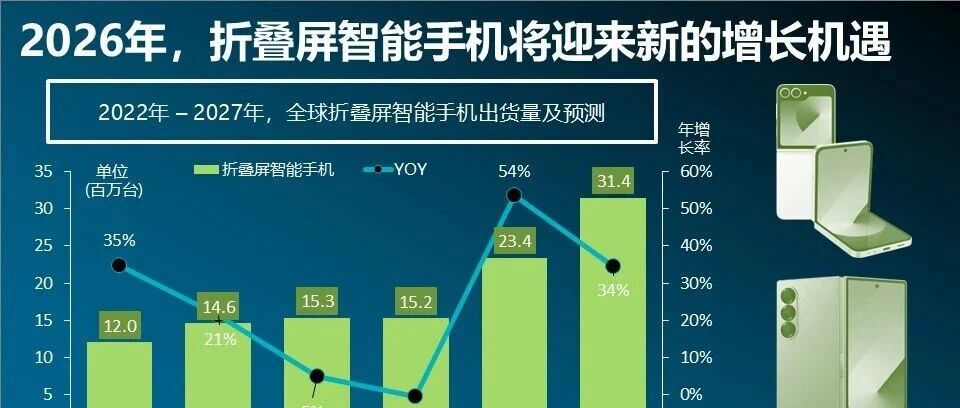
2026年,折叠屏智能手机迎来关键年
Canalys· 2025-09-12 03:03
Core Insights - The foldable smartphone market is experiencing a wave of new releases in 2025, with manufacturers addressing concerns about device thickness and weight through advanced engineering technologies [1][4] - Despite increased competition, global shipments of foldable smartphones remained stable at around 6.6 million units in the first half of 2025, with a notable 32.8% year-on-year growth in the Chinese market [4] - The foldable smartphone segment is expected to see significant growth in 2026, with a projected 51% year-on-year increase in shipments, driven by intensified competition and more affordable flip models [4][12] Market Dynamics - The foldable smartphone category remains a niche market, accounting for only 1.0-1.5% of global shipments, but its revenue contribution and strategic value are disproportionately high [7][11] - Samsung's product strategy exemplifies this, as its Galaxy Z Fold7 generates revenue equivalent to approximately 15 entry-level Galaxy A06 4G devices, highlighting the high average selling price (ASP) of foldable devices [11] Consumer Perception and Adoption Challenges - A consumer study revealed that while 96% of respondents are aware of foldable smartphones, nearly 40% expressed disinterest, primarily due to budget constraints or unmet needs [12][14] - Key challenges for broader adoption include changing consumer behavior, high pricing, and the need for effective marketing strategies that emphasize user experience and trust [14][12] Strategic Implications for Manufacturers - Foldable smartphones are becoming a strategic lever for manufacturers to drive high-end branding, differentiation, and long-term profitability, despite their limited market scale [11][7] - Companies are exploring enterprise applications for foldable devices, positioning them as productivity tools rather than mere consumer novelties [14][12]
2025年上半年,中国大陆可穿戴腕带设备市场创历史新高,出货量达3390万台,华为稳居第一,小米增速破百,vivo增幅最大
Canalys· 2025-09-10 03:03
Core Insights - The wearable wristband device market in mainland China is experiencing significant growth, with shipments reaching 33.9 million units in the first half of 2025, marking a 36% year-on-year increase, following a 33% growth in the second half of 2024 [1][6] - The basic wristband category is the fastest-growing segment, achieving an impressive 80% growth rate, which is a key driver of the market's strong performance [1] - Huawei leads the market with 12 million units shipped, capturing 36% market share, while Xiaomi follows closely with 11 million units and a 32% market share, both companies achieving significant milestones in shipment volumes [1][6] Market Dynamics - National subsidy policies have effectively boosted demand for wearable wristbands by encouraging existing users to upgrade and attracting new users, particularly during major promotional events like '618' [3] - The price sensitivity of consumers has been addressed, allowing for higher-priced basic watches and smartwatches to gain traction, reflecting the "lipstick effect" [3] - Devices priced between 1,599 to 2,999 RMB (approximately 400 USD) have seen increased consumer interest due to these subsidy policies [3] Competitive Landscape - Companies with a complete range of wearable devices are performing better, with Huawei's Watch GT series excelling in the basic smartwatch market due to its health management features and competitive pricing strategies [4] - Xiaomi continues to enhance its basic wristband category with the launch of the Xiaomi Band 10, focusing on functional upgrades and stylish designs to attract young, trend-conscious consumers [4] - Apple's participation in subsidy programs for its online and offline channels indicates the importance of optimizing channel structures to maintain its position in the high-end smartwatch segment [4] Emerging Trends - The promotion of health management initiatives by the National Health Commission has led to a significant increase in demand for high-end sports watches, which currently account for 10% of the market value in mainland China [4] - Brands like Garmin and Suunto are benefiting from this trend, as the high-end segment offers higher profit margins and opportunities for other manufacturers to transition to premium offerings [4] - Companies are encouraged to leverage the ongoing fitness trend by introducing AI coaching and smart guidance features tailored to individual and group users [4][5]

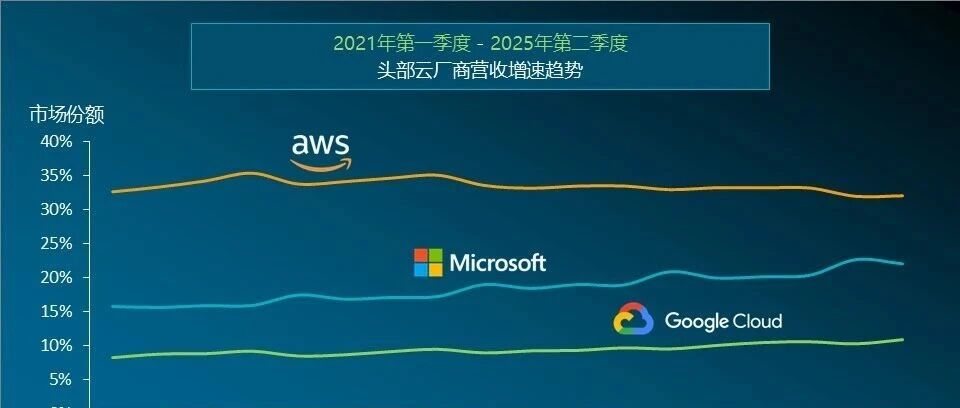
2025年第二季度,云基础设施市场连续四季增速超20%,AWS, 微软和谷歌狂揽65%份额,AI成最强增长引擎
Canalys· 2025-09-09 03:17
Core Viewpoint - The global cloud infrastructure services market is projected to reach $95.3 billion in Q2 2025, reflecting a 22% year-over-year growth, driven by increased AI usage, recovery in traditional system migrations, and scaling of cloud-native businesses [1][3]. Group 1: Market Growth and Trends - The cloud services market has maintained over 20% year-over-year growth for four consecutive quarters, indicating robust demand [1]. - Major cloud providers AWS, Microsoft Azure, and Google Cloud collectively hold 65% of the global market share, with a combined revenue growth of 27% year-over-year [1]. - AI infrastructure investments are accelerating, with Google raising its 2025 capital expenditure target from $75 billion to $85 billion, while AWS anticipates exceeding $100 billion in total spending for the year [3]. Group 2: Company Performance - AWS leads the market with a 32% share and a 17% year-over-year revenue growth, maintaining consistent growth rates between 17% and 19% over the past six quarters [7]. - Microsoft Azure, the second-largest provider, achieved a 39% year-over-year growth, driven by traditional workload migrations, cloud-native enterprise expansions, and the rapid adoption of AI workflows [8]. - Google Cloud, the third-largest provider, reported a 34% year-over-year growth, with significant increases in large contract volumes and a capital expenditure increase to $85 billion [9]. Group 3: AI and Model Development - Companies are shifting their focus from usability to flexibility and specific model selection for AI services, seeking the ability to switch between different AI models based on business needs [4]. - The competitive landscape in generative AI is characterized by both competition and collaboration among vendors, with AWS Bedrock integrating multiple models and OpenAI collaborating with Google Cloud for enhanced capacity [5]. - The trend towards open-source AI is gaining traction, with companies like Meta and OpenAI leading the way in providing open model weights to foster downstream innovation [5].
2025年第二季度,中国大陆PC出货量同比增长12% ,苹果PC市场增幅领先,华为稳居平板市场首位
Canalys· 2025-09-04 05:02
Core Insights - The article highlights the growth of the PC and tablet markets in mainland China, driven by consumer subsidies and strong procurement activities from state-owned enterprises and government [1][2][5] - It emphasizes the increasing demand for AI PCs, with a projected penetration rate of 34% in 2025 and 52% in 2026, indicating a shift towards higher hardware performance [5][7] PC Market Summary - In Q2 2025, the mainland China PC market (excluding tablets) is expected to grow by 12% year-on-year, with shipments reaching 10.2 million units [1] - The growth in PC shipments is attributed to both consumer and commercial demand, with increases of 13% and 12% respectively [1] - Major players in the PC market include Lenovo, Huawei, and ASUS, with Lenovo holding a 34% market share in Q2 2025 [7][8] Tablet Market Summary - The tablet market in mainland China is projected to see stable performance, with shipments expected to reach 34 million units in 2025, reflecting an 8% year-on-year growth [7] - However, a decline of 9% is anticipated in 2026, with shipments dropping to 31 million units due to cooling consumer demand [7] - Companies are targeting broader user groups, including gamers and creators, by introducing products with AI features [7] AI PC Development - AI PC shipments are expected to account for 28% of the overall PC market in Q2 2025, indicating a growing demand for advanced hardware [5] - The Chinese government has set ambitious goals for AI device penetration, aiming for 70% by 2027 and 90% for AI software and applications by 2030 [5] - The local AI ecosystem is rapidly developing, with significant advancements in AI chips and software platforms [5]

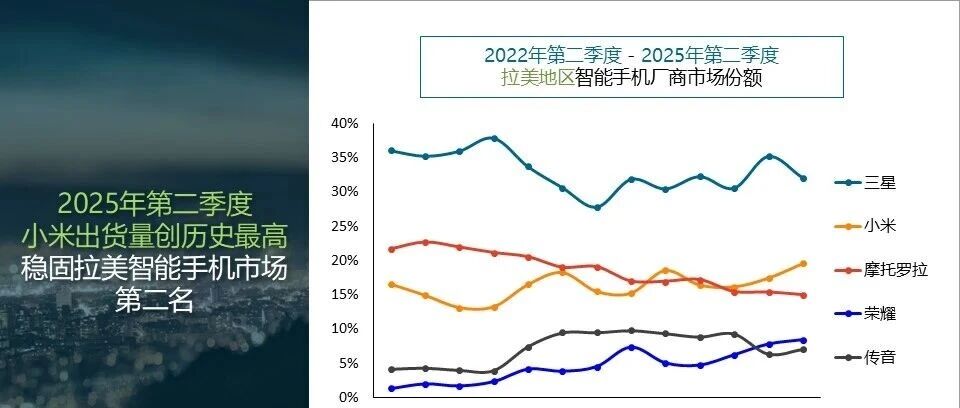
2025年第二季度,拉丁美洲智能手机市场同比增长2%,小米与荣耀表现亮眼
Canalys· 2025-09-03 05:02
Core Insights - The Latin American smartphone market experienced a slight year-on-year growth of 2% in Q2 2025, with total shipments reaching 34.3 million units [1][5] - Samsung maintained its market leadership with a shipment of 11 million units, driven by the popularity of its Galaxy A series, which accounted for over 60% of its sales [1][3] - Xiaomi ranked second with a record shipment of 6.7 million units, while Motorola fell to third place with a shipment of 5.1 million units, reflecting a year-on-year decline of 10% [1][5] - Honor and Transsion ranked fourth and fifth, respectively, with Honor experiencing a significant growth of 70%, reaching a record shipment of 2.4 million units, while Transsion saw a decline of 23% to 2.9 million units [1][5] Market Performance - The Brazilian market, the largest in the region, saw a year-on-year decline of 3%, indicating a saturation of demand due to intense competition over the past few years [5] - Mexico's market also experienced a decline of 10% due to weak demand, affecting all major manufacturers [5] - In contrast, Central America, Colombia, and Argentina showed strong double-digit growth, with Colombia and Argentina recovering significantly after nearly two years of socio-economic and political adjustments [5] Product Trends - The growth in the Latin American market in Q2 2025 was largely driven by entry-level smartphone models, highlighting their importance in the current market landscape [7] - Companies are advised to diversify their product offerings beyond entry-level models to ensure long-term sustainability, especially in light of macroeconomic uncertainties and potential tariff risks from the U.S. [7]

2025年第二季度,随着生态设计法规的生效,欧洲智能手机市场下滑9%,荣耀逆势实现增长
Canalys· 2025-08-28 11:03
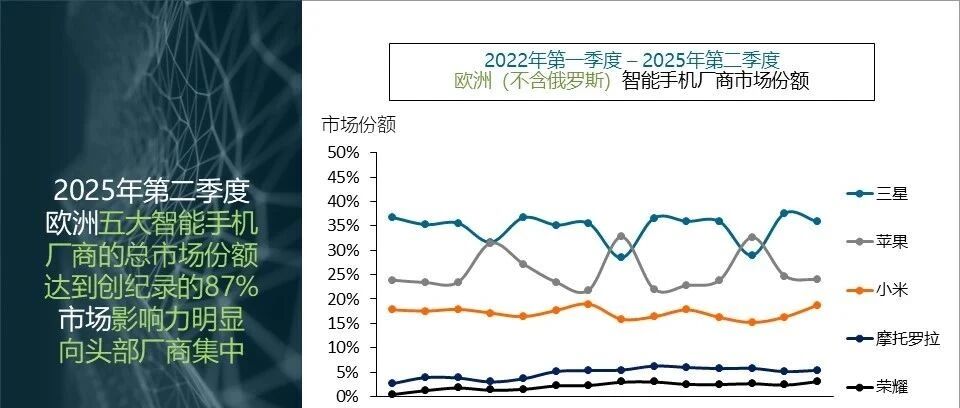
Core Insights - The European smartphone market is experiencing a decline in shipments, with a 9% decrease expected in Q2 2025, resulting in 28.7 million units shipped [1] - Major brands like Samsung, Apple, and Xiaomi are facing challenges, with Samsung's shipments down 10% to 10.3 million units, while Apple and Xiaomi also saw declines of 4% [1][3] - The market is becoming increasingly concentrated among the top five vendors, which now hold a record 87% market share, indicating a shift towards brand differentiation and scale [5] Market Performance - In Q2 2025, Samsung remains the top vendor despite a 10% year-on-year decline in shipments, attributed to regulatory impacts on product launches [1] - Apple ranks second with 6.9 million units shipped, benefiting from the stable performance of the iPhone 16 series, which mitigated some pressures from a reduced product lineup [1] - Xiaomi, in third place, shipped 5.4 million units, with a strong rebound in Italy contributing to a 50% year-on-year growth in that market [1] Consumer Behavior - A survey of 8,000 European consumers revealed that direct channels are preferred for better customer service and brand interaction, while open market channels are chosen primarily for price reasons [6] - Despite the rise of direct and open market channels, telecom operators remain crucial for market entry and the promotion of 5G and eSIM smartphones [6] Future Outlook - The smartphone market in Europe is expected to return to growth by 2026, driven by replacement demand for low-end devices and the maturation of applications [8] - Long-term growth projections remain modest, with an expected CAGR of 1.7% from 2025 to 2029, emphasizing the need for companies to understand evolving consumer purchasing motivations [8]
《肯尼亚非正规经济背景下智能手机融资的未来》报告简介
Canalys· 2025-08-25 06:17
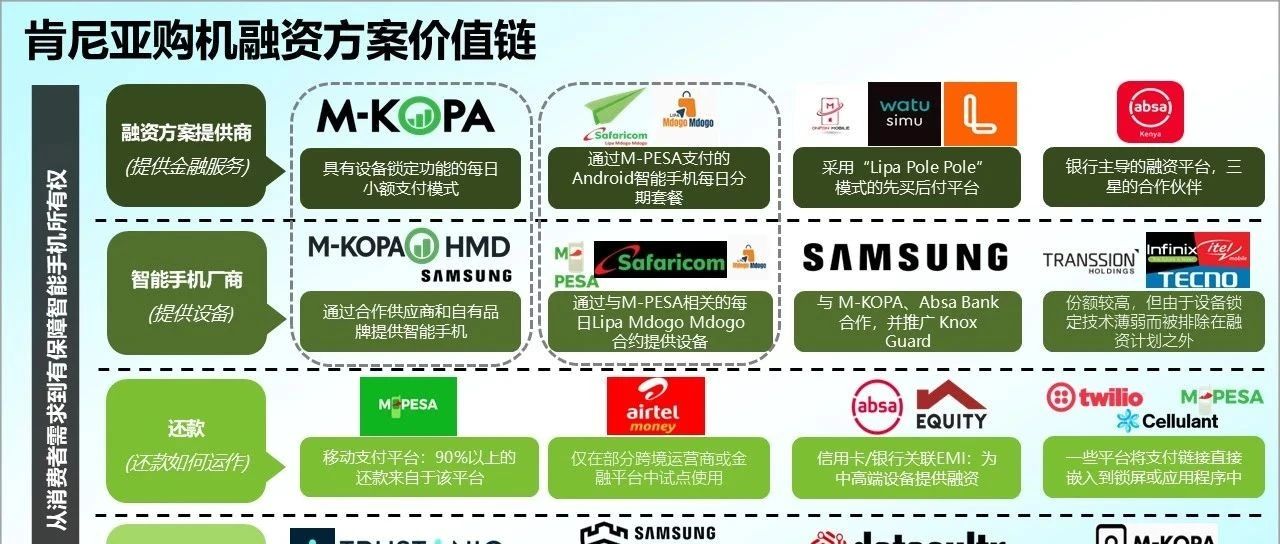
Core Insights - The article discusses Kenya's smartphone financing value chain as a successful model in Africa, addressing affordability challenges in emerging economies [1][2][10] - Financing has evolved from an optional strategy to a core distribution method in markets where income levels, credit availability, and device prices are mismatched [2][10] Background - Kenya's smartphone financing market provides a model for addressing long-standing affordability challenges in emerging economies [2] - As of March 2025, there will be 42.4 million smartphones in use in Kenya, accounting for 80.8% of total mobile connections [2] - Despite the growth in smartphone usage, 59% of mobile shipments in 2024 will still be feature phones, indicating a significant digital access gap [2] Price Trends - Since 2019, the average selling price (ASP) of smartphones in Kenya has nearly tripled, rising from KES 5,955 to KES 18,979 by Q2 2025 [3] - The share of smartphones priced below $100 has dropped to 32%, while mid-range devices priced between $100 and $199 now account for over half of total shipments [4] Financing Model - The financing model in Kenya is characterized by daily micro-payment plans, making smartphones accessible to low-income and informal employment groups [5][6] - The financing ecosystem includes various stakeholders such as lenders, manufacturers, and telecom operators, designed specifically for a mobile-first economy [7][8] Value Chain Complexity - Understanding the complexity of the financing value chain is crucial for success among participants in the ecosystem and for replicating best practices in other markets [8] - The report details four levels of the value chain, highlighting key players and technology drivers, including major brands and financial service providers [8] Emerging Market Insights - Kenya's smartphone financing value chain serves as a blueprint for addressing affordability challenges in emerging markets [10] - Financing is becoming a significant growth driver in environments where shipment volumes are stagnating, unlocking new value potential for manufacturers and ecosystem participants [12] Stakeholder Relevance - The insights are highly relevant for smartphone manufacturers, fintech providers, telecom operators, investors, and policymakers [11][15] - Strategies for expanding market penetration without sacrificing profit margins are discussed for manufacturers [15] - Recommendations for applying the Kenyan model to other emerging markets are provided, including insights for various stakeholders [15]
2025年第二季度,非洲智能手机市场增长7%,连续九个季度保持增长,传音稳固“非洲机王”的地位,小米持续增长,荣耀增幅最大
Canalys· 2025-08-22 02:32
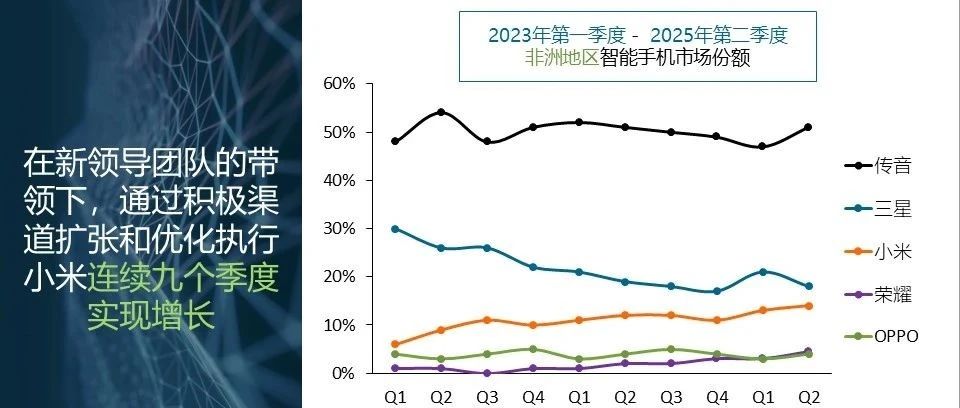
Core Insights - The African smartphone market is projected to grow robustly, with a year-on-year increase of 7% in Q2 2025, reaching 19.2 million units, making it one of the best-performing regions globally [1][7] - The growth is driven by improved consumer purchasing power due to easing inflation in key markets like Egypt, Nigeria, and South Africa, with a forecasted compound annual growth rate (CAGR) of 2.1% from 2025 to 2029 [1][6] Market Performance - Egypt leads the North African market with a 21% year-on-year growth, supported by local production capabilities to meet demand during the festive season [4] - Nigeria rebounded by 10% due to stabilized currency and inflation relief, while South Africa saw a modest 2% growth, with a significant 63% increase in 5G smartphone shipments [4] - Smaller markets like Kenya showed resilience with a slight decline of 2%, whereas Algeria and Morocco faced declines of 27% and 7% respectively due to weak demand and stricter import regulations [4] Manufacturer Insights - Demand for ultra-low-cost smartphones under $100 surged by 38%, leading to a decrease in average selling prices [3] - Transsion maintained the top position with a 6% growth, holding a 51% market share, while Samsung grew by 3% to capture 18% of the market through localized distribution and affordable models [3][7] - Xiaomi experienced a significant 32% growth, achieving a 14% market share, while Honor's sales surged by 161%, driven by popular entry and mid-range models [3][7] - OPPO faced an 11% decline but is restructuring and expanding its retail presence in Egypt [3] Future Outlook - The African smartphone market is expected to grow by 3% in 2025, outpacing the overall sluggish global market amid rising component costs [6] - The rural market is becoming a new competitive focus, with limited traditional banking services driving the adoption of mobile payments and fintech [6] - Local production and the rise of digital finance are anticipated to lead Africa into a new phase of sustainable growth, establishing it as a critical testing ground for global brands [6]

2025年第二季度,小米重夺东南亚智能手机市场桂冠,时隔四年再登顶,荣耀首次突破100万台出货量,市场整体持平
Canalys· 2025-08-13 03:18
Core Viewpoint - The Southeast Asian smartphone market is experiencing a slight decline in shipments due to ongoing tariff uncertainties, with a projected 1% decrease in Q2 2025, resulting in 25 million units shipped [1][3]. Market Performance - Xiaomi regained the top position in the Southeast Asian smartphone market for the first time in four years, with shipments of 4.7 million units and a market share of 19%, reflecting an 8% year-on-year growth [1][8]. - Transsion ranked second with 4.5 million units shipped and an 18% market share, showing a significant 17% increase year-on-year [1][8]. - Samsung followed closely in third place with 4.3 million units and a 17% market share, but experienced a 3% decline year-on-year [1][8]. - OPPO ranked fourth with 3.5 million units shipped and a 14% market share, facing a 19% year-on-year decline [1][8]. - Vivo, in fifth place, shipped 2.8 million units with an 11% market share, down 21% year-on-year [1][8]. Competitive Strategies - Xiaomi's success is attributed to its direct-to-consumer (DTC) and carrier channel expansion, which laid a solid foundation for scaling its sub-brands [3]. - Samsung has strengthened its channel diversification and high-end positioning through its enterprise market strategy, enhancing its average selling price (ASP) and creating new revenue streams beyond traditional retail [3]. - In the competitive landscape, differentiation beyond pricing remains a challenge for all manufacturers, with Xiaomi and Transsion leading in the low-price segment due to competitive pricing and active channel incentives [3]. Emerging Opportunities - TikTok's rapid expansion in the consumer electronics sector is opening new growth channels for smartphone manufacturers in Southeast Asia, with brands like Infinix and Xiaomi leveraging the platform for sales of low-cost models [6]. - The collaboration with local sellers and brands on TikTok, along with significant investments in partnerships and authorized brand stores, mirrors the early development stages of platforms like Shopee and Lazada [6].