Morningstar晨星

Search documents
10月基金月报 | 股市震荡债市向好,权益基金涨跌互现,固收基金多数录涨
Morningstar晨星· 2025-11-13 01:04
Group 1: Macroeconomic Indicators - In October, the manufacturing PMI recorded 49.0%, down 0.8 percentage points from September's 49.8%, indicating continued pressure on the macro economy with weak manufacturing sentiment [2] - The CPI decreased by 0.3% year-on-year in September, while the PPI fell by 2.3%, showing a narrowing decline compared to August [2] Group 2: A-Share Market Performance - A-shares experienced a mixed performance in October, with the Shanghai Composite Index rising by 1.85% and the Shenzhen Component Index falling by 1.10% [3] - The coal, steel, and non-ferrous metals sectors saw gains exceeding 5%, while electronics, automotive, beauty care, and media sectors declined by over 3% [3] Group 3: Bond Market Dynamics - The bond market showed a mixed performance in October, with medium to long-term government bond yields declining, while short-term yields increased slightly [4] - The overall return of the bond market, as reflected by the China Bond Index, rose by 0.73% in October [4] Group 4: Global Economic Performance - The US Markit Composite PMI rose to 54.8 in October, up 1.2 percentage points from September, indicating expansion [5] - Major overseas stock indices mostly rose in October, with the Nikkei 225 and S&P 500 showing average gains of 3.92% and 2.27%, respectively [5] Group 5: Fund Performance - The Morningstar China Open-End Fund Index recorded a decline of 0.87% in October, with equity funds showing a 1.62% drop [13] - Fixed income funds generally performed well, with the Morningstar China Bond Index rising by 0.40% [13] Group 6: QDII Fund Performance - Global emerging market equity and bond mixed funds and US equity funds recorded average returns of 7.60% and 3.27%, respectively, benefiting from strong overseas market performance [17]


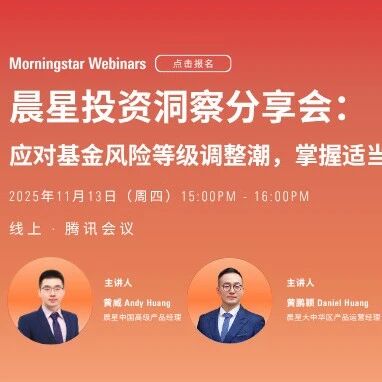
活动邀请 | 晨星投资洞察分享会:应对基金风险等级调整潮,掌握适当性管理实战指南
Morningstar晨星· 2025-11-06 01:04
Core Insights - The article discusses the recent wave of "risk level adjustments" in the domestic fund market, where numerous fund companies have raised the risk levels of hundreds of funds, posing challenges for institutional investors in terms of suitability management [1][3]. Group 1: Fund Risk Level Adjustments - A significant number of fund companies have adjusted the risk levels of their funds, primarily increasing them, which presents a direct challenge for institutional investors regarding how to interpret these adjustments and communicate risk information effectively [1]. - Morningstar has introduced a "suitability" solution to assist institutional clients in the full process of fund risk assessment and investor matching, enhancing compliance and service quality [1]. Group 2: Event Details - The upcoming online event will focus on the challenges posed by the recent fund risk level adjustments and will delve into the underlying logic of Morningstar's fund risk assessment [3]. - The event aims to provide practical strategies for addressing common issues in investor communication and suitability matching [6][7]. Group 3: Expert Insights - The event will feature insights from experts on the motivations and trends behind the recent concentrated adjustments in fund risk levels [6]. - Participants will learn about third-party risk assessment frameworks to improve product selection and suitability management capabilities [6].

【晨星焦点基金系列】:锁定长期价值:在业内经理更迭潮中选对投资 “同行者”
Morningstar晨星· 2025-11-06 01:04
Core Viewpoint - The article emphasizes the performance and management strategy of the China Europe New Trend Mixed Fund, highlighting the experience of fund manager Zhou Weiwen and the fund's strong long-term returns compared to its peers and benchmarks [3][22][31]. Fund Overview - Fund Code: 166001 - Fund Type: Actively Managed - Large Cap Growth - Benchmark Index: CSI 300 Relative Growth Total Return - Fund Size: 60.62 billion CNY as of September 30, 2025 [1][2]. Fund Manager Profile - Zhou Weiwen has 26 years of industry experience and has managed the fund for over 14 years, demonstrating stability through multiple market cycles [3][6]. - The fund manager's administrative responsibilities have decreased, allowing for a greater focus on investment management [7][6]. Investment Strategy - The fund adopts a growth investment style, utilizing a combination of macro and bottom-up analysis to achieve long-term stable returns [3][12]. - The investment strategy involves analyzing industry conditions and selecting stocks with sustainable performance and competitive advantages [12][14]. Performance Metrics - Since Zhou Weiwen took over in August 2011, the fund has achieved an annualized return of 12.76%, significantly outperforming the benchmark's annualized return of 9.35% [22]. - The fund's recent 3-year and 5-year annualized returns are 10.95% and 6.66%, respectively, surpassing the benchmark by 4.01% and 6.60% [22]. - The fund's Sharpe ratio stands at 0.74, outperforming the benchmark's 0.19, indicating strong risk-adjusted returns [22][30]. Risk Management - The fund maintains a diversified portfolio, with a standard deviation and downside risk lower than the average of its peers, reflecting effective risk management [22][29]. - The fund's turnover rate is relatively low, contributing to lower transaction costs and a comprehensive fee rate of 1.70%, which is below the average of 2.26% for similar funds [31][3]. Asset Allocation - As of June 30, 2025, the fund's asset allocation is 89.02% in equities, 4.13% in bonds, and 7.07% in cash, indicating a strong focus on stock investments [18][19]. - The fund's sector allocation shows a significant emphasis on cyclical and industrial sectors, with 42.28% and 19.96% respectively, compared to the benchmark [20].

晨星任命张哲为中国区董事总经理
Morningstar晨星· 2025-11-06 01:04
Group 1 - Morningstar has appointed Zhang Zhe as the Managing Director for its China operations, effective October 27, 2025, to oversee the company's strategic layout and sustainable growth in China [2][4] - Zhang Zhe has extensive experience in wealth management and banking, particularly in enhancing digital customer experiences and expanding data-driven businesses [2] - Prior to joining Morningstar, Zhang served as CEO of HSBC Financial Technology Services (Shanghai) and held key positions in several leading fintech companies [2][4] Group 2 - Since entering the Chinese market in 2003, Morningstar has focused on developing its business in China, aiming to enhance the experience of public fund investors and expand strategic client relationships [4] - Zhang Zhe will lead the China business team to accelerate development and deepen collaboration with financial institutions, regulatory bodies, and the public fund industry [4] - As of June 30, 2025, Morningstar managed and advised assets totaling approximately $352 billion, providing a wide range of products and solutions to various market participants [5]

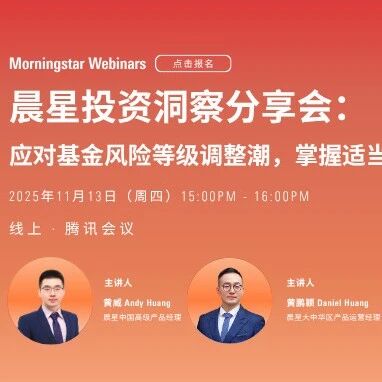
活动邀请 | 晨星投资洞察分享会:应对基金风险等级调整潮,掌握适当性管理实战指南
Morningstar晨星· 2025-10-30 01:04
Core Insights - The article discusses the recent wave of "risk level adjustments" in the domestic fund market, where numerous fund companies have raised the risk levels of hundreds of funds, posing challenges for institutional investors in terms of suitability management [1][3]. Group 1: Fund Risk Level Adjustments - A significant number of fund companies have adjusted the risk levels of their funds, primarily increasing them, which presents a direct challenge for institutional investors regarding how to interpret these adjustments and communicate risk information effectively [1]. - Morningstar has introduced a "suitability" solution to assist institutional clients in the full process of fund risk assessment and investor matching, enhancing compliance and service quality [1]. Group 2: Event Details - The upcoming online event will focus on the challenges posed by the recent fund risk level adjustments and will delve into the underlying logic of Morningstar's fund risk assessment [3]. - The event aims to provide practical strategies for addressing common issues in investor communication and suitability matching [6][7]. Group 3: Expert Insights - The event will feature insights from experts on the motivations and trends behind the recent concentrated adjustments in fund risk levels [6]. - Participants will learn about third-party risk assessment frameworks to improve product selection and suitability management capabilities [6].
【晨星焦点基金系列】:“十五五”开局,如何把握长期投资机会?
Morningstar晨星· 2025-10-30 01:04
Core Viewpoint - The article emphasizes the investment potential of the Guofu Strategy Return Mixed Fund (450010), highlighting its stable management and focus on long-term growth opportunities in the context of China's economic development goals [4][5]. Fund Overview - Fund Code: 450010 - Fund Type: Active Allocation - Large Cap Growth - Benchmark Index: CSI 300 Relative Growth Total Return [1] - Fund Manager: Wang Xiaoning, with 21 years of experience in the securities industry and 12 years in investment [6]. - Fund Size: 18 billion CNY as of September 30, 2025 [2]. Performance Metrics - The fund's annualized returns over the last three and five years are 6.97% and 6.57%, respectively, ranking 33rd and 28th among its peers [3]. - The fund outperformed the Morningstar benchmark (CSI 300 Relative Growth Index) by 0.03% and 6.50% over the same periods [3]. - The fund's comprehensive fee rate is 1.79%, significantly lower than the average of 2.26% for similar funds [3][31]. Investment Strategy - The fund employs a growth investment strategy focusing on three key factors: economic conditions, quality, and valuation [11]. - The investment portfolio is diversified across various sectors, with a low turnover rate, aligning with the fund's long-term growth focus [3][13]. - Key sectors in the recent portfolio include pharmaceuticals, electrical equipment, electronics, and consumer goods [13]. Risk and Return Analysis - The fund's risk-adjusted performance metrics, such as the Sharpe ratio (1.80) and Sortino ratio (8.92), indicate strong performance relative to peers [30]. - The fund's standard deviation is 11.36%, ranking it better than 92% of similar funds, reflecting lower volatility [29]. Manager's Track Record - Wang Xiaoning has successfully adjusted the fund's strategy since 2020, leading to improved performance and reduced volatility [25]. - The fund's annualized return since the strategy adjustment is 11.36%, with a ranking of 34th among peers [25]. Sector Allocation - The fund's asset allocation includes 79.32% in equities, 8.56% in bonds, and 16.20% in cash, indicating a strong equity focus [18]. - The sector distribution shows a significant allocation to cyclical sectors (42.30%) and technology (20.39%), reflecting the manager's growth-oriented strategy [19].

主动基金经理集体“出轨”?这个指标帮你精准避雷
Morningstar晨星· 2025-10-30 01:04
Core Viewpoint - The article discusses the transformation in China's public fund industry regarding the recognition and application of performance benchmarks, emphasizing the importance of the "Active Share" metric to help investors identify differences in investment strategies and avoid pitfalls associated with "pseudo-active" funds [2][8]. Group 1: Introduction and Regulatory Changes - The article highlights the issue of fund managers in China neglecting performance benchmarks, leading to significant deviations in fund holdings and resulting in poor investor experiences [1]. - The China Securities Regulatory Commission (CSRC) issued an action plan on May 7, 2023, aimed at enhancing the quality of public funds, which emphasizes the central role of benchmarks in defining product positioning, investment strategies, and performance evaluation [1]. Group 2: Active Share Metric - Active Share is defined as a quantitative measure of the difference between a fund's portfolio and its benchmark, calculated by summing the absolute differences in weights of individual securities [4][5]. - The metric allows for a clearer distinction between active management and passive replication, addressing limitations of traditional metrics like R-squared and tracking error [6][7]. Group 3: Current State of Active Equity Funds - As of June 30, 2025, the average Active Share for three categories of active equity funds in China is 89.82%, with 87% of funds having an Active Share above 80% [10][14]. - The article notes that active fund managers often deviate from benchmarks in terms of style, industry, and individual stock selection, leading to high Active Share levels [13]. Group 4: Category Analysis - The average Active Share for large-cap growth, large-cap balanced, and small-cap funds is reported as 89.86%, 86.29%, and 96.26%, respectively, indicating that small-cap funds exhibit significantly higher Active Share [14]. - The article explains that the concentration of large-cap stocks in indices limits the active management opportunities, while small-cap stocks provide a broader range of potential excess returns [14]. Group 5: Case Studies - The article compares two funds within the same category, highlighting significant differences in their Active Share due to varying investment strategies, with one fund maintaining a stable Active Share around 70% and the other nearing 100% [17]. - The contrasting strategies illustrate how fund managers' approaches to portfolio construction can lead to different levels of risk and performance volatility [17]. Group 6: Future Insights - The next article will delve into the relationship between Active Share and fund performance, as well as how to identify strategy drift and "pseudo-active" funds in light of new regulations [23].

活动邀请 | 晨星投顾研讨会:投顾场景的风险精细化识别与匹配
Morningstar晨星· 2025-10-23 01:04
Core Viewpoint - The article emphasizes the importance of risk matching in investment advisory services, especially in the context of current market volatility, highlighting that regardless of market conditions, aligning client risk tolerance with account risk levels is essential for enhancing the investment experience [1][2][3]. Group 1: Risk Matching Focus - The seminar will focus on the theme of "risk," exploring how to accurately match client account risk levels with their risk tolerance, thereby creating a robust investment strategy that can withstand market fluctuations [3][5]. - Traditional methods of understanding clients (KYC) and their holdings (KYP) often lack rigor, leading to mismatches between client risk tolerance and account risk levels, which negatively impacts the investment experience [2][3]. - The seminar aims to utilize Morningstar's professional risk assessment tools and methodologies to develop a practical asset allocation logic centered on risk matching [5][9]. Group 2: Seminar Highlights - Key highlights include mastering scientific risk assessment tools to ensure that client risk identification is substantive rather than superficial [8]. - The seminar will guide clients away from impulsive trading behaviors, such as "buying high and selling low," by establishing a risk-driven asset allocation framework [8]. - The focus will be on enhancing the precision of asset allocation and improving client experience, thereby reinforcing the professional value of investment advisory services [8][9]. Group 3: Participation and Registration - Interested participants can register for the seminar via a QR code or by clicking the link provided at the end of the article, with a registration deadline set for October 30 at noon [13]. Group 4: About Morningstar - Morningstar, Inc. is a leading global investment research firm, providing financial information, analysis, and ratings for various investment products, and managing approximately $352 billion in assets as of June 30, 2025 [16].

【晨星焦点基金系列】:波动加剧不用慌,这种策略或许能帮你稳住收益
Morningstar晨星· 2025-10-23 01:04
Core Viewpoint - The article discusses the performance and investment strategy of the Anxin Advantage Growth Flexible Allocation Mixed Fund, managed by Nie Shilin, highlighting its strong returns and risk management approach in a volatile market environment [2][4][19]. Fund Overview - Fund Code: 001287 - Fund Type: Active Allocation - Large Cap Growth - Benchmark Index: CSI 300 Relative Growth Total Return - Fund Size: 11.08 billion CNY as of June 30, 2025 - Annual Comprehensive Fee Rate: 1.47%, lower than the average of 2.26% for similar funds [2][24]. Manager Profile - Fund Manager: Nie Shilin, with 17 years of experience in the securities industry and 9 years in public fund management [5]. - Investment Style: GARP (Growth at a Reasonable Price), focusing on bottom-up investment strategies [9][10]. - Performance: Achieved an annualized return of 15.25% since Nie Shilin took over, surpassing the benchmark's annualized return of 10.98% [19]. Market Context - A-shares have shown a volatile upward trend since 2025, supported by policy and economic improvements, but with significant structural differentiation between sectors [3][4]. - The market has experienced rapid shifts in hot sectors, with notable disparities between large-cap blue chips and tech innovation assets [3][4]. Investment Strategy - The fund aims for steady asset appreciation while effectively controlling risks, employing a balanced industry allocation and in-depth stock research [9][10]. - The manager emphasizes understanding the fundamentals of industries and companies to identify turning points in market cycles [9][10]. - The fund's portfolio is characterized by a high concentration in top holdings, with the top ten stocks accounting for 55% to 70% of the portfolio [10][19]. Performance Metrics - The fund's Sharpe ratio is 0.94, outperforming the benchmark's 0.31, ranking in the top 8% among peers [19][23]. - Historical performance shows resilience during market downturns, with superior returns in bear markets and value-driven environments [17][19]. Risk Management - The fund manager's approach includes a focus on high-quality companies and a reduction in short-term trading opportunities, leading to a decrease in turnover rate from 400% to 200% [10][19]. - The fund's risk metrics indicate lower volatility compared to peers, with a standard deviation of 18.44% and a maximum drawdown of -16.30% [23].

穿越牛熊基金经理的制胜秘籍:不同风格流派图鉴
Morningstar晨星· 2025-10-23 01:04
Core Viewpoint - The article emphasizes the importance of having a clear and tested investment strategy to navigate the cyclical nature of capital markets, highlighting different investment styles in equity and fixed income markets that can help investors achieve long-term stable returns [1]. Equity Section - Long-term value investors focus on the essence of investment, leveraging the time factor to accumulate wealth through low turnover rates, avoiding impulsive trading during market fluctuations [2][3]. - Yang Xinxin from ICBC Credit Suisse adheres to the principle of "good company + good price," demonstrating excellent long-term performance with a clear investment framework that includes macroeconomic analysis and a focus on undervalued stocks [3]. - Jiang Cheng from Zhongtai Securities Asset Management employs a "concentrated waiting" strategy, emphasizing the scarcity of good companies and the need to wait for favorable prices, achieving positive returns even in a declining market [6]. - The hard-core growth style focuses on identifying high-growth potential companies, being sensitive to industry trends and technological innovations, and managing risks associated with growth stocks [8][9]. - Xie Zhiyu from Xingzheng Global Fund exemplifies this growth style by focusing on company growth and management capabilities, maintaining a balanced industry allocation to mitigate risks [9]. - GARP (Growth at a Reasonable Price) investors balance growth and valuation, understanding the risks of high valuations while seeking profitable opportunities [10][11]. - Zhou Yun from Oriental Red Asset Management practices GARP by focusing on quality companies at reasonable prices, maintaining a diversified portfolio to balance risks and opportunities [11]. - Liu Xu from Dacheng Fund employs a dynamic adjustment strategy to adapt to market cycles, effectively managing risks while seizing investment opportunities across growth and value stocks [14]. Fixed Income Section - Pure bond conservative managers focus on bond investments to achieve stable returns, emphasizing risk control and macroeconomic research [16]. - Li Yingfang and Peng Ziyun from Jianxin Fund exemplify this approach by managing duration and credit risk effectively, resulting in lower volatility compared to peers [16][17]. - Huang Jiliang from Fortune Fund adopts a strategy of focusing on high-grade credit bonds while diversifying across different bond types to maximize risk-adjusted returns [19]. - The fixed income plus enhancement style seeks to enhance returns through equity exposure, with Wang Xiaocheng from E Fund demonstrating this by combining high-grade bonds with equity investments [22][23]. - Zhu Song from Penghua Fund utilizes a strategy of credit bonds and interest rate trading to stabilize returns while enhancing them through convertible bonds [24]. Conclusion - The article concludes that there is no absolute "best strategy" among the various investment styles; the key is to find a suitable match based on individual risk preferences and investment horizons [26].