Z Potentials

Search documents
速递|SAP CEO战略转向:与其砸钱建"星际之门",不如专注AI落地应用
Z Potentials· 2025-07-07 02:54
Core Viewpoint - The CEO of SAP, Christian Klein, argues that Europe does not need to rush into building numerous data centers to compete in the AI sector, contrasting with Nvidia CEO Jensen Huang's recent statements during his visit to Europe [1][2]. Group 1: AI Infrastructure and Investment - Klein questions the necessity of constructing five data centers equipped with top-tier chips, expressing skepticism about whether this is truly what Europe needs [2]. - He highlights that large language models, which require significant energy and computational power for training, are rapidly being commercialized, as demonstrated by the Chinese company DeepMind, which claims to have surpassed leading US AI developers at a low cost [2]. - The US has announced the "Stargate" initiative, planning to invest up to $500 billion, while the EU has committed to investing €20 billion (approximately $23 billion) to build five AI "super factories" dedicated to developing and training next-generation models [3]. Group 2: Strategic Focus for Europe - Klein suggests that European industries, such as automotive and chemicals, should focus on applying AI to enhance their operations rather than trying to catch up with the US in AI infrastructure [5]. - SAP has shifted its stance and is no longer seeking to be an operator or investor in AI super factory projects, but rather aims to provide technology and software support for potential future projects [4][5]. Group 3: Changes in Perspective - Klein's current viewpoint marks a shift from earlier this year when he referred to the Stargate project as an "excellent example" for Europe and expressed strong support for a European version of the initiative during the World Economic Forum in Davos [3].



速递|大模型比应用估值便宜?OpenAI、Anthropic增速碾压同行却估值倍数低
Z Potentials· 2025-07-06 04:17
Core Insights - OpenAI and Anthropic are rapidly growing AI model manufacturers, expanding into application domains while maintaining relatively conservative valuations compared to application-layer companies [1][2][3] Group 1: Company Performance - Anthropic's annualized revenue is projected to be around $4 billion, having achieved this target ahead of schedule, with a valuation of $61.5 billion at a 15x revenue multiple [2][3] - OpenAI's annualized revenue is expected to reach $12 billion, with a valuation of $300 billion at a 25x revenue multiple [2][3] - Both companies are experiencing growth rates significantly higher than the median growth rates of other top software companies, which stand at 11% [3] Group 2: Market Positioning - OpenAI and Anthropic are positioned as leaders in creating a new industry rather than merely disrupting existing ones, justifying their higher valuation premiums [5] - The valuation multiples for smaller competitors like Cohere and Mistral AI exceeded 200x annual sales, highlighting the disparity in market expectations [5] Group 3: Competitive Landscape - OpenAI and Anthropic are encroaching on the territory of AI application developers, similar to strategies employed by major cloud providers [6] - The introduction of new products, such as Anthropic's programming assistant Claude Code and OpenAI's AI agents, is expected to drive revenue growth [6][7] Group 4: Investment Sentiment - Despite the rapid growth, there are concerns about the sustainability of their cash burn rates and potential competition from low-cost alternatives and open-source models like Meta's Llama [1][7] - Investors are increasingly cautious, as seen in the case of Perplexity, which faced challenges in meeting high revenue expectations despite a significant valuation increase [4][7]

喝点VC|从Demos到Deals,a16z发布企业级AI产品的创业指南
Z Potentials· 2025-07-06 04:17
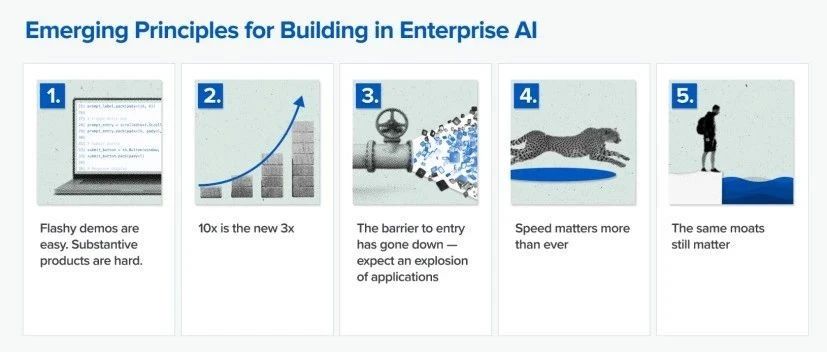
Core Insights - The article discusses the evolving landscape of AI companies and their distinct operational approaches compared to traditional SaaS firms, emphasizing the challenges and opportunities in building sustainable AI businesses [3][4][6]. Group 1: AI Company Dynamics - AI has become a strategic priority for nearly all enterprises, with OpenAI reporting that 10% of global systems are now using their products [3]. - AI companies are adapting to market demands by focusing on product reliability and understanding the unique contexts of their clients, which is crucial for successful implementation [5][6]. Group 2: Product Development Challenges - Creating impressive AI demos is easy, but delivering functional products that work in real-world scenarios is significantly more challenging due to unpredictable user behavior and messy data [4][5]. - The gap between AI product demos and actual products has widened, highlighting the complexities involved in deploying AI solutions in enterprise environments [4][5]. Group 3: Market Growth and Trends - AI companies are experiencing rapid growth, with some achieving over 10x year-over-year growth rates, driven by a shift in enterprise purchasing behavior and dedicated AI budgets [10][11]. - The cost of creating AI solutions has dramatically decreased, enabling a surge in new applications and tools that were previously economically unfeasible [12][13]. Group 4: Competitive Landscape - Speed and momentum are critical for AI companies to establish themselves as trusted vendors in a crowded market, allowing them to capture significant market share before competitors can react [14][15]. - Building a sustainable AI business requires establishing a "moat" through deep integration with client systems, creating workflow lock-in, and fostering strong customer relationships [17][18][20]. Group 5: Strategic Recommendations - Companies should aim to become a single source of truth (SoR) for their clients, capturing critical data and building workflows that enhance long-term value [17]. - Establishing deep vertical integrations and maintaining strong client relationships are essential strategies for AI companies to thrive in a competitive environment [19][20].
喝点VC|a16z最新洞察:滞后性市场调研的时代正在终结,AI驱动创企正重塑组织获取客户洞察、制定决策和大规模执行的方式
Z Potentials· 2025-07-05 03:45
Core Insights - The article discusses how AI is transforming market research by shifting spending from traditional human-based methods to software-driven solutions, significantly increasing efficiency and reducing costs [2][12][24] - AI-driven companies are redefining market research, moving from static, lagging feedback to continuous, dynamic insights that can be integrated into workflows [5][21][25] Current State of Market Research - Traditional market research has relied heavily on manual processes, leading to inefficiencies and high costs, with annual spending reaching $140 billion [2][6] - The emergence of online survey tools in the early 2000s improved data collection but resulted in fragmented approaches lacking enterprise-level governance [6][8] - New UX research tools have allowed product teams to embed research into development processes, but these tools are often limited to small teams and lack cross-departmental collaboration [8][12] AI-Driven Innovations - AI has accelerated survey design and analysis, enabling real-time adjustments and insights that were previously unattainable [12][20] - Generative agents simulate human behavior, allowing for the creation of virtual societies that can provide insights without relying on human samples [13][17][20] - The integration of AI into market research tools allows for immediate, actionable insights, transforming the decision-making process [21][24] Future Trends - The article predicts a "cleansing moment" in market research, where outdated methods will be replaced by AI-driven tools that provide faster and more accurate insights [25] - Companies that adopt AI research tools early will gain competitive advantages through quicker insights and better decision-making capabilities [25] - The potential for AI-native companies to dominate the market lies in their ability to innovate and adapt quickly, contrasting with traditional firms that may struggle with legacy systems [24][25]

速递|00后亚裔AI笔记Cluely上线一周ARR飙至700万美金,开源竞品Glass突袭
Z Potentials· 2025-07-04 03:56
Core Insights - Cluely's annual recurring revenue (ARR) surged to approximately $7 million within a week of launching its new enterprise product, driven by interest from both consumer and enterprise clients [1][2] - The company has gained significant venture capital support and has shifted its marketing approach from provocative to more refined messaging, emphasizing the utility of its product [2] - Cluely's real-time note-taking feature is highlighted as a key differentiator from competitors, although it faces potential competition from similar free products being developed [3] Company Overview - Cluely is a Silicon Valley startup that utilizes AI to analyze online conversations, providing real-time notes, contextual interpretations, and question suggestions [1] - The company was founded by Roy Lee, who has a controversial background related to developing tools for interview cheating, which has not deterred enterprise interest in its products [2] Product Features - The real-time note-taking functionality is the most attractive feature for customers, allowing users to review notes during meetings rather than after [3] - The enterprise version of Cluely's product includes additional features such as team management and enhanced security settings, catering to business applications like sales calls and customer support [2] Market Dynamics - Cluely has signed a contract with a publicly traded company, doubling the annual contract value to $2.5 million, indicating strong enterprise demand [2] - The emergence of competing products, such as the open-source Glass by Pickle, poses a challenge to Cluely's growth and market position [3]

Z Product|Product Hunt最佳产品(6.23-29),3款华人AI产品上榜
Z Potentials· 2025-07-04 03:56
Core Insights - The article highlights ten innovative AI-driven tools that address various professional needs, focusing on enhancing efficiency and user experience in different sectors. Group 1: Pally - Pally is an AI tool that integrates contact information from multiple social platforms to improve relationship management efficiency [1][3] - It targets professionals who frequently maintain career relationships, particularly in sales and marketing, addressing the growing complexity of social networks [4] - Key features include multi-platform contact integration, automated content research, and intelligent reminders, with a focus on deep content analysis [4][5] Group 2: Twenty - Twenty is an open-source, highly customizable modern CRM positioned as an affordable alternative to Salesforce [6][7] - It caters to startups and tech teams needing personalized CRM solutions, capitalizing on the demand for flexible and transparent CRM systems [8] - Highlights include customizable data models, strong automation capabilities, and seamless integration through REST and GraphQL APIs [8][9] Group 3: mysite.ai - mysite.ai is an AI-driven website building platform aimed at small businesses and creators, emphasizing a no-template, no-drag-and-drop approach [10][12] - It addresses the need for quick website launches with minimal technical skills, leveraging conversational AI to generate customized layouts and content [12][13] - Key features include integrated lead capture forms and flexible customization options post-launch [13][14] Group 4: Pythagora - Pythagora is an AI-driven full-stack application development platform that allows developers to build and deploy web applications in hours instead of months [15][16] - It targets small to medium-sized development teams and startups, responding to the demand for efficient and intelligent development tools [17] - Features include natural language interaction, automated code generation, and one-click deployment [17][18] Group 5: FlashDocs API - FlashDocs API is an AI tool for automatically generating slideshows from various content formats, enhancing the efficiency of presentation creation [19][23] - It serves data analysts and sales teams, addressing the need for automated, customizable presentation solutions [23][24] - Key features include multi-format export options and brand template customization [24][25] Group 6: HeyBoss AI Boss Mode - HeyBoss AI Boss Mode is a fully automated AI business management platform designed for entrepreneurs and small businesses [26][27] - It simplifies website creation and business operations by integrating various AI roles to manage tasks efficiently [27][28] - The platform targets a wide range of small businesses, emphasizing the need for rapid and automated digital business management [28][29] Group 7: Ops AI by Middleware - Ops AI by Middleware is a full-stack AI observability platform aimed at developers and operations teams [30][31] - It addresses the complexities of maintaining AI-driven applications by automating detection, diagnosis, and repair processes [31][32] - Key features include real-time alerts and a unified monitoring dashboard for enhanced issue tracking [32][33] Group 8: NativeMind - NativeMind is a local browser-based AI assistant that ensures data privacy by running advanced AI models on user devices [34][36] - It targets privacy-conscious users and developers, responding to the growing demand for local AI processing [36][37] - Features include local model operation, quick content summarization, and instant page translation [37][38] Group 9: Runbear - Runbear is a no-code platform for building AI assistants integrated into communication tools like Slack [39][41] - It simplifies team workflows by automating repetitive tasks, addressing the need for efficient collaboration [41][42] - Key features include role-specific AI agents and seamless integration with over 2700 tools [42][43] Group 10: Dyad - Dyad is a free, open-source AI programming assistant that operates locally, appealing to developers seeking privacy and control [44][46] - It addresses the need for flexible, non-subscription-based AI tools in programming [46][47] - Features include local operation for data privacy and support for various AI models [47][48]

喝点VC|红杉美国对谈OpenAI前研究主管:预训练已经进入边际效益递减阶段,其真正杠杆在于架构的改进
Z Potentials· 2025-07-04 03:56
Core Insights - The article discusses the evolution of AI, particularly focusing on the "trinity" of pre-training, post-training, and reasoning, and how these components are essential for achieving Artificial General Intelligence (AGI) [3][4][5] - Bob McGrew emphasizes that reasoning will be a significant focus in 2025, with many opportunities for optimization in compute usage, data utilization, and algorithm efficiency [4][5][6] - The article highlights the diminishing returns of pre-training, suggesting that while it remains important, its role is shifting towards architectural improvements rather than sheer computational power [6][8][9] Pre-training, Post-training, and Reasoning - Pre-training has reached a stage of diminishing returns, requiring exponentially more compute for marginal gains in intelligence [7][8] - Post-training focuses on enhancing the model's personality and intelligence, which can yield broad applicability across various fields [9][10] - Reasoning is seen as the "missing piece" that allows models to perform complex tasks through step-by-step thinking, which was previously lacking in models like GPT-3 [14][15] Agent Economics - The cost of AI agents is expected to approach the opportunity cost of compute usage, making it challenging for startups to maintain high pricing due to increased competition [17][18][19] - The article suggests that while AI can automate simple tasks, complex services requiring human understanding will retain their value and scarcity [19][20] Market Opportunities in Robotics - There is a growing interest in robotics, with the belief that the field is nearing commercialization due to advancements in language interfaces and visual encoding [22][25] - Companies like Skilled and Physical Intelligence are highlighted as potential leaders in the robotics space, capitalizing on existing technology and research [22][25] Proprietary Data and Its Value - Proprietary data is becoming less valuable compared to the capabilities of advanced AI models, which can replicate insights without extensive human labor [29][30] - The article discusses the importance of specific customer data that can enhance decision-making, emphasizing the need for trust in data usage [31] Programming and AI Integration - The integration of AI in programming is evolving, with a hybrid model where users engage in traditional coding while AI assists in the background [32][33] - The article notes that while AI can handle repetitive tasks, complex programming still requires human oversight and understanding [33][34] Future of AI and Human Interaction - The article explores how different generations interact with AI, suggesting that AI should empower individuals to become experts in their interests while alleviating mundane tasks [39][42] - It emphasizes the importance of fostering curiosity and problem-solving skills in the next generation, rather than merely teaching specific skills that may soon be automated [43][44]

速递|Meta人才争夺的“创始人级”阶段,前SSI联合创始人Gross,离职转投超级智能实验室
Z Potentials· 2025-07-04 03:56
Core Viewpoint - Meta is restructuring its AI department and recruiting top talent to develop superintelligent technology that meets or exceeds human-level capabilities, with Daniel Gross joining the newly established AI superintelligence lab [1][2]. Group 1 - Daniel Gross, former CEO and co-founder of Safe Superintelligence, will join Meta's new AI superintelligence lab to develop AI products [1]. - Meta's CEO Mark Zuckerberg is actively involved in recruiting top industry experts to compete with rivals like OpenAI and Alphabet's Google [1]. - Gross's departure from Safe Superintelligence was announced by Ilia Sutskever, the former chief scientist of OpenAI, who will take over as CEO of SSI [1][2]. Group 2 - Prior to co-founding SSI, Gross worked with former GitHub CEO Nat Friedman on tech investments, and both have been hired by Meta to lead the superintelligence lab [2]. - Gross co-founded the search engine startup Cue, which was acquired by Apple in 2013, and he assisted in leading AI and search projects at Apple from 2013 to 2017 [2]. - Reports indicate that Meta proposed acquiring a stake in the venture capital firm NFDG, co-founded by Friedman and Gross [2].


速递|AI编程黑马Lovable新一轮估值20亿美金,半年ARR5000万美金
Z Potentials· 2025-07-03 03:13
Core Insights - Lovable, a rapidly growing AI startup in the programming space, is raising over $150 million at a valuation of nearly $2 billion [1] - The company has quickly progressed from seed funding to a significant growth round, indicating strong market interest and potential [1] - Lovable's annual recurring revenue reached $50 million within six months of launching its web application building product [1] Funding and Valuation - Lovable completed a $15 million Pre-A funding round led by Creandum in February 2025, just months before the current funding round [1] - The current funding round is led by Accel, with participation from Creandum and 20VC [1] Product and Market Position - Lovable's product allows users to build complete web applications from initial text prompts, similar to competitors like Replit and Bolt [1] - The application includes user interface/front-end development and database connections, showcasing its comprehensive capabilities [1] Pricing and Business Model - Lovable offers a competitive pricing model starting at $25 per month for 250 "credits," making it accessible for users [2] - The company plans to introduce a beta version of an AI agent that can automate tasks such as code editing and debugging, with a usage-based pricing model [2] - This pricing strategy aligns with industry trends, as AI startups often incur variable costs from model providers like OpenAI or Anthropic [2]

深度|Sam Altman:创业者不要做OpenAI核心要做的事,还有很多领域值得探索,坚持深耕可长成比OpenAI更大的公司
Z Potentials· 2025-07-03 03:13
Core Insights - The conversation highlights the importance of decisive action and gathering talented individuals around ambitious goals, particularly in the context of OpenAI's early days and its focus on AGI [3][5][6] - The discussion emphasizes the current state of AI technology, including the rapid advancements in model capabilities and the lag in product development, as well as the potential for future innovations [7][8][9] - The dialogue also touches on the future of human-computer interaction, the role of AI in scientific progress, and the potential for a new industrial era driven by AI and robotics [15][27][29] Group 1: Early Decisions and Talent Gathering - One of the most crucial decisions for OpenAI was simply to commit to the project, despite initial doubts about the feasibility of AGI [3] - Attracting top talent was facilitated by presenting a unique and ambitious vision that few others were pursuing at the time [5] - OpenAI started small, with only eight people, and initially focused on producing quality research rather than having a clear business model [6] Group 2: Current State of AI Technology - There is a significant gap between the capabilities of AI models and the products available, indicating a "product lag" [7] - The cost of using models like GPT-4o is expected to decrease rapidly, enhancing accessibility and potential applications [7] - OpenAI plans to open-source a powerful model soon, which could surprise many users with its capabilities [7] Group 3: Future Innovations and Human-Computer Interaction - The introduction of memory features in AI is seen as a step towards creating more personalized and proactive AI assistants [8] - The future of human-computer interaction is envisioned as a "melted interface," where AI seamlessly manages tasks with minimal user intervention [21][22] - The integration of AI with real-world data sources is crucial for enhancing user experiences and operational efficiency [11] Group 4: Industrial and Scientific Progress - The conversation suggests that the next industrial revolution could be driven by AI and robotics, with the potential to automate various sectors [15][16] - AI is expected to significantly accelerate scientific discovery, which could lead to sustainable economic growth and improvements in human life [27] - The relationship between energy and AI is highlighted, emphasizing the need for sustainable energy solutions to support advanced AI operations [29][30] Group 5: Entrepreneurial Advice and Market Opportunities - Current technological shifts present a unique opportunity for startups to innovate and adapt quickly, leveraging the evolving landscape [23] - Founders are encouraged to focus on unique ideas rather than following trends, as true innovation often comes from exploring uncharted territories [17][18] - The importance of resilience and long-term vision in entrepreneurship is emphasized, particularly in the face of skepticism [19][32]