量子位

Search documents
Google全链路赋能出海:3人团队调度千个智能体,可成独角兽|MEET2026
量子位· 2025-12-17 03:38
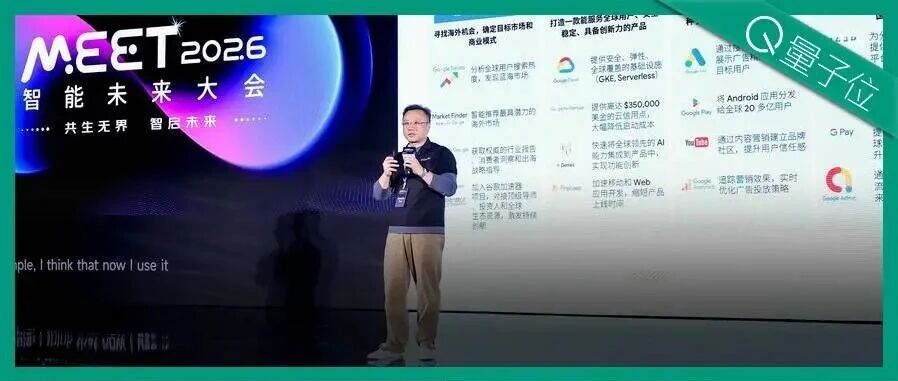
Core Insights - The future will be characterized by autonomous collaboration among intelligent agents, solving complex problems, automating workflows, and autonomously issuing tasks, creating a new business model [1] - AI agents are becoming new productivity units, injecting new meaning into the globalization logic of startups [2] - The intelligent agent sector is just beginning, with significant changes expected in the next one to two years, presenting a major opportunity for Chinese startups to go global [3] Google’s Integrated Solutions for Startups - Google has launched AI-driven integrated solutions to empower startups for efficient globalization [4] - The MEET2026 conference attracted nearly 1,500 offline attendees and over 3.5 million online viewers, highlighting the significant interest in the topic [6] - Startups face various challenges during globalization, and Google’s ecosystem can support them at every stage [7] Stages of Startup Globalization - The five stages of startup globalization include: 1. **Ideation and Strategic Planning**: Founders gather information and analyze competitors, often using Gemini for market research [8] 2. **Product Launch**: Google Cloud provides stable cloud infrastructure support [9] 3. **Market Validation**: Google Ads assists in reaching target customers [9] 4. **Market Expansion**: Google Play and other services support expansion into new markets [9] 5. **IPO Maturity**: Google’s data analysis tools aid in the final push before going public [10] Challenges and Innovations in AI - The AI field is evolving rapidly, with challenges such as hallucination (inaccurate or fabricated information) being addressed through better model training and engineering practices [11] - The introduction of the A2A (Agent-to-Agent) protocol aims to facilitate communication between intelligent agents across different enterprises [16] - The shift from SaaS subscription models to outcome-based payment models reflects a fundamental change in business logic, allowing small teams to scale significantly [18] Gemini's Evolution and Capabilities - Gemini has evolved from its initial version to Gemini 3, which has achieved significant advancements in reasoning, understanding, and problem-solving capabilities [15] - Key capabilities of Gemini 3 include: 1. **Extended Context Window**: Supports 1 million tokens, emphasizing the importance of context engineering [21] 2. **Native Multimodal Capability**: Understands text, video, images, and audio with improved clarity and accuracy [22] 3. **Function Calling Ability**: Enables intelligent agents to utilize external tools and services [23] - Gemini 3 is considered the safest model to date, having undergone comprehensive safety assessments [24]


是个公司都在用AI Agent,但大家真的用明白了吗??| MEET2026圆桌论坛
量子位· 2025-12-17 01:04
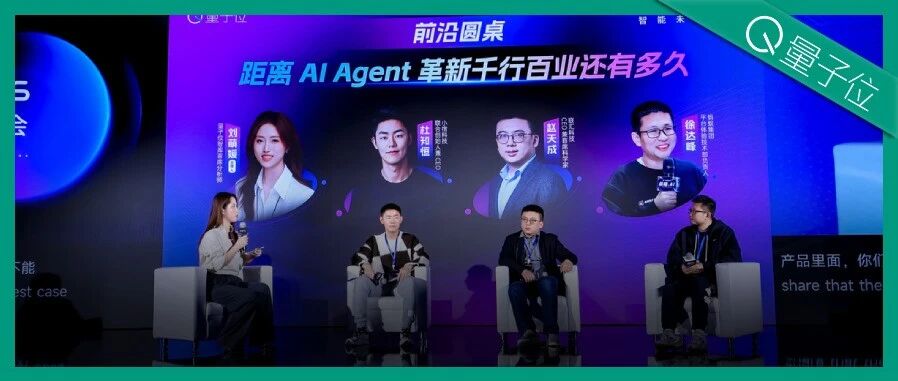
Core Insights - The article discusses the evolution of AI Agents, emphasizing that a significant milestone will be reached when two out of three most frequently used apps by individuals are AI Agents [1][72] - Key metrics for evaluating a good AI Agent include controllability, explainability, and the ability to execute tasks consistently and stably [1] - Many AI Agents currently face negative gross margin issues, where the cost of completing tasks exceeds users' willingness to pay, posing a challenge for entrepreneurs [2][49] Group 1: Industry Perspectives - The year 2025 is anticipated to be the "Year of the Agent," marking the initial deployment of AI Agents in standardized scenarios such as customer service and claims processing, validating their technical feasibility and value [1][4] - The industry faces the challenge of aligning technology, product, and business models to create a sustainable positive feedback loop for AI Agents [2][4] - The roundtable discussion featured insights from industry leaders, highlighting the need for a rational and pragmatic approach to the widespread application of AI Agents across various sectors [3][10] Group 2: Product Development and Use Cases - AI Agents are evolving from simple tasks to more complex functions, such as creating presentations and coding, demonstrating significant advancements in their capabilities [23][25] - Successful implementations of AI Agents have shown ROI improvements, particularly with the advent of multimodal models that enhance understanding of images and videos [20][21] - The development of coding agents has progressed from writing code to executing entire workflows, resulting in efficiency gains of 3 to 5 times in software engineering tasks [25][35] Group 3: Key Challenges and Future Directions - A major challenge for AI Agents is the discrepancy between operational costs and user payment willingness, which hinders scalability for many startups [49] - The future evolution of AI Agents will likely focus on enhancing reliability and integrating them into physical environments, requiring advancements in both foundational models and engineering capabilities [56][57] - The industry anticipates a significant increase in AI Agent penetration in 2026, driven by major investments from leading tech companies and the emergence of user-friendly applications [58][61]
反超Nano Banana!OpenAI旗舰图像生成模型上线
量子位· 2025-12-17 01:04
Core Viewpoint - OpenAI has launched its new image generation model, GPT-Image-1.5, which aims to enhance practical usability and compete directly with other leading models in the market [2][13][14]. Summary by Sections Model Features - The new model introduces four main highlights: improved instruction adherence, precise editing, better detail retention, and a speed increase of up to four times compared to its predecessor [3][5][14]. - GPT-Image-1.5 is designed to maintain consistency in key elements such as lighting, composition, and character appearance during input, output, and multi-round editing [15][19]. Performance and Comparisons - In benchmark tests, GPT-Image-1.5 has been rated first in both text-to-image and image editing categories, surpassing the Nano Banana Pro [33]. - The model's instruction adherence rate is reported to be as high as 90%, indicating a significant lead over competitors [35]. Pricing and Accessibility - The API for GPT-Image-1.5 has seen a 20% reduction in input and output costs compared to the previous version [39]. - Pricing varies by resolution, with high-quality images costing approximately $133 per thousand and low-quality images around $9 per thousand [40]. Market Positioning - OpenAI is positioning GPT-Image-1.5 as a productivity tool with its focus on fine editing capabilities and reduced pricing, indicating a strategic shift towards enhancing practical applications [41]. - The model is now available to all ChatGPT users and API users globally, marking a significant step in OpenAI's product offerings [38].

给Agent装上“海马体”!上海AILab开源MemVerse,定义多模态记忆新范式
量子位· 2025-12-16 11:52
Core Insights - The article emphasizes the need for a multi-modal memory system for AI agents, moving beyond traditional text-based memory to a more complex, experience-based memory framework [1][2][4] Group 1: Multi-Modal Memory Framework - MemVerse is introduced as the first general multi-modal memory framework for AI agents, integrating images, audio, and video with text into a unified semantic space [1][4] - The framework features a "dual-path" architecture and "memory distillation" technology, enabling AI agents to possess lifelong memory capabilities that are responsive and adaptable [1][4][10] Group 2: Performance and Efficiency - MemVerse has demonstrated significant performance improvements in benchmark tests, such as a nearly 9 percentage point increase in the ScienceQA score for GPT-4o-mini, from 76.82 to 85.48 [8] - In video retrieval tasks, MemVerse outperformed traditional methods like CLIP (29.7% recall rate) and specialized models such as ExCae (67.7%) and VAST (63.9%) [8] - The system can reduce token consumption by up to 90% while maintaining high accuracy, significantly lowering operational costs and delays for long-term memory [8][9] Group 3: Memory Architecture - MemVerse's architecture mimics human cognitive processes, consisting of a central coordinator, short-term memory (STM), and long-term memory (LTM) [6][11] - The central coordinator actively manages memory interactions, enhancing the agent's ability to make intelligent decisions rather than relying on passive data retrieval [11] - The LTM is structured into core memory (user profiles), situational memory (event timelines), and semantic memory (abstract concepts), facilitating deep associative reasoning and addressing "hallucination" issues [11] Group 4: Open Source and Community Engagement - The project has been open-sourced by the Shanghai Artificial Intelligence Laboratory, inviting developers to experiment with the framework [12]

用企业级智能体落地,还有谁没踩这四种大坑?无问芯穹的系统性解法来了
量子位· 2025-12-16 11:52
Core Viewpoint - The article discusses the challenges and opportunities in the implementation of AI agents in enterprises, emphasizing the need for a robust infrastructure to support their effective deployment and operation [4][52][63]. Group 1: Current State of AI Agents - AI agents have been integrated into many workflows but are often perceived as having only intern-level capabilities [2][3]. - Many teams use AI agents for automation but do not fully trust them with core responsibilities [3][4]. - The focus in the industry is shifting from merely achieving model performance to addressing engineering and application scenarios for enterprise-level deployment [4][52]. Group 2: Challenges in AI Agent Implementation - Enterprises face four common pitfalls when deploying AI agents: effectiveness issues, stability during scaling, rising costs, and difficulties in establishing a commercial loop [8][21]. - Effectiveness issues arise from various factors such as model selection and prompt design, leading to performance degradation over time [11][12][13]. - Stability problems become apparent when AI agents transition from small-scale trials to real business environments, resulting in task delays and errors [14][15]. - Despite expectations, AI agents have not significantly reduced costs, with high token usage leading to expenses of 20-50 yuan for large model calls [16][17][18]. - Establishing a commercial loop requires AI agents to integrate into product flows and payment systems, which many current solutions lack [19][20]. Group 3: Solutions Offered by Wenshu Qiong - Wenshu Qiong's AI agent service platform aims to address the systemic gaps in AI agent deployment [25][26]. - The platform provides a comprehensive solution that includes templates for various AI capabilities, allowing enterprises to avoid trial-and-error during initial implementation [28]. - It offers stability and scalability through robust technical support and system resilience, significantly improving operational efficiency [32][33]. - Cost management is enhanced through deep integration of model optimization and hardware collaboration, allowing enterprises to control expenses effectively [36][37][39]. - The platform facilitates commercial viability by connecting AI agents with external tools and payment systems, streamlining the integration process [41][42]. Group 4: Future Trends and Organizational Changes - The article predicts that as AI agents become more prevalent, enterprises will need to adapt their organizational structures to accommodate multiple agents working collaboratively [55][56]. - The competitive edge will increasingly depend on the number and quality of AI agents and their collaborative systems within organizations [60][61]. - The infrastructure for AI agents will be crucial for differentiating enterprises in the market, akin to the foundational systems that support vehicles [61][62]. - Wenshu Qiong positions itself as a provider of this essential infrastructure, focusing on creating a solid foundation for enterprise-level AI agent deployment [63][67].

量子位编辑作者招聘
量子位· 2025-12-16 11:52
Core Viewpoint - The article emphasizes the ongoing AI boom and invites individuals to join the company "Quantum Bit" to track AI advancements and become content experts in various AI-related fields [1]. Group 1: Job Opportunities - The company is hiring for three main directions: AI Industry, AI Finance, and AI Product, with positions available for both experienced professionals and fresh graduates [2][4]. - Positions are full-time and based in Beijing, with opportunities for editorial roles at various levels, including editor, lead writer, and chief editor [6]. Group 2: Job Responsibilities - **AI Industry Direction**: Focus on innovations in infrastructure, including chips, AI infrastructure, and cloud computing [6]. - **AI Finance Direction**: Track venture capital and financial reports in the AI sector, monitoring capital movements within the industry [6]. - **AI Product Direction**: Monitor advancements in AI applications and hardware, including software products and terminal technologies [6]. Group 3: Benefits and Growth - Employees will have access to the latest AI technologies and tools, enhancing work efficiency and creativity [6]. - The company offers a vibrant team environment, professional mentorship, and competitive compensation packages, including various benefits [6][12]. - The company aims to build personal influence through original content creation and networking opportunities with industry leaders [6]. Group 4: Company Overview - As of 2025, Quantum Bit has over 2.4 million subscribers on WeChat and more than 7 million users across platforms, with a daily reading volume exceeding 2 million [12]. - It is recognized as the top new media outlet in the AI and frontier technology sector according to third-party data platforms [12].

QQ音乐你变了,竟能免费在AI PC上原创一首《大东北》
量子位· 2025-12-16 11:52
Core Viewpoint - QQ Music has introduced an AI songwriting feature that allows users to create original songs for free, significantly lowering the barrier to music creation [1][2][4]. Group 1: AI Songwriting Feature - The AI songwriting feature enables users to input their song ideas and select a genre, resulting in a complete song generated in minutes [3][4]. - This feature is unique to the AI PC platform, utilizing local large models for real-time generation, making it accessible for both amateurs and professionals [5][6]. Group 2: AI PC Capabilities - The AI PC is transforming creative processes across various applications, including video editing, image processing, and report writing, by integrating high AI capabilities [7][8]. - The introduction of AI PCs is redefining personal computing, breaking down the barriers between professional and amateur creators [10][11]. Group 3: Technical Innovations - Intel's Core Ultra AI PC processor integrates a dedicated NPU, marking a shift from traditional CPU and GPU architectures to a new heterogeneous computing model [28][30]. - This new architecture enhances performance, reduces power consumption, and allows for efficient handling of continuous AI workloads, improving user experience [33][40]. Group 4: Future of AI PCs - The upcoming Panther Lake processor is expected to further elevate AI PC capabilities, emphasizing the importance of a robust AI ecosystem for future competition [41][43]. - Intel's innovations are aimed at meeting diverse user needs, positioning the Core Ultra as a critical advancement in enhancing productivity and creativity [44].


50万个AI生成的应用,正在赚钱
量子位· 2025-12-16 09:05
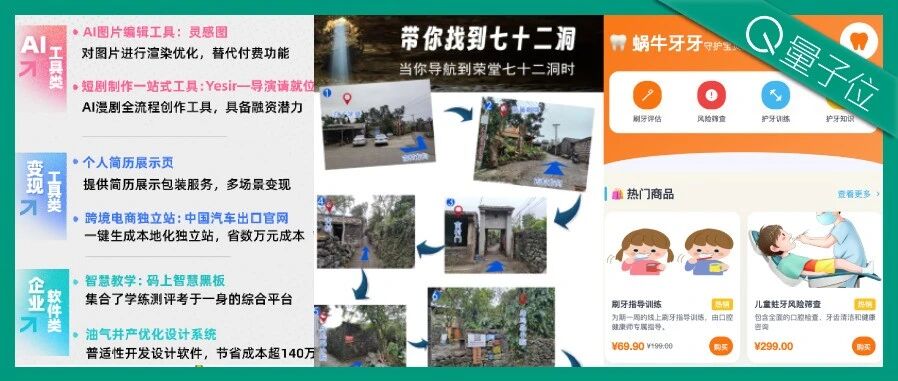
Core Insights - The article discusses the emergence of "no-code" AI application development platforms, specifically highlighting the success of the "秒哒" platform, which allows users to create applications without coding, at zero cost and with no deployment pressure. This has led to the creation of over 500,000 commercial applications across various sectors, serving more than 10 million users and generating economic value exceeding 5 billion yuan [1][2]. Group 1: Industry Trends - The "秒哒" platform has enabled a new wave of creators, referred to as "wild developers," who have successfully launched numerous applications in diverse fields such as education, business, content production, and enterprise services [1][2]. - The platform's approach focuses on practical applications with commercial viability, as emphasized by industry leaders who advocate for AI tools that create real value rather than mere prototypes [10][69]. Group 2: Case Studies - A notable example is the "荣堂古村数字博物馆," developed by a team in Haikou, which utilized AI to enhance visitor experiences and boost local revenue through digital content [3][5][7]. - Another case involves an engineer, Wang Zhilei, who created an oil and gas well design platform using "秒哒," addressing common issues in traditional software such as high costs and complexity [14][19]. Group 3: Platform Features - "秒哒" provides robust front-end and back-end capabilities, allowing users to deploy applications quickly without needing technical expertise. The platform includes a rich ecosystem of plugins and pre-built solutions for various functionalities [12][50]. - The application development process is streamlined, enabling users to describe their ideas in simple language, which the platform then translates into structured application requirements [34][50]. Group 4: Commercialization and Support - The platform has integrated payment capabilities, with over 20,000 applications now accepting payments and completing more than 80,000 transactions, indicating a growing trend towards monetization of user-generated applications [71]. - "秒哒" has launched the "创造者筑梦计划," aimed at supporting 1 million creators in achieving revenue generation, with plans to invest in promising projects [73][75].

推特吵架吵出篇论文!谢赛宁团队新作iREPA只要3行代码
量子位· 2025-12-16 05:58
Core Viewpoint - The article discusses the emergence of a new academic paper, iREPA, which was inspired by an online debate about self-supervised learning (SSL) models and their application to dense tasks, emphasizing the importance of spatial structure over global semantic information in generating quality representations [3][17][25]. Group 1: Background and Development - The discussion that led to the iREPA paper originated from a debate on Twitter, where a user argued that SSL models should focus on dense tasks rather than global classification scores [8][12]. - Following the debate, multiple teams collaborated to produce a complete paper based on the initial discussion, which only required three lines of code to implement [3][30]. Group 2: Key Findings - The research concluded that better global semantic information does not equate to better generation quality; instead, spatial structure is the primary driver of representation generation performance [25][30]. - It was found that visual encoders with lower linear detection accuracy (around 20%) could outperform those with higher accuracy (over 80%) in generating quality representations [25]. Group 3: Methodology and Innovations - The study involved a large-scale quantitative correlation analysis covering 27 different visual encoders and three model sizes, highlighting the significance of spatial information [26][28]. - The iREPA framework was proposed as an improvement to the existing representation alignment (REPA) framework, featuring modifications such as replacing the standard MLP projection layer with a convolutional layer and introducing a spatial normalization layer [30][31]. Group 4: Practical Implications - iREPA can be easily integrated into any representation alignment method with minimal code changes, and it shows improved performance across various training schemes [32].

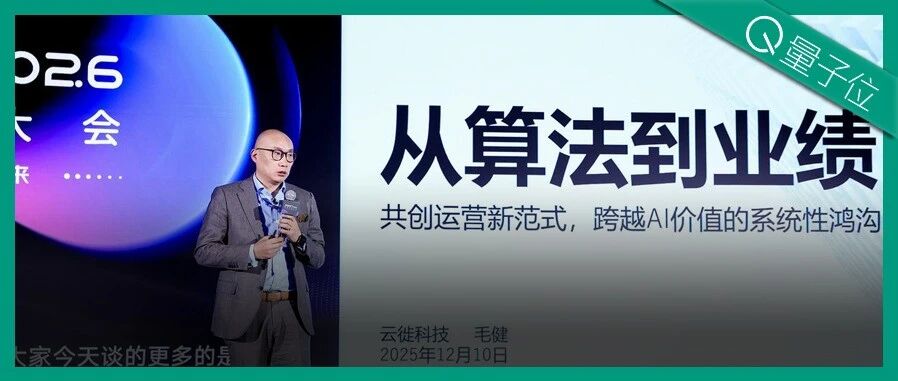
AI终点不是算法,而是业务成果 | 云徙科技@MEET2026
量子位· 2025-12-16 05:58
编辑部 整理自 MEET2026 量子位 | 公众号 QbitAI 大模型时代,基础模型卷到飞起,参数规模爆炸再爆炸,但谈到落地应用,产业端反馈出的问题依然明显: 企业的核心业务中的AI真实渗透率可能都不到1%。 在量子位MEET2026智能未来大会上,云徙科技执行总裁毛健如此坦言。 如何能让实验室里的前沿技术真正走向落地,更好地为企业创造价值? 毛健认为, 现在需要的不是"AI+",而是"×AI" 。 AI创业者更应该在增量中找市场、在专业里找空间、在业务中找场景、在结果中找收益 。 为了准确呈现毛健的完整思考,以下内容基于演讲实录进行整理编辑,希望能提供新的视角与洞察。 MEET2026智能未来大会是由量子位主办的行业峰会,近30位产业代表与会讨论。线下参会观众近1500人,线上直播观众350万+,获得了主 流媒体的广泛关注与报道。 核心观点梳理 时代会从"AI+"快速切换到"运营xAI", Agentic AI时代中,AI从工具将跃迁到业务主体。 对于企业来讲,核心的诉求不是买AI工具,而是需要能够直接对业务结果负责的AI运营智能体。 要让智能体走向自主运营有三步 。 第一步,面向"人+智能体+机器人" ...