生物世界

Search documents
内蒙古大学×北京大学合作最新Cell论文:揭秘妊娠期和哺乳期肝细胞的代谢适应性变化
生物世界· 2025-08-29 00:00
撰文丨王聪 编辑丨王多鱼 排版丨水成文 肝脏 在妊娠和哺乳期间,会经历代谢适应以满足不断变化的生理需求,但其确切的过程、调节机制和功能仍不清楚。 2025 年 8 月 28 日,北京大学 徐成冉 教授作为通讯作者 (内蒙古大学 Li Yang 、北京大学 Yu Zhang 、 Xinxin Yu 、 Yuheng Zhou 为共同第一作者) ,在 国际顶尖学术期刊 Cell 上发表了题为: Hepatocyte metabolic adaptations during pregnancy and lactation 的研究论文。内蒙古大学为论文的第一单位。 该研究 解析了妊娠期和哺乳期肝细胞的代谢适应性变化,并 确定了用以优化母体-胎儿健康和哺乳质量的潜在调控靶点。 尽管它们很重要,但驱动肝脏适应的机制仍知之甚少。研究表明,在妊娠期和哺乳期时肝脏明显增大,这归因于肝细胞的增殖和肥大。人体成像数据同样表明, 怀孕期间肝脏体积会增大,而在断奶后会恢复到基线水平。肝细胞分区沿门静脉 (PV) -肝小叶中部 (ML) -中央静脉 (CV) 轴定义了三个代谢区,其中肝 小叶中部的肝细胞在妊娠期间被确认为主要的新细胞来源 ...


罕见!上海科技大学Nature论文撤稿后,又重新在Nature发表
生物世界· 2025-08-28 10:00
Core Viewpoint - The research published in Nature reveals the crystal structures of human cannabinoid receptor CB 1 bound to two agonists, providing insights into the activation mechanism of the receptor and its implications for drug design [3][9]. Group 1: Research Findings - The study identifies two agonists, Δ9-tetrahydrocannabinol (AM11542) and hexahydrocannabinol (AM841), that bind to the human cannabinoid receptor CB 1 [9]. - Significant conformational changes were observed in the CB 1 receptor when bound to these agonists, including a 53% reduction in the volume of the ligand-binding pocket and an increase in the surface area of the G protein-binding region [10]. - The research highlights the importance of specific residues, Phe200 and Trp356, in the receptor activation process, suggesting they act as critical switches [10]. Group 2: Context and Background - CB 1 is the most abundantly expressed GPCR in the central nervous system, playing a role in regulating various physiological processes such as mood, appetite, and pain perception [3]. - The study builds on previous work that faced data integrity issues, leading to a retraction and subsequent re-publication after independent verification of the main conclusions [6].

Nature Chemistry:西湖大学曹龙兴团队实现可逆光响应蛋白的从头设计
生物世界· 2025-08-28 10:00
Core Insights - The article discusses the significant advancements in the field of protein design, particularly focusing on light-responsive proteins and the challenges associated with their de novo design [5][6][12]. Group 1: Research Development - On August 28, 2025, a team from West Lake University published a study in Nature Chemistry, detailing the de novo design of light-responsive protein-protein interactions, enabling reversible formation of protein assemblies [3]. - The research developed a protein docking program suitable for non-natural amino acids, integrating light-responsive non-natural amino acid AzoF with codon expansion technology to design a series of reversible light-responsive proteins [3][7]. Group 2: Challenges in Protein Design - Despite advancements, a major challenge remains in programming new proteins to respond to environmental stimuli and switch between different structural states, which is crucial for precise control of their structure and function [5][6]. - Natural light-responsive proteins have limitations, such as the need for continuous light exposure, long reverse process times, and complex folding, making them difficult to express and apply in heterologous systems [6]. Group 3: Innovations and Applications - The research team successfully designed a variety of protein complexes, including light-responsive homopolymeric and heterodimeric proteins, demonstrating excellent light-responsive characteristics [7][8]. - The heterodimer LRD-7 showed a remarkable affinity change of 167 times in response to light, and the designed proteins exhibited strong thermal stability, maintaining their secondary structure even after heating to 95°C [8]. - The study also explored the creation of light-responsive protein hydrogels and the use of heterodimeric proteins to control gene expression signals [10][12]. Group 4: Future Implications - This research not only resulted in a series of de novo designed light-responsive proteins but also provided new methods and ideas for the design of light-controlled protein-protein interactions, laying a solid foundation for future developments in light-responsive target-binding proteins and molecular machines [12].

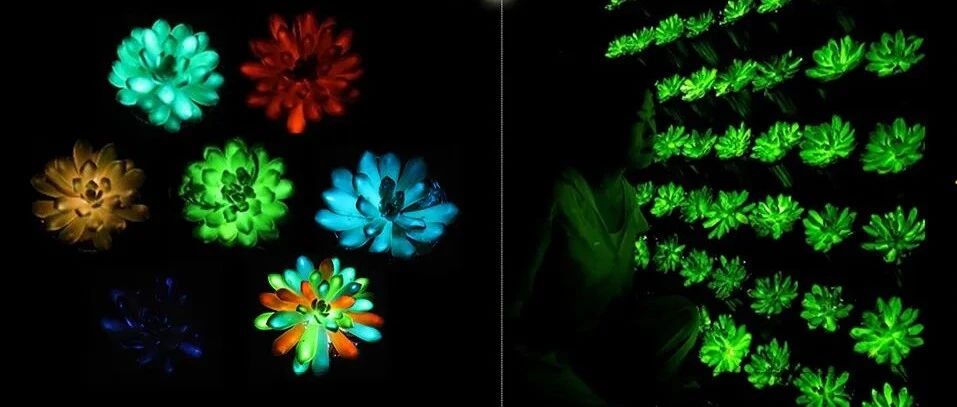
世界首创!我国学者创造多彩发光植物,晒太阳“充电”,成本仅10块钱
生物世界· 2025-08-28 07:30
Core Insights - The article discusses the development of bioluminescent plants, highlighting the introduction of genetically engineered glowing petunias and a new type of luminous succulent developed by researchers from South China Agricultural University [2][5][16]. Group 1: Genetically Engineered Glowing Plants - The first genetically engineered bioluminescent plant, Firefly Petunias, was launched by Light Bio, utilizing a gene from bioluminescent mushrooms, allowing it to glow green without special lighting [2][4]. - The brightness of Firefly Petunias is relatively low, limiting its use to indoor decoration [5]. Group 2: Development of Luminous Succulents - Researchers have created a new type of luminous succulent that can emit bright, multicolored light, marking a significant advancement in bioluminescent ornamental plants [5][16]. - This new succulent utilizes micro-sized phosphorescent particles that absorb specific wavelengths of light and release energy over time, allowing for a variety of colors including red, blue, green, and white [7][8]. - The production cost for creating such a luminous succulent is approximately 10 yuan [13]. Group 3: Research and Methodology - The research team injected phosphorescent particles into the leaves of a common ornamental succulent, achieving a uniform and enhanced luminescence effect [11][16]. - The process of preparing the luminous succulent takes about 10 minutes, and it can be charged using indoor LED lights or sunlight, emitting light for up to 120 minutes [11][14]. - This innovative approach overcomes traditional limitations regarding particle size and luminescence performance, paving the way for practical applications in plant-based lighting solutions [16].
Nature Medicine:替尔泊肽能够有效治疗遗传性肥胖
生物世界· 2025-08-28 07:30
Core Viewpoint - Tirzepatide, developed by Eli Lilly, is the most effective weight loss drug currently on the market, demonstrating a weight reduction of over 20% in clinical trials, particularly beneficial for patients with severe obesity (BMI > 40 kg/m²) [2][5] Group 1: Drug Efficacy - Tirzepatide has shown significant weight loss effects in obese patients, regardless of the presence of type 2 diabetes, with an approximate reduction of 20% [5] - The drug is particularly advantageous for patients with severe obesity, who face the highest burden of cardiovascular complications and mortality [5] Group 2: Genetic Obesity and MC4R Deficiency - MC4R deficiency is the most common hereditary obesity condition, characterized by hyperphagia and significant weight gain from early childhood, leading to severe obesity in adulthood [5][6] - Current treatments for MC4R deficiency have been ineffective, with no approved therapies available for this genetic condition [5][6] Group 3: Research Findings - A study published in Nature Medicine indicates that Tirzepatide effectively aids weight loss in patients with MC4R deficiency, achieving results comparable to non-genetic obesity patients [2][6] - In a clinical trial involving 2,291 participants, 32 individuals (1.4%) were found to carry pathogenic MC4R mutations, and both groups experienced similar weight loss trajectories over 72 weeks, with MC4R mutation carriers losing 18.3% of their body weight compared to 19.9% for non-carriers [6]


Cell子刊:张连军/王宸/孙海汐/张力元合作提出增强CAR-T实体瘤疗效新策略
生物世界· 2025-08-28 04:24
Core Viewpoint - The article discusses the limitations of current T cell-based immunotherapy strategies in treating solid tumors, primarily due to insufficient dendritic cell (DC) activity, particularly the conventional type 1 dendritic cells (cDC1) [2][3]. Group 1: Limitations of Current Therapies - CAR-T cell therapy has revolutionized cancer treatment, showing significant efficacy in B cell malignancies, but its effectiveness in solid tumors remains limited due to factors like poor tumor infiltration and immunosuppressive tumor microenvironment (TME) [3]. - T cell receptor (TCR) engineered T cells (TCR-T) and tumor-infiltrating lymphocytes (TIL) therapies show promising prospects in solid tumor treatment, highlighting the importance of DC-T cell interactions [3][4]. Group 2: Importance of Dendritic Cells - cDC1 cells are crucial for antigen cross-presentation and T cell activation, and the process of antigen spreading is vital for durable therapeutic efficacy [4]. - Manipulating dendritic cells to enhance polyclonal T cell responses is essential for improving cancer treatment outcomes [4]. Group 3: Recent Research Findings - A study published in Cell Reports Medicine demonstrated that engineered T cells overexpressing Flt3L and XCL1 can stimulate dendritic cell recruitment and enhance antigen spreading, leading to improved anti-tumor immunity [5][10]. - The research found that Tpex cells expressing XCL1 correlate with better prognosis and that the Flt3L-XCL1 signaling axis plays a key role in recruiting cDC1 cells [7][8]. Group 4: Implications for CAR-T Therapy - The engineered T cells (FX-T cells) significantly enhance dendritic cell migration and maturation, improving T cell interactions and leading to robust antigen spreading and effective polyclonal T cell responses [7][8]. - FX-modified CAR-T cells exhibited superior anti-tumor activity in both mouse and humanized mouse models, suggesting a promising new strategy for enhancing CAR-T therapy in solid tumors [8][10].

华人学者一天发表了10篇Nature论文
生物世界· 2025-08-28 04:24
撰文丨王聪 编辑丨王多鱼 排版丨水成文 2025 年 8 月 27 日,国际顶尖学术期刊 Nature 上线了 23 篇论文 , 其中 10 篇来自华人学者 (包括作为通讯作者 和第一作者的论文) 。 8 月 27 日, 北京大学 王兴军 教授、 香港城市大学 王骋 教授、北京大学 舒浩文 研究员 作为共同通讯作者, 在 Nature 期刊 发表了题为: Ultrabroadband on-chip photonics for full-spectrum wireless communications (超 宽带片上光子学技术在全频谱无线通信中的应用 ) 的研究论文 【1】 。 8 月 27 日,上海科技大学 iHuman 研究所 刘志杰 教授作为共同通讯作者, 华甜 作为第一作者,在 Nature 期刊发 表了题为: Crystal structures of agonist-bound human cannabinoid receptor CB 1 ( 人源 CB 1 与激动剂结合的 晶体结构 ) 的研究论文 【2】 。 8 月 27 日,浙江大学 狄大卫 教授、 赵保丹 研究员、 邹晨 研究员作为共同通 ...

全球首例!院士候选人使用通用型STAR-T细胞疗法成功治疗系统性红斑狼疮
生物世界· 2025-08-28 04:24
Core Insights - The article discusses a groundbreaking study led by Professor Xu Huji from the Second Affiliated Hospital of Naval Medical University, which successfully utilized CRISPR gene-edited universal CAR-T cell therapy to treat three patients with refractory autoimmune diseases [2][3] - Professor Xu was recognized in Nature's 2024 list of top ten individuals for his contributions to the field, highlighting the collaboration with Huaxia Yingtai, founded by Professor Lin Xin from Tsinghua University, to conduct human trials for systemic lupus erythematosus [2] Research Findings - The study published in Nature Medicine details a phase 1 trial of allogeneic CD19-targeting T cells (STAR-T cells, YTS109) for treatment-refractory systemic lupus erythematosus (SLE) with lupus nephritis (LN) [3] - The trial involved five patients who underwent lymphocyte depletion therapy followed by administration of STAR+ T cells at a dosage of 3×10⁶ cells per kilogram [8] - The primary endpoint was safety and the systemic lupus erythematosus response index 4 (SRI-4) at three months, with secondary endpoints including clinical remission and quality of life at six months [8] Results and Implications - Results indicated good tolerance for YTS109, with only mild cytokine release syndrome observed and no cases of graft-versus-host disease [10] - All five patients achieved SRI-4 response by the third month, with four patients showing a significant and sustained decrease in disease activity score from an average of 31.30 to 5.35 by the sixth month [10] - Quality of life assessments showed improvement for all patients, and kidney biopsies confirmed inflammation reduction and tissue repair, suggesting YTS109 as a promising treatment for severe, refractory SLE with LN [10]

Cell子刊:宋尔卫院士团队揭示T细胞抑制乳腺癌转移的新机制
生物世界· 2025-08-27 23:30
Core Viewpoint - The study reveals that tumor-antigen-specific cytotoxic CD8+ T cells can be deployed remotely to inhibit lung metastasis of breast cancer, highlighting the importance of effector immune cell deployment in cancer treatment [3][8][11]. Group 1: Research Findings - The abundance of tumor-specific CD103+ CD8+ T cells in tumor-draining lymph nodes (TDLN) is associated with prolonged disease-free survival in breast cancer patients [8]. - CD103+ CD8+ T cells are activated in TDLN and recruited to the lungs via CCL25/CCR9 signaling, effectively suppressing tumor metastasis [8][9]. - Tumor-derived extracellular vesicles (EVs) polarize alveolar macrophages, leading to the release of CCL25 and IDO1, which can inhibit the deployment of CD103+ CD8+ T cells and promote lung metastasis [8][9]. Group 2: Implications for Cancer Treatment - Enhancing the recruitment of CD103+ CD8+ T cells or blocking IDO1 can potentially curb lung metastasis of tumors [9]. - The study emphasizes the adaptive immune system's capability to deploy remotely to protect distant organs from tumor metastasis, suggesting a potential therapeutic strategy in cancer treatment [11].

Cell:我国学者鉴定出抗猴痘病毒的人源单克隆抗体
生物世界· 2025-08-27 08:00
撰文丨王聪 编辑丨王多鱼 排版丨水成文 猴痘 (mpox) ,是一种人畜共患病,由 猴痘病毒 ( MPXV ) 感染所致,其于 1958 年首次在用于研究的猴子中发现,主要在动物中传播。1970 年首次在刚 果 (金) 发现人类猴痘病例,此后猴痘一直在非洲的一些国家流行。而 2022 年爆发的猴痘疫情蔓延至了全球 100 多个国家和地区,世界卫生组织 (WHO) 在 2022 年和 2024 年两度就猴痘疫情发布最高级别预警,宣布其构成"国际关注的突发公共卫生事件" (PHEIC) 。 猴痘病毒包膜粒子上表达的 A35 蛋白 对于猴痘病毒在宿主内的感染和传播至关重要,使其成为有效的抗病毒靶点。 2025 年 8 月 26 日,深圳市第三人民医院 (南方科技大学第二附属医院) /深圳国家感染性疾病临床医学研究中心 张政 教授、 鞠斌 特聘研究员、中国医学科 学院医学实验动物研究所 薛婧 研究员、南方科技大学医学院 鄢仁鸿 副教授、中国疾病预防控制中心病毒病预防控制所 谭文杰 研究员作为共同通讯作者 ( 鞠斌 、 刘聪聪 、 张京京 、 李雅宁 、 杨浩楠 、 周兵 、 黄保英 为共同第一作者 ) 在国际顶尖学术 ...