HKEX(00388)

Search documents
保险行业净资产恢复快速增长!全市场孤品港股通非银ETF(513750)规模首次突破130亿元大关,年内规模已翻16倍!
Xin Lang Cai Jing· 2025-08-11 01:43
Core Insights - The Hong Kong Stock Connect Non-Bank ETF has reached a record size of 13.044 billion yuan as of August 8, 2025, marking a year-to-date growth of 1553.23% [1] - The ETF has seen a net inflow of 348 million yuan over the last three days, with a single-day peak inflow of 215 million yuan [1] - The ETF's net asset value has increased by 90.54% over the past year, ranking 38 out of 2954 index stock funds, placing it in the top 1.29% [2] Fund Performance - The Hong Kong Stock Connect Non-Bank ETF has achieved a maximum monthly return of 31.47% since its inception, with the longest consecutive monthly gain being 4 months and a total increase of 38.25% [2] - The ETF has outperformed its benchmark with an annualized return of 7.17% over the last six months [2] - The ETF has a turnover rate of 7.55% and an average daily trading volume of 1.536 billion yuan over the past month [1] Index Composition - The top ten weighted stocks in the CSI Hong Kong Stock Connect Non-Bank Financial Theme Index account for 78.19% of the index, with major holdings including China Ping An, AIA, and Hong Kong Exchanges and Clearing [3] - The insurance sector's net assets reached 3.75 trillion yuan in the first half of 2025, reflecting a year-on-year growth of 23.4% [3] Market Trends - The Hong Kong insurance industry reported a new single premium of 93.4 billion HKD in Q1 2025, representing a year-on-year increase of 43.4% and a quarter-on-quarter increase of 86.2% [4] - The demand for savings remains strong in the market, and regulatory changes are expected to ease liability costs for insurance companies [4] - The insurance sector is entering a new cycle of healthy growth, supported by regulatory measures and economic recovery [4] ETF Characteristics - The Hong Kong Stock Connect Non-Bank ETF is the first and only ETF tracking the Hong Kong non-bank index, with over 60% of its holdings in the insurance sector [5] - The ETF is designed to reflect the overall performance of up to 50 listed companies in the non-bank financial theme within the Hong Kong Stock Connect range [5]
前7月港交所新上市公司同比增长33%;花旗集团成港交所第二大股东丨港交所早参
Mei Ri Jing Ji Xin Wen· 2025-08-10 13:41
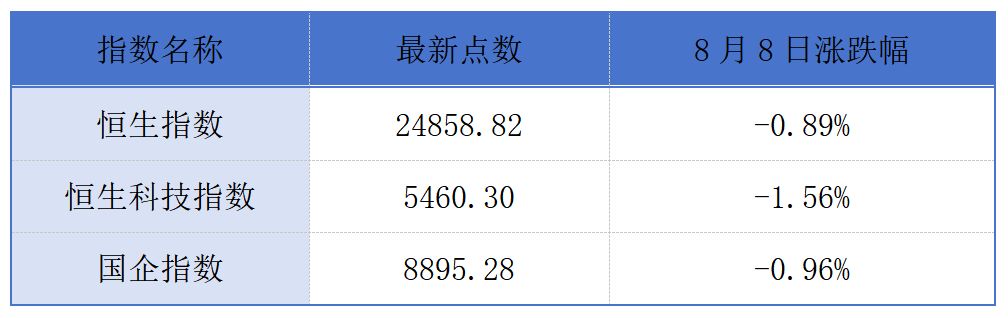
Group 1 - The Hong Kong Stock Exchange (HKEX) has seen a significant increase in new listings and fundraising, with 53 new companies listed in the first seven months of the year, a 33% increase year-on-year. The total fundraising amount reached HKD 127.9 billion, growing over six times compared to the previous year [1] - The total fundraising in the market reached HKD 331.8 billion, nearly tripling from HKD 83.5 billion in the same period last year [1] - The growth in new listings and fundraising is attributed to policy optimization, capital inflow, an increase in quality enterprise supply, and restored market confidence [1] Group 2 - Citigroup has become the second-largest shareholder of HKEX after increasing its stake to 5% by purchasing 225,000 shares at an average price of HKD 417.24 per share, totaling approximately HKD 93.9 million [2] - This acquisition surpasses JPMorgan Chase, which reduced its stake to 3.53% after selling 44.5 million shares last year [2] - The increase in Citigroup's holdings reflects confidence in the active trading environment and IPO financing in the Hong Kong market [2] Group 3 - Junsheng Electronics has refiled its application to list on the HKEX after a previous application lapsed in January, focusing on automotive technology solutions and being the second-largest supplier of passive safety products globally [3] - The company aims to expand its financing channels and accelerate overseas expansion and technological innovation if the listing is successful [3] Group 4 - Wanxing Technology announced plans to issue H-shares and list on the HKEX to enhance its global strategy and brand image, being a leading player in the digital creative software sector with over 1.5 billion users worldwide [4] - The listing is expected to attract international capital and expand its overseas market presence, although the company faces intense competition abroad [4] Group 5 - As of August 8, the Hang Seng Index closed at 24,858.82, down 0.89%, while the Hang Seng Tech Index and the National Enterprises Index fell by 1.56% and 0.96%, respectively [5]


业绩集中披露在即,重点关注绩优个股
Changjiang Securities· 2025-08-10 08:45
Investment Rating - The report maintains a "Positive" investment rating for the investment banking and brokerage industry [9] Core Insights - The brokerage sector is experiencing high trading activity, with several firms reporting strong interim results, indicating continued high growth in mid-year performance and an overall increase in valuation [2][6] - In the insurance sector, the expected increase in value rates is driving significant growth in new business value, supported by a rising equity market and favorable investment returns [6] - The report recommends companies with stable profit growth and dividend rates, including Jiangsu Jinzu, China Ping An, and China Pacific Insurance, as well as others like New China Life, China Life, Hong Kong Stock Exchange, CITIC Securities, Dongfang Wealth, Tonghuashun, and Jiufang Zhitu Holdings based on performance elasticity and valuation levels [2][6] Summary by Sections Market Performance - The non-bank financial index increased by 0.6% this week, with a year-to-date increase of 4.6%, although it ranks lower compared to the broader market [7] - The average daily trading volume in the market decreased by 6.26% to 16,964.10 billion yuan, with a daily turnover rate of 1.94% [7] Brokerage Sector - The brokerage sector shows a rebound in trading activity, with the average daily trading volume exceeding the 2024 average, indicating a gradual recovery in profitability [37][41] - Margin financing balances increased by 1.43% to 2.01 trillion yuan, suggesting a positive trend in credit business [43] Investment Business - The equity market is recovering, with the CSI 300 index rising by 1.23% and the ChiNext index by 0.49% [41] - The report highlights the importance of monitoring the performance of equity and bond markets for brokerage self-operated income [41] Insurance Sector - The insurance industry reported a cumulative premium income of 37,350 billion yuan in June 2025, reflecting a year-on-year growth of 5.31% [21][25] - The total assets of the insurance sector reached 39.22 trillion yuan, with a quarter-on-quarter increase of 2.08% [25] Company Announcements - Guosen Securities announced a major asset restructuring plan to acquire 96.08% of Wanhe Securities, which has been approved by the Shenzhen Stock Exchange [8] - China Ping An announced a cash dividend distribution of 0.37 yuan per share, totaling 33.40 billion yuan [8]



沸腾了!港股通互联网ETF年内吸金超330亿元,恒生创新药ETF涨超97%
Ge Long Hui· 2025-08-10 07:10
Group 1 - The Hong Kong stock market has seen significant activity in 2025, with southbound capital net purchases exceeding the total for the previous year, and IPO financing returning to the top globally [1][4] - The average daily trading volume of ETFs in the Hong Kong market has surged to 33.8 billion HKD, a 184% increase compared to the previous year [2] - The Hong Kong Internet ETF has attracted over 33 billion HKD in net inflows this year, making it the only ETF in the market to surpass 30 billion HKD [3] Group 2 - The performance of Hong Kong-related ETFs has been outstanding, with 19 ETFs rising over 50% this year, 18 of which are invested in Hong Kong stocks; the Hang Seng Innovation Drug ETF leads with a 97% increase [4] - The Hang Seng Index has risen by 23.92% this year, outperforming major global indices such as the S&P 500, which increased by 8.63% [4] Group 3 - Foreign investment banks, including Goldman Sachs, have repeatedly raised their target prices for the Hong Kong Stock Exchange, indicating positive sentiment [5] - Insurance capital has been actively purchasing Hong Kong stocks, with 22 instances of capital injection this year, favoring undervalued and high-dividend assets [6] Group 4 - Analysts predict that the Hong Kong stock market will continue its bull run in the second half of the year, with internet giants expected to increase investments in AI infrastructure [7] - The current valuation of Hong Kong internet stocks is considered low, and the ongoing AI wave is expected to drive technology leaders in the region to outperform the market [7]
巨头最新大调仓!
Ge Long Hui· 2025-08-10 06:48
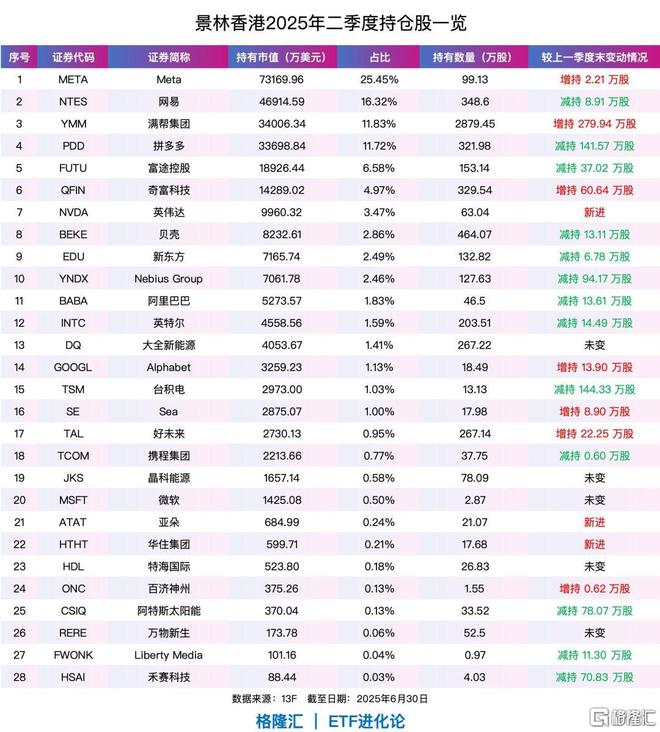
Group 1 - The core viewpoint of the article indicates that Jinglin Hong Kong has made significant adjustments to its U.S. stock holdings, with a total market value of $2.873 billion as of the end of Q2, equivalent to approximately 20.6 billion RMB [1] - Jinglin Hong Kong has initiated new positions in Nvidia, Atour, and Huazhu Group, while increasing stakes in Facebook, Manbang Group, Qifu Technology, Alphabet, Sea, TAL Education, and BeiGene [1][3] - The firm has reduced holdings in several companies, including NetEase, Pinduoduo, Futu Holdings, Beike, New Oriental, Nebius Group, Alibaba, Intel, TSMC, Ctrip, Astra Solar, Liberty Media, and Hesai Technology, and has completely exited positions in Apple, UnitedHealth Group, Regeneron Pharmaceuticals, Pfizer, Legend Biotech, and ZTO Express [1][3] Group 2 - Meta remains the largest holding for Jinglin Hong Kong, with a market value of approximately $731.7 million, accounting for 25.45% of its total U.S. stock holdings [3] - The top ten holdings collectively amount to $2.534 billion, representing over 88% of the total U.S. stock portfolio [1] - The firm emphasizes the importance of identifying new companies with strong business models and robust free cash flow, suggesting that companies with monopolistic advantages in rights, technology, scarce resources, and brand recognition are particularly valuable [1][4] Group 3 - The Hong Kong market has seen a resurgence in IPO financing, becoming the top market globally in the first half of the year, signaling a shift in international capital's perception of Chinese assets [5][6] - Southbound capital has net purchased over HKD 900.8 billion this year, surpassing the total for the previous year, indicating increased investor interest in Hong Kong stocks [7] - The average daily trading volume for ETFs has surged to HKD 33.8 billion, a 184% increase year-on-year, reflecting strong demand for Hong Kong-listed ETFs [9] Group 4 - The Hang Seng Index has risen by 23.92% year-to-date, outperforming major global indices such as the S&P 500, which has increased by 8.63% [18] - Several foreign investment banks, including Goldman Sachs, have raised their target prices for the Hong Kong Stock Exchange, indicating positive sentiment towards the market [18] - Insurance capital has been actively acquiring shares in Hong Kong stocks, with 22 instances of stake increases reported this year, focusing on undervalued, low-volatility, high-dividend, and high-certainty performance assets [19]


香港交易所(0388.HK):复苏动能强劲 聚焦成长与红利主线
Ge Long Hui· 2025-08-10 03:21
Group 1: Market Performance - The Hong Kong financial market showed a strong recovery in the first half of 2025, with multiple indicators reaching historical highs. The average daily trading amount on the Hong Kong Stock Exchange reached HKD 240.2 billion, a significant year-on-year increase of 118%, marking the highest level since 2010 [1] - The average daily trading amount of the Southbound Stock Connect reached HKD 110.96 billion, reflecting a year-on-year growth of 195%, indicating a notable increase in participation from mainland investors [1] - The derivatives market also performed well, with average daily trading volume of futures and options increasing by 11% year-on-year, and the average daily trading volume of RMB currency futures rising by 43%, highlighting the acceleration of RMB internationalization [1] Group 2: Market Capitalization and New Listings - As of June 30, 2025, the total market capitalization of Hong Kong reached HKD 42.7 trillion, a 33% increase compared to the same period last year, driven by the recovery of Chinese mainland economic conditions and the Hong Kong Stock Exchange's continuous optimization of listing regulations [2] - In the first half of 2025, the Hong Kong Stock Exchange received over 200 listing applications, with total new stock financing amounting to USD 14.1 billion, a year-on-year increase of 695%, significantly surpassing the global new stock financing growth of 8% [2] - It is expected that more than 80 medium to large enterprises will advance their plans for A-share or secondary listings in Hong Kong throughout the year [2] Group 3: Investment Outlook - The target price for the Hong Kong Stock Exchange has been raised to HKD 500.0, maintaining a buy rating based on strong fundamentals, including an average daily trading volume exceeding HKD 240 billion and record net inflows from Southbound funds [2] - The valuation corresponds to a price-to-earnings (PE) ratio of 42 times, reflecting a 15.8% increase from the previous trading day's closing price, with a safety margin as it remains below the historical bull market average of 44.7 times [2] - The Hong Kong stock market is currently undergoing a critical phase of valuation recovery and structural transformation, with significant long-term investment value despite potential short-term volatility due to policy expectations [2]
香港经济年中观察—— 亮点多 活力旺 动能足(香江在线)
Ren Min Ri Bao· 2025-08-09 21:43
Group 1: Economic Growth and Investment - Hong Kong has assisted over 1,300 overseas and mainland enterprises in establishing or expanding their businesses, resulting in over HKD 160 billion in foreign direct investment and the creation of more than 19,000 new jobs from January 2023 to mid-2025 [1] - The local GDP has experienced growth for 10 consecutive quarters, with various economic indicators showing positive trends and vitality [1] - The Hong Kong Stock Exchange has welcomed 31 new listings in the first half of 2025, raising over HKD 884 billion, ranking first globally [2][3] Group 2: Financial Market Performance - The market capitalization of Hong Kong's securities market increased to HKD 42.7 trillion in the first half of 2025, a 33% increase year-on-year [3] - The number of registered funds reached 976, with a net inflow of over USD 44 billion, marking a 285% increase year-on-year [3] - Hong Kong's banking deposits exceeded HKD 18 trillion, reflecting a 19% increase compared to June 2022 [3] Group 3: Consumer Market Recovery - Visitor numbers to Hong Kong increased by 12% in the first half of 2025, totaling approximately 24 million [5] - Retail sales value in May 2025 was estimated at HKD 31.32 billion, a 2.4% increase year-on-year, surpassing market expectations [5] - The Hong Kong Ocean Park saw a 19% increase in visitor numbers in May and June compared to the previous year, driven by the addition of new giant pandas [4] Group 4: Trade and International Relations - Hong Kong has signed 9 free trade agreements with 21 economies and 24 investment agreements with 33 economies, expanding its trade network [7] - The overall export value of goods from Hong Kong increased by 11.9% year-on-year in June 2025, marking 16 consecutive months of growth [8] - The establishment of a London Metal Exchange warehouse in Hong Kong is expected to enhance the efficiency of metal delivery in the Asian time zone [7] Group 5: Innovation and Development Initiatives - Hong Kong has launched several innovative measures, including a cross-border payment system and a digital asset development policy framework [3] - The government aims to enhance the breadth, depth, and efficiency of the financial market by encouraging new products and attracting new investments [3] - The Hong Kong government is optimistic about long-term prospects, with significant investments planned in real estate and aviation sectors [6]
港交所 IPO 新规!要点及市场影响解读
Sou Hu Cai Jing· 2025-08-09 13:52
Key Points Summary - The core viewpoint of the article is that the Hong Kong Stock Exchange (HKEX) has implemented significant reforms to its IPO pricing and public offering regulations, marking the most comprehensive adjustment in nearly three decades, which is expected to have profound impacts on the IPO market and attract more companies to list in Hong Kong [2][10]. Group 1: New Regulations Overview - The new regulations optimize the allocation of new shares, with at least 40% of shares now allocated to the book-building process, down from the previously suggested 50% [3][7]. - The public offering mechanism has been adjusted to allow issuers to choose between Mechanism A and Mechanism B, with Mechanism A allowing a maximum reallocation percentage of 35%, up from 20%, while Mechanism B allows issuers to set a public offering proportion between 10% and 60% without a reallocation mechanism [4][7]. - The public float requirement has been revised to introduce a tiered initial public float requirement based on market capitalization, allowing companies to choose a 10% public float for those with a market cap of HKD 1 billion [5][8]. Group 2: Comparison with Previous Requirements - Under the old rules, international subscriptions accounted for 90% and public subscriptions for 10%, with a maximum reallocation to 50%, which made it difficult for institutional investors to determine their allocation [7]. - The new rules enhance the certainty for institutional investors by allocating at least 40% to the book-building process, thus increasing their influence in the pricing process [7]. - The previous rigid public float requirement of 25% has been replaced with more flexible options, allowing companies to meet the requirements based on their market capitalization [8]. Group 3: Impact on HKEX IPO and Market - The new regulations are expected to attract more companies to list on HKEX by lowering the public float requirements, particularly for large companies and "A+H" issuers, which may encourage firms that were previously hesitant to consider an IPO in Hong Kong [11]. - The reforms are anticipated to improve IPO pricing efficiency by enhancing the role of institutional investors, who can provide more accurate valuations and reduce pricing distortions caused by retail investor behavior [12]. - The changes are likely to stabilize the pricing of large IPOs by providing clearer allocation rules and reducing volatility associated with public subscription uncertainties [12]. - The adjustments are expected to optimize the investor structure in the market, increasing the participation of international and institutional investors, which will contribute to a more mature and stable market environment [13]. - The reforms aim to enhance HKEX's international competitiveness by adapting to market changes and attracting more international issuers and investors, thereby solidifying Hong Kong's position as a global financial center [14]. - The implementation of the new rules is projected to boost the activity level of IPOs in Hong Kong, increasing the supply of stocks and promoting capital flow within the market [15].
花旗9.39亿港元增持港交所,持股比例升至5%成第二大股东
Jin Rong Jie· 2025-08-09 11:05
Group 1 - Citigroup completed a significant share purchase of 225,000 shares at an average price of HKD 417.24 per share, totaling approximately HKD 939 million, increasing its total holdings to 63.49 million shares, representing 5% of the issued shares [1] - This increase in shareholding positions Citigroup as the second-largest shareholder, just behind the Hong Kong SAR government, which holds 5.9% [1] - The shareholding structure of the Hong Kong Stock Exchange (HKEX) is relatively dispersed, with a high proportion of institutional investors, and Citigroup's actions have altered the dynamics among major shareholders [2] Group 2 - The Hong Kong stock market has seen a significant increase in trading volume and activity this year, with net inflows from southbound funds exceeding the total for the previous year [3] - The average daily trading amount for Hong Kong stocks reached HKD 240.2 billion in the first half of the year, a year-on-year increase of 118%, marking the highest level since 2010 [3] - The profitability of HKEX is highly correlated with trading volume and turnover, and Citigroup's increased shareholding aligns with the improved fundamentals of the exchange [3]

最新披露!花旗集团举牌港交所,位列第二大股东!
证券时报· 2025-08-09 03:46
Core Viewpoint - Citigroup Inc. has increased its stake in Hong Kong Exchanges and Clearing Limited (HKEX) by acquiring 225,000 shares for approximately HKD 93.8594 million, raising its total holdings to 63.4947 million shares, which represents 5% of the company, making it the second-largest shareholder after the Hong Kong SAR government [1][3]. Group 1: Shareholding Structure - The largest shareholder of HKEX is the Hong Kong SAR government, holding 5.9% of the shares, while Citigroup is the second-largest shareholder with 5% [3]. - Other significant shareholders include various mutual funds such as E Fund, GF Fund, and Huaxia Fund, which hold HKEX shares through multiple fund types, including actively managed funds and passive index funds [3]. - E Fund's two funds, managed by Zhang Kun, have maintained their holdings in HKEX, while other funds like E Fund Hong Kong Securities ETF have reduced their positions [3]. Group 2: Market Activity and Performance - The Hong Kong stock market has seen increased activity this year, with net inflows from southbound funds exceeding the total for the previous year, and IPO financing returning to the top globally [1][3]. - Goldman Sachs and other foreign investment banks have repeatedly raised their target prices for HKEX, with Goldman Sachs recently increasing its target price from HKD 450 to HKD 500 per share, based on better-than-expected average daily trading volumes [4][5]. Group 3: Earnings and Growth Potential - HKEX's earnings model is highly dependent on trading volume and transaction value growth, with the average daily trading amount reaching HKD 240.2 billion in the first half of the year, a significant year-on-year increase of 118% [5]. - Potential catalysts for earnings improvement include the A+H share listing boom, the strengthening of Hong Kong's status as an international financial center, and continued inflows from southbound funds [6].