
CHINA TELECOM(00728)

Search documents
十五五信息通信规划展望
HUAXI Securities· 2025-10-19 13:37
Investment Rating - Industry Rating: Recommended [4] Core Insights - The report emphasizes the importance of information communication as a critical infrastructure for the new round of technological upgrades, focusing on three major infrastructure networks: AI computing power infrastructure, integrated space-ground communication networks, and high-speed data circulation infrastructure [1][34] - The report highlights the rapid development of satellite internet and low-altitude economy, with a focus on the integration of satellite communication networks and the establishment of low-altitude economic networks [3][19] - The data element construction is crucial for building high-speed interconnected data circulation infrastructure, with significant growth expected in the data industry [24][27] - AI empowerment is seen as a key driver for industrial upgrades, with applications in various sectors including advanced manufacturing and smart manufacturing [29][30] Summary by Sections 1. Investment in Computing Power Infrastructure - Significant capital expenditure growth in computing power infrastructure, with major telecom operators increasing their investments [12][14] - Key beneficiaries include companies involved in AI chips, optical communication, and data center services [2][14][15] 2. Satellite and Low-Altitude Communication Infrastructure - The rapid deployment of satellite internet and the establishment of low-altitude economic networks are highlighted, with various companies benefiting from this trend [16][19][21] - Key beneficiaries include companies involved in satellite communication and low-altitude network equipment [6][23] 3. Data Element Construction - The data industry is projected to grow significantly, with a focus on building a robust data infrastructure to support data circulation [24][25][26] - Key beneficiaries include telecom operators and companies providing data platforms and security solutions [27][28] 4. AI Empowerment for Industrial Upgrades - AI is driving the transformation of traditional manufacturing into smart manufacturing, with a focus on enhancing productivity and efficiency [29][30][31] - Key beneficiaries include companies involved in AI applications across various sectors [35][36]



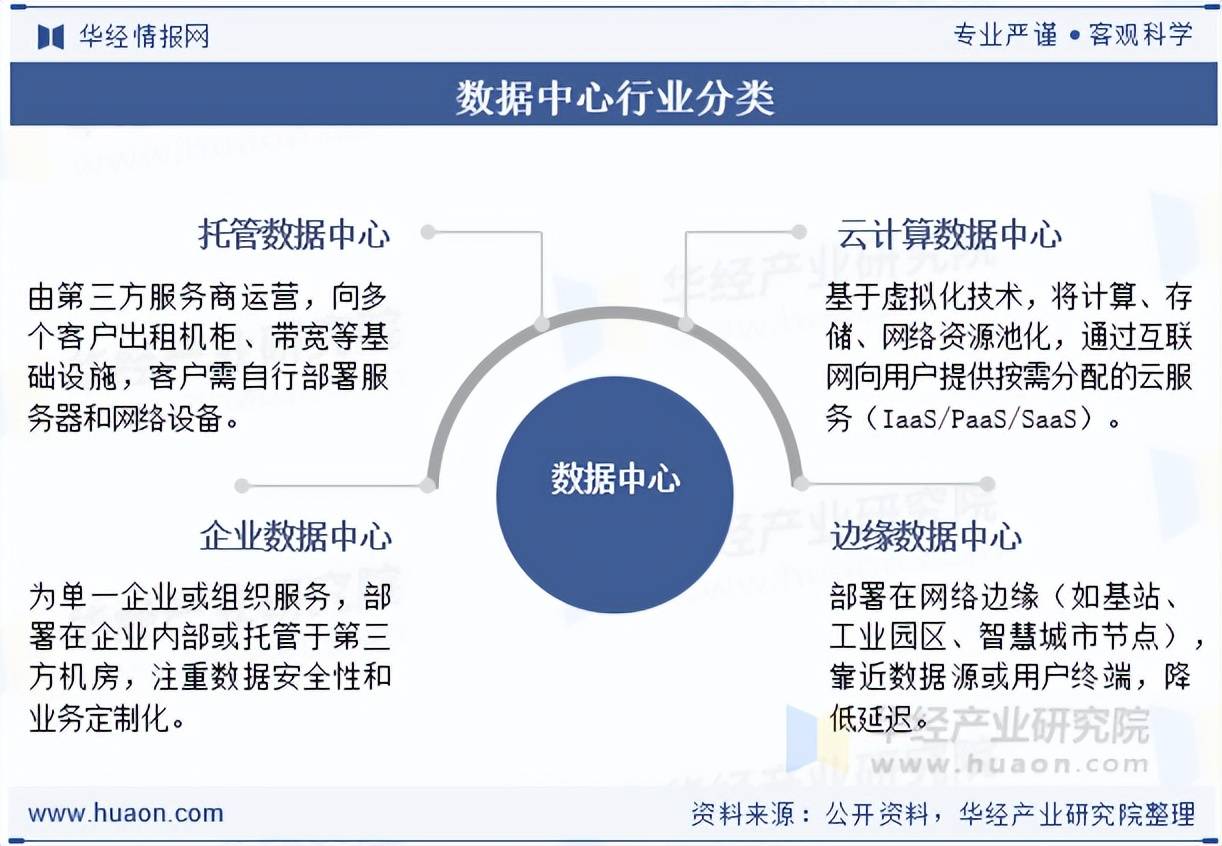
2025年中国数据中心行业分类、相关政策、市场规模及竞争格局分析
Sou Hu Cai Jing· 2025-10-19 07:24
Core Insights - The data center industry is experiencing robust growth driven by emerging technologies such as 5G, cloud computing, and artificial intelligence, with the market size reaching 507.83 billion yuan in 2023 [6]. Policy Support - The development of the data center industry is supported by various policies at both national and local levels, focusing on layout optimization, green development, technology upgrades, and financing channels [4]. - Key policies include the "2030 Carbon Peak Action Plan" aimed at promoting energy-saving and carbon reduction in data centers [5], and the "New Type Data Center Development Three-Year Action Plan (2021-2023)" which outlines six key tasks for quality upgrades [5]. Market Structure - The competitive landscape of the data center industry is diverse, with major players including Alibaba Cloud, Tencent Cloud, and Huawei Cloud in the first tier, and third-party service providers like GDS Services, Century Internet, and DataPort in the second tier [8]. - The industry is characterized by a multi-tier structure, with significant contributions from both cloud service providers and telecommunications operators [8]. Industry Growth - The data center market is projected to continue its growth trajectory, supported by the increasing demand for digital services and the ongoing digital transformation across various sectors [6]. - The industry is moving towards a more integrated, large-scale, green, and intelligent development model [4]. Company Strategies - Major companies are expanding their data center footprints across key regions, with Century Internet and GDS Services actively developing data centers in first-tier cities and strategic locations [10]. - Companies like Alibaba Cloud and Tencent Cloud are establishing large-scale data centers in multiple regions, enhancing their service capabilities [10].




三大运营商eSIM商用启幕 哪些产业链企业受益?|eSIM重返系列观察①
Mei Ri Jing Ji Xin Wen· 2025-10-17 15:32
Core Insights - The three major telecom operators in China have officially launched eSIM mobile services, marking a significant advancement in the eSIM technology for smartphones and creating new growth opportunities for the eSIM industry chain [1] Industry Overview - The global eSIM chip shipment reached 446 million in 2023, with predictions of 1 billion eSIM smartphone connections by the end of 2025 and 6.9 billion by 2030, accounting for three-quarters of total smartphone connections [1][6] - The eUICC chip is central to eSIM technology, enabling remote SIM configuration and management, which enhances user experience and positions the industry chain for growth [2] Market Dynamics - The demand for eUICC chips is expected to surge due to the commercial launch of eSIM services by telecom operators, with 3.62 million eSIM users in China as of 2023, predominantly in smartwatches [3] - The eSIM technology is anticipated to drive supply chain optimization within the telecommunications industry [1] Company Developments - New Henghui, a semiconductor packaging and testing company, has the capability to adapt its existing IoT eSIM packaging technology for smartphones and other devices, indicating a broad application potential [1][5] - Huada Electronics has developed an eSIM operating system in collaboration with a global eSIM service provider, achieving GSMA eUICC Security Assurance certification, which enhances its market position [2] Technical Advancements - The etching lead frame is a critical material for eSIM chip packaging, with significant potential for domestic substitution as eSIM applications accelerate [4] - The WLCSP (Wafer-Level Chip Scale Package) technology is crucial for miniaturizing eSIM chips and is already adopted by major international manufacturers like Apple and Samsung [5] Future Outlook - Companies that proactively invest in technology development and establish strong ties with terminal manufacturers and telecom operators are likely to gain competitive advantages in the evolving eSIM industry [6]
全国算力“一张网”正由蓝图变现实
Zheng Quan Ri Bao· 2025-10-17 15:26
Core Insights - The construction of a national integrated computing network is essential for the rapid growth of the digital economy, likened to a "smart city" where computing power is the vital resource [1][2][8] - Recent government initiatives, including the "Millisecond Computing" action plan, aim to enhance the speed and accessibility of computing resources across the country [1][3] - The "East Data West Computing" project is a strategic effort to optimize resource allocation and strengthen technological collaboration, facilitating high-quality development [2][6] Group 1: Policy and Strategic Initiatives - The Ministry of Industry and Information Technology has launched a "Millisecond Computing" initiative to create a high-capacity, low-latency urban network for computing resources [1] - The "East Data West Computing" project has expanded its scope to include all provinces, aiming for efficient nationwide computing resource allocation [2] - The implementation of the "Computing Interconnection Action Plan" aims to establish a comprehensive standard and resource-sharing platform by 2026 [3] Group 2: Infrastructure Development - China Mobile has developed a national computing network with a focus on infrastructure, application empowerment, and technological innovation [6] - The company has established a data center layout covering all core hubs of the "East Data West Computing" initiative, including major intelligent computing centers [6] - The national computing internet service platform has achieved connectivity across 31 provinces, enhancing the efficiency of computing resource management [4] Group 3: Industry Collaboration and Challenges - The industry is moving towards a collaborative ecosystem, with telecommunications operators playing a crucial role in resource allocation and technological innovation [7][8] - Despite progress, challenges remain in integrating disparate computing resources and improving operational efficiency across various platforms [9][10] - Experts emphasize the need for a robust framework to address energy consumption, data security, and privacy concerns during the construction of the integrated computing network [10]
天邑股份(300504.SZ)中标4580万元中国电信采购项目
智通财经网· 2025-10-17 09:56
Group 1 - The company Tianyi Co., Ltd. has been selected as one of the successful bidders for the centralized procurement project of China Telecom's embedded micro smart set-top box products for the years 2025-2026, with an expected transaction amount of 45.8 million yuan (including tax) [1]

天邑股份中标4580万元中国电信采购项目
Zhi Tong Cai Jing· 2025-10-17 08:49
Group 1 - The company Tianyi Co., Ltd. (300504.SZ) has been selected as one of the successful bidders for China Telecom's (601728) centralized procurement project for embedded micro smart set-top box products for the years 2025-2026 [1] - The expected transaction amount for this project is 45.8 million yuan (including tax) [1]
央企巨头布局AI玩具 故宫文化联合中国电信发布首款故宫猫福墩AI玩偶
Zheng Quan Ri Bao Wang· 2025-10-17 07:06
Core Insights - The global AI toy market is experiencing rapid growth, with major state-owned enterprises entering the sector [1] - The Palace Museum's AI toy, "Fudun," developed in collaboration with China Telecom's Tianyi IoT, represents a new paradigm of "AI + cultural creativity" [1] - The AI toy can interact intelligently, understand emotions, and provide cultural storytelling, enhancing the digital transformation of the cultural industry [1] Company Developments - Tianyi IoT, a subsidiary of China Telecom, is actively promoting the integration of AI and IoT technologies in various industries, particularly in cultural creativity [2] - The AI toy is equipped with a domestically developed RISC-V architecture cloud AI module, ensuring secure and reliable data processing [2] - The Tianyi IoT platform supports over a billion devices for online perception and intelligent control, enhancing the interactive capabilities of the AI toy [2]
【时代风口】 eSIM卡商用启航 国产通信大胆拥抱新技术
Zheng Quan Shi Bao· 2025-10-16 22:27
Core Insights - The launch of eSIM services by China's three major telecom operators marks a significant breakthrough in domestic communication technology, positioning China among the leaders globally in this field [1] - The adoption of eSIM technology is expected to reshape user habits and the competitive landscape of the telecom market, simplifying processes like number portability and enhancing device security [3][4] Group 1: eSIM Technology Overview - eSIM technology allows for the embedding of SIM functionality directly into device chips, eliminating the need for physical SIM cards, which enhances device design and user experience [1][2] - The global market for eSIM-enabled smartphones is projected to reach approximately 1 billion by the end of this year, with an expected growth to 6.9 billion by 2030, indicating a significant market opportunity for telecom operators [2] Group 2: Competitive Landscape - The strategic decision by Apple to exclusively offer eSIM versions of its iPhone Air globally, without a physical SIM card option for the Chinese market, has pressured Chinese telecom operators to accelerate their eSIM rollout [2] - The introduction of eSIM is anticipated to simplify the process of switching carriers, potentially transforming the market competition that has traditionally focused on package pricing [3] Group 3: User Experience and Market Implications - While many users currently prefer physical SIM cards for perceived security, the convenience of eSIM is expected to shift user preferences over time, similar to the transition from traditional banking to mobile banking [3] - eSIM technology integrates most functionalities into the device chip, enhancing security features such as anti-theft tracking and enabling users to manage multiple accounts easily [3][4]
eSIM卡商用启航 国产通信大胆拥抱新技术
Zheng Quan Shi Bao· 2025-10-16 18:47
Core Viewpoint - The launch of eSIM services by China's three major telecom operators marks a significant breakthrough in domestic communication technology, positioning China among the leaders globally in this field [1][2]. Group 1: eSIM Technology Overview - eSIM technology allows for the embedding of SIM cards directly into device chips, eliminating the need for physical SIM cards, which enhances convenience and security [1][2]. - The advantages of eSIM include space-saving, improved security, increased freedom in switching operators, and support for IoT infrastructure, driving mobile devices towards being lighter, smarter, and offering better user experiences [2][3]. - According to GSMA, approximately 1 billion eSIM smartphones are expected to be connected globally by the end of this year, with projections of growth to 6.9 billion by 2030 [2]. Group 2: Market Dynamics and Competition - The strategic decision by Apple to exclusively offer eSIM versions of the iPhone Air globally, without a physical SIM card option for the Chinese market, has pressured Chinese telecom operators to accelerate their eSIM commercialization efforts [2]. - The shift towards eSIM is expected to reshape user habits and the competitive landscape, simplifying the process of switching operators and potentially altering the focus from package pricing to service quality [3][4]. Group 3: Challenges and Considerations - While eSIM offers numerous benefits, concerns remain regarding potential high fees for switching numbers and the implications of losing the exclusivity of relationships with operators, which could affect service quality [4]. - The transition to eSIM is anticipated to face challenges, but ongoing market competition and technological advancements are expected to address these issues over time [4].

小摩:推荐买内地三大电讯股 首选中国电信(00728) 目标价7.5港元
智通财经网· 2025-10-16 08:20
Core Viewpoint - Morgan Stanley expresses optimism about three major telecom operators due to attractive shareholder returns, healthy profit growth, and potential cloud service revenue growth driven by AI [1] Group 1: Company Recommendations - The top pick is China Telecom (00728) due to its largest exposure to cloud business and resilient traditional mobile and broadband services, with a target price of HKD 7.5 [1] - China Mobile (00941) and China Unicom (00762) have target prices of HKD 110 and HKD 12 respectively, both rated as "Overweight" [1] Group 2: Market Performance - Over the past three months, the stock prices of the three major telecom operators, including China Mobile, China Telecom, and China Unicom, have underperformed the Hang Seng Index [1] - The current dividend yields for China Mobile, China Telecom, and China Unicom are projected to be 6.3%, 5.4%, and 5.6% respectively, making them attractive [1] Group 3: Revenue Trends - The growth of traditional telecom service revenue in the third quarter has slowed compared to the second quarter, which is reflected in the recent weakness of stock prices [1] - Investors are advised to take advantage of the lagging stock prices for potential buying opportunities [1]