CNOOC(00883)

Search documents
港股通红利ETF广发(520900)涨1.34%,成交额8806.33万元
Xin Lang Cai Jing· 2026-02-03 09:50
Group 1 - The core viewpoint of the news is the performance and characteristics of the Guangfa CSI National New Hong Kong Stock Connect Central Enterprise Dividend ETF (520900), which has shown a slight increase in scale despite a minor decrease in shares this year [1][2]. - As of February 2, 2025, the ETF's latest share count is 1.859 billion, with a total scale of 1.971 billion yuan, reflecting a 0.85% decrease in shares and a 1.39% increase in scale year-to-date [1]. - The ETF has a management fee rate of 0.50% and a custody fee rate of 0.10%, with its performance benchmark being the yield of the CSI National New Hong Kong Stock Connect Central Enterprise Dividend Index [1]. Group 2 - The current fund managers are Huo Huaming and Lü Xin, with Huo managing since June 26, 2024, achieving a return of 12.39%, while Lü has managed since April 30, 2025, with a return of 26.44% [2]. - The ETF's top holdings include China National Offshore Oil Corporation (10.05%), China Shenhua Energy (9.99%), and China Petroleum & Chemical Corporation (9.83%), among others, indicating a focus on major state-owned enterprises [2][3]. - The total trading volume for the ETF over the last 20 trading days is 1.530 billion yuan, with an average daily trading amount of 76.52 million yuan [1].




高股息策略配置性价比进一步提升,港股通红利ETF广发(520900)涨1.34%
Xin Lang Cai Jing· 2026-02-03 08:04
Group 1 - The core viewpoint of the articles emphasizes the increasing interest in high dividend yield stocks, particularly in the context of declining bond yields and the need for investors to seek higher returns in equity investments [1][2][3] - Long-term value in dividend investing is shifting from merely seeking high dividend rates to focusing on sustainable dividend capabilities, with a recommended expected return rate of over 3%-5% and a strong safety margin [1][2] - The performance of high dividend sectors has shown recovery, driven by strong demand for insurance funds and favorable pricing logic in cyclical high dividend sectors such as oil, steel, and coal [1][2] Group 2 - The market is experiencing challenges in restoring risk premiums, with significant volatility in cyclical products affecting market profitability, leading to a potential "small platform period" for investor risk appetite [2][3] - The insurance sector is seeing robust growth in new business, particularly in dividend insurance sales, which is increasing the allocation of investment funds towards long-duration assets [2][3] - The dividend strategy remains a key focus for equity investments, with pressures on cash investment returns expected to increase by 2026, reinforcing the importance of dividend strategies for companies [2][3] Group 3 - Looking ahead to 2026, dividend strategies are expected to continue serving as a stabilizing force in investment portfolios, with dividend assets showing lower valuation levels and volatility compared to other asset classes [3][9] - The Hong Kong Stock Connect Dividend ETF (520900) closely tracks the CSI National New Hong Kong Stock Connect Central Enterprise Dividend Index, which selects stable dividend-paying companies from the central state-owned enterprises [3][9] - The top five industries in the CSI National New Hong Kong Stock Connect Central Enterprise Dividend Index include oil and petrochemicals (28.63%), telecommunications (21.75%), coal (11.80%), transportation (10.47%), and public utilities (7.94%), indicating a strong value and defensive characteristic [4][10]
港股通央企红利ETF天弘(159281)涨1.21%,成交额7232.62万元
Xin Lang Cai Jing· 2026-02-03 07:12
Group 1 - The Tianhong CSI Hong Kong Stock Connect Central State-Owned Enterprises Dividend ETF (159281) closed up 1.21% on February 3, with a trading volume of 72.32 million yuan [1] - As of February 2, the fund's latest share count was 345 million shares, with a total size of 345 million yuan, reflecting a decrease of 2.54% in shares and 1.55% in size since December 31, 2025 [1] - The fund's management fee is 0.50% per year, and the custody fee is 0.10% per year [1] Group 2 - The top holdings of the Tianhong ETF include COSCO Shipping Holdings, China Shenhua Energy, CNOOC, Sinopec Engineering, China National Shipping, China Petroleum & Chemical Corporation, China Coal Energy, CITIC International, and China Construction Bank, with respective holding percentages [2] - The largest holding is COSCO Shipping Holdings at 4.11%, followed by China Shenhua Energy at 2.68% and CNOOC at 2.56% [2] - The fund manager, He Yuxuan, has managed the fund since August 20, 2025, achieving a return of 2.85% during the management period [1]
港股通红利低波ETF(159117)涨1.34%,成交额554.38万元
Xin Lang Cai Jing· 2026-02-03 07:12
Core Viewpoint - The Penghua Hong Kong Stock Connect Low Volatility Dividend ETF (159117) has experienced a decrease in both share count and total assets since the beginning of the year, indicating a potential shift in investor sentiment towards this fund [1][2]. Fund Overview - The Penghua Hong Kong Stock Connect Low Volatility Dividend ETF (159117) was established on September 30, 2025, with a management fee of 0.30% and a custody fee of 0.10% [1]. - As of February 2, 2025, the fund's latest share count was 89.40 million, with a total asset size of 94.24 million yuan, reflecting a 38.51% decrease in shares and a 36.35% decrease in total assets since December 31, 2025 [1]. Liquidity Analysis - The cumulative trading amount for the ETF over the last 20 trading days reached 174 million yuan, with an average daily trading amount of 8.68 million yuan [1]. Fund Management - The current fund managers are Yan Dong and Yu Zhanchang, both of whom have managed the fund since its inception, achieving a return of 7.68% during their tenure [2]. Top Holdings - The ETF's major holdings include Jiangxi Copper Co. (4.39%), Far East Horizon (3.33%), China Shenhua Energy (3.09%), CNOOC (3.04%), and Hang Lung Properties (2.97%), among others, with specific holding percentages and market values detailed [3].


化工行业ETF易方达(516570)涨2%,机构:“三桶油”及油服有望强化资源领军地位
Sou Hu Cai Jing· 2026-02-03 06:09
Group 1 - The core viewpoint of the articles highlights the strong performance of the chemical industry ETF, with significant capital inflows and a bullish outlook for the "three oil giants" amid geopolitical tensions and resource competition [1][2] Group 2 - As of February 2, the chemical industry ETF managed by E Fund reached a new high in scale at 1.537 billion yuan and a total of 1.453 billion shares, indicating strong investor interest [1] - The ETF has seen continuous net inflows over the past 12 days, with a peak single-day inflow of 391 million yuan, totaling 1.357 billion yuan in net inflows [1] - The "three oil giants" are expected to maintain high capital expenditures and strengthen their positions in the natural gas market, which will support long-term growth despite oil price fluctuations [2] Group 3 - The domestic high upstream capital expenditure is expected to benefit oil service companies, with improved operational quality and performance even during periods of declining oil prices [2] - The E Fund chemical industry ETF offers a cost-effective investment option with a management and custody fee rate of 0.15% + 0.05% per year, lower than similar products in the petrochemical sector [2] - The ETF tracks a diversified index that includes leading companies in the petrochemical and basic chemical industries, providing exposure to both high dividend and high growth components [2]
中国海洋石油(00883.HK):2月2日南向资金减持477.5万股
Sou Hu Cai Jing· 2026-02-02 19:21
Core Viewpoint - Southbound funds reduced their holdings in China National Offshore Oil Corporation (CNOOC) by 4.775 million shares on February 2, while they had net purchases for 4 out of the last 5 trading days, totaling 17.2422 million shares [1] Group 1: Southbound Fund Activity - In the last 20 trading days, southbound funds increased their holdings on 14 days, with a total net increase of 104 million shares [1] - As of now, southbound funds hold 10.307 billion shares of CNOOC, accounting for 21.67% of the company's total issued ordinary shares [1] Group 2: Company Overview - CNOOC is primarily engaged in the exploration, development, production, and sales of crude oil and natural gas [1] - The company operates through three segments: exploration and production, trading, and business segment management [1] - The exploration and production segment focuses on upstream oil activities, including conventional oil and gas, shale oil and gas, oil sands, and other unconventional oil and gas [1]


港股通央企红利ETF天弘(159281)跌2.94%,成交额8213.40万元
Xin Lang Cai Jing· 2026-02-02 17:22
Group 1 - The Tianhong CSI Hong Kong Stock Connect Central State-Owned Enterprises Dividend ETF (159281) closed down 2.94% on February 2, with a trading volume of 82.134 million yuan [1] - As of January 30, the fund had a total of 335 million shares and a total size of 343 million yuan, reflecting a decrease of 5.36% in shares and 2.16% in size since December 31, 2025 [1] - The fund's management fee is 0.50% per year, and the custody fee is 0.10% per year [1] Group 2 - The top holdings of the Tianhong CSI Hong Kong Stock Connect Central State-Owned Enterprises Dividend ETF include COSCO Shipping Holdings, China Shenhua Energy, CNOOC, Sinopec Engineering, China National Shipping, China Petroleum & Chemical Corporation, and others, with respective holding percentages [2] - The largest holding is COSCO Shipping Holdings at 4.11%, followed by China Shenhua Energy at 2.68% and CNOOC at 2.56% [2] - The fund manager, He Yuxuan, has managed the fund since August 20, 2025, achieving a return of 2.85% during the tenure [1]
港股红利ETF工银(159691)跌3.71%,成交额4.72亿元
Xin Lang Cai Jing· 2026-02-02 11:57
Group 1 - The Hong Kong Dividend ETF (ICBC, 159691) closed down 3.71% on February 2, with a trading volume of 472 million yuan [1] - The fund was established on March 30, 2023, with an annual management fee of 0.45% and a custody fee of 0.07% [1] - As of January 30, 2024, the fund's latest share count was 6.306 billion, with a total size of 8.691 billion yuan, reflecting a 3.43% decrease in shares and a 3.03% increase in size since December 31, 2025 [1] Group 2 - The current fund managers are Liu Weilin and He Shun, with Liu managing since March 30, 2023, achieving a return of 39.18%, while He is set to manage from May 30, 2024, with a return of 16.38% [2] - The fund's top holdings include China National Offshore Oil Corporation (14.55%), China Shenhua Energy (9.65%), and China Pacific Insurance (8.90%), among others [2][3]

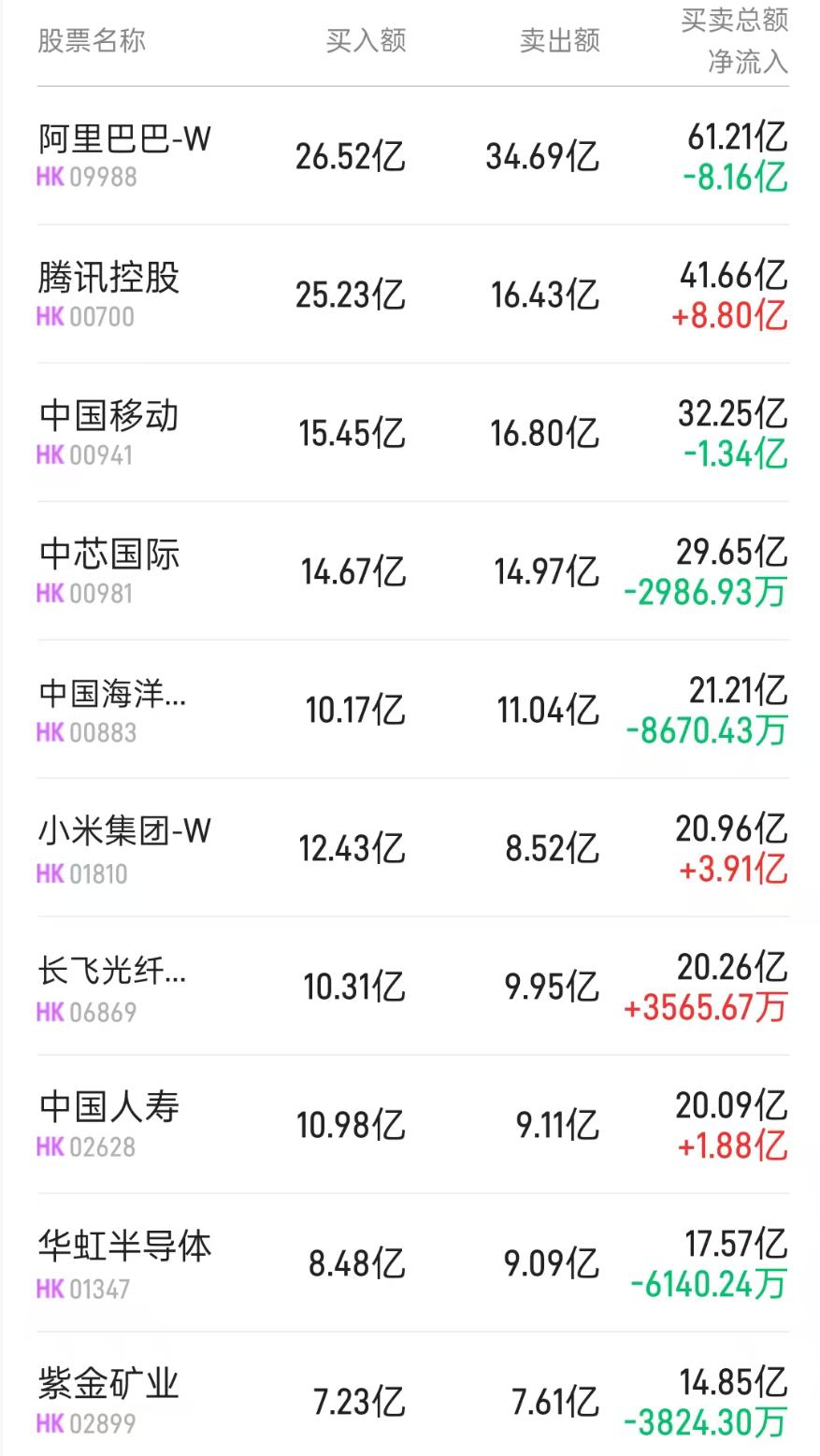
智通港股通活跃成交|2月2日
智通财经网· 2026-02-02 11:01
Core Insights - On February 2, 2026, Alibaba-W (09988), Tencent Holdings (00700), and China Mobile (00941) were the top three companies by trading volume in the Southbound Stock Connect, with transaction amounts of 6.121 billion, 4.166 billion, and 3.225 billion respectively [1] - In the Shenzhen-Hong Kong Stock Connect, Alibaba-W (09988), Tencent Holdings (00700), and SMIC (00981) also led the trading volume, with transaction amounts of 3.730 billion, 2.511 billion, and 2.012 billion respectively [1] Southbound Stock Connect Top Active Companies - Alibaba-W (09988) had a trading amount of 6.121 billion with a net buy of -0.816 billion [2] - Tencent Holdings (00700) recorded a trading amount of 4.166 billion with a net buy of +0.880 billion [2] - China Mobile (00941) had a trading amount of 3.225 billion with a net buy of -0.134 billion [2] - SMIC (00981) had a trading amount of 2.965 billion with a net buy of -29.8693 million [2] - Other notable companies included Xiaomi Group-W (01810) with a trading amount of 2.096 billion and a net buy of +0.391 billion [2] Shenzhen-Hong Kong Stock Connect Top Active Companies - Alibaba-W (09988) had a trading amount of 3.730 billion with a net buy of +0.488 billion [2] - Tencent Holdings (00700) recorded a trading amount of 2.511 billion with a net buy of +0.424 billion [2] - SMIC (00981) had a trading amount of 2.012 billion with a net buy of -1.32 billion [2] - Other significant companies included China Mobile (00941) with a trading amount of 1.401 billion and a net buy of +0.0651447 billion [2]



北水动向|北水成交净买入19.07亿 元宝春节红包活动启动 北水抢筹腾讯(00700)超13亿港元
智通财经网· 2026-02-02 10:01
Summary of Key Points Core Viewpoint - The Hong Kong stock market experienced significant net inflows from northbound capital, with a total net buy of HKD 19.07 billion on February 2, 2023, indicating strong investor interest in certain stocks while others faced net sell-offs [1]. Group 1: Northbound Capital Activity - Northbound capital recorded a net buy of HKD 27.38 billion through the Shanghai Stock Connect and a net sell of HKD 8.3 billion through the Shenzhen Stock Connect [1]. - The most bought stocks included Tencent (00700), Xiaomi Group-W (01810), and China Life (02628) [1]. - The most sold stocks were Hua Hong Semiconductor (01347), Zijin Mining (02899), and CSPC Pharmaceutical Group (01093) [1]. Group 2: Individual Stock Performance - Alibaba-W (09988) had a net sell of HKD 3.28 billion, with plans to invest HKD 30 billion in a "Spring Festival Treat Plan" [6][7]. - Tencent (00700) saw a net buy of HKD 13.03 billion, boosted by the launch of its "Yuanbao" Spring Festival red envelope activity, which is expected to increase downloads and user engagement [4]. - China Life (02628) received a net buy of HKD 1.87 billion, supported by positive forecasts for its individual insurance sales [5]. - Hua Hong Semiconductor (01347) faced a net sell of HKD 6.15 billion, amid tightening order reviews from major chip manufacturers [6]. - Zijin Mining (02899) experienced a net sell of HKD 4.64 billion, as it announced plans to issue USD 1.5 billion zero-coupon convertible bonds for project financing [7].