CNOOC(00883)

Search documents
石油ETF(561360)开盘涨1.42%,重仓股中国石油涨2.01%,中国海油涨1.98%
Xin Lang Cai Jing· 2026-02-04 04:56
Group 1 - The core viewpoint of the article highlights the performance of the Oil ETF (561360), which opened with a gain of 1.42% at 1.431 yuan on February 4 [1] - Major holdings of the Oil ETF include China National Petroleum Corporation, which rose by 2.01%, China National Offshore Oil Corporation by 1.98%, and Sinopec by 0.79% [1] - The Oil ETF's performance benchmark is the CSI Oil and Gas Industry Index return, managed by Guotai Fund Management Co., Ltd., with a return of 41.01% since its establishment on October 23, 2023, and a return of 14.47% over the past month [1] Group 2 - The article lists other notable stocks within the Oil ETF, including Jereh Group (up 0.98%), China Merchants Energy Shipping (up 1.56%), Guanghui Energy (up 1.30%), COSCO Shipping Energy (up 0.82%), Hengli Petrochemical (up 1.82%), Rongsheng Petrochemical (up 0.79%), and Intercontinental Oil and Gas (up 2.24%) [1]





能源央企负责人激励收入公布!
中国能源报· 2026-02-04 03:52
Core Viewpoint - The article discusses the incentive compensation for executives of major state-owned enterprises in the energy sector in China for the 2022-2024 term, highlighting the amounts allocated to various leaders within these companies [1][3][4]. Group 1: Central Enterprises and Their Incentive Compensation - The State-owned Assets Supervision and Administration Commission (SASAC) has released the incentive compensation details for executives of central enterprises, which include companies like China National Petroleum Corporation (CNPC), China Petroleum & Chemical Corporation (Sinopec), and State Grid Corporation of China [1][3]. - The incentive compensation consists of annual salary and term incentive income, with the latter being distributed every three years [1]. Group 2: Individual Executive Compensation - For CNPC, the chairman Dai Houliang is set to receive an incentive income of 86.21 million RMB for the 2022-2024 term [3]. - In Sinopec, chairman Ma Yongsheng's incentive income is 84.81 million RMB, while other executives like Zhao Dong and Zhang Shaofeng have amounts of 83.23 million RMB and 75.35 million RMB respectively [4]. - China National Offshore Oil Corporation (CNOOC) chairman Wang Dongjin will receive 86.06 million RMB, with other executives like Zhou Xinhai and Huojian receiving 49.43 million RMB and 76.86 million RMB respectively [5]. Group 3: Summary of Other Major Enterprises - State Grid Corporation of China chairman Zhang Wei will receive 78.17 million RMB, while other executives like He Zhongwen and Jiang Changliang will receive 48.54 million RMB and 70.14 million RMB respectively [7]. - China Southern Power Grid's chairman Meng Zhenping is set to receive 83.54 million RMB, with other executives like Qian Chaoyang receiving 26.35 million RMB [10]. - China Huaneng Group's chairman Wenshu Gang will receive 63.47 million RMB, while other executives like Zhang Wenfeng and Dong Jianling will receive 39.02 million RMB and 67.79 million RMB respectively [11]. Group 4: Additional Notable Executives - In China Datang Corporation, chairman Zou Lei will receive 80.02 million RMB, while Liu Mingsheng and Zhang Chuanjiang will receive 44.23 million RMB and 17.78 million RMB respectively [12]. - China Huadian Corporation's chairman Jiang Yi will receive 63.24 million RMB, with other executives like Ye Xiangdong receiving 84.32 million RMB [14]. - National Energy Investment Group's former chairman Wang Xiangshi received 16.46 million RMB for his term, while other executives like Feng Laifa and Xu Xinfeng will receive 60.97 million RMB and 39.94 million RMB respectively [18].


中国海油2月3日获融资买入1.22亿元,融资余额15.88亿元
Xin Lang Cai Jing· 2026-02-04 02:56
Group 1 - The core viewpoint of the news is that China National Offshore Oil Corporation (CNOOC) has shown a slight increase in stock price and has low financing and margin trading balances, indicating a potential investment opportunity [1][2]. Group 2 - On February 3, CNOOC's stock rose by 0.75% with a trading volume of 1.452 billion yuan. The financing buy-in amount was 122 million yuan, while the financing repayment was 152 million yuan, resulting in a net financing outflow of 29.93 million yuan [1]. - As of February 3, the total financing and margin trading balance for CNOOC was 1.596 billion yuan, with a financing balance of 1.588 billion yuan, accounting for 1.57% of the circulating market value, which is below the 30th percentile level over the past year [1]. - In terms of margin trading, on February 3, CNOOC repaid 42,900 shares and sold 32,000 shares, with a selling amount of 1.081 million yuan at the closing price. The remaining margin balance was 819.16 thousand yuan, also below the 30th percentile level over the past year [1]. Group 3 - CNOOC, established on August 20, 1999, and listed on April 21, 2022, primarily engages in the exploration, production, and sales of crude oil and natural gas. The company operates in three segments: exploration and production, trading, and business management [2]. - The revenue composition of CNOOC is as follows: oil and gas sales account for 82.73%, trading for 14.96%, and other activities for 2.31% [2]. - As of September 30, 2025, CNOOC reported a total revenue of 312.503 billion yuan, a year-on-year decrease of 4.15%, and a net profit attributable to shareholders of 101.971 billion yuan, down 12.59% year-on-year [2]. Group 4 - CNOOC has distributed a total of 255.995 billion yuan in dividends since its A-share listing, with 179.051 billion yuan distributed over the past three years [3]. - As of September 30, 2025, the number of CNOOC shareholders was 216,500, a decrease of 7.02% from the previous period, while the average circulating shares per person increased by 7.62% [2].
2月3日华宝港股通恒生中国(香港上市)30ETF(520560)遭净赎回369.86万元
Xin Lang Cai Jing· 2026-02-04 02:22
Group 1 - The core point of the article highlights the net redemptions of the Hua Bao Hong Kong Stock Connect Hang Seng China (Hong Kong Listed) 30 ETF (520560), which faced a net outflow of 3.6986 million yuan on February 3, ranking 40th out of 212 in cross-border ETF net outflows [1] - As of February 3, the latest scale of the Hua Bao Hong Kong Stock Connect Hang Seng China (Hong Kong Listed) 30 ETF is 755 million yuan, down from 766 million yuan the previous day, indicating a net outflow of 0.48% relative to the previous day's scale [1] - Over the past 5 days, the fund experienced net redemptions totaling 35.4312 million yuan, ranking 25th out of 212 in cross-border ETF net outflows [1] - The fund's scale has decreased by 7.60% and its assets by 7.01% since the beginning of the year, with the latest share count at 814 million [2] Group 2 - The fund's management fee is 0.50% annually, and the custody fee is 0.10% annually [2] - The fund is managed by Zhang Fang and Jiang Junyang, both of whom have recorded a return of -7.27% since the fund's inception on September 24, 2025 [3] - The top holdings of the fund include Tencent Holdings (14.92%), Alibaba-W (13.98%), and China Construction Bank (7.23%), among others, with significant investments in major Chinese companies [3]




2月3日港股通央企红利ETF(159266)遭净赎回401.33万元
Xin Lang Cai Jing· 2026-02-04 02:22
Core Viewpoint - The Hong Kong Stock Connect Central State-Owned Enterprises Dividend ETF (159266) experienced a net redemption of 4.0133 million yuan on February 3, ranking 38th out of 212 in cross-border ETF net outflows [1] Group 1: Fund Performance - As of February 3, the latest size of the Hong Kong Stock Connect Central State-Owned Enterprises Dividend ETF (159266) is 562 million yuan, down from 564 million yuan the previous day, with a net outflow of 0.71% of the previous day's size [1] - Year-to-date, the fund's shares have decreased by 9.58% and its size has decreased by 8.03% compared to December 31, 2025, when the shares were 616 million and the size was 611 million yuan [2] Group 2: Liquidity and Trading Activity - Over the last 20 trading days, the cumulative trading amount for the ETF is 254 million yuan, with an average daily trading amount of 12.6913 million yuan [2] - In the 22 trading days this year, the cumulative trading amount is 266 million yuan, with an average daily trading amount of 12.0983 million yuan [2] Group 3: Fund Management and Holdings - The current fund managers are Liu Tingyu and Cai Leping, with Liu managing the fund since July 23, 2025, achieving a return of 0.96%, while Cai has managed it since November 5, 2025, with a return of -1.82% [2] - Major holdings in the fund include China COSCO Shipping, China Shenhua Energy, CNOOC, Sinopec Engineering, China National Offshore Oil Corporation, and others, with respective holding percentages and market values detailed [2]
2月3日港股红利ETF工银(159691)遭净赎回2822.78万元
Xin Lang Cai Jing· 2026-02-04 02:22
Core Viewpoint - The Hong Kong Dividend ETF (工银, 159691) experienced significant net redemptions, indicating a trend of outflow from this fund, which may reflect investor sentiment and market conditions [1][2]. Fund Performance - As of February 3, the latest scale of the Hong Kong Dividend ETF is 85.4 billion yuan, with a net outflow of 28.23 million yuan on that day, representing 0.33% of the previous day's scale [1]. - Over the past five days, the fund faced net redemptions totaling 68.26 million yuan, ranking 15th out of 212 in cross-border ETF net outflows [1]. - In the last ten days, the total net redemptions reached 202 million yuan, ranking 7th out of 212 [1]. - Over the past 20 days, the fund saw net redemptions of 332 million yuan, ranking 8th out of 212 [1]. Fund Size and Liquidity - The current share count of the Hong Kong Dividend ETF is 6.282 billion shares, with a scale of 85.4 billion yuan, showing a 3.80% decrease in shares and a 1.24% increase in scale since December 31, 2025 [2]. - The cumulative trading amount over the last 20 trading days is 6.501 billion yuan, with an average daily trading amount of 325 million yuan [2]. - Year-to-date, the cumulative trading amount is 7.151 billion yuan, with an average daily trading amount of 325 million yuan [2]. Fund Management - The current fund managers are Liu Weilin and He Shun, with Liu managing since March 30, 2023, achieving a return of 36.96%, while He is set to manage from May 30, 2024, with a return of 14.67% [2]. Top Holdings - The fund's top holdings include: - China National Offshore Oil Corporation (14.55% holding) - China Shenhua Energy (9.65% holding) - China Pacific Insurance (8.90% holding) - China Hongqiao Group (7.68% holding) - CLP Holdings (7.53% holding) - WH Group (7.36% holding) - Power Assets Holdings (6.21% holding) - Haier Smart Home (3.50% holding) - People's Insurance Company of China (3.42% holding) - CSPC Pharmaceutical Group (3.41% holding) [2].

A股低开,贵金属板块走强
第一财经· 2026-02-04 01:48
Market Overview - The A-share market opened lower with the Shanghai Composite Index down 0.08%, the Shenzhen Component down 0.39%, and the ChiNext Index down 0.80% [3][4] - The Hong Kong market also opened lower, with the Hang Seng Index down 0.14% and the Hang Seng Tech Index down 0.87% [5][6] Sector Performance - The storage chip sector experienced significant declines, with companies like Deep Kangjia A hitting the daily limit down, and others such as Puran, Lanke Technology, Baiwei Storage, and Shannon Chip also opening lower [2] - The AI computing power industry chain saw a downturn, particularly in the storage and CPO sectors, while semiconductor and consumer electronics themes were among the hardest hit [4] - Conversely, gold, basic metals, and oil and gas sectors showed signs of rebound [4]



油气ETF华泰柏瑞(561570)开盘涨1.22%,重仓股中国海油涨1.98%,中国石油涨2.01%
Xin Lang Cai Jing· 2026-02-04 01:42
Group 1 - The oil and gas ETF Huatai-PB (561570) opened with a gain of 1.22%, priced at 1.331 yuan [1] - Major holdings in the ETF saw positive movements: CNOOC rose by 1.98%, PetroChina by 2.01%, Sinopec by 0.79%, and others like Jereh, COSCO Shipping, and Guanghui Energy also experienced gains [1] - The ETF's performance benchmark is the CSI Oil and Gas Industry Index, managed by Huatai-PB Fund Management Co., with a return of 31.70% since its inception on October 9, 2024, and a monthly return of 14.01% [1]
中国海洋石油(00883.HK):2月3日南向资金减持2170.59万股
Sou Hu Cai Jing· 2026-02-03 19:44
Core Viewpoint - Southbound funds reduced their holdings in China National Offshore Oil Corporation (CNOOC) by 21.71 million shares on February 3, indicating a shift in investor sentiment towards the company [1] Group 1: Shareholding Changes - In the last 5 trading days, southbound funds have reduced their holdings for 2 days, with a total net reduction of 4.71 million shares [1] - Over the past 20 trading days, there have been 13 days of net increases in holdings by southbound funds, totaling 56.62 million shares [1] - Currently, southbound funds hold 10.285 billion shares of CNOOC, accounting for 21.63% of the company's total issued ordinary shares [1] Group 2: Company Overview - CNOOC is primarily engaged in the exploration, development, production, and sales of crude oil and natural gas [1] - The company operates through three segments: exploration and production, trading, and business segment management [1] - The exploration and production segment focuses on upstream oil activities, including conventional oil and gas, shale oil and gas, oil sands, and other unconventional oil and gas operations [1]

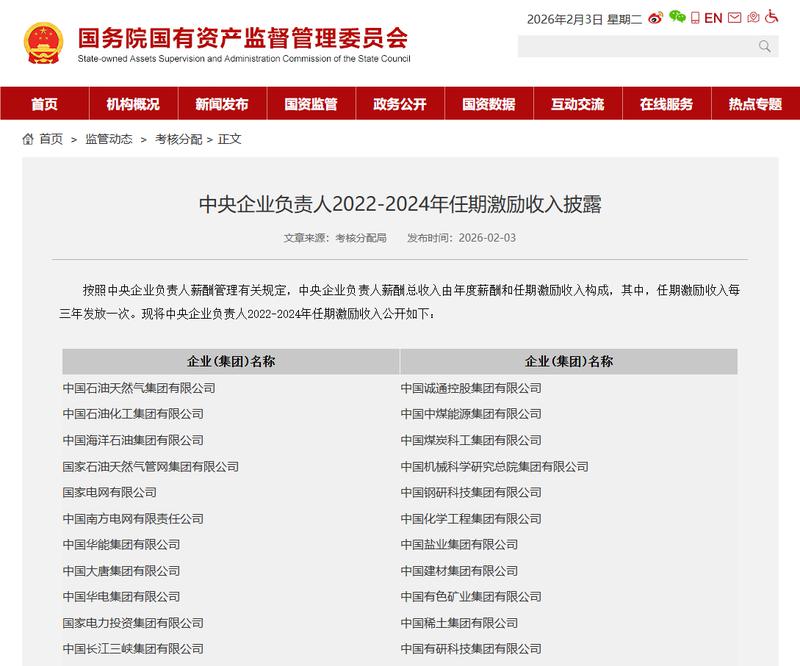
80多家中央企业负责人激励收入披露
Xin Jing Bao· 2026-02-03 12:00
Group 1 - The total income of central enterprise leaders consists of annual salary and term incentive income, with the latter being distributed every three years [1] - The term incentive income for central enterprise leaders for the period 2022-2024 has been publicly disclosed [1] - The disclosure includes various state-owned enterprises such as China National Petroleum Corporation and State Grid Corporation of China [1]