
CNOOC(00883)

Search documents
港股红利低波ETF(159569)跌2.81%,成交额5636.34万元
Xin Lang Cai Jing· 2026-02-02 09:58
Core Viewpoint - The Invesco Great Wall Hong Kong Stock Connect Dividend Low Volatility ETF (159569) experienced a decline of 2.81% on February 2, 2024, with a trading volume of 56.36 million yuan [1] Fund Overview - The fund was established on August 14, 2024, with an annual management fee of 0.50% and a custody fee of 0.08% [1] - As of January 30, 2025, the fund had 343 million shares outstanding and a total size of 478 million yuan, showing a 1.72% decrease in shares and a 2.60% increase in size compared to December 31, 2024 [1] Liquidity Analysis - Over the last 20 trading days, the ETF recorded a cumulative trading amount of 690 million yuan, with an average daily trading amount of 34.49 million yuan [1] - Since the beginning of the year, the ETF has seen a cumulative trading amount of 726 million yuan over 21 trading days, with an average daily trading amount of 34.58 million yuan [1] Fund Management - The current fund managers are Gong Lili and Wang Yang, with Gong managing the fund since August 29, 2024, achieving a return of 45.41%, while Wang has managed it since August 13, 2025, with a return of 3.51% [2] Top Holdings - The ETF's top holdings include: - China COSCO Shipping (8.86% of holdings) - Orient Overseas International (7.48%) - Yanzhou Coal Mining (5.65%) - Seaspan Corporation (4.52%) - Yancoal Australia (4.46%) - WH Group (3.76%) - China Shenhua Energy (3.63%) - Far East Horizon (3.39%) - CNOOC (3.27%) - Sinopec (3.26%) [2][3]


智通AH统计|2月2日
智通财经网· 2026-02-02 08:18
Core Viewpoint - The report highlights the premium rates of AH shares, with Northeast Electric (00042), Sinopec Oilfield Service (01033), and Zhejiang Shibao (01057) leading in premium rates, while CATL (03750), China Merchants Bank (03968), and Heng Rui Medicine (01276) are at the bottom of the list [1] Premium Rate Rankings - The top three AH shares by premium rate are: - Northeast Electric (00042) with a premium rate of 864.29% - Sinopec Oilfield Service (01033) with a premium rate of 361.80% - Zhejiang Shibao (01057) with a premium rate of 345.22% [1] - The bottom three AH shares by premium rate are: - CATL (03750) with a premium rate of -14.10% - China Merchants Bank (03968) with a premium rate of -4.16% - Heng Rui Medicine (01276) with a premium rate of 0.99% [1] Deviation Value Rankings - The top three AH shares by deviation value are: - Sinopec Oilfield Service (01033) with a deviation value of 89.71% - Northeast Electric (00042) with a deviation value of 34.53% - Zhongwei New Materials (02579) with a deviation value of 25.28% [1] - The bottom three AH shares by deviation value are: - Zhejiang Shibao (01057) with a deviation value of -53.92% - Changfei Optical Fiber (06869) with a deviation value of -35.50% - Nanhua Futures (02691) with a deviation value of -30.81% [1] Additional Insights - The report includes detailed tables showing the premium rates and deviation values for various AH shares, indicating significant disparities in market valuations between H-shares and A-shares [2]

港股“三桶油”持续走弱,中国石油股份、中国海洋石油双双跌超5%
Mei Ri Jing Ji Xin Wen· 2026-02-02 06:57
每经AI快讯,2月2日,港股"三桶油"持续走弱,中国石油股份(00857.HK)、中国海洋石油(00883.HK)双 双跌超5%,中国石油化工股份(00386.HK)跌超3%。 ...


大宗商品集中宣泄,原油跌4.8%!中国海油大跌超4%!油气ETF汇添富(159309)资金逆势涌入超1亿元,连续15日吸金!“OPEC+”3月延续暂停增产
Sou Hu Cai Jing· 2026-02-02 05:45
Core Viewpoint - The A-share market is experiencing volatility and decline, particularly in the oil and gas sector, with significant net inflows into the oil and gas ETF Huatai-PineBridge (159309) despite the downturn [1][3]. Group 1: Market Performance - As of 13:22, the oil and gas ETF Huatai-PineBridge (159309) has dropped over 4%, with a net inflow of more than 106 million yuan during the day, marking a total of over 500 million yuan in inflows over the past 15 days [1]. - Major component stocks of the oil and gas ETF have mostly retreated, with Intercontinental Oil and Gas down over 9%, and China National Offshore Oil Corporation and China Petroleum down over 4% [3]. Group 2: Component Stocks - The top ten component stocks of the oil and gas ETF include: - Jerry Holdings (002353) up 1.71% - CNOOC (601857) down 3.54% - China Petroleum (600028) down 1.54% - Intercontinental Oil and Gas (600759) down 9.91% [4]. Group 3: Geopolitical and Supply Factors - Geopolitical risks have eased, with the U.S. indicating a positive relationship with Venezuela, potentially sharing oil revenues, and ongoing negotiations with Iran [5]. - OPEC+ members have agreed to maintain their production cut policies, with a commitment to market stability and low inventory levels [5]. Group 4: Industry Outlook - The medium to long-term outlook for the oil and gas industry remains positive, with expected exploration and development spending to maintain historical median levels from 2024 to 2030 [7]. - Key variables affecting the market include North American data center construction progress, OPEC+ production policies, and domestic policies on refining capacity [7]. Group 5: ETF Characteristics - The oil and gas ETF Huatai-PineBridge (159309) focuses on the oil and gas industry chain, including exploration, equipment, refining, and sales, emphasizing companies with quality reserves and low-cost advantages [8]. - The ETF has a streamlined sample size of 44 stocks, ensuring high purity with all top ten component stocks being leading oil and gas companies [8].



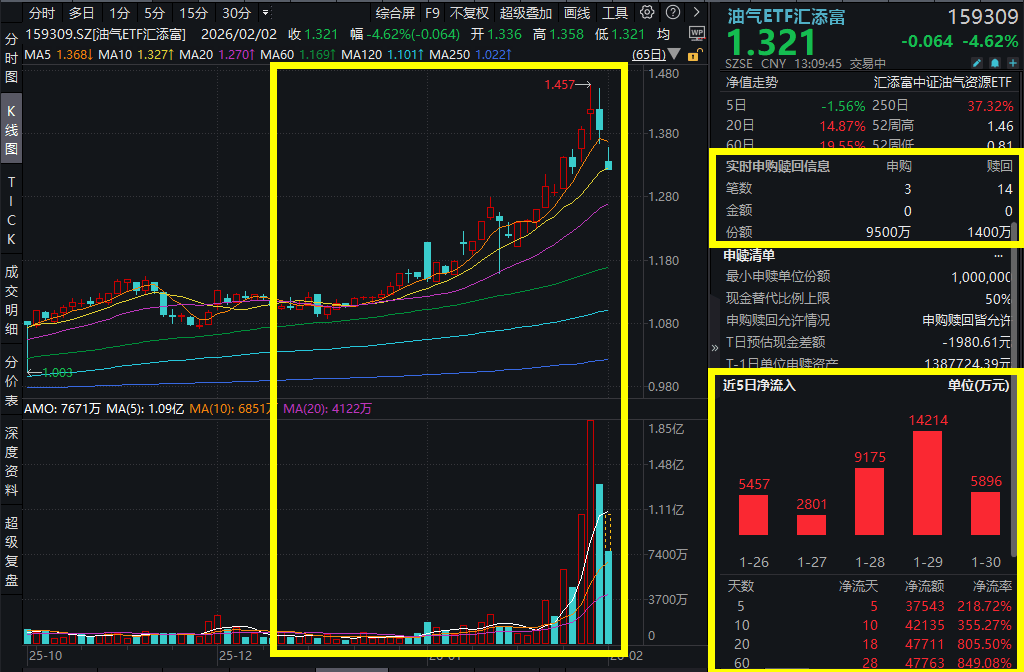
油气ETF汇添富(159309)开盘跌3.54%,重仓股中国石油跌2.90%,中国海油跌4.70%
Xin Lang Cai Jing· 2026-02-02 04:09
Group 1 - The oil and gas ETF Huatai Fu (159309) opened down 3.54% at 1.336 yuan [1] - Major holdings in the ETF saw varied performance: China National Petroleum Corporation down 2.90%, CNOOC down 4.70%, Sinopec down 1.69%, and Jereh Group up 6.74% [1] - The ETF's performance benchmark is the CSI Oil and Gas Resource Index return rate, managed by Huatai Fund Management Co., Ltd. [1] Group 2 - Since its inception on May 31, 2024, the ETF has returned 38.77%, with a one-month return of 20.14% [1]
港股石油股继续走低
Jin Rong Jie· 2026-02-02 03:25
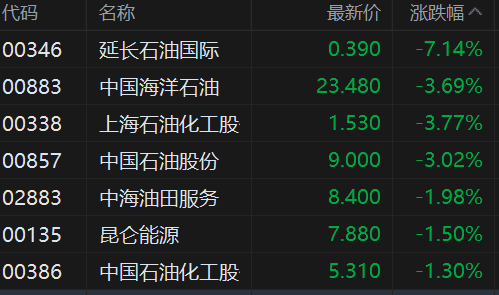
Core Viewpoint - International oil prices have declined, leading to a continued drop in Hong Kong's oil stocks, with significant losses reported across various companies in the sector [1] Group 1: Company Performance - Yanchang Petroleum International has seen a decline of over 7% [1] - CNOOC (China National Offshore Oil Corporation) and Shanghai Petrochemical have both dropped nearly 4% [1] - PetroChina has experienced a decrease of 3% [1] - China Oilfield Services has fallen by 2% [1] - Sinopec (China Petroleum & Chemical Corporation) has decreased by 1.3% [1]


港股异动丨石油股继续走低 美伊现谈判迹象 国际油价大跌4%
Ge Long Hui· 2026-02-02 03:05
Group 1 - International oil prices have declined, leading to a continued drop in Hong Kong oil stocks, with 延长石油国际 falling over 7% and 中国海洋石油 and 上海石油化工 down nearly 4% [1] - In Asian early trading, WTI crude oil fell below $63 per barrel, down 4.24%, while Brent crude dropped 3.29% to $67.037 per barrel [1] - The decline in oil prices is attributed to reduced supply disruption risks due to indications of potential negotiations between the US and Iran, as stated by Trump and reported by The Wall Street Journal [1] Group 2 - The stock performance of various oil companies includes 延长石油国际 at 0.390 (-7.14%), 甲国海洋石温 at 23.480 (-3.69%), 上海石油化工股 at 1.530 (-3.77%), 中国石油股份 at 9.000 (-3.02%), 中海油田服务 at 8.400 (-1.98%), 昆仑能源 at 7.880 (-1.50%), and 中国石油化工股 at 5.310 (-1.30%) [2]
港股石油及油服股早盘走低
Mei Ri Jing Ji Xin Wen· 2026-02-02 02:26
Group 1 - Oil and oil service stocks experienced a decline in early trading [1] - Shandong Molong (00568.HK) fell by 8.6%, trading at HKD 3.93 [1] - Sinopec Oilfield Service (01033.HK) decreased by 7.22%, trading at HKD 0.9 [1] - CNOOC Oilfield Services (02883.HK) dropped by 1.98%, trading at HKD 8.4 [1] - CNOOC (00883.HK) declined by 2.87%, trading at HKD 23.68 [1] - PetroChina (00857.HK) fell by 2.16%, trading at HKD 9.08 [1]
石油及油服股早盘走低 伊朗局势持续扰动油价 机构提示警惕地缘事件反转
Zhi Tong Cai Jing· 2026-02-02 02:05
Group 1 - Oil and oil service stocks experienced a decline in early trading, with Shandong Molong down 8.6% to HKD 3.93, Sinopec Oilfield down 7.22% to HKD 0.9, CNOOC Oilfield down 1.98% to HKD 8.4, CNOOC down 2.87% to HKD 23.68, and PetroChina down 2.16% to HKD 9.08 [1] - WTI crude oil fell by 4% and Brent crude oil dropped by over 5% [1] - Iranian Foreign Minister Zarif indicated the possibility of reaching a fair agreement with the U.S., and an Iranian official stated that there are no plans for military exercises in the Strait of Hormuz, contradicting previous reports [1] Group 2 - Huatai Futures reported that the recent rise in oil prices is attributed to a combination of geopolitical, macroeconomic, and liquidity factors [2] - The macro sentiment and potential stabilization of the dollar may reduce the upward pressure on oil prices, while liquidity factors could also retreat [2] - The situation in Iran remains tense, particularly in the Strait of Hormuz, which is a critical oil export chokepoint, necessitating close monitoring of developments [2]

港股异动 | 石油及油服股早盘走低 伊朗局势持续扰动油价 机构提示警惕地缘事件反转
智通财经网· 2026-02-02 02:03
Group 1 - Oil and oil service stocks experienced a decline, with Shandong Molong down 8.6% to HKD 3.93, Sinopec Oilfield down 7.22% to HKD 0.9, CNOOC Oilfield down 1.98% to HKD 8.4, CNOOC down 2.87% to HKD 23.68, and PetroChina down 2.16% to HKD 9.08 [1] - WTI crude oil fell by 4% and Brent crude oil dropped by over 5% [1] - Iranian Foreign Minister indicated the possibility of reaching a fair agreement with the U.S., and an Iranian official stated there are no plans for military exercises in the Strait of Hormuz, contradicting previous reports [1] Group 2 - Huatai Futures reported that the recent rise in oil prices is influenced by geopolitical, macroeconomic, and liquidity factors [2] - The macro sentiment and potential stabilization of the dollar may reduce the upward pressure on oil prices, while liquidity factors could also retreat [2] - The situation in Iran remains tense, particularly concerning the Strait of Hormuz, which is crucial for global oil exports, necessitating close monitoring of developments [2]