
互动媒体及服务

Search documents
集体拉升!大反弹在即?
格隆汇APP· 2026-03-25 09:36
Core Viewpoint - The article discusses the recent downturn in the Hang Seng Technology Index, attributing it to three main negative factors, and questions whether the index has reached a value bottom [2][3]. Group 1: Factors Driving the Downturn - The first factor is the heightened global risk aversion due to the Iran conflict, which has led to significant disruptions in the Strait of Hormuz and increased oil prices, with Brent crude surpassing $100 per barrel [4][5][6][7]. - The second factor is the renewed expectations of monetary tightening by the Federal Reserve, as indicated by Chairman Powell's hawkish remarks, which have raised concerns about liquidity and inflation [9][10][12][13]. - The third factor involves disappointing market reactions to earnings reports from major tech companies like Tencent and Alibaba, despite their solid financial performance, due to concerns over AI capital expenditures and competitive dynamics [14][15][16]. Group 2: Current Valuation of the Hang Seng Technology Index - The Hang Seng Technology Index is currently at a historical low valuation, with a PE (TTM) ratio of 21.41, placing it in the 19.66% historical percentile, indicating that 80% of the time, valuations have been higher [20]. - Relative to similar indices, the Hang Seng Technology Index is significantly undervalued, with the Nasdaq at 37.43 and the ChiNext Index at 40.1, suggesting that the Hang Seng's valuation is slightly more than half of the Nasdaq and equal to about half of the ChiNext [23][24]. - Earnings growth expectations for the Hang Seng Technology Index are projected at 34% for 2026, with a PEG ratio of less than 1, indicating that the low valuation is not based on deteriorating earnings expectations but rather on market sentiment and external liquidity pressures [25][26]. Group 3: Market Sentiment and Fund Flows - Domestic investors are actively buying into the market, with net inflows from southbound funds reaching HKD 403.84 billion since March, indicating a positive long-term outlook despite the current downturn [36]. - The Hang Seng Technology ETF has seen a net inflow of HKD 1.342 billion this year, reflecting continued interest in core technology assets [37]. - In contrast, foreign investors remain cautious, although interest in Chinese stocks has reportedly increased, with only about 10% of surveyed clients considering Chinese stocks "uninvestable," a significant improvement from two years ago [41][42]. Group 4: Conditions for a Potential Rebound - A potential rebound in the Hang Seng Technology Index may depend on several conditions, including a de-escalation of the Iran conflict and a subsequent improvement in market sentiment regarding oil prices, inflation, and interest rates [30][31]. - The commercial viability of AI technologies is also crucial, as evidenced by Tencent and Alibaba's earnings reports showing tangible benefits from AI, which could provide fundamental support for the sector [32][33]. - Overall, while the index is currently undervalued, a sustained rebound will require careful monitoring of geopolitical risks, monetary policy expectations, and the pace of AI commercialization [45].


百度受监管约谈与AI业务进展影响,股价承压下行
Xin Lang Cai Jing· 2026-02-15 22:24
Group 1 - Baidu Group-SW (09888.HK) is influenced by regulatory dynamics and advancements in its AI business, with the National Market Regulation Administration recently engaging Baidu and six other platform companies to regulate promotional behaviors and prevent "involution" competition [1] - The release of the "Internet Platform Antitrust Compliance Guidelines" emphasizes the regulation of risks associated with algorithm collusion and "lowest price" strategies [1] - During the 2026 Spring Festival, the Wenxin APP attracted users through interactive activities, achieving an 8-fold increase in daily new users and ranking in the top four of the App Store efficiency list [1] - Baidu announced a stock buyback plan of up to $5 billion and plans to distribute dividends for the first time, while its subsidiary Kunlun Chip has submitted a listing application to the Hong Kong Stock Exchange, potentially increasing market attention [1] Group 2 - Over the past week (February 9 to 13, 2026), Baidu's stock price has faced downward pressure, with a decline of 1.45% and a volatility of 10.30% [2] - On February 12, Baidu's closing price was 140.10 HKD (down 2.91%), and it further dropped to 135.80 HKD on February 13 (down 3.07%), with trading volume increasing to approximately 2 billion HKD [2] - The stock price decline is attributed to the overall pullback in technology stocks and emotional disturbances caused by regulatory discussions, although net inflows from southbound funds provided some support [2]

港股收评:三大指数集体下跌!教育股逆势上涨,贵金属急回调
Ge Long Hui· 2026-01-30 08:48
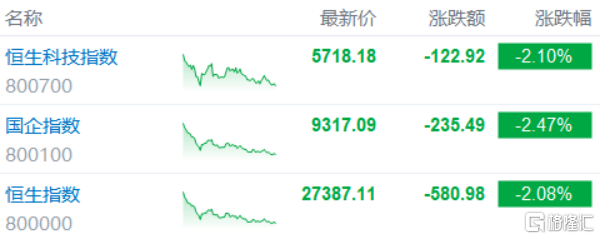
Market Performance - The Hong Kong stock market indices showed weak performance on January 30, with the Hang Seng Index falling by 2.08% to 27,387.11 points, the Hang Seng China Enterprises Index down by 2.47%, and the Hang Seng Tech Index decreasing by 2.1% [1][2] - For the month, the Hang Seng Index recorded a cumulative increase of 6.85%, briefly surpassing 28,000 points, marking a four-year high, while the Hang Seng China Enterprises Index rose by 4.53% and the Hang Seng Tech Index increased by 3.67% [1] Sector Performance - Major technology stocks mostly declined, with Kuaishou and Xiaomi dropping over 3%, and Tencent falling by 2.57% [2][4] - Precious metals experienced a significant sell-off, with gold, aluminum, and copper prices retreating sharply [2] - The application software sector continued to decline, with Kingdee International dropping by 7.7% and Kingsoft falling nearly 4% [2] - Local retail stocks in Hong Kong saw widespread declines, with Chow Tai Fook down by 6.7% [2] - Some education stocks rose against the trend, with China Spring rising over 22% and New Oriental increasing by 5.5% [2][14] Specific Stock Movements - Kingdee International's stock price fell to 12.95 HKD, down 7.7% [5] - Kuaishou's stock price decreased to 80.15 HKD, down 3.38% [5] - Tencent's stock price fell to 606.00 HKD, down 2.57% [5] - Precious metal stocks like Chifeng Jilong Gold and Shandong Gold saw declines of over 14% [7] - Ganfeng Lithium's stock price dropped by 10.90% to 60.50 HKD [9] Educational Sector Insights - New Oriental reported a net revenue of 1.19 billion USD for Q2 of FY2026, a year-on-year increase of 14.7%, with a net profit of 45.45 million USD, up 42.3% [14] - The management expressed confidence in exceeding annual targets, with a profit margin expansion of 300 basis points [14] Capital Flows - Southbound funds recorded a net inflow of 3.218 billion HKD, with 2.036 billion HKD from the Shanghai-Hong Kong Stock Connect and 1.182 billion HKD from the Shenzhen-Hong Kong Stock Connect [20] Market Outlook - According to Everbright Securities, the Hong Kong stock market is expected to trend positively due to earnings recovery, improved liquidity, low valuations, and policy support, with a structural rebound anticipated in Q1 [22]
港股收评:脑机接口概念火爆!科技股分化,快手飙涨11%
Ge Long Hui· 2026-01-05 08:47
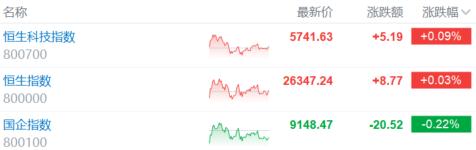
Market Overview - The Hong Kong stock market showed a narrow range of fluctuations on January 5, with the Hang Seng Index slightly up by 0.03%, the Hang Seng China Enterprises Index down by 0.22%, and the Hang Seng Tech Index up by 0.09% [1][2]. Sector Performance - Large tech stocks exhibited mixed performance, with Kuaishou surging by over 11%, while other notable stocks like Bilibili and Alibaba also saw gains of over 5% and 2%, respectively. Conversely, stocks like NetEase and Xiaomi fell by over 2% [2][4]. - The biotechnology sector was active, with companies like Rongchang Bio and Kelun-Bothai rising over 7%, and other firms like Fuhong Hanlin and Tigermed increasing by over 6% [7]. - The insurance sector saw strong gains, with China Pacific Insurance up over 6% and New China Life Insurance up over 5%. Analysts highlighted five key trends in the life insurance industry for 2026, including rapid growth in new business and a shift in customer demographics [8]. - The automotive sector faced declines, with Great Wall Motors dropping over 6% and NIO nearly 6%. Despite some brands achieving record sales in 2025, only a few met their annual sales targets [10]. Notable Stock Movements - Kuaishou's stock price reached 73.60 HKD, reflecting an increase of 11.09% with a market cap of 317.91 billion HKD [5]. - Nanjing Panda Electronics surged by nearly 40%, while Micron Brain Science and Brainhole Technology rose by nearly 20% and over 17%, respectively, following news of Neuralink's plans for large-scale production of brain-computer interface devices [6][4]. - The "three oil giants" saw significant declines, with China Petroleum and China National Offshore Oil Corporation both dropping over 3% due to geopolitical tensions and OPEC+ decisions [9]. Capital Flows - Southbound funds recorded a net inflow of 18.723 billion HKD, with the Shanghai-Hong Kong Stock Connect contributing 9.809 billion HKD and the Shenzhen-Hong Kong Stock Connect contributing 8.914 billion HKD [12]. Future Outlook - Goldman Sachs recommends overweighting Chinese stocks, predicting a 15% to 20% annual increase in the Chinese stock market for 2026 and 2027. Guosen Securities also sees potential in the market driven by a weaker US dollar and improved domestic liquidity in the spring of 2026 [15].

把握AI时代科技发展机遇 华安恒生港股通科技主题ETF7月28日发行
Quan Jing Wang· 2025-12-21 04:23
Group 1 - The technology sector is becoming the core driver of China's economic growth, with the Hong Kong stock market's technology sector offering more investment options [1] - The Huazhang Hang Seng Hong Kong Stock Connect Technology Theme ETF (subscription code: 520843) has been launched, focusing on the AI industry chain and providing a new tool for investors in the Hong Kong technology sector [1] - The ETF closely tracks the Hang Seng Hong Kong Stock Connect Technology Theme Index, which includes key sectors such as information technology, electronic components, interactive media and services, online retailers, and payment services, covering the entire AI industry chain [1] Group 2 - The Hang Seng Hong Kong Stock Connect Technology Theme Index includes major tech companies like Xiaomi, Alibaba, Tencent, Kuaishou, SMIC, Meituan, and Lenovo, and is more focused on the AI industry chain compared to other indices [1] - The index consists of 30 constituent stocks, with a quarterly adjustment frequency, and has a stock weight cap of 10%, which is higher than the 8% cap of the Hang Seng Technology Index, indicating a more concentrated weight distribution [1] - The Hong Kong stock market is expected to see revenue growth of 3.4% and profit growth of 8.5% in 2024, with the technology sector benefiting from the overall development of the AI industry, projecting a profit growth rate of 51% for the Hang Seng Hong Kong Stock Connect Technology sector in 2024 [2]
关注港股科技ETF(513020)投资机会,市场情绪回暖支撑港股科技板块
Mei Ri Jing Ji Xin Wen· 2025-12-11 05:56
Group 1 - The Hong Kong stock market is boosted by multiple favorable factors, including a potential interest rate cut by the Federal Reserve in December, improving China-U.S. trade relations, expanding PMI in high-tech manufacturing, and an active consumer market [1] - The outlook for the market suggests that Hong Kong tech stocks, particularly those with innovation capabilities and growth potential, will continue to attract attention due to global liquidity easing and improvements in the domestic economy [1] - The Hong Kong Tech ETF (513020) tracks the Hong Kong Stock Connect Technology Index (931573), which focuses on technology-themed companies that are tradable through the Stock Connect channel, covering core technology sectors such as information technology, electronic components, and interactive media and services [1] Group 2 - The index emphasizes high R&D investment and growth characteristics, incorporating both hardware manufacturing and electronic communication industries, while also including software services and internet applications to reflect the overall performance of the technology industry chain in the Hong Kong market [1]
港股科技ETF(513020)近10日净流入超2亿元,市场关注科技板块长期逻辑
Mei Ri Jing Ji Xin Wen· 2025-12-05 03:09
Core Insights - The Hong Kong technology sector is expected to benefit from a dual drive of global AI recovery and Chinese policy dividends, with the Hang Seng Technology Index showing a year-to-date increase of over 25% in 2025 [1] - The technology sector's stock price growth and performance have significantly outpaced the overall A-share market, indicating a robust growth phase for China's tech industry [1] - Concerns regarding an "AI bubble" have eased since late November 2025, attributed to signals of interest rate cuts from the Federal Reserve, better-than-expected corporate earnings, and the practical implementation of AI applications [1] Sector Performance - The technology sector encompasses areas such as semiconductors, digital economy, and biotechnology, showcasing comprehensive growth potential [1] - The Hong Kong Technology ETF (513020) tracks the Hong Kong Stock Connect Technology Index (931573), which selects the top 30 listed companies in sectors like information technology, electronic components, interactive media and services, online retail, and payment services based on market capitalization [1] - The index focuses on high R&D investment and high-growth technology companies, reflecting the overall performance of core technology industry securities in the Hong Kong market [1]
关注港股科技ETF(513020)投资机会,科技成长板块有望继续成为市场主线
Mei Ri Jing Ji Xin Wen· 2025-12-01 06:12
Group 1 - The core viewpoint of the articles indicates that the recent performance of the Hong Kong technology sector is primarily driven by sentiment and policy expectations from the mainland market, with significant improvements in valuation expectations for mainland technology and consumer companies listed in Hong Kong due to new policies [1] - The implementation of policies aimed at enhancing the adaptability of supply and demand for consumer goods is expected to further stimulate consumption, contributing positively to the technology growth sector, which is likely to remain a market focus [1] - The Hong Kong technology ETF (513020) tracks the Hong Kong Stock Connect Technology Index (931573), which selects 30 high-market-cap securities from various technology-related industries, reflecting the overall performance of quality technology companies in the Hong Kong market [1] Group 2 - The index employs a closed-loop ecosystem strategy focusing on "hardware manufacturing + software application," prioritizing high R&D investment and high-growth technology companies, with significant layouts in cutting-edge technology fields such as artificial intelligence and smart driving [1] - The ongoing support for technology and consumption sectors from mainland policies is expected to sustain a recovery trend in related sectors, while the development of Hong Kong's own biotechnology industry may present structural opportunities [1] - Investors are advised to remain attentive to the Federal Reserve's subsequent policy directions and their potential impact on global liquidity [1]
关注港股科技ETF(513020)投资机会,流动性改善与AI产业机遇推动,年初至今涨近40%
Sou Hu Cai Jing· 2025-11-27 06:15
Group 1 - The core viewpoint is that the Hong Kong stock market's technology sector is experiencing marginal benefits, driven by AI and non-ferrous metal sectors, despite macroeconomic uncertainties [1] - The potential for a "preventive rate cut" by the Federal Reserve may provide liquidity support for growth-oriented technology sectors [1] - Structural opportunities are emerging in the industry, with the AI industry chain benefiting from global technological upgrades, and leading technology companies showing potential for valuation recovery [1] Group 2 - The Hong Kong Technology ETF (513020) tracks the Hong Kong Stock Connect Technology Index (931573), focusing on technology-themed companies traded through the Hong Kong Stock Connect [1] - The index primarily covers core technology sectors such as information technology, electronic components, and interactive media and services [1] - Some sub-sectors within the Hong Kong technology sector are already showing signs of supply and demand improvement after a period of consolidation in the fourth quarter [1]
港股科技ETF(513020)连续3日迎资金净流入,资金持续布局,科技板块长期价值获关注
Mei Ri Jing Ji Xin Wen· 2025-11-21 06:32
Group 1 - The core viewpoint of the article highlights the continuous inflow of funds into the Hong Kong Technology ETF (513020) over three consecutive days, indicating sustained investment interest in the technology sector and its long-term value [1] - According to Shenwan Hongyuan Securities, the AI sector within the Hong Kong Stock Connect is shifting from a focus on capital expenditure to a greater emphasis on return on investment, with domestic AI chip listings accelerating and AI animated dramas emerging as a rapidly commercialized application [1] - Cloud computing businesses and internet companies with rich application scenarios are gaining attention due to their quick revenue realization and high valuation cost-effectiveness [1] Group 2 - The Hong Kong Technology ETF (513020) tracks the Hong Kong Stock Connect Technology Index (931573), which selects listed companies involved in internet, electronic components, interactive media, and services from the Hong Kong Stock Connect range, focusing on leading enterprises with high R&D intensity and growth potential [1]