
CIFI HOLD GP(00884)

Search documents
维持大股东控制权,房企债务重组的共同选择
Ge Long Hui· 2025-10-24 01:04
Core Viewpoint - The real estate industry is witnessing a significant acceleration in debt restructuring efforts among several companies, driven by changing creditor expectations and a shift from debt extension to debt reduction strategies [1][5]. Group 1: Debt Restructuring Progress - Multiple real estate companies, including Shimao, Yuzhou, and Kaisa, have announced successful debt restructuring plans, with some reaching the final stages of the process [1]. - The restructuring trend is characterized by a preference for "debt-to-equity swaps," which, while beneficial for debt reduction, may dilute the ownership stakes of major shareholders [1][5]. Group 2: Major Shareholder Support - Major shareholders are providing substantial financial support through various means, such as converting loans into equity, as seen with Shimao and Sunac [2]. - Shareholders are also participating in rights issues to bolster the companies' financial positions during restructuring, ensuring their control remains intact [2]. Group 3: Control Retention Strategies - Companies are designing restructuring plans to maintain major shareholders' control, with Shimao's major shareholder expected to retain a stake between 22.8% and 28.6% post-restructuring [3]. - Yuzhou's major shareholder plans to increase their stake to 62.39% through participation in rights issues, while CIFI is employing a combination of debt-to-equity swaps and shareholder loans to maintain control [3][4]. Group 4: Long-term Stability and Recovery - The restructuring efforts aim to stabilize management teams, which is crucial for maintaining strategic direction and operational continuity during the recovery phase [5][6]. - A healthier capital structure and aligned interests between major shareholders and the company are expected to enhance the likelihood of debt recovery for creditors, with potential recovery rates significantly improving post-restructuring [5][6].
年底融资潮起,房企备战土储与销售“关键一役”
Bei Ke Cai Jing· 2025-10-23 13:55
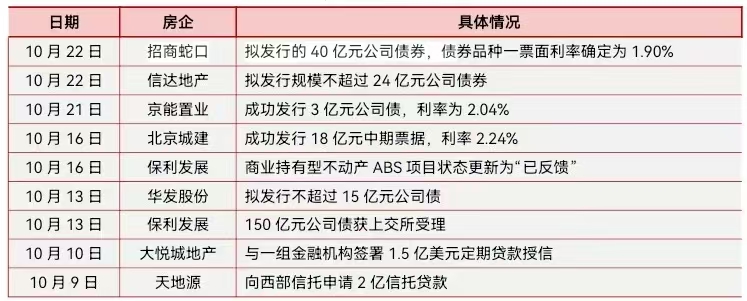
Core Viewpoint - The real estate industry is accelerating financing through various channels such as credit bonds, overseas bonds, and asset securitization to address year-end debt maturity pressures and prepare for future development amid increased supply of quality land parcels [1][3][10]. Financing Trends - In September, the total bond financing in the real estate sector reached 561 billion yuan, marking a year-on-year increase of 31%, with credit bond financing alone amounting to 322 billion yuan, a significant year-on-year growth of 89.5% [3][9]. - The average issuance term for credit bonds in September was 3.65 years, indicating a trend towards longer financing terms, which helps optimize debt structure and alleviate short-term repayment pressures [7]. Company Financing Activities - Several companies are actively issuing bonds, including China Merchants Shekou with a planned issuance of 40 billion yuan at a coupon rate of 1.90%, and China Vanke with a bond issuance of up to 24 billion yuan [6][8]. - Notable issuances include Beijing Urban Construction Group's successful issuance of 18 billion yuan in medium-term notes and Poly Developments' 150 billion yuan bond application accepted by the Shanghai Stock Exchange [6][8]. Challenges in Sales and Cash Flow - Despite the positive financing trends, real estate companies face significant challenges in sales, with a reported 8.4% year-on-year decline in funds received by real estate developers from January to September, particularly in deposits and pre-sales [9][10]. - The ongoing sluggish sales market continues to exert pressure on the overall cash flow of real estate companies, making it crucial for them to balance external financing with internal cash generation [10]. Debt Restructuring Progress - Some distressed real estate companies have made substantial progress in debt restructuring, with over 75% of creditors approving restructuring plans for companies like Longfor Group and Sunac China [8].







债权人回收率几何?融创、旭辉与金科的对比分析
Zhi Tong Cai Jing· 2025-10-22 00:42
Core Insights - Recent debt restructuring efforts by troubled real estate companies have gained momentum, with significant plans announced by CIFI, Sunac, and Jinke [1][2][3] Group 1: Debt Restructuring Plans - CIFI announced a debt restructuring plan involving mandatory convertible bonds, shareholder loans, and a long-term equity incentive plan, pending approval at a special shareholders' meeting on October 31 [1] - Sunac reported that 94.5% of its creditors agreed to its second round of overseas restructuring, with a court hearing scheduled for November 5 [1] - Jinke has signed a trust contract for bankruptcy restructuring, marking a significant step in its debt repayment mechanism, with a major investor becoming the largest shareholder after injecting 2.628 billion [1] Group 2: Debt-to-Equity Conversion - All three companies are utilizing debt-to-equity swaps as a key method for debt reduction, which involves issuing new shares to convert debt into equity, thereby increasing the company's capital base [1] - Jinke's restructuring plan includes cash payments for small creditors, stock conversions, and trust benefit rights, with recovery rates heavily dependent on stock price fluctuations [2][4] - Sunac's plan allows for debt conversion at different stock prices, with potential recovery rates significantly influenced by future stock performance [3] Group 3: Shareholder Control and Incentives - The restructuring plans ensure that the controlling shareholders maintain their positions, aligning their interests with those of creditors and minority shareholders [5][6] - Jinke's restructuring investors will hold nearly 30% of the company and have significant board representation, ensuring control over the company's direction [5] - Sunac's plan includes a "stability plan" to maintain shareholder control, while CIFI's plan incorporates a long-term incentive program for management to align interests with creditors [6][7]
债权人回收率几何?融创、旭辉(00884)与金科的对比分析
智通财经网· 2025-10-22 00:02
Core Viewpoint - Recent debt restructuring efforts by troubled real estate companies have gained momentum, with significant plans announced by CIFI, Sunac, and Jinke to convert debt into equity and stabilize their financial positions [1][2][3]. Group 1: Debt Restructuring Plans - CIFI announced a detailed debt restructuring plan involving mandatory convertible bonds, shareholder loans, and a long-term equity incentive plan, which will be presented for approval at a special shareholders' meeting on October 31 [1]. - Sunac reported that 94.5% of its creditors agreed to its second round of overseas restructuring plan, with a court hearing scheduled for November 5 [1]. - Jinke signed a trust contract for bankruptcy reorganization, marking a significant step in its debt repayment mechanism, with a major investor injecting 26.28 billion yuan to become the largest shareholder [1]. Group 2: Debt-to-Equity Conversion - All three companies are utilizing debt-to-equity conversion as a key method for debt reduction, which involves issuing new shares to convert debt, thereby increasing the company's equity base [1]. - Jinke's restructuring plan includes cash payments for small creditors, stock conversions, and trust benefits, with recovery rates heavily dependent on stock price fluctuations [2]. - Sunac's plan allows for 75% of debt to be converted at 6.8 HKD per share, with potential recovery rates significantly increasing if the stock price rises [3]. Group 3: Shareholder Control and Incentives - The restructuring plans ensure that the major shareholders maintain control, aligning their interests with those of creditors and minority shareholders [5][6]. - Jinke's restructuring investors will hold nearly 30% of the company and have significant board representation, ensuring control over the company's direction [5]. - Sunac's plan includes a "stability plan" for its equity structure, ensuring that the major shareholder retains a 23% control stake, while CIFI's plan includes measures to maintain the controlling family's stake at around 25% [6]. Group 4: Impact of Stock Performance - The future performance of these companies' stock prices is crucial for creditors' recovery rates, as sustainable operations and profitability are necessary for increasing valuations [4]. - The design of these restructuring plans aims to maintain management stability and align the interests of major shareholders with those of creditors, which is essential for the companies' recovery [7].
环球房产周报:北京住房租赁企业税收新政出台,苏州、杭州土拍,融创债务重组获通过……
Huan Qiu Wang· 2025-10-20 01:21
Group 1: Government Policies and Initiatives - The Minister of Housing and Urban-Rural Development, Ni Hong, emphasizes the need to construct safe, comfortable, green, and smart houses, while also renovating old ones [1] - Nine departments, including the Ministry of Housing, have issued an action plan to develop and implement intelligent municipal infrastructure construction and renovation plans [2] - Beijing has introduced a new tax policy for housing rental enterprises, reducing the VAT rate from 5% to 1.5% starting January 1, 2026, and lowering the property tax rate from 12% to 4% [3] Group 2: Real Estate Transactions and Market Activity - In Chengdu, a new policy has been released that removes local deposit restrictions for housing provident fund loans, allowing eligible non-local contributors to apply for conversion loans [4] - Two low-density residential land parcels in Suzhou's Xiangcheng district were sold at a total price of 661 million yuan, with floor prices of 7,500 yuan and 7,000 yuan per square meter [5] - A residential land parcel in Hangzhou's Binjiang district was sold for 1.264 billion yuan, reflecting a nearly 20% premium over the starting price [6] Group 3: Land Supply and Development - Beijing has announced the eighth round of proposed residential land supply for 2025, covering 9 plots with a total area of approximately 44 hectares and a planned construction scale of about 1.03 million square meters [7] - Shanghai is set to auction 6 land parcels in its eighth batch of land sales, with a total starting price of 18.495 billion yuan [8] Group 4: Company Performance and Leadership Changes - China State Construction's project, Yunhe Jiuyuan, achieved sales of 448 units in September, leading in sales volume, area, and amount in Beijing [9] - Beijing Urban Construction's Xi Yuan project opened its humanistic demonstration area, showcasing high-end residential values [10] - Sunac China’s debt restructuring plan received approval from 98.5% of creditors, marking a significant step towards resolving its offshore debt issues [12] Group 5: Sales Performance of Real Estate Companies - China Resources Land reported a cumulative contract sales amount of approximately 154.4 billion yuan for the first nine months, a year-on-year decline of 10.4% [13] - China Jinmao's contract sales for the same period reached 80.685 billion yuan, with a total area of 3.6745 million square meters sold [14] - Longfor Group's total contract sales amounted to 50.75 billion yuan, with a sales area of 3.943 million square meters [15]

拟注销81亿美元境外债务 旭辉控股“化债求生”
Zhong Guo Jing Ying Bao· 2025-10-18 03:20
Core Viewpoint - CIFI Holdings Group Co., Ltd. announced details of its offshore debt restructuring, including plans to issue $4.1 billion in mandatory convertible bonds and convert shareholder loans into equity, with a special shareholders' meeting scheduled for October 31 to seek approval [2][3]. Group 1: Debt Restructuring Details - The restructuring will result in the cancellation of approximately $8.1 billion in existing offshore debt, which includes $6.8 billion in unpaid principal and $1.3 billion in accrued unpaid interest [2]. - The company will issue approximately $6.7 billion in new instruments and pay about $9.5 million in cash as part of the restructuring [2]. - The mandatory convertible bonds will have an initial conversion price of HKD 1.6 per share, representing a 7-fold premium over the current stock price [2]. Group 2: Conversion Mechanism - The conversion mechanism for the mandatory convertible bonds includes voluntary conversion, phased mandatory conversion over four years, and trigger-based conversion if the stock price exceeds HKD 5 for 90 consecutive trading days [2]. Group 3: Shareholder Support and Incentives - The major shareholder, the Lin family, has shown strong support by converting over HKD 500 million in shareholder loans into equity and converting approximately $4 million in existing notes into mandatory convertible bonds [3]. - A ten-year equity incentive plan will be launched to ensure operational stability and performance improvement post-restructuring, covering major shareholders and core management [3]. - The incentive plan is designed to tie the granting conditions to quantifiable performance metrics, ensuring team stability during the recovery phase [3]. Group 4: Financial Performance - For the first half of 2025, CIFI Holdings reported revenue of approximately 12.281 billion yuan, a year-on-year decline of 39.22%, with a net loss attributable to shareholders of about 6.358 billion yuan, further widening compared to the previous year [3]. - In September, the company recorded a contract sales amount of approximately 900 million yuan, only about 50% of the same period last year, with cumulative contract sales for January to September amounting to approximately 13.06 billion yuan, also showing a decline compared to the previous year [3].
北京发布今年第八轮拟供商品住宅用地清单;财信发展控股股东破产重整投资人确定 | 房产早参
Mei Ri Jing Ji Xin Wen· 2025-10-16 22:18
Group 1: Beijing Land Supply - Beijing has released its eighth round of proposed residential land supply for 2025, involving 9 plots covering approximately 44 hectares and a planned construction area of about 1.03 million square meters [1] - All plots are located in areas with significant market demand and well-developed infrastructure and public services, including 3 in the central urban area and 6 in sub-centers and plains [1] - The supply of high-quality land in core areas, combined with favorable housing policies, is expected to boost market confidence in high-quality residential development and related industries [1] Group 2: Chengdu Land Auction - Chengdu successfully auctioned 4 residential plots, totaling an area of 125,500 square meters and a planned construction area of approximately 239,000 square meters, with a starting total price of 1.99 billion yuan [2] - The final transaction amount reached 1.995 billion yuan, with 3 plots sold at the base price and 1 plot sold at a slight premium, reflecting a differentiation between core and non-core areas [2] - This outcome reinforces the perception of asset optimization and development certainty among real estate companies, particularly state-owned and certain private enterprises focusing on core cities [2] Group 3: China Overseas Land Financing - China Overseas Land announced that its wholly-owned subsidiary plans to issue medium-term notes not exceeding 3 billion yuan, with two varieties: one for 1 billion yuan for 3 years and another for 2 billion yuan for 5 years [3] - The issuance is likely aimed at optimizing debt structure or supporting land acquisition in core cities, given the company's past practices of using medium-term notes for project construction and liquidity [3] - The company's ability to secure low-interest financing and maintain a stable financial position will be key points of market focus [3] Group 4: CIFI Holdings Debt Restructuring - CIFI Holdings disclosed details of its overseas debt restructuring plan, which includes issuing mandatory convertible bonds (MCB) to significantly reduce debt and optimize capital structure [4] - The major shareholder's previous loan of over 500 million HKD will also be converted into equity, and a 10-year equity incentive plan will be introduced to stabilize and motivate the team post-restructuring [4] - This marks a critical phase in CIFI's overseas restructuring, with potential positive implications for its balance sheet repair and asset-light transformation [4] Group 5: Caixin Development Bankruptcy Restructuring - Caixin Development announced that the management has completed the selection of an investor for its bankruptcy restructuring, with Jiangxi Zhongjiu Natural Gas Group confirmed as the selected investor [5] - However, the restructuring investment agreement has not yet been signed, and specific terms and payment arrangements are still under negotiation [5] - The restructuring may involve changes in company control, and while daily operations are reportedly unaffected, the new investor's capital injection and business collaboration plans will be crucial for improving performance [5]


旭辉控股集团(00884) - 致非登记股东的通知信函及回条
2025-10-16 14:48
CIFI Holdings (Group) Co. Ltd. 旭 輝 控 股 ( 集 團 ) 有 限 公 司 (Incorporated in the Cayman Islands with limited liability) ( 於開曼群島註冊成立的有限公司 ) (Stock code 股份代號: 00884) N O T I F I C AT I O N L E T T E R 通 知 信 函 Dear non-registered shareholder(s) (Note) , CIFI Holdings (Group) Co. Ltd. (the "Company") – Notice of Publication of Circular (the "Current Corporate Communication") The Current Corporate Communication of the Company has been published in English and Chinese languages and is available on the website of the C ...
旭辉控股集团(00884) - 致登记股东之通知信函及回条
2025-10-16 14:47
N O T I F I C A T I O N L E T T E R 通 知 信 函 Dear registered shareholders, CIFI Holdings (Group) Co. Ltd. (the "Company") – Notice of Publication of Circular and Proxy Form (the "Current Corporate Communication") CIFI Holdings (Group) Co. Ltd. 旭 輝 控 股 ( 集 團 ) 有 限 公 司 (Incorporated in the Cayman Islands with limited liability) 於開曼群島註冊成立的有限公司 (Stock code 股份代號: 00884) The Current Corporate Communication of the Company has been published in English and Chinese languages and is available on the Company's website ...
旭辉控股集团(00884) - 股东特别大会代表委任表格
2025-10-16 14:46
CIFI Holdings (Group) Co. Ltd. 旭輝控股(集團)有限公司 (於開曼群島註冊成立的有限公司) (股份代號:00884) (債 務 股 份 代 號:05261、40316、40464、40519、40681、40682) 股 東 特 別 大 會 代 表 委 任 表 格 本 人╱吾 等 (註1) 地 址 為 為 旭 輝 控 股(集 團)有 限 公 司(「本 公 司」)股 本 中 每 股 面 值0.10港 元 股 普 通 股 (註2) 的 登 記 持 有 人, 茲 委 任 (註3) 地 址 為 或 如 其 未 能 出 席,則 委 任 大 會 主 席 為 本 人╱吾 等 的 代 表,代 表 本 人╱吾 等 出 席 本 公 司 將 於 二 零 二 五 年 十 月 三 十 一 日(星 期 五)上 午 十 時 正 假 座 中 國 上 海 市 閔 行 區 申 虹 路1088 弄39 號 旭 輝 中 心 二 樓 簽 約 室 舉 行 的 股 東 特 別 大 會(「股 東 特 別 大 會」)或 其 任 何 續 會 及 於 會 上 投 票,並(但 不 限 於)代 表 本 人╱吾 等 以 本 人╱吾 等 的 ...