CCB(00939)

Search documents
金融行业周报(2026、01、25):业绩比较基准新规正式落地,坚定保险中长期向好逻辑-20260125
Western Securities· 2026-01-25 10:30
Investment Rating - The report maintains a positive long-term outlook for the insurance sector, indicating a strong continuity in market performance despite recent fluctuations [2][12][16]. Core Insights - The financial sector experienced a mixed performance this week, with the non-bank financial index down by 1.45%, underperforming the CSI 300 index by 0.83 percentage points. The insurance sector saw a decline of 4.02%, while the brokerage sector decreased by 0.61% [1][10]. - The insurance sector's performance is driven by two main factors: policy support leading to economic recovery and liquidity easing combined with a strong stock market. The report suggests a shift from liquidity-driven growth to a focus on macro policy support and economic recovery expectations [2][13][16]. - The brokerage sector is expected to benefit from new regulations that enhance investment management quality, with a recommendation to focus on larger, undervalued firms and those involved in mergers and acquisitions [3][18]. - The banking sector is facing a slight decline, but there are signs of recovery in profitability for leading banks, with recommendations to focus on banks with high dividend yields and those expected to benefit from market conditions [19][21]. Summary by Sections Insurance Sector - The insurance sector's recent decline is attributed to short-term market sentiment and liquidity changes, but the long-term outlook remains positive due to strong support from both the liability and asset sides [2][12][16]. - Key recommendations include focusing on companies like China Pacific Insurance, China Ping An, China Life (H), and China Taiping, with a specific recommendation for New China Life [4][16]. Brokerage Sector - The brokerage sector's performance is slightly better than the overall market, with a focus on the new guidelines from the regulatory body that aim to improve fund management quality [3][17]. - Recommended firms include Guotai Junan, Huatai Securities, and others, particularly those with strong merger and acquisition prospects [4][18]. Banking Sector - The banking sector has shown a decline but is expected to stabilize, with recommendations to focus on banks with high earnings elasticity and strong dividend yields [19][21]. - Specific banks to watch include Hangzhou Bank, Ningbo Bank, and others, with a focus on those that have previously been undervalued [4][21].




二级资本债周度数据跟踪-20260125
Soochow Securities· 2026-01-25 07:11
1. Report Industry Investment Rating There is no information about the industry investment rating in the provided content. 2. Core Viewpoints of the Report - This week (January 19 - January 23, 2026), there were no new secondary capital bonds issued in the inter - bank market and the exchange market [1]. - This week, the total trading volume of secondary capital bonds was approximately 334.2 billion yuan, an increase of 69.1 billion yuan compared to last week. The top three bonds in terms of trading volume were 25 Bank of China Secondary Capital Bond 02BC (44.352 billion yuan), 25 China Guangfa Bank Secondary Capital Bond 01BC (21.98 billion yuan), and 25 Bank of China Secondary Capital Bond 03A(BC) (7.753 billion yuan) [2]. - In terms of the issuing regions, the top three regions in terms of trading volume were Guangdong Province, Shanxi Province, and Shandong Province, with trading volumes of approximately 252.1 billion yuan, 29.9 billion yuan, and 14.7 billion yuan respectively [2]. - As of January 23, the changes in the yields to maturity of 5Y secondary capital bonds with ratings of AAA -, AA +, and AA compared to last week were - 2.18BP, - 2.84BP, and - 3.84BP respectively; for 7Y secondary capital bonds, the changes were - 2.72BP for all ratings of AAA -, AA +, and AA; for 10Y secondary capital bonds, the changes were - 4.60BP, - 5.09BP, and - 5.09BP respectively [2]. - This week, the overall deviation of the average trading price valuation of secondary capital bonds was not significant. The proportion of discount transactions was greater than that of premium transactions, and the discount amplitude was greater than the premium amplitude [3]. 3. Summary by Related Catalogs 3.1 Primary Market Issuance - This week (January 19 - January 23, 2026), there were no new secondary capital bonds issued in the inter - bank market and the exchange market [1]. 3.2 Secondary Market Transactions - **Trading Volume**: The total trading volume of secondary capital bonds this week was approximately 334.2 billion yuan, an increase of 69.1 billion yuan compared to last week. The top three bonds in terms of trading volume were 25 Bank of China Secondary Capital Bond 02BC (44.352 billion yuan), 25 China Guangfa Bank Secondary Capital Bond 01BC (21.98 billion yuan), and 25 Bank of China Secondary Capital Bond 03A(BC) (7.753 billion yuan) [2]. - **Regional Distribution**: In terms of the issuing regions, the top three regions in terms of trading volume were Guangdong Province, Shanxi Province, and Shandong Province, with trading volumes of approximately 252.1 billion yuan, 29.9 billion yuan, and 14.7 billion yuan respectively [2]. - **Yield to Maturity**: As of January 23, the changes in the yields to maturity of 5Y secondary capital bonds with ratings of AAA -, AA +, and AA compared to last week were - 2.18BP, - 2.84BP, and - 3.84BP respectively; for 7Y secondary capital bonds, the changes were - 2.72BP for all ratings of AAA -, AA +, and AA; for 10Y secondary capital bonds, the changes were - 4.60BP, - 5.09BP, and - 5.09BP respectively [2][10]. 3.3 Top Thirty Bonds with Valuation Deviation - **Discount Bonds**: The top three discount bonds were 23 Kecheng Rural Commercial Secondary Capital Bond 01 (- 1.7012%), 22 Xinchang Rural Commercial Bank Secondary Capital Bond 01 (- 1.6229%), and 25 Ninghai Rural Commercial Secondary Capital Bond 01 (- 1.6108%). The Zhongzhai implicit ratings were mainly AAA -, AA +, and AA -, and the bonds were mainly distributed in Beijing, Zhejiang, and Guangdong [3][13]. - **Premium Bonds**: The top three premium bonds were 25 Jilin Bank Secondary Capital Bond 02 (0.6619%), 22 Shengjing Bank Secondary Capital Bond 01 (0.1965%), and 24 Shengjing Bank Secondary Capital Bond 01 (0.1959%). The Zhongzhai implicit ratings were mainly AAA -, AA, and AA +, and the bonds were mainly distributed in Beijing, Zhejiang, and Liaoning [3][14].



抢疯了!金饰克价突破1500元,银行保管箱业务火爆,预约排到两三个月后,网友:这都要抢?
Mei Ri Jing Ji Xin Wen· 2026-01-25 03:50
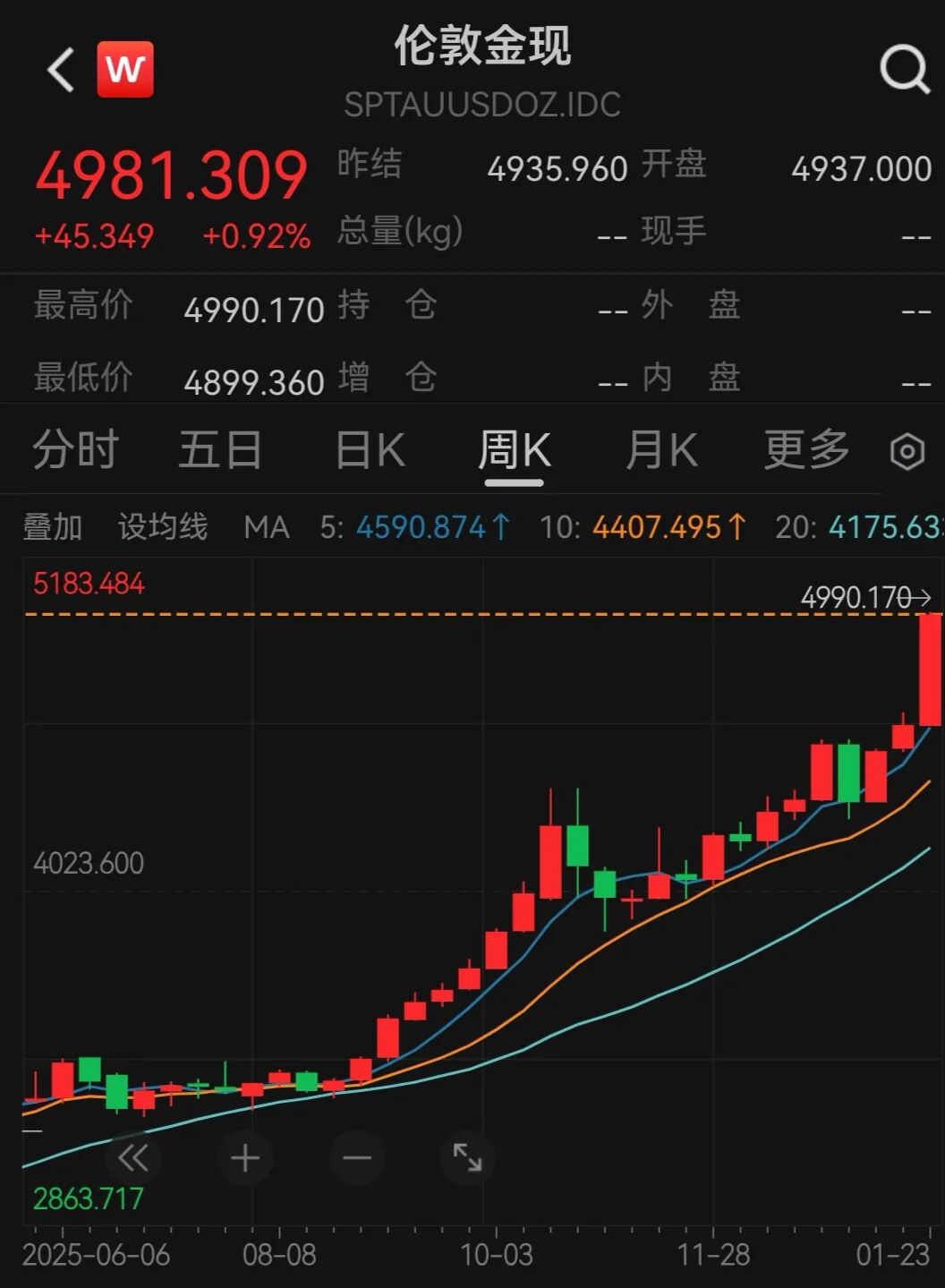
Group 1: Gold Price Surge - The price of gold has surged significantly, with spot gold reaching $4981.309 per ounce, approaching the $5000 mark [1] - Domestic gold prices have also increased, with several brands of gold jewelry exceeding 1500 yuan per gram, and some reaching 1548 yuan, marking a daily increase of over 50 yuan [3] Group 2: Demand for Bank Safe Deposit Boxes - The demand for bank safe deposit boxes has skyrocketed, with many banks reporting that all available boxes are rented out, leading to waiting lists for new customers [7][9] - In Hangzhou, major banks have completely rented out their safe deposit boxes, and new customers must wait for existing customers to return their boxes before they can rent one [8] - The surge in demand for safe deposit boxes is attributed to the increasing need for secure storage of high-value items like gold bars, particularly among high-net-worth individuals in major cities [9]



展望“十五五” 八桂启新篇 | 关键金属里的“金”动力
Guang Xi Ri Bao· 2026-01-25 02:58
Group 1 - The first major acquisition loan in the critical metals industry in Guangxi was successfully issued, amounting to 224 million yuan, aimed at supporting resource integration and capacity expansion [1] - Guangxi is recognized as a significant region for non-ferrous metals, holding a leading position in the reserves of various critical metals such as tin, antimony, indium, gallium, germanium, and rare earths [1] - To promote the high-quality development of the critical metals industry, Guangxi has introduced several policy documents in 2025, including measures for financial support and the establishment of the "Nandan Critical Metals Loan" [1] Group 2 - Financial institutions in Guangxi are innovating to support the green and high-quality development of the critical metals industry, with notable loans such as 100 million yuan from China Construction Bank for operational needs and 300 million yuan from Industrial and Commercial Bank of China for production stability [2] - The establishment of the Guangxi Critical Metals Industry Development Group in January 2026 aims to provide comprehensive financial services, with plans for Guangxi Beibu Gulf Bank to invest at least 20 billion yuan in the critical metals sector over the next five years [2] - By the end of 2025, 53 enterprises in the critical metals industry chain in Guangxi had been included in the "Nandan Critical Metals Loan" list, with 33 enterprises receiving a total of 2.838 billion yuan in loans [3]

2025年4季度公募基金银行持仓点评:主动基金配置比例仍处低位
Guolian Minsheng Securities· 2026-01-25 02:04
2025 年 4 季度公募基金银行持仓点评 主动基金配置比例仍处低位 glmszqdatemark 分析师:王先爽 分析师:乔丹 执业证书:S0590525120014 执业证书:S0590526010003 邮箱:wangxianshuang@glms.com.cn 邮箱:qiaodan@glms.com.cn 推荐 维持评级 相对走势 -10% 3% 17% 30% 2025/1 2025/7 2026/1 银行 沪深300 相关研究 本公司具备证券投资咨询业务资格,请务必阅读最后一页免责声明 证券研究报告 1 2026 年 01 月 25 日 [Table_Author] 25Q4 公募基金持仓银行情况。为了追踪市场偏股公募基金对银行的持仓情况, 我们把其分为三类:1、主动基金:主动股票、偏股混合和灵活配置型基金;2、 ETF 基金:追踪沪深 300、中证 A500 等与银行相关的主要指数的 ETF 基金;3、 非 ETF 指数基金:追踪以上主要指数的非 ETF 类被动指数、指数增强型基金。25 年四季度主动、ETF 和非 ETF 指数基金分别持有银行板块 305.8、2607.2、574.1 亿元,分 ...

金融行研系列:17 中国私人银行业2025发展报告
Xin Lang Cai Jing· 2026-01-24 23:03
Core Insights - The Chinese private banking industry is undergoing a historic shift from "scale expansion" to "value cultivation," with high-quality growth expected by 2025 [3][4] - The number of high-net-worth individuals (HNWIs) in China has surpassed 3 million, with assets under management (AUM) reaching 24.6 trillion yuan, projected to grow to 42 trillion yuan by 2030, reflecting a compound annual growth rate (CAGR) of 9.5% [3][6] - The market is characterized by a dual trend of "head concentration and distinctive breakthroughs," with major state-owned banks dominating the sector [3][8] Industry Overview - The private banking sector in China continues to show steady growth, with AUM reaching 18.8 trillion yuan by mid-2025, a 9.3% increase from the end of 2024 [5][6] - The number of clients served by 16 banks reached 1.649 million, a year-on-year growth of 13.17% [5] - The market is highly concentrated, with the top four state-owned banks holding nearly 70% of the total AUM among the 12 major private banks [8][7] Market Dynamics - Business innovation is becoming a new driving force for industry development, with family trusts and insurance trusts experiencing rapid growth [4][19] - By Q3 2025, the total scale of family trusts exceeded 950 billion yuan, while insurance trusts reached 420 billion yuan, reflecting growth rates of 5.6% and 19.1% respectively [4][19] - The industry faces challenges such as stricter regulations, talent shortages, and intensified competition [4][29] Client Demographics - The number of high-net-worth families in China reached 2.066 million by 2025, with the total wealth of billionaires growing to 1.8 trillion USD, a 22.2% increase [12][6] - The average age of high-net-worth individuals is 35, with a significant portion being young entrepreneurs [13][12] - The income sources of high-net-worth individuals are diverse, with business income being the primary source [13][16] Business Model Innovations - Family office services are rapidly developing, with over 85% of private banking departments establishing independent family office service systems by the end of 2023 [22] - The demand for family office services is expected to grow, with annual expenditures on tax planning projected to reach 2.8 million yuan by 2025 [23] - ESG investments are becoming a key focus, with ESG-themed financial products seeing significant growth [24][25] Digital Transformation - The digital transformation of the private banking sector is entering a deepening phase, with at least 60% of institutions expected to adopt AI-driven advisory systems by 2025 [26][27] - Technology investments are projected to exceed 4.8 billion yuan, with a CAGR of 27.3% [26] - The integration of digital services is crucial for enhancing customer experience and operational efficiency [28] Regulatory Environment - The regulatory environment is becoming stricter, leading to increased compliance costs, which are expected to rise by 23 percentage points of operating income [29][30] - The implementation of new asset management regulations is reshaping product design and increasing the entry barriers for new players [29][30] Talent Shortage - The private banking industry faces a significant talent shortage, with a demand gap of approximately 24,000 professional bankers by 2025 [33][34] - The ratio of talent supply to demand is 1:8, indicating a critical need for skilled professionals [33] - The industry is increasingly focusing on talent training and recruitment to address this gap [34]
高强被开除党籍!
Zhong Guo Ji Jin Bao· 2026-01-24 13:36
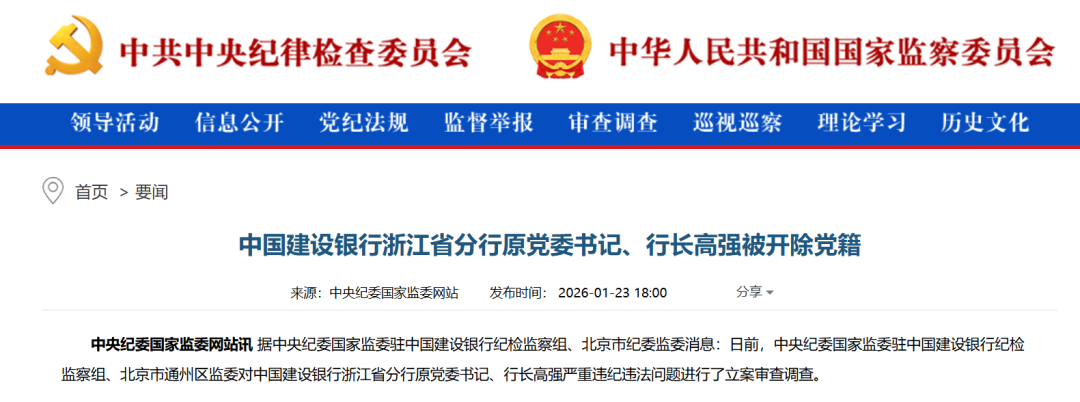
Core Viewpoint - The former Party Secretary and President of China Construction Bank's Zhejiang branch, Gao Qiang, has been expelled from the Party due to serious violations of discipline and law [1][2]. Group 1: Violations and Investigations - Gao Qiang was investigated for serious disciplinary and legal violations, including obstructing organizational reviews and hiding evidence [2]. - He disregarded the central government's eight-point regulations by accepting gifts and benefits that could influence his official duties [2]. - Gao was found to have engaged in corrupt practices, such as using his position to benefit others in loan financing and illegally accepting large sums of money [2]. Group 2: Consequences and Actions Taken - The decision to expel Gao from the Party was made by the China Construction Bank's Party Committee, and his illegal gains will be confiscated [2]. - His case has been referred to the prosecutorial authorities for legal proceedings, along with the related assets [2]. - The investigation into Gao's conduct is part of a broader crackdown on corruption within the China Construction Bank's Zhejiang branch, which has seen multiple officials disciplined [2]. Group 3: Background Information - Gao Qiang, born in September 1960, has held various significant positions within the China Construction Bank and has extensive experience in the financial sector [2]. - His previous roles include serving as the risk director and vice president of the Anhui branch, as well as the president of the Shanxi branch [2]. - The Zhejiang branch has faced scrutiny, with several other officials also being investigated or disciplined for similar issues [2].
高强被开除党籍!
中国基金报· 2026-01-24 13:09
Core Viewpoint - The article reports on the expulsion of Gao Qiang, the former Party Secretary and President of China Construction Bank's Zhejiang branch, from the Party due to serious violations of discipline and law [2][4]. Summary by Sections Investigation and Findings - Gao Qiang was subjected to an investigation by the Central Commission for Discipline Inspection and the Beijing Municipal Commission for Discipline Inspection for serious violations of discipline and law [4]. - The investigation revealed that Gao Qiang lost his ideals and beliefs, resisted organizational scrutiny, and concealed evidence [5]. - He ignored the spirit of the Central Eight Regulations, accepted gifts and money that could influence his official duties, and violated organizational principles by seeking personal benefits for others [5]. Violations and Misconduct - Gao Qiang's misconduct included giving gifts to public officials, engaging in profit-making activities, and gambling [5]. - He exploited his position to benefit others in loan financing and illegally accepted large sums of money [6]. - His actions constituted severe violations of political, organizational, and disciplinary regulations, and he continued these behaviors even after the 18th and 19th National Congresses of the Communist Party [6]. Disciplinary Actions - As a result of his violations, Gao Qiang was expelled from the Party, and his illegal gains were confiscated [6]. - His case has been referred to the prosecution for legal proceedings, and all related assets have been transferred [6]. - The article notes that several other officials from the Zhejiang branch of China Construction Bank have also faced disciplinary actions in recent years [7]. Background Information - Gao Qiang, born in September 1960, has held various significant positions within the China Construction Bank system and has also served in leadership roles in other organizations [6][7]. - The article highlights a pattern of disciplinary issues within the Zhejiang branches of major state-owned banks, indicating a broader concern regarding governance and compliance in the financial sector [7].

你的信用卡账单分期,国家要贴息啦
2 1 Shi Ji Jing Ji Bao Dao· 2026-01-24 02:33
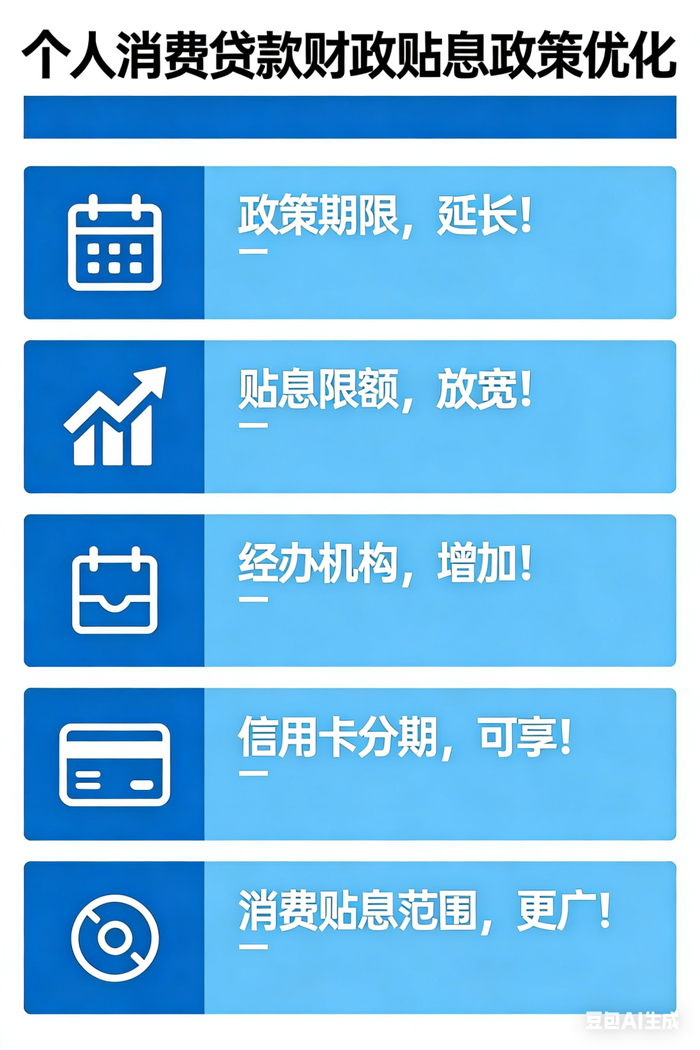
Group 1 - The core viewpoint of the news is the optimization of the personal consumption loan interest subsidy policy, which aims to stimulate consumer spending by extending the policy duration and expanding its coverage [1][2][4] - The new policy extends the implementation period until the end of this year and includes credit card installment payments in the subsidy scope, thereby broadening the areas eligible for interest subsidies [1][3] - Financial institutions, including major banks, are quickly responding to the policy by optimizing their services to ensure consumers can benefit from the subsidies seamlessly, enhancing the overall consumer experience [4][6] Group 2 - The collaboration between financial institutions and e-commerce platforms is highlighted, with initiatives like interest-free installment products being offered to consumers, which have led to significant increases in sales for participating brands [6] - The policy is part of a broader strategy to boost domestic demand and consumer confidence, aligning with the central economic work conference's focus on enhancing the domestic market [7] - The implementation of the policy is expected to improve consumer sentiment and market vitality, contributing to a stable economic outlook and encouraging higher quality consumption [7]
智通ADR统计 | 1月24日



智通财经网· 2026-01-24 00:15
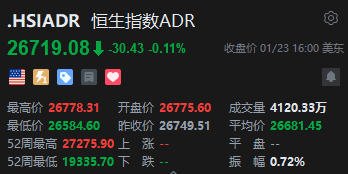
Market Overview - The US stock market indices showed mixed performance on Friday, with the Hang Seng Index ADR closing at 26,719.08 points, down by 30.43 points or 0.11% compared to the Hong Kong close [1]. Major Blue-Chip Stocks - HSBC Holdings closed at HKD 130.896, up by 0.69% from the Hong Kong close [2]. - Tencent Holdings closed at HKD 598.184, up by 0.54% from the Hong Kong close [2]. Stock Performance Summary - Tencent Holdings (HKD 595.000) saw a decrease of HKD 2.500, or -0.42%, with its ADR price at HKD 598.184, reflecting an increase of HKD 3.184 or 0.54% [3]. - Alibaba Group (HKD 168.500) increased by HKD 3.700, or 2.25%, with its ADR price at HKD 168.834, up by HKD 0.334 or 0.20% [3]. - HSBC Holdings (HKD 130.000) rose by HKD 0.300, or 0.23%, with its ADR price at HKD 130.896, up by HKD 0.896 or 0.69% [3]. - Xiaomi Group (HKD 36.240) increased by HKD 1.000, or 2.84%, with its ADR price at HKD 36.287, up by HKD 0.047 or 0.13% [3]. - AIA Group (HKD 83.050) rose by HKD 0.550, or 0.67%, with its ADR price at HKD 83.077, up by HKD 0.027 or 0.03% [3]. - Meituan (HKD 97.550) increased by HKD 0.550, or 0.57%, with its ADR price at HKD 97.735, up by HKD 0.185 or 0.19% [3]. - Kuaishou (HKD 81.250) rose by HKD 2.150, or 2.72%, with its ADR price at HKD 82.648, up by HKD 1.398 or 1.72% [3]. - Ctrip Group (HKD 485.400) increased by HKD 3.800, or 0.79%, with its ADR price at HKD 490.273, up by HKD 4.873 or 1.00% [3].