CHINA MOBILE(00941)

Search documents
中国移动实现通信网时间同步从“城域自治”迈向“全国一体”
Bei Jing Ri Bao Ke Hu Duan· 2026-01-21 03:13
Core Viewpoint - China Mobile has successfully completed the first large-scale, cross-provincial commercial trial of the BeiDou satellite co-view synchronization system, marking a significant advancement in high-precision time synchronization capabilities from "metropolitan autonomy" to "national integration" [1][2]. Group 1: Technical Achievements - The trial utilized the distributed satellite co-view (DCV) technology to achieve nanosecond-level high-precision time synchronization across a nationwide network, overcoming the previous issue of "time islands" in metropolitan areas [1]. - The implementation of the industry standard for the BeiDou satellite co-view synchronization system (YD/T 4769-2024) in this large-scale trial represents a significant milestone in the integration of communication networks and high-precision time synchronization [1][2]. - The relative time difference between different regional time servers was stabilized within 9 nanoseconds, which is an improvement of more than an order of magnitude compared to traditional methods [2]. Group 2: Infrastructure and Future Outlook - The trial achieved a deep integration of national-level timing infrastructure with communication networks, utilizing the high-precision ground timing system from the National Time Service Center as a unified reference for standard time signals [2]. - China Mobile plans to continue enhancing collaboration with various sectors to accelerate the construction of a nationwide integrated time-space synchronization network, which will support emerging services such as 6G communication, computing networks, and artificial intelligence [2].
智通港股通持股解析|1月21日




智通财经网· 2026-01-21 00:34
Group 1 - The top three companies by Hong Kong Stock Connect holding ratios are China Telecom (71.01%), Gree Power Environmental (69.50%), and Tianjin Chuangye Environmental (67.58%) [1][2] - Alibaba-W, Tencent Holdings, and China Construction Bank have seen the largest increases in holding amounts over the last five trading days, with increases of +30.01 billion, +25.58 billion, and +14.29 billion respectively [1][2] - The companies with the largest decreases in holding amounts over the last five trading days are China Mobile (-27.58 billion), China Aluminum (-8.63 billion), and Zijin Mining (-8.06 billion) [1][3] Group 2 - The latest holding ratios for the top 20 companies in Hong Kong Stock Connect show that China Telecom has 9.856 billion shares, representing 71.01% of its total [2] - The recent five trading days' increase list includes Alibaba-W with a change of +30.01 billion, translating to an increase of 18.79 million shares [2] - The recent five trading days' decrease list highlights China Mobile with a change of -27.58 billion, equating to a decrease of 34.77 million shares [3]
智通港股通资金流向统计(T+2)|1月21日





智通财经网· 2026-01-20 23:33
Group 1 - The top three companies with net inflow of southbound funds are SMIC (10.84 billion), Xiaomi Group (8.70 billion), and Hua Hong Semiconductor (5.82 billion) [1] - The top three companies with net outflow of southbound funds are China Mobile (-11.60 billion), Alibaba Health (-4.83 billion), and Kuaishou-W (-4.55 billion) [1] - In terms of net inflow ratio, Qinhuangdao Port (82.38%), 361 Degrees (76.04%), and Southern Hong Kong Stock Connect (62.50%) lead the market [1] Group 2 - The top ten companies with the highest net inflow include SMIC (10.84 billion, 15.56%), Xiaomi Group (8.70 billion, 11.77%), and Hua Hong Semiconductor (5.82 billion, 15.18%) [2] - The top ten companies with the highest net outflow include China Mobile (-11.60 billion, -39.71%), Alibaba Health (-4.83 billion, -20.48%), and Kuaishou-W (-4.55 billion, -15.50%) [2] - The top three companies with the highest net inflow ratio are Qinhuangdao Port (82.38%), 361 Degrees (76.04%), and Southern Hong Kong Stock Connect (62.50%) [2][3] Group 3 - The top three companies with the highest net outflow ratio are Jiangnan Buyi (-60.89%), Yancoal Australia (-60.02%), and Standard Chartered Group (-56.28%) [3] - Other notable companies with significant net outflow include Tianli International Holdings (-55.78%) and China Shenhua Energy (-48.70%) [3]
港股通(深)净买入2.18亿港元
Zheng Quan Shi Bao Wang· 2026-01-20 15:44
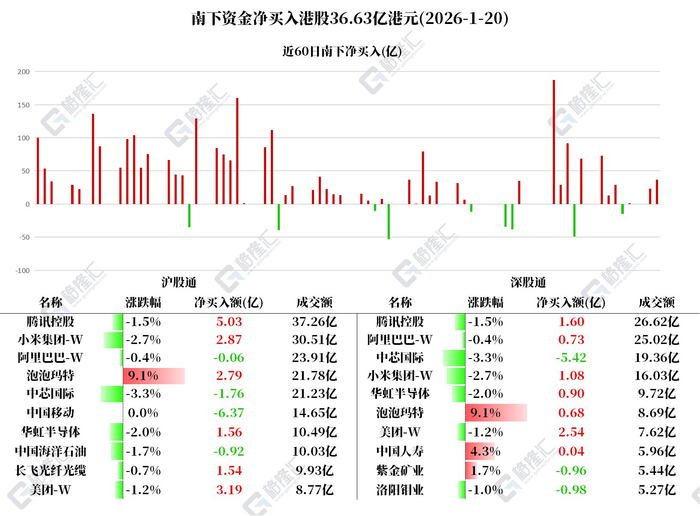
Core Viewpoint - On January 20, the Hang Seng Index fell by 0.29%, closing at 26,487.51 points, while southbound funds through the Stock Connect recorded a net buy of HKD 36.63 billion [1]. Group 1: Market Activity - The total trading volume for the Stock Connect on January 20 was HKD 972.83 billion, with a net buy of HKD 36.63 billion [1]. - The Shanghai Stock Connect accounted for HKD 594.79 billion in trading volume with a net buy of HKD 34.44 billion, while the Shenzhen Stock Connect had a trading volume of HKD 378.04 billion and a net buy of HKD 2.18 billion [1]. Group 2: Active Stocks - In the Shanghai Stock Connect, Tencent Holdings was the most actively traded stock with a transaction amount of HKD 37.26 billion, followed by Xiaomi Group-W and Alibaba-W with transaction amounts of HKD 30.51 billion and HKD 23.91 billion, respectively [1]. - Tencent Holdings had a net buy of HKD 5.03 billion, despite its closing price dropping by 1.48% [1]. - China Mobile recorded the highest net sell amount of HKD 6.37 billion, closing flat [1]. Group 3: Shenzhen Stock Connect Activity - In the Shenzhen Stock Connect, Tencent Holdings also led with a transaction amount of HKD 26.62 billion, followed by Alibaba-W and SMIC with transaction amounts of HKD 25.02 billion and HKD 19.36 billion, respectively [2]. - Meituan-W had the highest net buy amount of HKD 2.54 billion, although it closed down by 1.17% [2]. - SMIC experienced the largest net sell amount of HKD 5.42 billion, closing down by 3.25% [2].


三大运营商定调2026:继续战略收缩 聚焦AI转型
Zhong Guo Jing Ying Bao· 2026-01-20 13:24
Core Insights - The three major telecom operators in China are shifting their strategies towards "strategic contraction and focused transformation," moving away from a "large and comprehensive" approach to concentrate resources on core business areas such as computing power, AI applications, and enterprise markets [1][4] Financial Performance - In 2024, the total revenue of the three operators approached 2 trillion yuan, with a year-on-year growth rate slowing to approximately 3%, a significant decline compared to previous years. The combined net profit was about 192 billion yuan, reflecting a year-on-year increase of approximately 6.1%. The combined EBITDA was around 574 billion yuan, showing a slight decline of about 0.7%, indicating a fatigue in profitability [2] Strategic Focus - China Telecom is upgrading its strategy from "cloud transformation" to "intelligent and beneficial cloud transformation," emphasizing AI empowerment and security in enterprise construction. In 2024, the revenue from digitalization in its industry is expected to increase, with a 22% year-on-year growth in capital expenditure for computing power [3] - China Unicom is focusing on four core areas: connectivity, computing power, services, and security, moving away from a comprehensive coverage model. Its investment in computing power is expected to rise by 19% in 2024, with plans to build a multi-layered computing supply system [3] - China Mobile aims to strengthen its three main businesses: communication services, computing services, and intelligent services, with a focus on technology leadership and scale synergy. The planned investment in computing power for 2025 is 37.3 billion yuan, maintaining the same level as 2024 but increasing its share in capital expenditure to 25% [4] Embracing AI - All three operators are sending a clear signal of "fully embracing AI." China Unicom is focusing on the synergy between AI and its core areas, while China Telecom is integrating AI throughout its operations. China Mobile is also prioritizing intelligent services and plans to develop 15 million AI terminals by 2026 [5][6] Capital Expenditure Trends - The capital expenditure of the three operators is showing a trend of "overall contraction with localized increases," with a total planned capital expenditure for 2025 reduced by 9.1% to 289.8 billion yuan. The focus is shifting towards "intelligent computing centers" and "massive card clusters" [7]

智慧连接千行百业 浙江移动5G-A覆盖感知升级
Ren Min Wang· 2026-01-20 12:58
Core Viewpoint - The deployment of "5G-A" technology by China Mobile Zhejiang is enhancing network speed and coverage, contributing to the economic and social development of Zhejiang province while improving the quality of life for its residents [1] Group 1: 5G-A Technology Implementation - The establishment of the first 5G-A×AI uplink demonstration zone in West Xixi Wetland allows for a maximum uplink speed of 1 Gbps, facilitating various intelligent applications [1][3] - The deployment of 5G-A three-carrier aggregation at the recent New Year's concert in Chuzhou significantly improved network capacity and speed, supporting high-bandwidth applications like live streaming [3][5] Group 2: Smart Applications and User Experience - The AI-guided robot "Xiao Tian" utilizes 5G-A technology for real-time interaction and navigation, enhancing the visitor experience at tourist sites [3] - The introduction of the "UE LOGO display" feature by China Mobile in Wenzhou allows mobile signals to provide location-specific information, enriching the cultural tourism experience [5][7] Group 3: Infrastructure and Economic Impact - The deployment of over 1,600 5G-A base stations in Wenzhou has improved network performance, achieving peak speeds of up to 2.8 Gbps in key areas [7] - The integration of 5G technology in rural areas, such as in Anji County, is enhancing the quality of services in homestays and reducing operational costs, thus supporting rural revitalization [8] - At Jiaxing Nanhu Airport, the implementation of 5G-A technology is creating a smart communication network that improves operational efficiency and passenger experience [9][11]


智通港股通活跃成交|1月20日
智通财经网· 2026-01-20 11:01
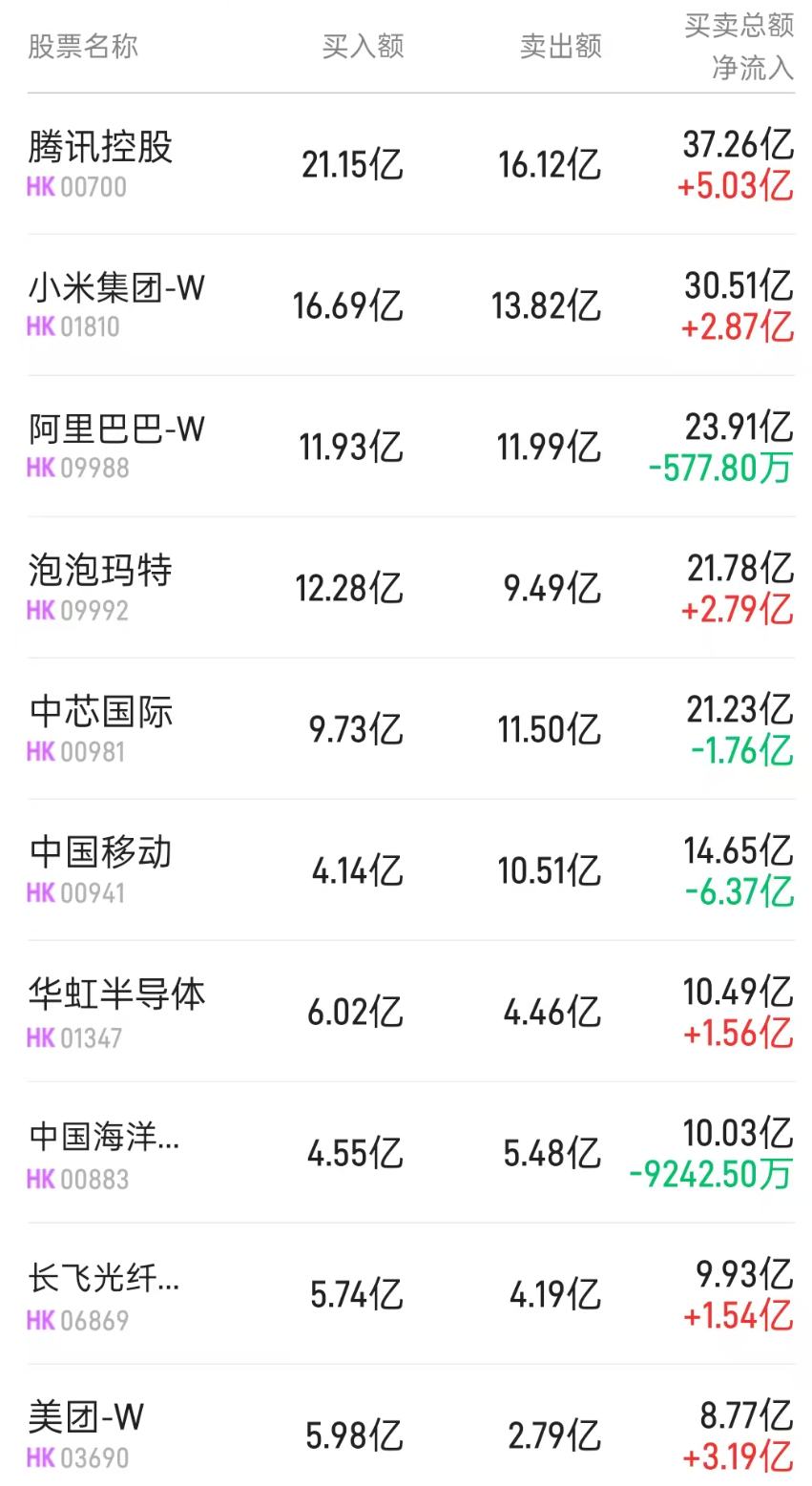
Core Insights - On January 20, 2026, Tencent Holdings (00700), Xiaomi Group-W (01810), and Alibaba-W (09988) were the top three companies by trading volume in the Southbound Stock Connect, with trading amounts of 3.726 billion, 3.051 billion, and 2.391 billion respectively [1] - In the Shenzhen-Hong Kong Stock Connect, Tencent Holdings (00700), Alibaba-W (09988), and SMIC (00981) led the trading volume, with amounts of 2.662 billion, 2.502 billion, and 1.936 billion respectively [1] Southbound Stock Connect Trading Activity - The top active companies in the Southbound Stock Connect included: - Tencent Holdings (00700) with a trading amount of 3.726 billion and a net buying amount of +0.503 billion [2] - Xiaomi Group-W (01810) with a trading amount of 3.051 billion and a net buying amount of +0.287 billion [2] - Alibaba-W (09988) with a trading amount of 2.391 billion and a net selling amount of -5.778 million [2] - Other notable companies included Pop Mart (09992) and SMIC (00981) with trading amounts of 2.178 billion and 2.123 billion respectively [2] Shenzhen-Hong Kong Stock Connect Trading Activity - The top active companies in the Shenzhen-Hong Kong Stock Connect included: - Tencent Holdings (00700) with a trading amount of 2.662 billion and a net buying amount of +0.160 billion [2] - Alibaba-W (09988) with a trading amount of 2.502 billion and a net buying amount of +7.257 million [2] - SMIC (00981) with a trading amount of 1.936 billion and a net selling amount of -5.420 billion [2] - Other notable companies included Xiaomi Group-W (01810) with a trading amount of 1.603 billion and a net buying amount of +0.108 billion [2]

图解丨南下资金连续10日净买入腾讯,连续12日净卖出中国移动
Ge Long Hui A P P· 2026-01-20 10:07
Group 1 - Southbound funds net bought Hong Kong stocks worth HKD 3.663 billion today [1] - The top net purchases included Tencent Holdings at HKD 663 million, Meituan-W at HKD 573 million, and Xiaomi Group-W at HKD 395 million [1] - Continuous net buying trends were observed for Tencent over 10 days totaling HKD 10.62116 billion and Alibaba over 7 days totaling HKD 4.75655 billion [1] Group 2 - Southbound funds net sold shares of SMIC at HKD 717 million and China Mobile at HKD 637 million [1] - China Mobile has seen continuous net selling for 12 days, amounting to HKD 9.29936 billion [1] - Hua Hong Semiconductor and Xiaomi also experienced net buying trends over multiple days, with Hua Hong totaling HKD 1.33901 billion over 4 days and Xiaomi HKD 1.42914 billion over 3 days [1]
北水动向|北水成交净买入36.63亿 泡泡玛特(09992)时隔两年回购 北水抢筹超3亿港元
智通财经网· 2026-01-20 10:01
Core Viewpoint - The Hong Kong stock market experienced significant net inflows from northbound trading, with a total net buy of HKD 36.63 billion on January 20, 2023, indicating strong investor interest in certain stocks [1]. Group 1: Net Buying and Selling Activities - Tencent (00700) received the highest net buy of HKD 21.15 billion, with a total trading volume of HKD 37.26 billion, reflecting a net inflow of HKD 5.03 billion [2]. - Meituan-W (03690) saw a net buy of HKD 16.69 billion, with a total trading volume of HKD 30.51 billion, resulting in a net inflow of HKD 2.87 billion [2]. - Xiaomi Group-W (01810) had a net buy of HKD 3.95 billion, contributing to the overall positive sentiment in the tech sector [7]. - Conversely, SMIC (00981) faced the largest net sell of HKD 9.73 billion, with a total trading volume of HKD 21.23 billion, indicating a net outflow of HKD 1.76 billion [2]. - China Mobile (00941) also experienced significant net selling, with a net outflow of HKD 6.37 billion [7]. Group 2: Sector Insights and Market Trends - The technology sector, particularly companies like Tencent, Meituan, and Alibaba, is seeing increased investment interest, driven by expectations of growth in AI and cloud computing [4]. - The semiconductor sector showed divergence, with Hua Hong Semiconductor (01347) receiving a net buy of HKD 2.45 billion, while SMIC faced a net sell of HKD 7.17 billion, reflecting varying investor confidence [5]. - The optical fiber and cable industry is experiencing a price recovery, with Longi Optical Fiber (06869) receiving a net buy of HKD 1.54 billion, supported by rising market prices for G.652.D optical fibers [5]. - The mining sector, particularly Zijin Mining (02899) and Luoyang Molybdenum (03993), faced net selling pressures, attributed to changing market sentiments regarding metal demand and supply dynamics [6].


港股20日跌0.29% 收报26487.51点
Xin Hua Wang· 2026-01-20 09:51
Market Overview - The Hang Seng Index fell by 76.39 points, a decrease of 0.29%, closing at 26,487.51 points [1] - The total turnover on the main board was HKD 2,377.66 million [1] - The National Enterprises Index dropped by 39.69 points, closing at 9,094.76 points, a decline of 0.43% [1] - The Hang Seng Tech Index decreased by 66.54 points, closing at 5,683.44 points, a drop of 1.16% [1] Blue-Chip Stocks - Tencent Holdings decreased by 1.48%, closing at HKD 601 [1] - Hong Kong Exchanges and Clearing fell by 1.11%, closing at HKD 427 [1] - China Mobile remained unchanged, closing at HKD 79.3 [1] - HSBC Holdings increased by 1.1%, closing at HKD 128.4 [1] Local Hong Kong Stocks - Cheung Kong Holdings rose by 0.74%, closing at HKD 43.34 [1] - Sun Hung Kai Properties decreased by 0.99%, closing at HKD 110.2 [1] - Henderson Land Development increased by 0.52%, closing at HKD 31.12 [1] Chinese Financial Stocks - Bank of China fell by 0.45%, closing at HKD 4.47 [1] - China Construction Bank decreased by 0.51%, closing at HKD 7.76 [1] - Industrial and Commercial Bank of China dropped by 0.47%, closing at HKD 6.31 [1] - Ping An Insurance rose by 0.88%, closing at HKD 69 [1] - China Life Insurance increased by 4.31%, closing at HKD 33.4 [1] Oil and Petrochemical Stocks - China Petroleum & Chemical Corporation fell by 0.61%, closing at HKD 4.92 [1] - China National Petroleum Corporation decreased by 0.12%, closing at HKD 8.21 [1] - CNOOC Limited dropped by 1.74%, closing at HKD 21.52 [1]