
SMIC(00981)

Search documents
智通港股通持股解析|12月2日
智通财经网· 2025-12-02 00:36
Core Insights - The top three companies by Hong Kong Stock Connect holding ratios are China Telecom (72.69%), Power Assets Holdings (69.90%), and GCL-Poly Energy Holdings (69.11%) [1] - Alibaba (W) saw the largest increase in holding amount over the last five trading days, with an increase of 7.925 billion yuan, followed by Pop Mart with 1.242 billion yuan and China Merchants Bank with 969 million yuan [1] - The largest decreases in holding amounts were observed in the Tracker Fund of Hong Kong (-2.649 billion yuan), Tencent Holdings (-1.534 billion yuan), and Hang Seng China Enterprises Index (-822 million yuan) [2] Group 1: Top Holding Ratios - China Telecom (00728) has a holding of 10.089 billion shares, representing 72.69% [1] - Power Assets Holdings (01635) has a holding of 373 million shares, representing 69.90% [1] - GCL-Poly Energy Holdings (01330) has a holding of 279 million shares, representing 69.11% [1] Group 2: Recent Increases in Holdings - Alibaba (W) (09988) increased its holding amount by 7.925 billion yuan, with a change of 51.1647 million shares [1] - Pop Mart (09992) increased its holding amount by 1.242 billion yuan, with a change of 5.7703 million shares [1] - China Merchants Bank (03968) increased its holding amount by 969 million yuan, with a change of 18.3774 million shares [1] Group 3: Recent Decreases in Holdings - Tracker Fund of Hong Kong (02800) decreased its holding amount by 2.649 billion yuan, with a change of -101.111 million shares [2] - Tencent Holdings (00700) decreased its holding amount by 1.534 billion yuan, with a change of -2.476 million shares [2] - Hang Seng China Enterprises Index (02828) decreased its holding amount by 822 million yuan, with a change of -8.7834 million shares [2]



港股通12月1日成交活跃股名单
Zheng Quan Shi Bao Wang· 2025-12-01 13:52
Core Viewpoint - The Hang Seng Index rose by 0.67% on December 1, with southbound capital recording a total transaction amount of HKD 85.91 billion, resulting in a net inflow of HKD 2.15 billion [1][2] Southbound Capital Activity - Total transaction amount for southbound capital was HKD 85.91 billion, with buy transactions at HKD 44.03 billion and sell transactions at HKD 41.88 billion, leading to a net buy of HKD 2.15 billion [1] - Breakdown of transactions shows that the Shenzhen Stock Connect had a total transaction amount of HKD 31.81 billion, with net buying of HKD 2.91 billion, while the Shanghai Stock Connect had a total transaction amount of HKD 54.10 billion, resulting in a net sell of HKD 0.76 billion [1] Active Stocks - Alibaba-W was the most actively traded stock with a total transaction amount of HKD 11.07 billion and a net buy of HKD 1.32 billion, closing up by 2.24% [1][2] - Other notable stocks included Meituan-W and Xiaomi Group-W, with transaction amounts of HKD 4.50 billion and HKD 4.17 billion, respectively [1][2] - Net buying was observed in 8 stocks, with Alibaba-W leading at HKD 1.32 billion, followed by ZTE Corporation at HKD 0.61 billion and Meituan-W at HKD 0.60 billion [1][2] Continuous Net Buying and Selling - Alibaba-W, Pop Mart, and Meituan-W have seen continuous net buying for over three days, with Alibaba-W leading at a total net buy of HKD 27.87 billion [2] - Conversely, SMIC and Zijin Mining experienced continuous net selling, with total net sells of HKD 24.96 billion and HKD 7.35 billion, respectively [2]
资金动向 | 再加仓!北水抢筹阿里超13亿港元,连续8日减持中芯国际
Ge Long Hui· 2025-12-01 11:19
Group 1: Southbound Capital Inflows - Southbound capital recorded a net purchase of HKD 2.148 billion on December 1, with notable net buys in Alibaba-W (HKD 1.321 billion), ZTE Corporation (HKD 606 million), Meituan-W (HKD 594 million), Jiangxi Copper (HKD 137 million), and Xiaomi Group-W (HKD 100 million) [1] - Continuous buying trends were observed, with Alibaba seeing net purchases for 13 consecutive days totaling HKD 27.86542 billion, and Meituan for 3 days totaling HKD 1.39023 billion [3] Group 2: Company Developments - Alibaba-W launched the Quark AI glasses, offering two series with six models, and a Morgan Stanley report indicated increased B-end interest in Qianwen and Alibaba Cloud, predicting Qianwen to surpass DeepSeek in three years [4] - Xiaomi Group-W announced the upcoming "on-site vehicle selection" for its cars, allowing users to prioritize orders for available models, with all vehicles undergoing strict quality checks and offering full factory warranties [4] - Jiangxi Copper announced two non-binding cash offers to acquire Solgold, which were rejected, and the company must issue a formal offer or abandon the acquisition by December 26 [4] - ZTE Corporation introduced a limited release of the Nubia M153 smartphone featuring the Doubao mobile assistant technology, with ByteDance leading the AI integration [5] - Semiconductor Manufacturing International Corporation (SMIC) faced a terminated acquisition of its subsidiary, SMIC Ningbo, as per a recent announcement [6]

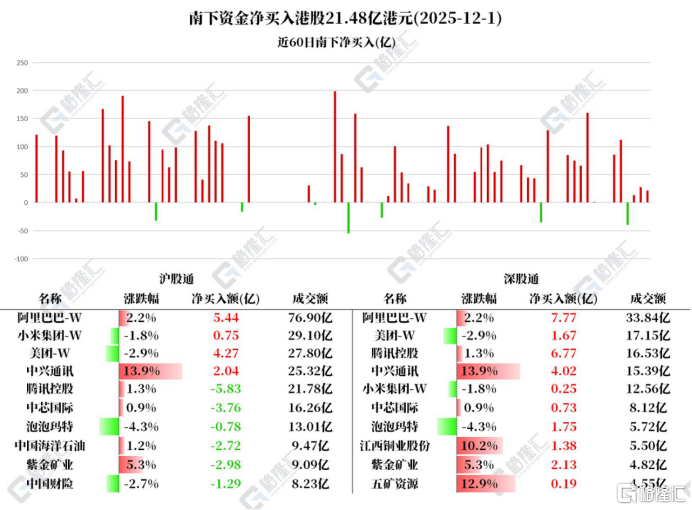
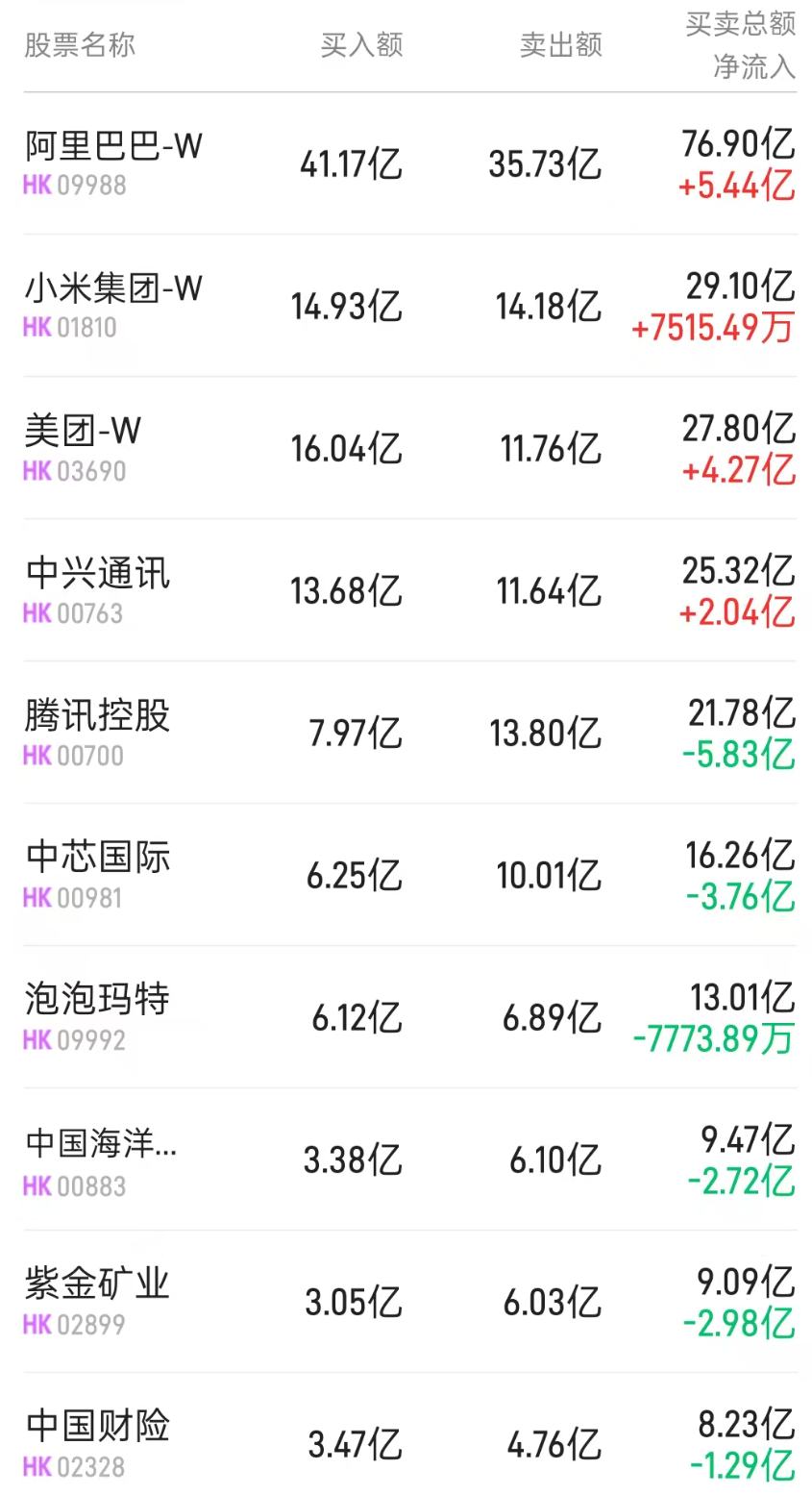
智通港股通活跃成交|12月1日





智通财经网· 2025-12-01 11:05
Group 1 - On December 1, 2025, Alibaba-W (09988), Xiaomi Group-W (01810), and Meituan-W (03690) ranked as the top three companies by trading volume in the Southbound Stock Connect, with trading amounts of 76.90 billion, 29.10 billion, and 27.80 billion respectively [1][2] - In the Shenzhen-Hong Kong Stock Connect, Alibaba-W (09988), Meituan-W (03690), and Tencent Holdings (00700) were the top three companies by trading volume, with amounts of 33.84 billion, 17.15 billion, and 16.53 billion respectively [1][2] Group 2 - The top active companies in the Southbound Stock Connect included Alibaba-W (09988) with a net buy of 5.44 billion, Meituan-W (03690) with a net buy of 4.27 billion, and Xiaomi Group-W (01810) with a net buy of 75.15 million [2] - In the Shenzhen-Hong Kong Stock Connect, Alibaba-W (09988) had a net buy of 7.77 billion, Meituan-W (03690) had a net buy of 1.67 billion, and Tencent Holdings (00700) had a net buy of 6.77 billion [2]
中芯国际(688981) - 港股公告:翌日披露报表
2025-12-01 10:30
FF305 翌日披露報表 (股份發行人 ── 已發行股份或庫存股份變動、股份購回及/或在場内出售庫存股份) 表格類別: 股票 狀態: 新提交 公司名稱: 中芯國際集成電路製造有限公司 呈交日期: 2025年12月1日 第 1 頁 共 6 頁 v 1.3.0 | 2). 就根據股份計劃授予參與人(發行人的董事除外)的股份獎勵或期權 | | | 13,382 | 0.00017 % | HKD | 0.031 | | | --- | --- | --- | --- | --- | --- | --- | --- | | 而發行新股或轉讓庫存股份 - 涉及新股 | | | | | | | | | 非本公司董事因行使根據2014以股支薪獎勵計劃(於2013年6月13日 | | | | | | | | | 獲採納)所授予的受限制股份单位而發行的普通股股份 | | | | | | | | | 變動日期 | 2025年12月1日 | | | | | | | | 於下列日期結束時的結存 (註5及6) | | 2025年12月1日 | 6,000,721,923 | | 0 | | 6,000,721,923 | | B. 贖 ...
中芯国际(00981)因行使限制性股票单位而发行9.42万股
智通财经网· 2025-12-01 10:18
Core Viewpoint - Semiconductor Manufacturing International Corporation (SMIC) announced the issuance of 94,200 ordinary shares due to the exercise of restricted stock units granted under the 2024 Share Award Plan, adopted on June 28, 2023, and 13,400 ordinary shares under the 2014 Share-Based Payment Award Plan, adopted on June 13, 2013 [1] Summary by Categories - **Share Issuance Details** - 94,200 ordinary shares will be issued as a result of the exercise of restricted stock units under the 2024 Share Award Plan [1] - 13,400 ordinary shares will be issued due to the exercise of restricted stock units under the 2014 Share-Based Payment Award Plan [1]
中芯国际(00981) - 翌日披露报表
2025-12-01 10:08
FF305 翌日披露報表 (股份發行人 ── 已發行股份或庫存股份變動、股份購回及/或在場内出售庫存股份) 表格類別: 股票 狀態: 新提交 公司名稱: 中芯國際集成電路製造有限公司 呈交日期: 2025年12月1日 如上市發行人的已發行股份或庫存股份出現變動而須根據《香港聯合交易所有限公司(「香港聯交所」)證券上市規則》(「《主板上市規則》」)第13.25A條 / 《香港聯合交易所有限公司GEM證券 上市規則》(「《GEM上市規則》」)第17.27A條作出披露,必須填妥第一章節 。 | 第一章節 | | | | | | | | --- | --- | --- | --- | --- | --- | --- | | 1. 股份分類 | 普通股 | 股份類別 不適用 | | 於香港聯交所上市 | 是 | | | 證券代號 (如上市) | 00981 | 說明 港股 | | | | | | A. 已發行股份或庫存股份變動 | | | | | | | | | | 已發行股份(不包括庫存股份)變動 | | 庫存股份變動 | 每股發行/出售價 (註4) | 已發行股份總數 | | 事件 | | 已發行股份(不包括庫存股 ...
北水动向|北水成交净买入21.48亿 豆包携手中兴推出首款AI手机 北水抢筹中兴通讯(00763)超6亿港元
智通财经网· 2025-12-01 10:05
Summary of Key Points Core Viewpoint - The Hong Kong stock market experienced significant net inflows from northbound trading, with a total net buy of 21.48 billion HKD on December 1, 2023, indicating strong investor interest in certain stocks while others faced net sell-offs [1]. Group 1: Northbound Trading Activity - Northbound trading saw a net buy of 29.13 billion HKD through the Shenzhen Stock Connect and a net sell of 7.65 billion HKD through the Shanghai Stock Connect [1]. - The most bought stocks included Alibaba-W (09988), ZTE Corporation (00763), and Meituan-W (03690) [1]. - The most sold stocks were SMIC (00981), CNOOC (00883), and China Pacific Insurance (02328) [1]. Group 2: Individual Stock Performance - Alibaba-W (09988) had a net buy of 13.21 billion HKD, driven by the launch of Quark AI glasses and increased interest in Alibaba Cloud [4]. - ZTE Corporation (00763) saw a net buy of 6.06 billion HKD, with news of the Nubia M153 smartphone featuring the Doubao assistant technology [5]. - Meituan-W (03690) received a net buy of 5.94 billion HKD, reflecting positive market sentiment [6]. - Xiaomi Group-W (01810) had a net buy of 1 billion HKD, indicating stable investor confidence [6]. - CNOOC (00883) faced a net sell of 2.72 billion HKD, suggesting negative market sentiment [6]. - China Pacific Insurance (02328) experienced a net sell of 1.29 billion HKD amid rumors regarding its leadership [6]. - SMIC (00981) had a net sell of 3.02 billion HKD following the termination of an asset acquisition plan [6].

中芯国际涨0.70%,成交额37.25亿元,后市是否有机会?
Xin Lang Cai Jing· 2025-12-01 07:26
Core Viewpoint - SMIC (Semiconductor Manufacturing International Corporation) is experiencing a positive market response, with a slight increase in stock price and significant trading volume, indicating investor interest and confidence in the company's growth potential [1]. Group 1: Company Overview - SMIC is the largest integrated circuit manufacturing enterprise in mainland China, recognized for its advanced technology and comprehensive support [3]. - The company specializes in wafer foundry services across various technology nodes, providing design services, IP support, and photomask manufacturing [3]. - As of September 30, 2025, SMIC reported a revenue of 49.51 billion yuan, reflecting a year-on-year growth of 18.22%, and a net profit of 3.82 billion yuan, up 41.09% from the previous year [7]. Group 2: Investment and Shareholding - The National Integrated Circuit Industry Investment Fund holds a 1.61% stake in SMIC, indicating institutional support [2]. - As of September 30, 2025, the number of shareholders in SMIC increased to 336,200, with an average of 6,134 shares held per shareholder, showing growing retail investor interest [7]. - Major institutional shareholders include various ETFs, with notable reductions in holdings from some funds, while new entries have been observed [8]. Group 3: Market Performance - On December 1, SMIC's stock price increased by 0.70%, with a trading volume of 3.725 billion yuan and a market capitalization of 915.22 billion yuan [1]. - The stock's average trading cost is reported at 122.64 yuan, with the current price approaching a resistance level of 119.22 yuan, suggesting potential for upward movement if this level is surpassed [6].
中芯国际11月28日获融资买入4.18亿元,融资余额132.69亿元
Xin Lang Cai Jing· 2025-12-01 06:17
Core Viewpoint - SMIC's stock performance shows a slight increase, with significant trading activity and a notable balance in margin trading, indicating investor interest and market dynamics [1][2]. Group 1: Stock Performance and Trading Activity - On November 28, SMIC's stock rose by 0.79%, with a trading volume of 3.487 billion yuan [1]. - The margin trading data for the same day indicates a financing purchase of 418 million yuan and a repayment of 488 million yuan, resulting in a net financing outflow of 69.965 million yuan [1]. - As of November 28, the total margin trading balance for SMIC reached 13.291 billion yuan, with the financing balance accounting for 5.84% of the circulating market value, which is above the 80th percentile of the past year [1]. Group 2: Shareholder and Financial Performance - As of September 30, the number of shareholders for SMIC increased to 336,200, a rise of 33.27%, while the average circulating shares per person decreased by 25.41% to 6,134 shares [2]. - For the period from January to September 2025, SMIC reported a revenue of 49.51 billion yuan, reflecting a year-on-year growth of 18.22%, and a net profit attributable to shareholders of 3.818 billion yuan, up 41.09% year-on-year [2]. - The top ten circulating shareholders include several ETFs, with notable reductions in holdings for some, while new entries were observed for others, indicating shifts in institutional investment [2].