
SMIC(00981)

Search documents
智通港股通持股解析|12月1日



智通财经网· 2025-12-01 00:32
智通财经APP获悉,根据2025年11月28日披露数据,中国电信(00728)、绿色动力环保(01330)、大 眾公用(01635)位居港股通持股比例前3位,分别为72.72%、69.20%、68.60%。此外,万国黄金集团 (03939)、阿里巴巴-W(09988)、快手-W(01024)在最近有统计数据的5个交易日内,持股额增 幅最大,分别为+119.66亿元、+108.43亿元、+12.76亿元;盈富基金(02800)、中芯国际(00981)、恆 生中国企业(02828)在最近有统计数据的5个交易日内,持股额减幅最大,分别为-26.36亿元、-15.15 亿元、-8.09亿元。 具体数据如下(交易所数据根据T+2日结算): 1、港股通最新持股比例排行(前20名) | 公司名称 | 持股额变动 | 持股数变动 | | --- | --- | --- | | 万国黄金集团(03939) | +119.66亿元 | +37582.04万股 | | 阿里巴巴-W(09988) | +108.43亿元 | +7157.37万股 | | 快手-W(01024) | +12.76亿元 | +1881.69万股 | | ...
智通港股通资金流向统计(T+2)|12月1日
智通财经网· 2025-11-30 23:32
Core Insights - The top three stocks with net inflows are Alibaba-W (09988) with 1.522 billion, Pop Mart (09992) with 385 million, and China Merchants Bank (03968) with 330 million [1] - The top three stocks with net outflows are the Tracker Fund of Hong Kong (02800) with -2.261 billion, Tencent Holdings (00700) with -1.182 billion, and Hang Seng China Enterprises (02828) with -833 million [1] - In terms of net inflow ratios, China National Freight (00598) leads with 73.90%, followed by Southern Eastern Select (03441) with 64.44%, and COSCO Shipping Ports (01199) with 60.69% [1] - The stocks with the highest net outflow ratios include Ruian Real Estate (00272) at -64.09%, CNOOC Services (02883) at -62.56%, and Haitian International (01882) at -55.09% [1] Net Inflow Rankings - The top ten stocks by net inflow include: - Alibaba-W (09988): 1.522 billion, 8.82% [2] - Pop Mart (09992): 385 million, 19.66% [2] - China Merchants Bank (03968): 330 million, 32.52% [2] - CSPC Pharmaceutical Group (01093): 241 million, 20.20% [2] - Vanke Enterprises (02202): 196 million, 35.18% [2] - Yangtze Optical Fibre and Cable (06869): 180 million, 11.11% [2] - China Life Insurance (02628): 168 million, 15.04% [2] - UBTECH Robotics (09880): 148 million, 21.68% [2] - Bilibili-W (09626): 135 million, 20.46% [2] - Lion Group (02562): 132 million, 17.89% [2] Net Outflow Rankings - The top ten stocks by net outflow include: - Tracker Fund of Hong Kong (02800): -2.261 billion, -16.10% [2] - Tencent Holdings (00700): -1.182 billion, -13.16% [2] - Hang Seng China Enterprises (02828): -833 million, -10.01% [2] - Meituan-W (03690): -365 million, -2.74% [2] - China Mobile (00941): -268 million, -23.21% [2] - SMIC (00981): -255 million, -7.67% [2] - Hua Hong Semiconductor (01347): -227 million, -10.96% [2] - China Hongqiao Group (01378): -196 million, -18.31% [2] - BYD Company (01211): -153 million, -5.55% [2] - HSBC Holdings (00005): -153 million, -14.03% [2] Net Inflow Ratios - The top stocks by net inflow ratio include: - China National Freight (00598): 73.90%, 13.0298 million [3] - Southern Eastern Select (03441): 64.44%, 3.7299 million [3] - COSCO Shipping Ports (01199): 60.69%, 11.5153 million [3] - Qingdao Bank (03866): 54.25%, 11.6628 million [3] - China Power (02380): 51.21%, 15.0679 million [3] - Tanwan (09890): 47.54%, 2.8146 million [3] - Power Development (01277): 47.25%, 9.1556 million [3] - Shougang Resources (00639): 45.84%, 15.6165 million [3] - Dashi Holdings (01405): 44.46%, 5.6236 million [3] - Qingdao Port (06198): 44.08%, 2.5357 million [3] Net Outflow Ratios - The top stocks by net outflow ratio include: - Ruian Real Estate (00272): -64.09%, -1.9067 million [3] - CNOOC Services (02883): -62.56%, -56.8889 million [3] - Haitian International (01882): -55.09%, -10.1836 million [3] - Hong Kong and China Gas (00003): -54.67%, -129 million [3] - Angelalign Technology (06699): -48.57%, -34.5458 million [3] - Anhui Wanshan Expressway (00995): -46.19%, -22.9518 million [3] - 361 Degrees (01361): -42.89%, -3.5273 million [3] - Greentown Management Holdings (09979): -42.86%, -5.2056 million [3] - Weigao Group (01066): -42.55%, -44.5428 million [3] - Fenbi (02469): -41.23%, -14.4094 million [3]





中芯国际终止出售宁波晶圆厂!
Sou Hu Cai Jing· 2025-11-30 05:06
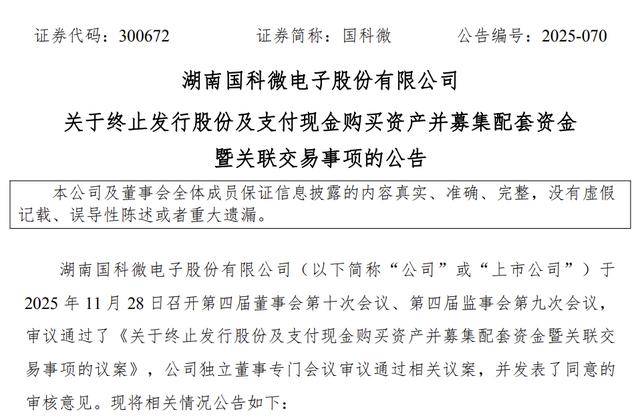
Core Viewpoint - The acquisition of Zhongxin Ningbo by Guoke Micro has been terminated due to the inability to reach consensus on related matters within the expected timeframe, prioritizing the long-term interests of the company and its investors [1][6]. Group 1: Announcement of Termination - Guoke Micro announced the termination of the acquisition of Zhongxin Ningbo on November 28, following the approval of the board and supervisory committee [1][5]. - The termination was formalized through a signed agreement with relevant parties, including Zhongxin International's wholly-owned subsidiary [5]. Group 2: Background of the Acquisition - The acquisition plan was initially announced on June 5, where Guoke Micro intended to purchase 94.366% of Zhongxin Ningbo's shares through a combination of stock issuance and cash payment [4]. - Guoke Micro had issued multiple progress announcements regarding the acquisition from July to October [4]. Group 3: Reasons for Termination - The termination was attributed to the inability to reach agreement on various aspects of the transaction despite efforts from all parties involved [6]. - The decision was made after thorough communication and consideration, emphasizing a cautious approach to protect the interests of the company and its investors [6]. Group 4: Expert Opinions - Experts had previously expressed skepticism about the acquisition, noting the lack of synergy between Guoke Micro, a fabless chip design company, and Zhongxin Ningbo, a foundry specializing in RF devices and MEMS [7]. - The differing focuses of the two companies raised concerns about the limited collaborative potential between digital chip design and analog chip foundry services [7].

中芯国际取得基于OLED显示的半导体器件结构、形成方法和显示器件专利
Sou Hu Cai Jing· 2025-11-29 09:25
Core Points - Semiconductor companies SMIC Beijing and SMIC Shanghai have obtained a patent for "semiconductor device structure, formation method, and display device based on OLED display" with the announcement number CN119698187B, applied on September 2023 [1] Company Overview - SMIC Beijing, established in 2002, is located in Beijing and primarily engages in the manufacturing of computers, communications, and other electronic devices, with a registered capital of 100 million USD. The company has made one external investment, participated in 53 bidding projects, holds 5000 patent records, and possesses 225 administrative licenses [1] - SMIC Shanghai, founded in 2000, is based in Shanghai and also focuses on the manufacturing of computers, communications, and other electronic devices, with a registered capital of 244 million USD. The company has made four external investments, participated in 127 bidding projects, has 150 trademark records, holds 5000 patent records, and possesses 446 administrative licenses [1]
陆家嘴财经早餐2025年11月29日星期六
Wind万得· 2025-11-28 22:38
Group 1 - Wentech Technology issued an official statement urging Anshi Netherlands to stop spreading misinformation and to address the core issues regarding the supply chain chaos and related disputes [2] - Vanke bonds experienced significant volatility, with "23 Vanke 01" closing down over 58%, while "22 Vanke 06" and "22 Vanke 04" both fell over 40% [2] Group 2 - The National Development and Reform Commission held a meeting to discuss the high-quality development of the service industry during the 14th Five-Year Plan, emphasizing the need for enterprises to strengthen their main businesses and expand effective investment [3] - The Ministry of Finance reported that from January to October, state-owned enterprises generated total revenue of 6,835.293 billion yuan, a year-on-year increase of 0.9%, while total profit decreased by 3.0% [3] - In October, China's international balance of payments for goods and services showed an export of 341.6 billion USD and an import of 262.5 billion USD, resulting in a surplus of 79.2 billion USD [3] Group 3 - The China Securities Regulatory Commission is seeking public opinion on the implementation measures for the supervision of the securities and futures market, outlining common regulatory actions [5] - The CSRC announced a pilot program for commercial real estate investment trusts, detailing product definitions and operational requirements [5] - The A-share market saw a low opening but closed higher, with the Shanghai Composite Index rising 0.34% [5] Group 4 - The Hong Kong Hang Seng Index experienced slight fluctuations, closing down 0.34%, while the Hang Seng Technology Index rose slightly [6] - The Shanghai Stock Exchange took self-regulatory measures against 80 cases of abnormal trading behavior, focusing on stocks with significant volatility [7] - Meituan reported a revenue of 95.5 billion yuan for Q3 2025, a year-on-year increase of 2%, but faced a loss of 14.1 billion yuan due to intensified industry competition [7] Group 5 - The Ministry of Industry and Information Technology held a meeting to address irrational competition in the power and energy battery industry and initiated a commercial trial for satellite IoT services [9] - The National Energy Administration is promoting the integration of artificial intelligence in the energy sector to enhance intelligent development [9] Group 6 - The China Logistics and Purchasing Federation reported that from January to October, the total social logistics volume reached 293.7 trillion yuan, a year-on-year increase of 5.1% [10] - The China Index Academy reported that the total land acquisition amount for the top 100 real estate companies from January to November was 847.8 billion yuan, a year-on-year increase of 14.1% [10] Group 7 - The U.S. stock market saw all three major indices rise, with the Dow Jones up 0.61% and the S&P 500 up 0.54%, marking five consecutive days of gains [20] - European stock indices also saw slight increases, with the German DAX rising 0.29% [20] Group 8 - The domestic bond market showed signs of recovery, with government bond yields generally declining [22] - U.S. Treasury yields collectively rose, with the 10-year yield increasing by 2.3 basis points [22] Group 9 - The Chicago Mercantile Exchange experienced a global derivatives trading interruption due to a cooling system failure, affecting multiple markets [23] - The Shanghai Futures Exchange announced adjustments to position limits for certain futures contracts starting January 1, 2026 [24]


中芯国际(688981.SH):终止出售参股公司中芯宁波股权
Ge Long Hui· 2025-11-28 20:03
Core Viewpoint - SMIC announced the termination of the asset purchase agreement, indicating challenges in reaching consensus among the parties involved [1] Group 1 - On November 28, 2025, the parties involved signed a termination agreement for the asset purchase agreement [1] - Following the termination, SMIC Holdings retains a 14.832% stake in SMIC Ningbo [1] - The parties had been actively working towards the transaction since its announcement, but were unable to reach an agreement within the expected timeframe [1]
11月28日南向资金净买入27.27亿港元
Zheng Quan Shi Bao Wang· 2025-11-28 15:33
Market Overview - On November 28, the Hang Seng Index fell by 0.34%, closing at 25,858.89 points, with a total net inflow of southbound funds through the Stock Connect amounting to HKD 2.727 billion [1][3] - The total trading volume for the Stock Connect on the same day was HKD 60.238 billion, with a net buy of HKD 2.727 billion [1][3] Stock Performance - In the Shanghai Stock Connect, the total trading volume was HKD 37.898 billion, with a net buy of HKD 0.933 billion; in the Shenzhen Stock Connect, the trading volume was HKD 22.339 billion, with a net buy of HKD 1.794 billion [1][3] - The most actively traded stock in the Shanghai Stock Connect was Alibaba-W, with a trading volume of HKD 4.408 billion and a net buy of HKD 0.800 billion, closing up by 0.60% [1][2] - Tencent Holdings and Pop Mart were also among the top traded stocks, with trading volumes of HKD 1.528 billion and HKD 1.305 billion, respectively [1][2] Net Buy/Sell Analysis - In the Shenzhen Stock Connect, Tencent Holdings had the highest net buy amount of HKD 0.435 billion, while the stock closed flat [2] - The stock with the highest net sell amount was SMIC, with a net sell of HKD 0.162 billion, while its stock price increased by 0.66% [2]


【公告精选】天风证券被中国证监会立案;中芯国际终止出售中芯宁波股权;寒武纪选举陈天石为董事长
Sou Hu Cai Jing· 2025-11-28 15:25
Group 1 - Guizhou Moutai elected Chen Hua as the chairman of the fourth board of directors [4] - Tianfeng Securities is under investigation by the China Securities Regulatory Commission for suspected violations of information disclosure and illegal financing [4] - Yongtai Energy's actual controller Wang Guangxi received a notice of investigation from the China Securities Regulatory Commission for matters unrelated to the company [4] Group 2 - Shenzhou Pharmaceutical's controlling shareholder plans to reduce its stake by no more than 3% [4] - Zhenhua Group intends to increase its stake in China Jushi by 550 million to 1.1 billion yuan [4] - Jihong Co., Ltd. and its concerted parties plan to reduce their stake by no more than 2.93% [4] Group 3 - XJ Electric won a 1.518 billion yuan procurement project from the State Grid [4] - China XD Electric's subsidiaries collectively won procurement projects from the State Grid worth approximately 2.98 billion yuan [4] - Chaozhuo Aerospace's actual controller will change to the Hubei Provincial State-owned Assets Supervision and Administration Commission, with stock resuming trading on December 1 [4] Group 4 - Huakong Saige terminated its specific object stock issuance [5] - Shenzhen Energy plans to apply for a public bond issuance with a total scale not exceeding 20 billion yuan [5] Group 5 - Blue Sail Medical's board proposed to lower the conversion price of "Blue Sail Convertible Bonds" [6] - ST Lifang's stock will be subject to delisting risk warning and will be suspended from trading on December 1 [7] - Cambrian elected Chen Tianshi as chairman [8]




中芯国际根据2024年股份奖励计划而发行1.72万股
Zhi Tong Cai Jing· 2025-11-28 14:54
Core Viewpoint - Semiconductor Manufacturing International Corporation (SMIC) announced the issuance of 17,200 ordinary shares on November 28, 2025, due to the exercise of restricted stock units granted under the 2024 Share Award Plan adopted on June 28, 2023 [1] Group 1 - The company will issue a total of 17,200 ordinary shares [1] - The shares are being issued as a result of the exercise of restricted stock units [1] - The 2024 Share Award Plan was adopted on June 28, 2023 [1]
港股开盘丨恒指涨0.25% 中芯国际涨近2%
Di Yi Cai Jing· 2025-11-28 13:52
Core Viewpoint - The Hang Seng Index increased by 0.25%, while the Hang Seng Tech Index rose by 0.43%, indicating a positive market sentiment in the technology sector [1] Group 1: Market Performance - The Hang Seng Index experienced a rise of 0.25% [1] - The Hang Seng Tech Index saw an increase of 0.43% [1] Group 2: Stock Movements - Semiconductor stocks opened higher, with SMIC rising nearly 2% and Hua Hong Semiconductor increasing by nearly 1% [1] - New stock Haiwei Co. opened down over 5% [1]