SMIC(00981)

Search documents
港股半导体板块持续拉升,中芯国际涨超5%
Mei Ri Jing Ji Xin Wen· 2025-11-06 03:12
Core Viewpoint - The semiconductor sector in Hong Kong is experiencing a significant rally, with notable increases in stock prices for key companies [1] Company Summaries - SMIC (中芯国际) has seen its stock price rise by over 5% [1] - Hua Hong Semiconductor (华虹半导体) has increased by nearly 5% [1] - Shanghai Fudan (上海复旦) has experienced a stock price increase of nearly 3% [1]

港股半导体板块持续拉升,中芯国际涨超5%,华虹半导体涨近5%,上海复旦涨近3%。
Xin Lang Cai Jing· 2025-11-06 03:08
Core Viewpoint - The semiconductor sector in Hong Kong is experiencing a significant rally, with notable increases in stock prices for key companies [1] Company Summaries - SMIC (中芯国际) has seen its stock price rise by over 5% [1] - Hua Hong Semiconductor (华虹半导体) has increased by nearly 5% [1] - Shanghai Fudan (上海复旦) has experienced a rise of nearly 3% [1]
港股异动 | AI及自主可控持续推进 中芯国际(00981)涨超5% 华虹半导体(01347)涨近4%
智通财经网· 2025-11-06 03:07
Group 1 - Semiconductor stocks experienced a rise in early trading, with notable increases in shares of SMIC (5.09% to HKD 75.35), Hua Hong Semiconductor (3.88% to HKD 76.3), and Shanghai Fudan (2.73% to HKD 40.58) [1] - According to Guosen Securities, over half of the 146 A-share semiconductor companies, including SMIC and Hua Hong, are expected to achieve record quarterly revenues by 2025, driven by AI and self-sufficiency initiatives [1] - The report highlights the growth of domestic chip design companies and the trend towards high-end domestic chips, recommending companies like SMIC and Hua Hong Semiconductor as beneficiaries of this trend [1] Group 2 - Industrial outlook for 2026 indicates a convergence of "price cycle" and "product iteration cycle" in the storage sector, with capital expenditures expected to exceed previous forecasts, leading to sustained growth in equipment orders [1] - The long-term impact of the AI wave suggests that domestic replacements for computing power and high-performance storage will require significant time and investment, but there is optimism regarding capital expenditures for advanced domestic processes [1] - The industry is expected to maintain high levels of capital expenditure, with a strong outlook for domestic substitution trends in semiconductor wafer manufacturing, equipment, materials, and components [1]
港股拉升!恒生科技指数上涨1%至5,844.29点,中芯国际涨超3%,阿里巴巴、海尔智家、华虹半导体涨超2%
Ge Long Hui· 2025-11-06 02:38
格隆汇11月6日|恒生科技指数上涨1%至5,844.29点。中芯国际涨超3%,阿里巴巴、海尔智家、华虹半 导体涨超2%。 ...



港股速报 | 反弹来临港股全线高开 4新股上市3只遭遇破发
Sou Hu Cai Jing· 2025-11-06 02:32
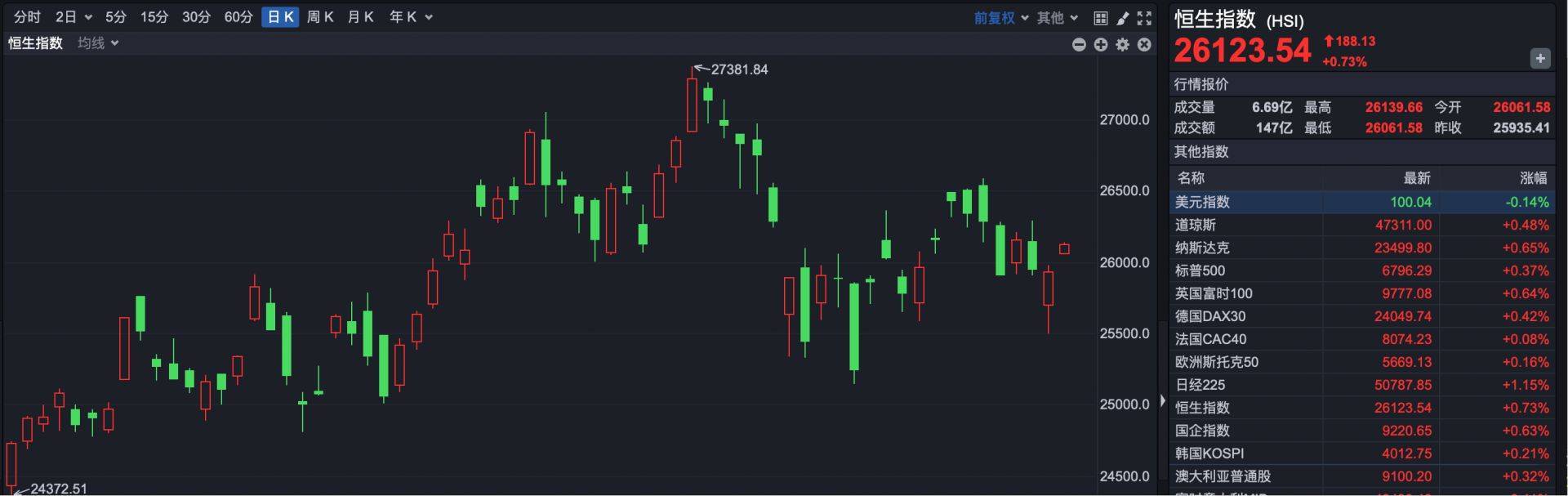
Market Overview - The Hong Kong stock market experienced a rebound, with the Hang Seng Index reaching 26,123 points, up 188 points, or 0.73% [1] - The Hang Seng Technology Index reported 5,825 points, increasing by 39 points, or 0.68% [4] Sector Performance - The semiconductor sector led the market gains, with notable increases: SMIC (00981.HK) up over 3%, Hua Hong Semiconductor (01347.HK) up over 2%, and Shanghai Fudan (01385.HK) up over 1% [3] - The machinery sector also showed strength, with Weichai Power (02338.HK) rising over 11%, China National Heavy Duty Truck Group (03808.HK) up over 5%, and others like CRRC (01766.HK) and Sany Heavy Industry (06031.HK) up over 2% [3] New Listings - Four new stocks were listed on the Hong Kong market today, with Wangshan Wangshui-B (02630.HK) opening nearly 185% higher [3] - Conversely, three other new stocks faced declines, with Xiaoma Zhixing-W (02026.HK) down over 12% and Wenyuan Zhixing-W (00800.HK) also down over 12% [5][6] Investment Trends - There is a noticeable shift in market funding, with capital moving from previously high-performing tech stocks to traditional economic sectors and utility stocks, such as local banks, real estate, and high-dividend stocks like CLP Holdings and MTR Corporation [7] - The market is expected to be influenced by three key variables: the pace of Federal Reserve interest rate cuts, developments in US-China relations, and progress in China's domestic growth policies [7]


港股半导体概念股走高,中芯国际涨超3%
Mei Ri Jing Ji Xin Wen· 2025-11-06 01:54
每经AI快讯,11月6日,港股半导体概念股走高,中芯国际涨超3%,华虹半导体、晶门半导体涨超 2%,上海复旦涨超1%。 ...
半导体板块持续走强 德明利触及涨停
2 1 Shi Ji Jing Ji Bao Dao· 2025-11-06 01:50
Core Viewpoint - The semiconductor sector is experiencing a strong upward trend, with several companies reaching significant gains in their stock prices [1] Company Performance - Deminor has hit the daily limit up in stock price [1] - Haiguang Information has increased by over 5% [1] - Companies such as Cambricon, SMIC, and Huahai Chengke have also seen their stock prices rise [1]


半导体ETF南方(159325)开盘涨1.09%,重仓股中芯国际涨1.77%,寒武纪涨2.82%
Xin Lang Cai Jing· 2025-11-06 01:41
Core Viewpoint - The semiconductor ETF from Southern (159325) opened with a gain of 1.09%, indicating positive market sentiment towards semiconductor stocks [1] Group 1: ETF Performance - The Southern Semiconductor ETF (159325) opened at 1.485 yuan, reflecting a 1.09% increase [1] - Since its inception on October 31, 2024, the fund has achieved a return of 46.53% [1] - The fund has experienced a decline of 9.89% over the past month [1] Group 2: Major Holdings Performance - Key holdings in the ETF include: - SMIC (中芯国际) up by 1.77% [1] - Cambricon (寒武纪) up by 2.82% [1] - Haiguang Information (海光信息) up by 2.25% [1] - Northern Huachuang (北方华创) up by 0.55% [1] - Lattice Semiconductor (澜起科技) up by 1.30% [1] - GigaDevice (兆易创新) up by 2.80% [1] - Zhongwei Company (中微公司) up by 1.42% [1] - OmniVision (豪威集团) up by 0.14% [1] - JCET (长电科技) up by 1.00% [1] - Unisoc (紫光国微) up by 1.14% [1] Group 3: Fund Management - The ETF is managed by Southern Fund Management Co., Ltd. [1] - The fund managers are Zhao Zhuoxiong and He Dianhong [1]


智通港股通持股解析|11月6日
智通财经网· 2025-11-06 00:32
Core Insights - The top three companies by Hong Kong Stock Connect holding ratios are China Telecom (71.27%), COSCO Shipping Energy (70.09%), and GCL-Poly Energy (69.45%) [1][2] - The largest increases in holdings over the last five trading days were seen in the Tracker Fund of Hong Kong (+4.963 billion), Meituan-W (+2.012 billion), and Hang Seng China Enterprises (+1.946 billion) [1][2] - The largest decreases in holdings were recorded for SMIC (-2.028 billion), Tencent Holdings (-1.614 billion), and Hua Hong Semiconductor (-638 million) [1][3] Group 1: Hong Kong Stock Connect Holding Ratios - China Telecom (00728) has a holding of 9.892 billion shares, representing 71.27% [2] - COSCO Shipping Energy (01138) has a holding of 908 million shares, representing 70.09% [2] - GCL-Poly Energy (01330) has a holding of 281 million shares, representing 69.45% [2] - Other notable companies include China Shenhua (67.64%) and Tianjin Capital Environmental Protection (66.54%) [2] Group 2: Recent Increases in Holdings - Tracker Fund of Hong Kong (02800) saw an increase of 4.963 billion in holdings, with a change of 19.059 million shares [2] - Meituan-W (03690) experienced an increase of 2.012 billion, with a change of 1.988 million shares [2] - Hang Seng China Enterprises (02828) had an increase of 1.946 billion, with a change of 2.079 million shares [2] Group 3: Recent Decreases in Holdings - SMIC (00981) had a decrease of 2.028 billion in holdings, with a change of 2.828 million shares [3] - Tencent Holdings (00700) saw a decrease of 1.614 billion, with a change of 256,560 shares [3] - Hua Hong Semiconductor (01347) experienced a decrease of 638 million, with a change of 868,410 shares [3]



智通港股通资金流向统计(T+2)|11月6日
智通财经网· 2025-11-05 23:32
Key Points - Xiaomi Group-W (01810), China National Offshore Oil Corporation (00883), and CanSino Biologics (09926) ranked the top three in net inflow of southbound funds, with net inflows of 1.03 billion, 0.99 billion, and 0.53 billion respectively [1] - Semiconductor Manufacturing International Corporation (00981), Alibaba Group Holding Limited-W (09988), and the Tracker Fund of Hong Kong (02800) ranked the top three in net outflow of southbound funds, with net outflows of -1.38 billion, -0.96 billion, and -0.70 billion respectively [1] - In terms of net inflow ratio, Qingdao Bank (03866), Tsingtao Brewery Group (00168), and Beijing Automotive Group (01958) led the market with ratios of 88.99%, 72.17%, and 65.26% respectively [1] - In terms of net outflow ratio, Boleton (01333), Guangzhou-Shenzhen Railway (00525), and Jin Hui Holdings (09993) had the highest ratios of -46.65%, -42.57%, and -41.08% respectively [1] Top 10 Net Inflow Stocks - Xiaomi Group-W (01810) had a net inflow of 1.03 billion with a net inflow ratio of 10.99% and closed at 44.720, up 3.52% [2] - China National Offshore Oil Corporation (00883) had a net inflow of 0.99 billion with a net inflow ratio of 27.37% and closed at 20.460, up 3.49% [2] - CanSino Biologics (09926) had a net inflow of 0.53 billion with a net inflow ratio of 33.46% and closed at 118.300, up 4.32% [2] Top 10 Net Outflow Stocks - Semiconductor Manufacturing International Corporation (00981) had a net outflow of -1.38 billion with a net outflow ratio of -19.89% and closed at 72.850, down 2.87% [2] - Alibaba Group Holding Limited-W (09988) had a net outflow of -0.96 billion with a net outflow ratio of -7.84% and closed at 163.200, down 1.15% [2] - Tracker Fund of Hong Kong (02800) had a net outflow of -0.70 billion with a net outflow ratio of -5.01% and closed at 26.260, up 0.77% [2] Top 10 Net Inflow Ratios - Qingdao Bank (03866) had a net inflow ratio of 88.99% with a net inflow of 0.215 billion and closed at 4.280, down 0.23% [2] - Tsingtao Brewery Group (00168) had a net inflow ratio of 72.17% with a net inflow of 0.125 billion and closed at 52.250, down 0.48% [2] - Beijing Automotive Group (01958) had a net inflow ratio of 65.26% with a net inflow of 13.59 million and closed at 2.000, down 0.50% [2]