LENOVO GROUP(00992)

Search documents
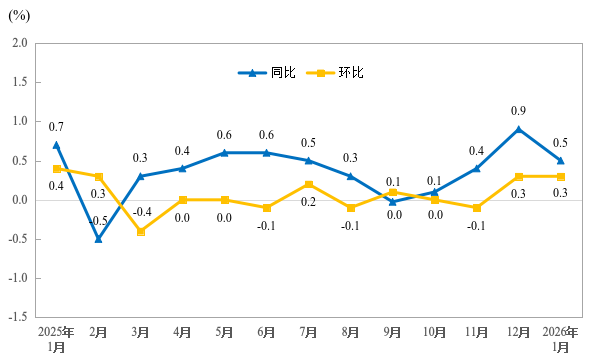
1月份武汉CPI同比上涨0.5%,智能化商品消费需求旺
Chang Jiang Ri Bao· 2026-02-13 00:53
Group 1 - The core viewpoint of the articles highlights the significant price increases in various consumer goods in Wuhan, driven by factors such as AI demand and structural adjustments in supply chains [1][4]. - In January, the price of data storage devices in Wuhan rose by 85.3% year-on-year, reflecting the growing demand from the AI industry [1]. - The Consumer Price Index (CPI) in Wuhan increased by 0.5% year-on-year in January, which is higher than the national increase of 0.2% and the provincial increase of 0.1% [1]. Group 2 - The market for service consumption is active, with customized and deep travel becoming popular, leading to a 4.0% year-on-year increase in semi-self-service travel prices [2]. - Prices for online audio-visual services surged by 16.2% year-on-year, indicating a growing willingness to pay for content [2]. - The price of gasoline at gas stations decreased by 11.8% year-on-year, providing savings for drivers, while the price of electricity for vehicles increased by 7.6% [2]. Group 3 - The price of food items shifted from an increase to a decrease, with fresh vegetable prices still rising but at a reduced rate, and pork prices dropping by 13.4% year-on-year [2]. - The increase in prices for smart products and upgraded services, along with consumption related to new energy, reflects the resilience of urban consumption and industrial transformation [4].



太豪横!影石公司年会送出5套房,员工:获奖房者均90后、无高管;DeepSeek更新后被指变冷淡!网友:快调回来;荣耀前CEO赵明加入千里科技
雷峰网· 2026-02-13 00:27
Key Points - Insta360 held its annual meeting where it awarded five sets of properties and several cars to employees, all of whom were born in the 1990s, emphasizing the importance of material incentives alongside recognition [5][6] - The company reported that 2025 was its highest revenue year, with a significant increase in R&D investment, surpassing the total of the previous three years [6] - DeepSeek's recent update has faced backlash from users who feel the model has become less engaging, despite a significant increase in context window capacity [11][12] - AWS has completed layoffs in its Greater China region, affecting approximately 150 employees, primarily in second-tier departments [14][15] - Zhao Ming, former CEO of Honor, has joined Qianli Technology, focusing on AI business models [16] - BMW announced a global recall of multiple models due to a defect in the starter motor that poses a fire risk [56] - Xiaomi's YU7 became the best-selling car in China for January 2026, with a total of 37,869 units sold, significantly outpacing competitors [35][36] - Chery employees expressed dissatisfaction with the company's strict leave policies during the Spring Festival, which limited vacation days [23] - Great Wall Motors announced that its average year-end bonus for 2025 would exceed 50,000 yuan per employee, with a total bonus pool potentially exceeding 42.45 billion yuan [25][26] - Huawei's new vehicle, the Zun Jie S800, will appear on the CCTV Spring Festival Gala, highlighting its market presence [45]






智通港股沽空统计|2月13日
智通财经网· 2026-02-13 00:21
Group 1 - The core point of the article highlights the short-selling ratios and amounts for various companies, indicating significant market activity and investor sentiment towards these stocks [1][2]. Group 2 - The top three companies by short-selling ratio are China Resources Beer (80291), Great Wall Motor (82333), and JD Health (86618), all at 100.00% [1][2]. - The top three companies by short-selling amount are Meituan (03690) with 1.878 billion, Zijin Mining (02899) with 1.770 billion, and Tencent Holdings (00700) with 1.606 billion [1][2]. - The companies with the highest deviation values in short-selling are Kuaishou (81024) at 36.81%, Zhaojin Mining (01818) at 33.02%, and China Shipbuilding Leasing (03877) at 30.32% [1][2].



Apple, Nvidia And Other 8 Tech Stocks Wipe Out $500 Billion In A Day - NVIDIA (NASDAQ:NVDA), Tesla (NASDAQ:TSLA)
Benzinga· 2026-02-12 19:06
Group 1 - Wall Street's tech sector experienced a significant decline, erasing over $500 billion in market value across 10 major companies, with both software and legacy hardware firms affected [1] - The iShares Expanded Tech-Software Sector ETF (NYSE:IGV) fell more than 3% on Thursday, marking a year-to-date decline of over 20% [2] - Cisco's earnings report was a key catalyst for the broader tech slump, as the company saw an 11% drop in stock price despite reporting earnings of $1.04 per share, exceeding the $1.02 consensus, and revenue of $15.35 billion, above estimates of $15.11 billion [2] Group 2 - Cisco's gross margin guidance for the fiscal third quarter was 65.5%-66.5%, which fell short of the 68% consensus, attributed to a heavier hardware mix and rising commodity costs [3] - Cisco's networking revenue grew 21% year over year, with orders accelerating above 20%, indicating strong demand despite margin pressures [3] - Lenovo, a major player in the tech industry, acknowledged the risk of declining PC shipments due to worsening memory shortages, with the CEO stating the company aims to maintain profitability amid these challenges [4]



联想集团:第三季度营收1575亿元人民币 同比增长18%
Feng Huang Wang· 2026-02-12 16:14
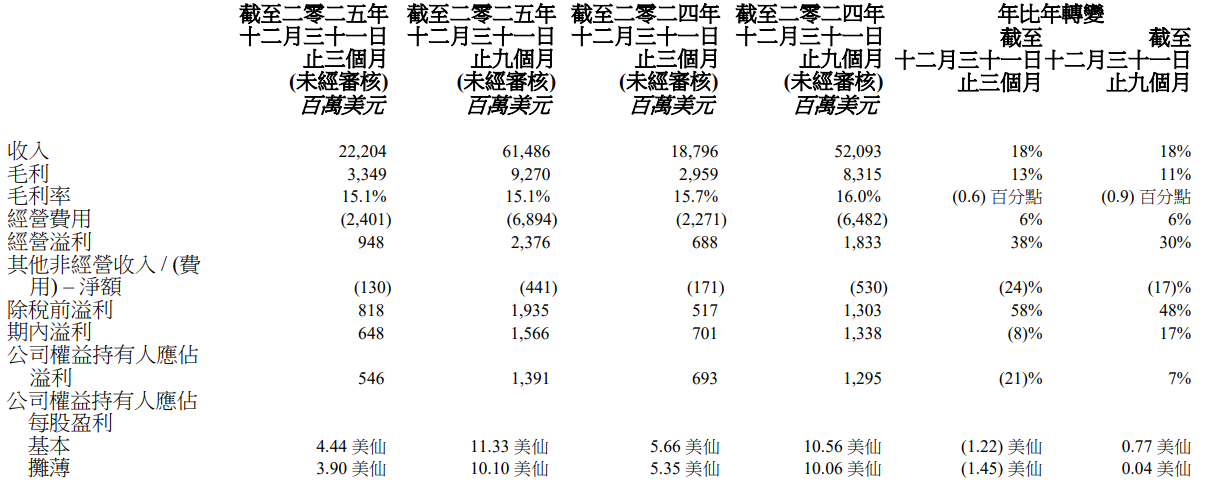
Core Insights - Lenovo Group reported record revenue of 157.5 billion RMB for Q3 of FY 2025/26, representing a year-on-year growth of over 18% and a net profit increase of 36%, which is double the revenue growth rate [1] Group 1: Business Performance - All three major business segments of Lenovo achieved double-digit growth during the quarter [1] - The Intelligent Devices Group (IDG) generated over 110 billion RMB in revenue, with a year-on-year growth of 14.3% and a market share increase to 24.9% in the personal computer segment [1] - The Infrastructure Solutions Group (ISG) reported revenue of 36.7 billion RMB, a 31% year-on-year increase, with AI server revenue experiencing high double-digit growth and an order backlog of 15.5 billion USD [1] - The Solutions and Services Group (SSG) saw an 18% year-on-year revenue growth, maintaining double-digit growth for 19 consecutive quarters, with an operating profit margin of 22.5% [1] Group 2: AI Business Growth - AI-related revenue for Lenovo grew by 72% year-on-year, accounting for 32% of total revenue [1] - Revenue from AI PCs, AI smartphones, AI servers, and AI services all recorded double-digit to triple-digit growth [1] Group 3: Strategic Initiatives - Lenovo launched the super intelligent agent Lenovo Qira and initiated a strategic restructuring of its ISG business, aiming for annual net cost savings of 1.4 billion RMB over the next three years [1] - The Chairman of Lenovo, Yang Yuanqing, emphasized the commitment to advancing a hybrid AI strategy to capitalize on growth opportunities presented by AI [1]
存储价格翻番、CPU跟涨,杨元庆:这时候拼供应、拼成本
第一财经· 2026-02-12 12:17
Core Viewpoint - The article highlights the significant challenges faced by the technology industry, particularly in the context of rising component prices, with storage prices increasing by 40%-50% in the last quarter and potentially doubling in the current quarter. This price surge is expected to impact the prices of PCs and smartphones, leading to a forecasted price increase of 15%-20% across the market [3][5]. Group 1: Financial Performance - Lenovo Group reported a revenue of 157.5 billion RMB for the third quarter of the 2025/26 fiscal year, representing a year-on-year growth of over 18% [5]. - Adjusted net profit reached 4.07 billion RMB, with a year-on-year increase of 36%, indicating that profit growth is outpacing revenue growth [5]. - AI-related revenue surged by 72% year-on-year, accounting for 32% of total revenue, with AI PCs, smartphones, and servers all showing significant growth [5]. Group 2: Business Segments - The IDG (Intelligent Devices Group) segment generated over 110 billion RMB, growing by over 14% year-on-year, despite rising core component costs [5]. - The ISG (Infrastructure Solutions Group) segment reported revenue of 36.7 billion RMB, a 31% increase year-on-year, with AI server business experiencing high double-digit growth [5][6]. - Lenovo's inventory increased to 9.077 billion USD, up from 7.924 billion USD at the end of the previous fiscal year, attributed to business growth and longer delivery cycles for cloud service provider orders [6]. Group 3: Supply Chain and Market Dynamics - The hardware industry is facing extreme tests of efficiency and resilience due to supply chain challenges, particularly driven by the high demand for AI training and memory [8]. - Lenovo's scale across PC, smartphone, and server businesses provides it with strong negotiating power with suppliers, allowing it to secure better costs and supplies [8][9]. - The company has established deep, trust-based relationships with upstream suppliers, ensuring priority access during supply shortages, with significant growth targets set for partnerships, such as with NVIDIA [9]. Group 4: AI and Future Outlook - AI is viewed as a critical growth driver, with the potential for significant value creation in enterprise and personal intelligence through the use of private data [9]. - Lenovo's strategy focuses on "hybrid AI," emphasizing the importance of data, computing power, and models in driving future market demand for intelligent terminals and AI infrastructure [9].

存储价格翻番、CPU跟涨,杨元庆:这时候拼供应、拼成本
Di Yi Cai Jing Zi Xun· 2026-02-12 11:45
Core Viewpoint - The industry is facing significant challenges due to rising component costs, particularly in storage and CPU prices, which are expected to increase by 40%-50% and potentially double in the upcoming quarter [1] Group 1: Financial Performance - Lenovo's revenue for Q3 of the fiscal year 2025/26 reached 157.5 billion RMB, representing a year-on-year growth of over 18% [2] - Adjusted net profit for the same period was 4.07 billion RMB, with a year-on-year increase of 36%, indicating that profit growth is outpacing revenue growth [2] - AI-related revenue surged by 72% year-on-year, accounting for 32% of total revenue, with AI PCs, smartphones, and servers all showing significant growth [2] Group 2: Business Segments - The IDG (Intelligent Devices Group) segment generated over 110 billion RMB in revenue, growing by more than 14% year-on-year, despite rising core component costs [2] - The ISG (Infrastructure Solutions Group) reported revenue of 36.7 billion RMB, a 31% increase year-on-year, with AI server business experiencing high double-digit growth [2][3] - Motorola's smartphone shipments increased by 9% year-on-year, contributing to the overall growth in the AI device activation rate [2] Group 3: Supply Chain and Inventory - The increase in component costs is expected to raise prices for PCs and smartphones by 15%-20%, potentially leading to flat or slightly declining shipment volumes this year [1] - Lenovo's inventory rose to 9.077 billion USD, up from 7.924 billion USD at the end of the previous fiscal year, attributed to business growth and longer delivery cycles for CSP orders [3] - The company maintains a diversified supply network, allowing for better negotiation power and resource allocation amidst supply chain challenges [5] Group 4: AI and Market Trends - AI is viewed as a critical growth driver, with the company emphasizing the importance of leveraging private data for enterprise and personal intelligence [6] - The ongoing demand for AI infrastructure and smart devices is expected to continue, driven by the irreversible trend towards AI integration in various sectors [6]
联想集团杨元庆:AI没有任何泡沫,是不能停止的大趋势
Xin Lang Cai Jing· 2026-02-12 11:16
联想集团董事长兼CEO杨元庆表示,所谓的"AI过热",可能只是在某个局部区域投资多了些,"但是我 觉得在任何方向的尝试都有价值。AI作为一个整体,没有任何泡沫,只是一个大的趋势,而且是不能 停止的趋势。" 责任编辑:何俊熹 责任编辑:何俊熹 新浪科技讯 2月12日下午消息,联想集团发布FY2025/26 Q3业绩,并举行了媒体沟通会。 新浪科技讯 2月12日下午消息,联想集团发布FY2025/26 Q3业绩,并举行了媒体沟通会。 联想集团董事长兼CEO杨元庆表示,所谓的"AI过热",可能只是在某个局部区域投资多了些,"但是我 觉得在任何方向的尝试都有价值。AI作为一个整体,没有任何泡沫,只是一个大的趋势,而且是不能 停止的趋势。" ...

AI收入同比增长72%,联想集团Q3净利增速达营收两倍
Guang Zhou Ri Bao· 2026-02-12 10:42
Core Viewpoint - Lenovo Group reported strong financial results for the third quarter of the 2025/26 fiscal year, with significant growth across all major business segments, driven by AI-related revenue growth [1][4]. Financial Performance - The total revenue reached 157.5 billion RMB, representing a year-on-year increase of over 18% [1]. - Adjusted net profit grew by 36%, doubling the revenue growth rate [1]. - All three major business segments achieved double-digit growth: - IDG smart devices revenue exceeded 110 billion RMB, up 14.3% year-on-year [1]. - ISG infrastructure solutions revenue reached 36.7 billion RMB, growing over 31% [1]. - SSG solutions and services revenue increased by 18%, marking the 19th consecutive quarter of double-digit growth, with an operating profit margin of 22.5% [1]. AI Business Growth - AI-related revenue surged by 72% year-on-year, accounting for 32% of total revenue [1]. - AI PC revenue experienced high double-digit growth, while AI smartphones and servers saw triple-digit growth [1]. - The AI service revenue also achieved triple-digit growth, indicating a shift towards high-value business structures [1]. Industry Trends - The global AI industry is transitioning from a focus on centralized training to a stage centered on inference, closely aligned with real-world applications [2]. - The industry value is concentrating on "AI super gateway" companies that integrate computing power, terminals, infrastructure, and services [2]. - 2026 is anticipated to be the "year of AI hardware explosion," with significant shifts in computing power distribution and device intelligence [2]. Strategic Initiatives - Lenovo is focusing on personal AI twins and has launched the Lenovo Qira super intelligent agent, marking a significant step in creating a unified AI terminal entry across platforms and devices [3]. - In the enterprise sector, Lenovo is developing enterprise super intelligent agents and has launched the Lenovo xIQ technology platform, enhancing its AI capabilities [3]. - The company is collaborating with NVIDIA on an AI cloud super factory plan and is delivering next-generation GPU servers [3]. Future Outlook - Lenovo's CEO emphasized the importance of integrating AI into daily life and business operations, aiming to leverage mixed AI strategies for sustainable growth and improved profitability [4].
联想集团杨元庆:推动AI的普及普惠,不是大家用豆包、千问和Kimi就可以促成的
Xin Lang Cai Jing· 2026-02-12 10:36
Core Viewpoint - Lenovo Group emphasizes the need for AI to be accessible and beneficial for everyone, rather than relying solely on public AI platforms like OpenAI and others [2][4] Group 1: AI Accessibility - The CEO of Lenovo, Yang Yuanqing, states that promoting AI accessibility is not just about using public AI services [2][4] - He highlights that both individuals and businesses are unlikely to share confidential data and personal privacy for AI intelligence [2][4] Group 2: Data Utilization - Yang points out that AI fundamentally relies on data intelligence, and without providing data, intelligence cannot be obtained [2][4] - To achieve widespread AI adoption, it is essential to integrate suitable models that utilize data effectively and build the necessary infrastructure for computing, storage, and networking [2][4]