AGRICULTURAL BANK OF CHINA(01288)

Search documents
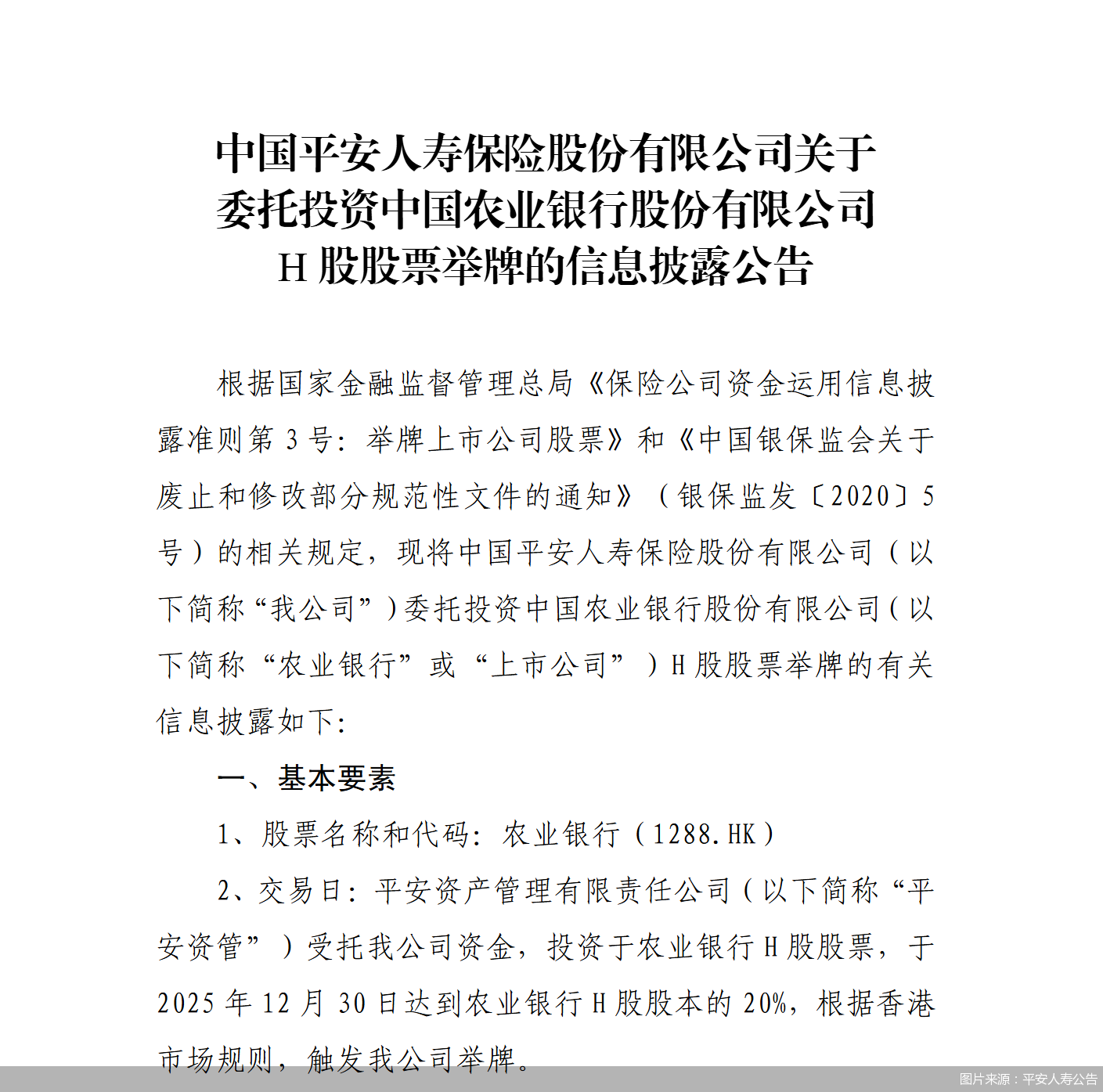
平安人寿举牌农业银行H股 持股比例达20% 账面余额324.28亿元
Jin Rong Jie· 2026-01-07 12:17
Core Viewpoint - Ping An Life has announced that it has triggered a stake increase in Agricultural Bank of China H-shares through its asset management subsidiary, Ping An Asset Management, which has acquired 20% of the total H-share capital by December 30, 2025 [1] Group 1: Investment Details - Ping An Asset Management, acting on behalf of Ping An Life, purchased Agricultural Bank of China H-shares via competitive trading in the Hong Kong market [1] - As of December 30, 2025, the book balance of Ping An Life's holdings in Agricultural Bank of China H-shares is 32.428 billion yuan, representing 0.58% of its total assets at the end of the previous quarter [1] - The investment scale is considered manageable, indicating a controlled approach to asset allocation [1] Group 2: Overall Asset Allocation - As of September 30, 2025, Ping An Life's equity assets have a book balance of 1,504.6 billion yuan, accounting for 27.00% of total assets at the end of the quarter [1] - The equity asset allocation complies with regulatory requirements for insurance institutions, reflecting a stable overall asset allocation structure [1]

按揭、信用卡、消费贷与经营贷深度:深度银行四大零售资产的风险分析框架
ZHONGTAI SECURITIES· 2026-01-07 11:17
Investment Rating - The report maintains an "Overweight" rating for the banking sector [2] Core Insights - The four categories of retail loans (mortgages, credit cards, consumer loans, and business loans) collectively constitute household liabilities, each with distinct collateral types, duration structures, and policy influences. The report aims to establish a risk framework for these retail assets and assess their impact on banking operations in the future [2][4] - Under stress testing, the non-performing loan (NPL) ratios for mortgages, credit cards, and consumer loans are projected to increase by 11, 12, and 20 basis points respectively in 2026, while the growth in non-performing amounts remains manageable. The overall quality of corporate assets is expected to continue improving, indicating a stable banking sector [2][4] - Retail asset risks are deemed controllable, with policies expected to maintain stability in the near term [2] Summary by Sections Retail Asset Analysis Framework: Collateral Types + Duration Structure + Policy Impact - The overall NPL ratio for retail loans of listed banks is estimated at 1.27% in the first half of 2025, slightly above the corporate NPL ratio of 1.26%, but the increase in NPL ratios is stabilizing. The composition of existing NPLs is 63% corporate and 37% retail, with business loans and mortgages showing higher proportions of both existing and newly added NPLs [2][12] - The report establishes a risk analysis framework for retail assets, highlighting the differences in collateral types, duration structures, and policy impacts among the four categories of retail loans [2][4] Consumer Loans: "High-Risk" Assets - The relationship between consumer loans and consumption trends is closely aligned, with notable deviations occurring during strict property purchase restrictions and regulatory cycles for online loans. The market structure for consumer credit (excluding credit cards and mortgages) shows that listed banks hold over 51.5% of the market, while non-listed banks account for 17% and other players for 31% [2][4] - The risk logic for consumer credit indicates that risk pricing is primarily determined by interest rates, which can be categorized into four tiers based on risk levels. The report estimates that 4.4% of consumer loans fall into the "high-risk" category, with commercial banks' high-risk consumer loans representing only 0.6% of their total consumer loans [2][4] Mortgage Loans: Risk Sources and International Comparisons - The primary sources of mortgage risk include negative cash flow and high loan-to-value (LTV) ratios, with 1.2% of respondents reporting monthly incomes below their mortgage payments. The report anticipates that the current high LTV portion, which constitutes 2.9% of total mortgage balances, will not necessarily lead to increased NPLs [2][4] - International comparisons indicate that mortgage NPL ratios in most countries remain below 2%, suggesting that the risks in the domestic market are manageable [2][4] Business Loans: High-Risk Assets - The report estimates that approximately 2 trillion yuan of high-risk business loans were outstanding at the end of 2021, with nearly one-third of these high-risk assets already exposed. The peak of risk exposure is expected in 2024 and the first half of 2025, with NPL ratios projected to rise by 18 basis points to 1.96% under stress testing conditions [2][4] Credit Cards: Early NPL Exposure - Credit cards have historically shown early exposure to NPLs, with the NPL ratio at 2.44% in the first half of 2025. The report notes that the net increase in credit card NPLs has significantly decreased, indicating that credit cards are not currently a major pressure point for banks [2][4] Investment Recommendations - The report suggests two main investment lines for bank stocks: focusing on regional banks with strong certainty and advantages, particularly in areas like Jiangsu, Shanghai, Chengdu, Shandong, and Fujian, and recommending large banks with high dividend yields such as Agricultural Bank, Construction Bank, and Industrial and Commercial Bank [2][4]




平安人寿四度举牌农行H股 去年险资举牌次数39次创十年新高
2 1 Shi Ji Jing Ji Bao Dao· 2026-01-07 10:20
21世经济报道记者 叶麦穗 农行H股继续被平安举牌。香港联交所股权披露信息近日显示,2025年12月 30日,平安人寿以5.7854港元的平均价增持9558.2万股农业银行H股股份,合计耗资约5.53亿港元。在此 次增持后,平安人寿持有的农行H股股份由19.79%增至20.1%,触发举牌。 随着平安人寿的收尾举牌, 2025年险资的举牌次数达到39次,仅次于2015年的62次,为历史第二高。 险资扎堆H股 此前,平安人寿曾于2025年2月17日、5月12日、8月26日分别举牌农行H股,持有农行H股的比例分别达 到5%、10%、15%。以此计算,截至2025年12月30日,平安人寿持有约61.8亿股农行H股,持仓市值近 350亿港元。 除此之外,农行2025年三季报显示,平安人寿还在当年三季度新进农行A股前十大股东序列,至三季度 末持有农行49.13亿股A股股份,持股比例约1.4%。 在农行的股本结构中,H股占比不足9%。若平安人寿在去年四季度未减持农行A股,其合计持有的农行 股份超过3%。 就银行股2025年股价表现来看,农行A股股价年内涨幅达52.66%,稳居A股上市银行第一;农行H股年 内涨幅达40.83 ...



持股达20%!平安人寿举牌农业银行H股
Bei Jing Shang Bao· 2026-01-07 07:45
北京商报讯(记者 李秀梅)1月7日,中国平安人寿保险股份有限公司(以下简称"平安人寿")公告表示,平安资管受托平安人寿资金,投资于农业银行H股 股票,于2025年12月30日达到农业银行H股股本的20%,根据香港市场规则,触发平安人寿举牌。 ...

“破净股”大缩水,仅剩300只!国家队持有+绩优+回购+低价全名单来了!
私募排排网· 2026-01-07 07:00
Core Viewpoint - The article discusses the performance of the Chinese stock market in 2025, highlighting a "slow bull" trend with significant gains in A-shares and Hong Kong stocks, particularly noting the impressive performance of the ChiNext index with nearly 50% growth [2]. Group 1: Market Performance - By December 31, 2025, the average increase in A-shares was 38.15%, with 572 stocks doubling in value. In comparison, the "924 market" from 2024 saw an average increase of 87.84%, with 1586 stocks doubling [2]. - The number of "broken net" stocks decreased from 836 in the previous "924 market" to 303, representing only 5.54% of all A-shares, indicating a market recovery [3]. Group 2: Broken Net Stocks - The article categorizes broken net stocks into five groups: broken net + performance stocks, broken net + repurchase stocks, broken net stocks + state-owned holdings, broken net + high dividend stocks, and broken net + low price stocks [4]. - Among the 303 broken net stocks, only 15 were identified as performance stocks with significant revenue growth and profit increases of over 50% [4]. Group 3: Repurchase Stocks - Of the 303 broken net stocks, 72 companies engaged in stock repurchases, with 29 companies repurchasing over 100 million yuan. This indicates management's belief that their stock prices are undervalued [6][7]. - The top three companies by repurchase amount in 2025 were Jiuan Medical (925 million yuan), China State Construction (887 million yuan), and Youngor (693 million yuan) [7]. Group 4: High Dividend Stocks - There are 22 broken net stocks with a dividend yield of over 5%, enhancing their investment appeal due to potential capital appreciation and stable dividend income [9]. - Among these, Jizhong Energy had a net asset ratio of 0.99 and a dividend yield of 11.15%, despite a significant drop in revenue and profit [9]. Group 5: State-Owned Holdings - The "national team" held 95 broken net stocks in the third quarter, with significant investments in Agricultural Bank of China, Bank of China, and Industrial and Commercial Bank of China, indicating a focus on stabilizing these sectors [11][12]. - The national team increased its holdings in 17 broken net stocks, with six being newly added in the third quarter [11]. Group 6: Low Price Stocks - There are 34 broken net stocks priced below 3 yuan, with only 7 showing positive revenue and profit growth, indicating that many may not have strong underlying asset values [14].



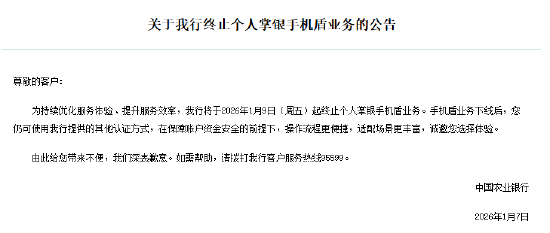
农业银行:将于本周五起终止个人掌银手机盾业务
Xin Lang Cai Jing· 2026-01-07 05:08
Group 1 - The Agricultural Bank of China announced the termination of its personal mobile security service, "Mobile Shield," effective January 9, 2026, to enhance service experience and efficiency [1][3] - After the discontinuation of the Mobile Shield service, users will still have access to other authentication methods provided by the bank, ensuring account security while offering a more convenient operational process and a wider range of applicable scenarios [1][3]
农业银行取得测试数据部署方法及装置专利
Sou Hu Cai Jing· 2026-01-07 04:18
国家知识产权局信息显示,中国农业银行股份有限公司取得一项名为"测试数据部署方法、装置、设 备、可读存储介质及产品"的专利,授权公告号CN114328215B,申请日期为2021年12月。 来源:市场资讯 天眼查资料显示,中国农业银行股份有限公司,成立于1986年,位于北京市,是一家以从事货币金融服 务为主的企业。企业注册资本34998303.3873万人民币。通过天眼查大数据分析,中国农业银行股份有 限公司共对外投资了16家企业,参与招投标项目5000次,财产线索方面有商标信息1309条,专利信息 5000条,此外企业还拥有行政许可119个。 声明:市场有风险,投资需谨慎。本文为AI基于第三方数据生成,仅供参考,不构成个人投资建议。 ...
农业银行将终止个人掌银手机盾业务
Bei Jing Shang Bao· 2026-01-07 02:43
Core Viewpoint - Agricultural Bank of China announced the termination of its personal mobile security service, "Mobile Shield," effective January 9, 2026, to enhance service experience and efficiency [1] Group 1 - The decision to discontinue the Mobile Shield service aims to optimize user experience and improve service efficiency [1] - After the Mobile Shield service is discontinued, users will still have access to other authentication methods provided by the bank [1] - The bank emphasizes that the alternative methods will ensure account security while offering a more convenient operation process and a wider range of applicable scenarios [1]
智通港股通持股解析|1月7日
智通财经网· 2026-01-07 00:31
Core Insights - The top three companies by Hong Kong Stock Connect shareholding ratios are China Telecom (71.63%), Gree Power Environmental (69.81%), and Da Zhong Public Utilities (68.41%) [1] - In the last five trading days, the largest increases in shareholding amounts were seen in China Merchants Bank (+2.22 billion), Industrial and Commercial Bank of China (+1.47 billion), and Agricultural Bank of China (+1.39 billion) [1] - The largest decreases in shareholding amounts during the same period were recorded for China Mobile (-2.62 billion), Tencent Holdings (-2.37 billion), and the Tracker Fund of Hong Kong (-1.56 billion) [1] Group 1: Shareholding Ratios - China Telecom (00728) holds 9.941 billion shares, with a shareholding ratio of 71.63% [1] - Gree Power Environmental (01330) has 0.282 billion shares, with a shareholding ratio of 69.81% [1] - Da Zhong Public Utilities (01635) possesses 0.365 billion shares, with a shareholding ratio of 68.41% [1] Group 2: Recent Increases in Shareholding - China Merchants Bank (03968) saw an increase of 2.22 billion in shareholding, with a change of 42.72 million shares [1] - Industrial and Commercial Bank of China (01398) increased by 1.47 billion, with a change of 237.38 million shares [1] - Agricultural Bank of China (01288) rose by 1.39 billion, with a change of 249.72 million shares [1] Group 3: Recent Decreases in Shareholding - China Mobile (00941) experienced a decrease of 2.62 billion, with a change of -31.85 million shares [3] - Tencent Holdings (00700) saw a reduction of 2.37 billion, with a change of -3.75 million shares [3] - Tracker Fund of Hong Kong (02800) decreased by 1.56 billion, with a change of -58.09 million shares [3]

中国农业银行西藏自治区分行贷款余额历史性突破2000亿元大关
Xin Lang Cai Jing· 2026-01-06 13:19
Core Insights - The Agricultural Bank of China (ABC) Tibet Branch has achieved a historic milestone by surpassing a loan balance of 200 billion RMB, with corporate loans exceeding 100 billion RMB, marking a significant "double hundred billion" achievement [1][3] Group 1: Financial Performance - The loan balance of the ABC Tibet Branch has reached over 200 billion RMB, indicating a strong financial capability to support the economic and social development of Tibet [1] - The corporate loan balance has crossed the 100 billion RMB mark, reflecting the bank's commitment to enhancing its financial services in the region [1] Group 2: Strategic Initiatives - ABC Tibet Branch has established a "1+N" panoramic rural revitalization service system, focusing on directing credit resources towards county areas and the agricultural sector [3] - The bank promotes specialized financial products such as "Yak Industry Loan," "Smart Animal Husbandry Loan," and "Rural Tourism Loan" to support local industries like barley, yaks, Tibetan medicine, and tourism [3] Group 3: Future Projections - By 2025, the bank plans to issue a total of 20.3 billion RMB in personal loans to farmers, with a balance of 43 billion RMB, and 29 billion RMB in agricultural loans, with a balance of 62.8 billion RMB [3] - The bank aims to provide over 28 billion RMB in loans for major projects, with a balance exceeding 68 billion RMB, and 20.8 billion RMB in green loans, with a balance surpassing 41 billion RMB by 2025 [3] Group 4: Commitment to Development - The bank's leadership emphasizes a commitment to supporting the region's development by aligning with national strategies and focusing on key areas such as transportation infrastructure, energy, and resource development [5] - The bank aims to enhance its role as a "financial national team" to promote national unity and contribute to building a beautiful and prosperous Tibet [5]