AIA(01299)

Search documents
智通ADR统计 | 12月30日




智通财经网· 2025-12-29 22:58
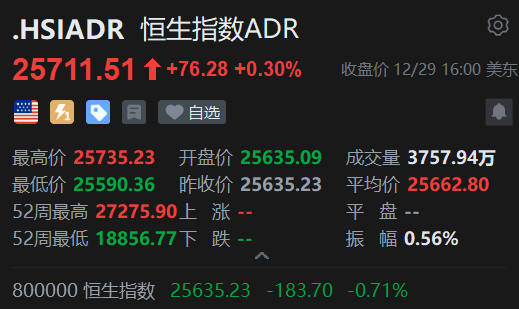
Market Overview - The Hang Seng Index (HSI) closed at 25,711.51, up by 76.28 points or 0.30% from the previous close [1] - The index reached a high of 25,735.23 and a low of 25,590.36 during the trading session [1] - The trading volume was 37.5794 million shares, with an average price of 25,662.80 [1] Blue-Chip Stocks Performance - HSBC Holdings closed at HKD 122.589, an increase of 0.57% from the previous close [2] - Tencent Holdings closed at HKD 598.176, up by 0.28% from the previous close [2] Individual Stock Movements - Tencent Holdings (00700) reported a latest price of HKD 596.500, down by HKD 6.500 or 1.08% [3] - Alibaba Group (09988) closed at HKD 143.300, down by HKD 2.700 or 1.85% [3] - HSBC Holdings (00005) reported a price of HKD 121.900, down by HKD 1.900 or 1.53% [3] - China Construction Bank (00939) increased by HKD 0.060 or 0.79%, closing at HKD 7.620 [3] - Xiaomi Group (01810) decreased by HKD 0.640 or 1.63%, closing at HKD 38.580 [3] - AIA Group (01299) closed at HKD 82.200, down by HKD 1.050 or 1.26% [3] - NetEase (099999) increased by HKD 3.000 or 1.41%, closing at HKD 216.200 [3] - Meituan (03690) closed at HKD 104.200, up by HKD 1.000 or 0.97% [3] - Industrial and Commercial Bank of China (01398) increased by HKD 0.100 or 1.63%, closing at HKD 6.230 [3] - Hong Kong Exchanges and Clearing (00388) closed at HKD 408.200, down by HKD 1.800 or 0.44% [3] - Ping An Insurance (02318) increased by HKD 0.200 or 0.30%, closing at HKD 66.400 [3] - Bank of China (03988) closed at HKD 4.440, up by HKD 0.010 or 0.23% [3] - Ctrip Group (09961) decreased by HKD 4.000 or 0.71%, closing at HKD 559.500 [3] - BYD Company (01211) increased by HKD 3.500 or 3.74%, closing at HKD 97.100 [3] - CITIC Limited (00267) increased by HKD 0.060 or 0.50%, closing at HKD 12.050 [3] - Baidu (098888) closed at HKD 119.100, down by HKD 0.400 or 0.33% [3] - JD.com (09618) decreased by HKD 0.800 or 0.71%, closing at HKD 112.000 [3] - China Hongqiao Group (01378) decreased by HKD 0.560 or 1.73%, closing at HKD 31.760 [3] - Hang Seng Bank (00011) closed at HKD 153.600, down by HKD 0.300 or 0.19% [3] - Kuaishou Technology (01024) decreased by HKD 0.800 or 1.24%, closing at HKD 63.800 [3] - Sun Hung Kai Properties (00016) closed at HKD 94.900, down by HKD 1.700 or 1.76% [3] - Pop Mart International (09992) decreased by HKD 0.300 or 0.15%, closing at HKD 199.900 [3] - BeiGene (06160) increased by HKD 0.300 or 0.16%, closing at HKD 183.800 [3] - China Merchants Bank (03968) increased by HKD 0.550 or 1.07%, closing at HKD 52.150 [3]

智通ADR统计 | 12月25日
智通财经网· 2025-12-24 22:22
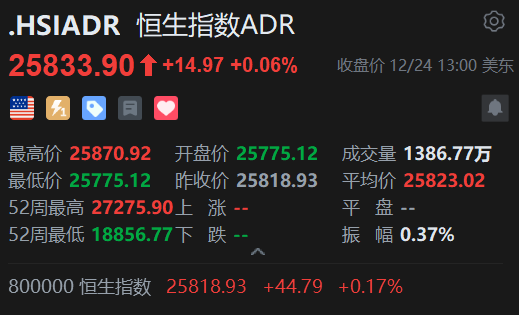
Market Overview - The Hang Seng Index (HSI) closed at 25,833.90, up by 14.97 points or 0.06% [1] - The index reached a high of 25,870.92 and a low of 25,775.12 during the trading session, with a trading volume of 13.8677 million [1] - The 52-week high for the index is 27,275.90, while the 52-week low is 18,856.77, indicating a fluctuation of 0.37% [1] Major Blue-Chip Stocks Performance - HSBC Holdings closed at 123.759 HKD, down 0.03% from the Hong Kong close [2] - Tencent Holdings closed at 602.001 HKD, down 0.17% from the Hong Kong close [2] - Alibaba Group (W) saw a decrease of 1.200 HKD, closing at 146.000 HKD, a drop of 0.82% [3] - China Construction Bank decreased by 0.050 HKD, closing at 7.560 HKD, a decline of 0.66% [3] - Xiaomi Group (W) increased slightly by 0.020 HKD, closing at 39.220 HKD, a rise of 0.05% [3] ADR Performance - Tencent's ADR closed at 602.001, down by 0.999 HKD or 0.17% compared to its Hong Kong stock price [3] - Alibaba's ADR closed at 145.796, down by 0.204 HKD or 0.14% compared to its Hong Kong stock price [3] - HSBC's ADR closed at 123.759, down by 0.041 HKD or 0.03% compared to its Hong Kong stock price [3] - AIA Group's ADR closed at 83.298, up by 0.048 HKD or 0.06% compared to its Hong Kong stock price [3]
港股市场2025年终盘点:IPO规模冠全球 多项指标创纪录
Zheng Quan Shi Bao· 2025-12-24 18:35
Core Viewpoint - The Hong Kong stock market is expected to fully recover in 2025 after experiencing a significant downturn from 2021 to 2024, with the Hang Seng Index dropping over 50% during that period. The market is now witnessing a resurgence driven by technological breakthroughs and strong IPO activity, leading to record levels in various capital market dimensions [1]. IPO Performance - The IPO scale in Hong Kong is projected to exceed 300 billion HKD in 2026, with 2025 expected to see an IPO scale of 286.3 billion HKD, reclaiming the title of the world's largest IPO market [2][3]. - Eight companies in the top ten IPOs of 2025 raised over 10 billion HKD each, with many being A-share companies listed in Hong Kong [3]. - The IPO failure rate has decreased significantly, reaching a low of 28.83% in 2025, attributed to market conditions and new pricing mechanisms implemented by the Hong Kong Stock Exchange [4]. New Share Subscription Records - The Hong Kong market has set multiple records in new share subscriptions, including a historic oversubscription of 11,465 times for the IPO of Jinye International Group, marking the highest oversubscription in Hong Kong's history [5]. Refinancing Market - The refinancing scale in Hong Kong surpassed 300 billion HKD in 2025, with a total of 3,166 billion HKD raised, significantly exceeding the total from the previous three years [6][7]. - Leading companies like Xiaomi and BYD are at the forefront of major refinancing projects, raising substantial amounts for business expansion and development [8]. Stock Index Performance - The Hang Seng Index recorded a year-to-date increase of 28.49% as of December 23, 2025, positioning it among the top global stock indices [9]. - Sectors such as innovative pharmaceuticals and non-ferrous metals have shown remarkable performance, with stocks like Yaojie Ankang experiencing a staggering increase of 950.95% [10]. Capital Inflows and Buybacks - Southbound capital inflows into the Hong Kong market reached a record high of approximately 1.41 trillion HKD in 2025, significantly enhancing market liquidity [11][12]. - Stock buybacks by listed companies totaled 1,759.36 billion HKD in 2025, with Tencent leading the buyback amounts [13][14]. - Dividends distributed by Hong Kong companies reached nearly 1.46 trillion HKD, surpassing the total for the entire year of 2024 [15]. Delisting Trends - The pace of delistings in Hong Kong accelerated in 2025, with 61 companies exiting the market, primarily due to privatization and forced delisting mechanisms [16].





破局低利率:寿险业产品结构转型的逻辑、路径与未来
13个精算师· 2025-12-23 10:13
Core Insights - The report analyzes the core challenges and strategic choices faced by the Chinese life insurance industry under the long-term downward trend of interest rates and the regulatory push for a "dynamic interest rate adjustment mechanism" [1] - It highlights the historical shift from traditional fixed-income products to floating-income products, particularly focusing on dividend insurance as a new growth point [1] - The report emphasizes the importance of understanding the relationship between interest rates, pricing, and product structure in navigating the current transformation logic [1] Summary by Sections Interest Rate and Pricing Relationship - The pricing of life insurance products, especially long-term savings and protection products, follows the principle of actuarial balance, where premiums are calculated based on the present value of insurance payouts divided by (1 - expense ratio) [3] - The predetermined interest rate is crucial as it represents the long-term return promised to customers and the company's liability cost [3] - Historical cases show that the global insurance industry has faced significant crises due to poor management of interest rate risks, leading to regulatory caps on predetermined interest rates to prevent systemic risks [3] Product Structure Evolution - The evolution of product structure in the Chinese life insurance market is closely linked to macroeconomic interest rate cycles and regulatory policy adjustments [6] - The regulatory environment has led to cyclical changes in product structure, with dividend insurance becoming mainstream during periods of low predetermined interest rates [3][6] Market Trends and Company Strategies - As of 2023, the downward adjustment of predetermined interest rates and the establishment of a dynamic adjustment mechanism have fundamentally impacted product structures, reducing the attractiveness of traditional fixed-income products [12] - Companies like Xinhua Insurance have seen a significant increase in the proportion of dividend insurance premiums, indicating a historical shift in product structure [10] - Major listed insurance companies are transitioning from strategic consensus to tactical execution, with differentiated paths based on their resource endowments [14] Future Growth Opportunities - The recent regulatory approval for dividend-type long-term health insurance, particularly critical illness insurance, is seen as a milestone for optimizing the industry's benefit structure and stimulating demand [17] - The potential market gap for critical illness insurance is significant, with estimates indicating a health protection gap of $143 billion in China by 2024 [19] - The development of dividend critical illness insurance is expected to follow successful models from Hong Kong, focusing on low guarantees and high dividends to address inflation concerns [20] Strategic Recommendations - Insurance companies should make clear strategic choices between low-risk, high-guarantee products for the mass market and high-risk, high-flexibility products for high-net-worth clients [22] - Enhancing long-term investment capabilities and integrating health/retirement ecosystems are essential for increasing product value and customer loyalty [23] - The transformation requires a systemic approach, considering regulatory requirements, customer needs, and economic trends, to establish a competitive advantage in the evolving market landscape [25]

智通港股沽空统计|12月23日
智通财经网· 2025-12-23 00:25
Group 1 - The top short-selling ratios are led by China Resources Beer (80291) at 100.00%, Meituan (83690) at 93.03%, and CNOOC (80883) at 85.70% [1][2] - The highest short-selling amounts are recorded for Alibaba (09988) at 1.293 billion, Tencent (00700) at 1.242 billion, and Xiaomi (01810) at 1.084 billion [1][3] - The highest deviation values are noted for Far East Development (00035) at 56.81%, CNOOC (80883) at 55.68%, and Meituan (83690) at 52.53% [1][2] Group 2 - The top short-selling amount rankings show Alibaba at 1.293 billion with a short-selling ratio of 15.00%, Tencent at 1.242 billion with a ratio of 14.58%, and Xiaomi at 1.084 billion with a ratio of 16.39% [3] - The short-selling ratio rankings indicate that China Resources Beer has the highest ratio at 100.00%, followed by Meituan at 93.03%, and CNOOC at 85.70% [2] - The deviation values highlight that Far East Development has the highest deviation at 56.81%, followed by CNOOC at 55.68%, and Meituan at 52.53% [3]




智通ADR统计 | 12月23日
智通财经网· 2025-12-22 22:19
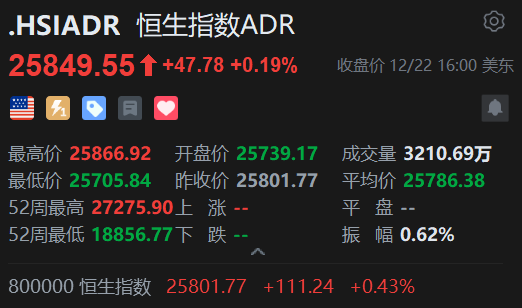
Market Overview - The Hang Seng Index (HSI) closed at 25,849.55, up by 47.78 points or 0.19% from the previous close [1] - The index reached a high of 25,866.92 and a low of 25,705.84 during the trading session [1] - The trading volume was 32.1069 million shares [1] Major Blue-Chip Stocks Performance - HSBC Holdings closed at 122.506 HKD, an increase of 0.99% compared to the Hong Kong close [2] - Tencent Holdings closed at 614.085 HKD, a slight decrease of 0.07% from the Hong Kong close [2] - Alibaba Group (W) saw a rise of 0.76%, closing at 146.400 HKD [3] Stock Price Movements - Tencent Holdings: Latest price 614.500 HKD, up by 0.500 HKD (0.08%), ADR price 614.085 HKD, down by 0.415 HKD (-0.07%) [3] - Alibaba Group (W): Latest price 146.400 HKD, up by 1.100 HKD (0.76%), ADR price 146.811 HKD, up by 0.411 HKD (0.28%) [3] - HSBC Holdings: Latest price 121.300 HKD, up by 2.000 HKD (1.68%), ADR price 122.506 HKD, up by 1.206 HKD (0.99%) [3] - Xiaomi Group (W): Latest price 39.800 HKD, down by 0.740 HKD (-1.83%), ADR price 39.647 HKD, down by 0.153 HKD (-0.38%) [3] - AIA Group: Latest price 82.650 HKD, up by 0.150 HKD (0.18%), ADR price 83.053 HKD, up by 0.403 HKD (0.49%) [3]
Hong Kong Proposal to Let Insurers Invest Capital in Crypto, Infrastructure
Yahoo Finance· 2025-12-22 08:14
Core Insights - The Hong Kong Insurance Authority plans to allow insurance providers to invest in digital assets like cryptocurrency and infrastructure projects, requiring a 100% risk charge to protect policyholder funds [1][6] - The proposal comes as Hong Kong aims to strengthen its financial sector and position itself as a hub for the Asian digital assets market [3] Insurance Market Overview - As of June 2025, there were 158 authorized insurers in Hong Kong, with total gross premiums reported at $81.69 billion in 2024 [2] - The new investment opportunities may attract significant participation from major insurers, such as AIA, which is the seventh largest insurance firm by global market cap [6] Digital Economy Initiatives - The proposal aligns with Hong Kong's broader strategy, including the "Fintech 2030" initiative, which emphasizes tokenization and includes over 40 initiatives aimed at enhancing the financial sector [4] - The Securities and Futures Commission is also considering easing restrictions on cryptocurrency trading, which would further integrate local virtual-asset trading platforms with global markets [5]
智通港股沽空统计|12月22日
智通财经网· 2025-12-22 00:24
Core Insights - The top short-selling ratios are observed in Sun Hung Kai Properties-R (80016), Anta Sports-R (82020), and JD Group-SWR (89618), all at 100.00% [1] - The highest short-selling amounts are recorded for Alibaba-SW (09988) at 2.008 billion, Tencent Holdings (00700) at 1.701 billion, and Xiaomi Group-W (01810) at 1.183 billion [1] - The highest deviation values are seen in MGM China (02282) at 49.34%, Xiaomi Group-WR (81810) at 46.08%, and Shenzhen Holdings (00604) at 39.03% [1] Top Short-Selling Ratios - Sun Hung Kai Properties-R (80016) has a short-selling amount of 42,700 with a ratio of 100.00% and a deviation of 24.87% [2] - Anta Sports-R (82020) has a short-selling amount of 14,700 with a ratio of 100.00% and a deviation of 17.57% [2] - JD Group-SWR (89618) has a short-selling amount of 20,300 with a ratio of 100.00% and a deviation of 38.44% [2] Top Short-Selling Amounts - Alibaba-SW (09988) leads with a short-selling amount of 2.008 billion, a ratio of 19.61%, and a deviation of 3.66% [2] - Tencent Holdings (00700) follows with a short-selling amount of 1.701 billion, a ratio of 15.61%, and a deviation of 2.97% [2] - Xiaomi Group-W (01810) has a short-selling amount of 1.183 billion, a ratio of 26.97%, and a deviation of 8.81% [2] Top Short-Selling Deviation Values - MGM China (02282) has a short-selling amount of 130 million, a ratio of 57.40%, and a deviation of 49.34% [2] - Xiaomi Group-WR (81810) has a short-selling amount of 6.7943 million, a ratio of 89.71%, and a deviation of 46.08% [2] - Shenzhen Holdings (00604) has a short-selling amount of 3.5736 million, a ratio of 49.93%, and a deviation of 39.03% [2]
《保险公司资产负债管理办法(征求意见稿)》点评:全面规范资负管理引导长期经营,利好头部险企
国泰海通· 2025-12-21 11:50
Investment Rating - The report maintains an "Overweight" rating for the insurance industry [1][2]. Core Insights - The "Insurance Company Asset-Liability Management Measures (Draft for Comments)" aims to comprehensively standardize the asset-liability management system of insurance companies, reinforcing the primary responsibility of companies and clarifying regulatory indicators to guide long-term stable operations [2][3]. - The introduction of the new measures is expected to enhance the asset-liability management framework, particularly under the backdrop of interest rate fluctuations and accounting standard reforms, benefiting leading insurance companies that align with stricter regulatory requirements [4]. Summary by Sections Regulatory Framework - The draft requires insurance companies to establish a governance structure for asset-liability management, with the board of directors ultimately responsible and senior management directly leading the efforts [4][5]. - It specifies the need for a professional department dedicated to asset-liability management, ensuring independence from business and investment management departments [4][7]. Management Policies and Procedures - The measures outline requirements for asset and liability analysis, product pricing management, asset allocation policies, and stress testing [4][5]. - Regulatory indicators include minimum standards for liquidity coverage ratios and effective duration gaps, with specific metrics for property and life insurance companies [9][10]. Monitoring and Risk Management - Monitoring indicators are established to identify and warn against asset-liability mismatch risks, enhancing risk management capabilities [4][9]. - The report emphasizes the importance of aligning asset-liability management with long-term operational goals, with a focus on achieving cost-revenue matching and liquidity matching [4][10]. Investment Recommendations - The report suggests that the new measures will guide the industry towards long-term stable operations and optimize asset-liability matching, maintaining an "Overweight" stance on the industry [4][12]. - Recommended companies include China Ping An, China Pacific Insurance, New China Life, and China Life Insurance [4][12].



友邦进入行业NO.1榜单;泰康人寿总裁离任;险企资产负债管理办法公开征求意见,明确监管指标和指标阈值|13精周报
13个精算师· 2025-12-20 03:03
Regulatory Dynamics - Three departments are promoting the development of commercial insurance annuities and other insurance products to enhance financial adaptability to service consumption [6] - The Medical Insurance Bureau plans to expedite the clearing of major illness insurance funds and medical assistance funds, aiming for annual clearance completion by March 31 each year starting in 2028 [8][9] - The Medical Insurance Bureau has allocated 416.6 billion for medical insurance financial subsidies and construction funds for 2026 [10] - The Financial Regulatory Bureau emphasizes long-term assessment for insurance companies to prevent excessive pursuit of business expansion and short-term profits, introducing new regulatory indicators [11][12] - The China Insurance Industry Association has published a guide on ESG information disclosure for insurance institutions to enhance their practices [13] - Sichuan province is encouraging insurance companies to develop technology insurance products through the "Tianfu Sci-tech Insurance" initiative [14] Company Dynamics - Zhongyou Life has increased its stake in Sichuan Road and Bridge to 5%, triggering a takeover bid [16] - Great Wall Life has increased its holdings in Qin Port shares by 906,000 shares [17] - Great Wall Life has also increased its stake in Datang New Energy by 5 million shares [18] - China Pacific Insurance reported a cumulative original insurance premium income of 250.32 billion for the first 11 months, a 9.4% year-on-year increase [28] - New China Life's cumulative original insurance premium income reached 188.85 billion, with a 16% year-on-year growth [29] - China Life has increased its investment in the Guoshou Qihang No. 1 (Tianjin) equity investment fund by 5 billion [22] - Ping An Life has been approved to issue up to 20 billion in capital supplement bonds [25] - Huagui Life has been approved to increase its registered capital by 615 million, raising it to 2.615 billion [24] Industry Dynamics - Insurance companies have supplemented capital by 114.4 billion this year, with a notable focus on bond issuance [55] - The value of insurance stocks is being reassessed as both asset and liability sides continue to optimize [57] - The retirement income replacement rate for high-net-worth seniors has reached 75%, highlighting the significant role of commercial annuity insurance [58] - The establishment of the China Insurance Investment Fund and other partnerships in Xiamen with a capital contribution of 5 billion [63] - Ant Group has launched an AI health application, enhancing health services through technology [64] - The stock of Muxi Co. surged by 692% on its first trading day, with significant gains for insurance capital involved in its pre-IPO financing [65][66]