ICBC(01398)

Search documents
中国工商银行取得信息录入方法及相关装置等专利
Sou Hu Cai Jing· 2025-11-29 06:05
Core Points - The State Intellectual Property Office of China has granted a patent to Industrial and Commercial Bank of China (ICBC) for a technology related to "information input methods, devices, computer equipment, storage media, and program products" with the authorization announcement number CN115510201B, applied for on September 2022 [1] - ICBC, established in 1985 and headquartered in Beijing, primarily engages in monetary financial services, with a registered capital of 35,640.6257 million RMB [1] - According to data analysis from Tianyancha, ICBC has invested in 1,097 companies, participated in 5,000 bidding projects, holds 988 trademark records, and has 5,000 patent records, in addition to possessing 77 administrative licenses [1]

工商银行取得网络节点校验方法、装置、设备、介质和程序产品专利
Sou Hu Cai Jing· 2025-11-29 05:32
Group 1 - The core point of the article is that the Industrial and Commercial Bank of China (ICBC) has obtained a patent for a "network node verification method, device, equipment, medium, and program product," with the authorization announcement number CN119728109B and an application date of December 2024 [1] Group 2 - ICBC was established in 1985 and is located in Beijing, primarily engaged in monetary financial services [1] - The registered capital of ICBC is approximately 35.64 billion RMB [1] - According to data analysis, ICBC has invested in 1,097 companies, participated in 5,000 bidding projects, has 988 trademark information entries, and holds 5,000 patent information entries, along with 77 administrative licenses [1]
事关香港火灾!多家银行捐钱捐物、提供应急服务 支持灾后重建
Bei Ke Cai Jing· 2025-11-29 04:33
Core Viewpoint - Multiple banks in Hong Kong are actively providing financial support and donations to assist victims of the recent fire incident in Tai Po, aiming to help them recover and rebuild their lives. Group 1: Donations and Support - Industrial and Commercial Bank of China (ICBC) and its Hong Kong branches will donate HKD 10 million for disaster relief and reconstruction efforts, while also organizing a volunteer team to assist local government [2][3] - Agricultural Bank of China (ABC) will also donate HKD 10 million specifically for fire rescue and post-disaster recovery, coordinating with public welfare organizations for targeted donations [2][3] - China Bank will contribute HKD 20 million and has set up a special account for public donations, while other banks like Bank of Communications and Minsheng Bank are also making significant contributions [3][4] Group 2: Emergency Financial Services - ICBC is extending service hours and providing special service windows for affected customers, offering cash withdrawal without cards and loan extensions [4][5] - China Bank is expediting the reissuance of bank cards for customers without identification and is waiving related fees, while also providing flexible repayment options for loans [5][6] - Bank of Communications is increasing staff at affected branches and extending service hours to assist customers, offering emergency cash support and fee waivers for withdrawals [6][7] Group 3: Insurance Claims Support - Agricultural Bank of China is coordinating with insurance companies to simplify claims processes and provide rapid responses to affected customers [7] - China Bank's insurance division has established a service hotline and emergency claims green channel to expedite claims for affected clients [7] - Bank of Communications Insurance is also reaching out to clients to offer quick service solutions and simplify claims procedures [7]


今日水贝投资金、首饰金及各大银行报价【2025.11.29】
Xin Lang Cai Jing· 2025-11-29 03:38
Group 1 - The article provides the latest gold and silver prices from various banks and institutions as of November 28, 2025, indicating real-time fluctuations in precious metal prices [1][2][3] - The Shanghai Gold Exchange lists the gold price at 953 yuan per gram, while silver prices vary, with the benchmark silver price from 中钞国鼎 at 7.43 yuan per gram and from 斯尔沃银器 at 12.2 yuan per gram [2][3] - The prices are subject to change and are provided for reference, with the final settlement price being the authoritative figure [3]

工行、农行、中行、建行、交行、邮储 停售!
Zhong Guo Ji Jin Bao· 2025-11-29 03:28
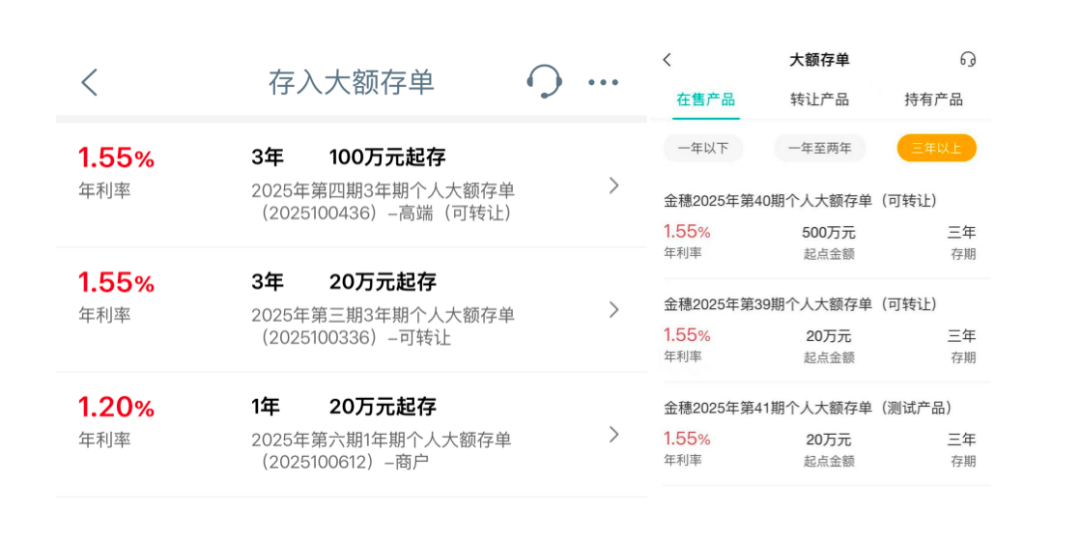
Core Viewpoint - The six major state-owned banks have collectively discontinued the 5-year large denomination certificates of deposit (CDs), reflecting a broader trend of adjustments in long-term deposit products among banks to reduce liability costs and stabilize net interest margins [1][3][8]. Group 1: Market Reactions and Adjustments - The discontinuation of 5-year large denomination CDs by major banks has drawn significant attention, as many smaller banks have also been adjusting their long-term deposit products [3][8]. - Some state-owned banks had already stopped offering 5-year CDs prior to this collective action, indicating a shift in the market [5][8]. - The adjustments in deposit products are primarily aimed at lowering high-cost liabilities and optimizing the banks' liability structures [9][10]. Group 2: Interest Rate Trends - Recent data shows that the net interest margin for commercial banks remains under pressure, with state-owned banks having the lowest net interest margin at 1.31% compared to 3.83% for private banks [8][10]. - The trend of lowering deposit rates is expected to continue, with banks likely to maintain a limited number of 5-year products at reduced rates [10][11]. - The adjustments reflect a significant transformation in the financial system under a low-interest-rate environment, with banks responding to declining asset yields by shortening deposit terms [9][10]. Group 3: Investor Guidance - Investors are advised to shift from a single deposit mindset to a diversified investment strategy, considering options like money market funds, cash management products, and government bonds to balance risk and return [11]. - The expectation of continued declines in deposit rates suggests that investors should lower their return expectations and adjust their investment strategies accordingly [11].

工行晋级全球系统重要性银行第三组 中国金融业全球话语权再进阶
Shang Hai Zheng Quan Bao· 2025-11-28 18:40
Core Insights - The Financial Stability Board (FSB) has updated the list of Global Systemically Important Banks (G-SIBs) for 2025, highlighting the advancement of Chinese banks in the global financial system [1][2] - Five major state-owned banks from China have been recognized, with Industrial and Commercial Bank of China (ICBC) moving from the second group to the third group, marking it as the first Chinese bank to achieve this status [1][2] Group 1: ICBC's Advancement - ICBC's elevation to the third group reflects its ongoing efforts in smart risk control, modern layout, digital empowerment, comprehensive services, and ecological systems [2] - External factors such as changes in international competition and currency fluctuations contributed to ICBC's rise, with the appreciation of the Renminbi against the Euro positively impacting its score [2] Group 2: Implications for Chinese Banking Sector - The elevation of ICBC signifies a notable increase in the systemic importance of Chinese banks within the global financial framework [3] - This event sends three key signals: the enhanced global significance of Chinese banks, a shift in competitive focus towards emerging markets, and the potential reshaping of the global banking landscape [3] - ICBC's advancement is expected to have a demonstration effect on other large domestic banks, promoting adherence to global regulatory standards and encouraging a transition from "scale expansion" to "quality expansion" in the Chinese banking sector [3]
商界和金融机构踊跃捐款 助力香港大埔火灾救灾及重建
Zhong Guo Xin Wen Wang· 2025-11-28 15:11
Group 1 - A major fire occurred at Hong Kong's Ma On Shan Wong Fuk Court on November 26, resulting in 128 fatalities as of November 28 [1] - Various business and financial institutions are actively participating in disaster relief efforts by donating funds and materials to support recovery and rebuilding efforts for affected residents [1] Group 2 - The Chinese General Chamber of Commerce announced a donation of 11 million HKD to assist disaster victims, emphasizing the urgent need for support [3] - The Hong Kong General Chamber of Commerce pledged 1 million HKD to aid residents affected by the fire, expressing deep sympathy for those impacted [3] - The Hong Kong Chinese Manufacturers' Association committed to donating 10 million HKD, aiming to provide support and care for affected families [3] Group 3 - Financial institutions are also contributing to disaster relief, with Bank of China (Hong Kong) donating 20 million HKD for emergency relief and post-disaster recovery efforts [4] - Industrial and Commercial Bank of China announced a donation of 10 million HKD and is implementing emergency financial services to assist affected residents [4] - Industrial Bank is donating 10 million HKD to the designated "Ma On Shan Wong Fuk Court Assistance Fund" to support medical treatment for the injured and community rebuilding [4]



六大行集体“下架”5年期大额存单?真相是……
券商中国· 2025-11-28 15:03
Core Viewpoint - The absence of 5-year large denomination certificates of deposit (CDs) from major state-owned banks reflects a broader trend in the banking industry towards shorter-term products and more refined liability management strategies in a low interest rate environment [1][11]. Summary by Sections Current Market Situation - Recently, the six major state-owned banks, including Industrial, Agricultural, Bank of China, Construction, Communications, and Postal Savings banks, have no 5-year large denomination CDs available for sale, which has drawn attention [1]. - The Bank of China has historically offered 5-year CDs but has limited their availability to specific customers since 2023, indicating a shift in product strategy [2][6]. Historical Context - The Bank of China has issued at least 37 batches of personal large denomination CDs from 2016 to 2025, with several 5-year products released in 2018, 2019, and 2023 [2]. - Other banks, such as Agricultural Bank of China, have not offered 5-year CDs for several years, focusing instead on shorter-term products [8][10]. Interest Rate Dynamics - The current interest rate environment shows a phenomenon where the interest rates for 5-year fixed deposits are lower than those for 3-year deposits, indicating a "negative spread" situation [11]. - As of the third quarter of this year, the net interest margin for commercial banks was reported at 1.42%, showing a year-on-year decrease of 11 basis points, despite some stabilization in recent months [11]. Strategic Responses - Banks are adopting more precise liability management strategies, including shortening deposit terms and offering differentiated rates for specific customer segments, particularly targeting older clients with higher rates and lower minimum deposit requirements [12][13]. - This approach aims to optimize the liability structure, secure stable long-term funding, and enhance customer retention, particularly among the elderly demographic, which constitutes over 70% of savings deposits [12][13].

捐款、贷款展期、开设绿色通道多家银行全力支持香港大埔救灾及灾后重建
Mei Ri Jing Ji Xin Wen· 2025-11-28 14:42
Core Viewpoint - Following the fire incident at Hong Kong's Tai Po Wang Fuk Court, multiple banks have swiftly mobilized to support disaster relief and post-disaster reconstruction through donations, emergency financial services, loan extensions, and fee waivers [1][2][3]. Group 1: Donations and Financial Support - Shanghai Bank initiated an emergency donation mechanism, contributing 10 million HKD to the Hong Kong White Magnolia Charity Foundation to support rescue operations, medical treatment, and post-disaster recovery [1]. - Major banks including ICBC Asia, Bank of China Hong Kong, and others have also announced donations to aid emergency relief and reconstruction efforts [1][2]. Group 2: Emergency Services - ICBC Asia has set up dedicated service windows for affected customers, offering cardless cash withdrawals and expedited card replacements [2]. - SPD Bank established a green channel for emergency services, prioritizing the transfer of disaster relief funds and ensuring uninterrupted financial services [3]. - Several banks have increased staffing and extended operating hours at branches in the affected area to assist customers [3]. Group 3: Loan Management - Banks such as Bank of Communications (Hong Kong) and Bank of China Hong Kong are considering individual cases of affected customers for loan management, including loan extensions and fee waivers [4]. - ICBC Asia is also implementing a comprehensive plan for loan extensions, interest reductions, and fee waivers for early withdrawals from fixed deposits to meet the financial needs of disaster-affected individuals [4]. Group 4: Insurance Claims - Several banks have announced the establishment of emergency claims channels for affected customers, simplifying the claims process and providing prompt responses to inquiries [5]. - Agricultural Bank of China Insurance has initiated customer risk assessments and launched a service green channel to ensure the rights of disaster-affected individuals are protected [5].


工行、农行、中行、建行、交行等,齐出手
中国基金报· 2025-11-28 14:35
Core Viewpoint - Multiple banks in Hong Kong are actively supporting rescue and reconstruction efforts following a significant fire incident in Tai Po, New Territories, which resulted in major casualties [1] Group 1: Donations and Support Actions - Industrial and Commercial Bank of China (ICBC) donated 10 million HKD and organized a volunteer team to assist local government in rescue efforts [3] - Agricultural Bank of China (ABC) also donated 10 million HKD, focusing on supporting fire rescue and post-disaster recovery [6] - Bank of China (BOC) announced a donation of 20 million HKD and established a special account for public donations [11] - China Construction Bank (CCB) pledged 10 million HKD for emergency relief and recovery efforts, while also facilitating cross-border donations [15] - Bank of Communications (BoCom) plans to donate 10 million HKD and set up emergency service stations in affected areas [18] - Shanghai Bank and Minsheng Bank collectively donated over 50 million HKD, with Shanghai Bank contributing 10 million HKD and Minsheng Bank 5 million HKD [24] Group 2: Financial Services and Customer Support - ICBC is providing emergency financial services, including extended service hours and special service windows for affected customers [3] - ABC is coordinating with public welfare organizations for targeted donations and has initiated a volunteer team for disaster support [6] - BOC is expediting the reissuance of bank cards for affected customers and waiving related fees [12] - CCB is offering flexible identity verification and free reissuance of bank cards for customers unable to provide identification [15] - BoCom has set up priority service channels and is providing emergency cash support for affected customers [19]