ICBC(01398)

Search documents
最新全球系统重要性银行名单出炉,中资机构首次进入第三组
Di Yi Cai Jing· 2025-11-30 11:21
Group 1: Core Insights - The 2025 Global Systemically Important Banks (G-SIBs) list has been released, with Chinese banks maintaining the same number of five institutions as the previous year, but with the Industrial and Commercial Bank of China (ICBC) moving up to the third group, becoming the first Chinese bank in this category [1][2] - The assessment framework for G-SIBs includes five weighted dimensions: size, interconnectedness, substitutability, complexity, and cross-border activity, with 13 secondary indicators used for a comprehensive evaluation [3] - Fitch Ratings noted that the scoring changes for Chinese G-SIBs this year are driven less by size and more by exchange rate effects, which have historically alleviated upward pressure on scores [3][4] Group 2: TLAC and Regulatory Requirements - Following the successful achievement of the first phase of Total Loss-Absorbing Capacity (TLAC) requirements, the pressure for the next phase remains a concern, with the issuance of TLAC non-capital bonds exceeding 300 billion yuan this year, totaling 540 billion yuan cumulatively [1][7] - The G-SIBs face higher core capital and TLAC regulatory requirements, with specific targets set for 2025 and 2028, including a TLAC risk-weighted ratio of at least 16% and 18% respectively [6][9] - As of Q1 2025, the four major banks have exceeded the minimum TLAC/RWA requirement of 20%, but the second phase compliance is still under scrutiny, with some banks needing additional capital to meet the requirements [7][9] Group 3: Market Dynamics and Future Outlook - The issuance of TLAC non-capital bonds has been a significant tool for G-SIBs to meet their total loss-absorbing capacity requirements, with the major banks having issued multiple tranches since last year [7][8] - Fitch Ratings anticipates that while some banks can meet the next phase of TLAC requirements, others may need government capital injections to alleviate pressure on their total loss-absorbing capacity [9] - The report indicates that if risk-weighted asset growth remains stable, the major banks are likely to meet the upcoming TLAC requirements on schedule [9]

6400亿元!绿色金融债发行翻倍,中小银行加速入场
券商中国· 2025-11-30 07:29
Core Viewpoint - The issuance of green financial bonds in China has significantly increased in 2023, driven by supportive policies and a diverse range of issuing institutions, including small and medium-sized banks, which have become new growth points in the market [2][3][9]. Group 1: Green Bond Issuance - On November 27, the National Development Bank successfully issued 9 billion yuan of 3-year green financial bonds with an interest rate of 1.52%, achieving a subscription multiple of 2.46 times [1]. - Since the implementation of the "Green Bond Support Project Directory (2025 Edition)" in October, financial institutions have entered a "fast track" for green bond issuance, with 14 bank green bonds issued in November alone, marking the highest issuance density of the year [2]. - In November, various banks issued a total of 110.7 billion yuan in green financial bonds, setting a new monthly record for 2023 [3]. Group 2: Diverse Issuers - The issuance of green bonds has expanded beyond state-owned banks to include small and medium-sized banks and non-bank financial institutions, indicating a diversification of issuers [4][9]. - In November, several small banks issued green bonds ranging from 700 million yuan to 3.5 billion yuan, with specific examples including Tangshan Bank and Chongqing Three Gorges Bank [5][6][7]. Group 3: Policy Support and Market Growth - The explosive growth in green bond issuance is attributed to continuous policy support, particularly following the launch of the new project directory, which has unified various green financial products and reduced identification costs for financial institutions [9]. - As of November 28, over 240 green bonds have been issued by financial institutions, with a total issuance scale exceeding 640 billion yuan, doubling the issuance scale from 2024 [9]. Group 4: Cost Optimization and Innovation - The average issuance cost of bank green bonds has improved, decreasing from 1.94% in 2024 to 1.74% in 2023, enhancing the financing cost-effectiveness [3]. - There has been a notable increase in product innovation within the green bond market, with various financial institutions exploring new mechanisms, including floating rate bonds and thematic bonds focused on specific sectors like green manufacturing [11][13].





中国工商银行贺州分行精准赋能区域科创企业成长
Zheng Quan Ri Bao Zhi Sheng· 2025-11-30 07:12
Core Viewpoint - The Industrial and Commercial Bank of China (ICBC) Hezhou Branch is focusing on technology finance as a key engine to support the high-quality development of the local economy in Hezhou, Guangxi [1][2] Group 1: Financial Support for Technology Enterprises - ICBC Hezhou Branch has increased resource investment to meet the financial needs of technology enterprises throughout their lifecycle, resulting in a loan balance of 470 million yuan for technology enterprises by the end of October 2025, a 16.34% increase from the beginning of the year, significantly outpacing the average loan growth of the bank [1] - The branch has established a special service mechanism to ensure effective resource allocation and strategic implementation for technology finance [1] Group 2: Tailored Financial Solutions - The bank provides differentiated solutions for various types and stages of technology enterprises, including customized financing support such as "Technology Innovation Loan" and "Industrial e-Loan" for specialized enterprises, and promotes intellectual property pledge financing for high-tech enterprises [1][2] - For startups and growing technology SMEs, the bank utilizes online credit products like "Business Quick Loan" and "Tax Loan" to address the challenges of first-time loans [1][2] Group 3: Innovative Financial Products - To overcome the common challenges faced by technology enterprises, such as "light assets and lack of collateral," ICBC Hezhou Branch has promoted exclusive innovative products like "Technology Credit Loan" and "Intellectual Property Pledge Financing," with nearly 20 million yuan in intellectual property pledge financing loans issued by the end of October [2] - The branch has expanded its service offerings beyond traditional credit to include a comprehensive range of services such as settlement, cash management, international business, payroll services, and personal finance [2] Group 4: Efficiency and Engagement - The bank has established a "green channel" for credit to technology enterprises, implementing a "three priorities" principle (priority acceptance, approval, and disbursement) to streamline processes and accelerate approvals [2] - Through various bank-enterprise connection activities, the branch promotes policies, listens to needs, and provides customized solutions to enhance operational efficiency for enterprises [2]
市场利率定价自律机制工作会议在京召开
Mei Ri Jing Ji Xin Wen· 2025-11-30 03:05
(文章来源:每日经济新闻) 每经AI快讯,11月27日,市场利率定价自律机制(以下简称利率自律机制)工作会议召开。中国人民 银行党委委员、副行长邹澜出席会议并讲话,利率自律机制主任委员、中国工商银行行长刘珺致辞。利 率自律机制15家核心成员、其他全国性银行有关负责同志参加会议。会议表决通过了关于增选利率自律 机制副秘书长的决议,对当前利率定价和自律管理的热点问题进行探讨交流。 ...
工商银行取得文本聚类方法、装置及电子设备专利
Sou Hu Cai Jing· 2025-11-29 12:00
Core Insights - China Industrial and Commercial Bank has obtained a patent for a "text clustering method, device, and electronic equipment," with the authorization announcement number CN114691868B, and the application date is March 2022 [1] Company Overview - China Industrial and Commercial Bank was established in 1985 and is located in Beijing, primarily engaged in monetary financial services [1] - The registered capital of the company is approximately 35.64 billion RMB [1] Investment and Operations - The company has invested in 1,097 enterprises and participated in 5,000 bidding projects [1] - In terms of intellectual property, the company holds 988 trademark records and 5,000 patent records, along with 77 administrative licenses [1]
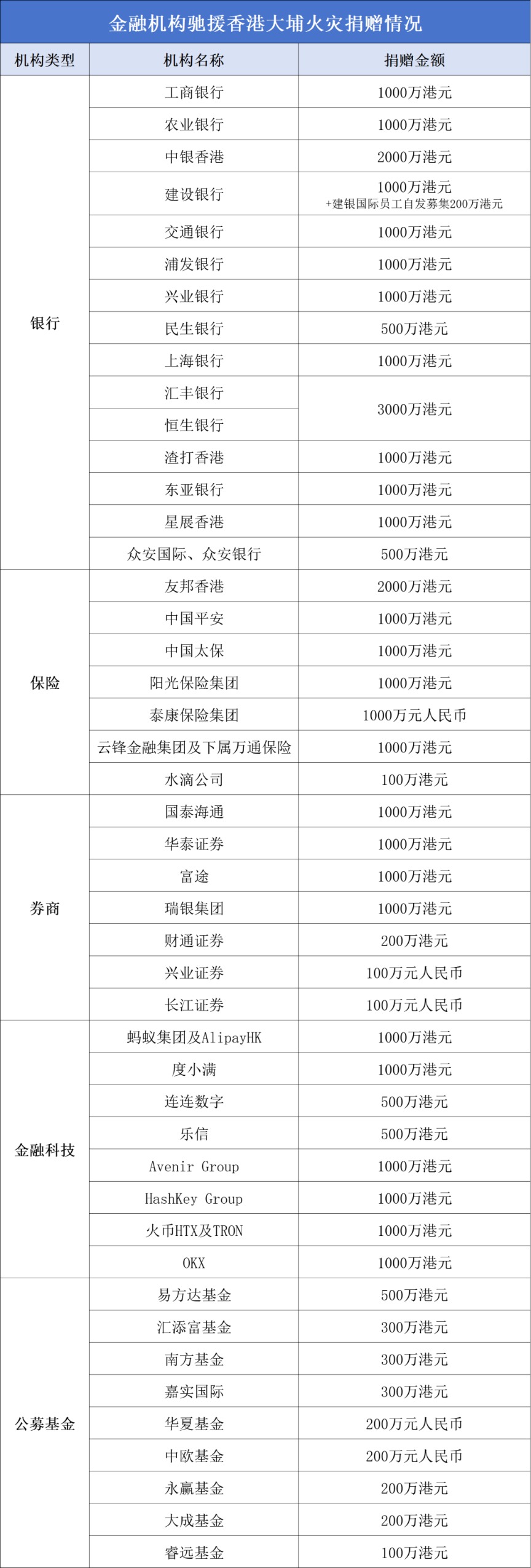
逾3.7亿港元!近50家金融机构捐款捐物驰援香港大埔火灾
Guo Ji Jin Rong Bao· 2025-11-29 10:06
Core Viewpoint - The fire at Hong Kong's Tai Po Wang Fuk Court resulted in significant casualties, with 128 confirmed dead and around 200 individuals unaccounted for, prompting a swift response from the financial sector to support relief efforts [1][2]. Financial Institutions' Donations - Nearly 50 financial institutions have contributed over 370 million HKD to aid in disaster relief, including major banks, insurance companies, and fintech firms [1][2]. - Notable contributions include: - Bank of China Hong Kong: 20 million HKD - HSBC: 30 million HKD - Agricultural Bank of China: 10 million HKD [2][3][6]. Emergency Support Measures - The Hong Kong Monetary Authority and the Hong Kong Association of Banks urged banks to provide flexible support to affected individuals, including expedited cash withdrawals and waiving fees [6][7]. - Major state-owned banks, including ICBC and Agricultural Bank of China, quickly mobilized to assist in relief and reconstruction efforts [6][7]. Insurance Companies' Response - Insurance firms activated emergency plans, offering streamlined claims processes and immediate financial support to affected clients [9][10]. - AIA Hong Kong pledged 20 million HKD for community support and initiated contact with potentially affected clients [9][10]. Securities Firms' Contributions - Several securities firms, including Guotai Junan and Huatai Securities, donated funds to support emergency relief and reconstruction efforts [12][13]. - UBS announced a donation of 10 million HKD through its charitable foundation for community support [13][14]. Fintech Sector Involvement - Fintech companies, such as Ant Group and Du Xiaoman, contributed 10 million HKD each to assist with emergency relief and recovery efforts [17][18]. - Various digital asset platforms also pledged significant donations to support affected communities [19]. Public Fund Contributions - Public fund companies collectively donated over 20 million HKD to support disaster relief and recovery initiatives [20][21]. - Notable contributions include: - E Fund: 5 million HKD - Huatai Fund: 3 million HKD [21][22][23]. Overall Impact - The financial sector's rapid response and substantial contributions highlight its role as a stabilizing force in times of crisis, providing essential support to affected communities [27][28].



工商银行宣城分行:一张“明白纸”,让企业贷得更安心
Zhong Guo Jin Rong Xin Xi Wang· 2025-11-29 07:21
Group 1 - The core idea of the article is the introduction of the "Loan Clarity Paper" by the Bank of Communications in Xuancheng, which addresses the information asymmetry faced by enterprises when seeking financing [1] - The "Loan Clarity Paper" helps enterprises understand the total cost of loans, including various fees, thereby reducing their concerns about obtaining loans and the associated costs [1] - The implementation of the "Loan Clarity Paper" has significantly improved the efficiency and transparency of loan information access for enterprises, allowing them to clearly understand the composition and direction of each fee [1] Group 2 - The Bank of Communications in Xuancheng plans to continue promoting various measures to benefit enterprises, enhancing policy awareness and coverage to contribute to the high-quality development of the local economy [2]
超百家企业捐赠总额超12亿港元,企业驰援香港大埔火灾救援


第一财经· 2025-11-29 07:06
Core Points - A significant fire occurred in Hong Kong's Tai Po district, resulting in major casualties and prompting over 100 companies and foundations to donate for emergency relief and community recovery efforts, with total donations exceeding HKD 1.2 billion [2][4]. Donation Summary - Major companies such as Yuexiu Group donated HKD 10 million, while China Overseas and China State Construction contributed HKD 20 million [3]. - Tencent donated HKD 30 million, and Alibaba made an initial donation of HKD 20 million [3]. - Other notable contributions include HKD 30 million from the Li Ka Shing Foundation and HKD 12 million from the Chaozhou Association [4]. - The total amount of donations has surpassed HKD 1.2 billion as of the latest reports [4].

央行、工行、农行、中行、建行、交行等集体出手,全力支持救灾及灾后重建工作
2 1 Shi Ji Jing Ji Bao Dao· 2025-11-29 07:04
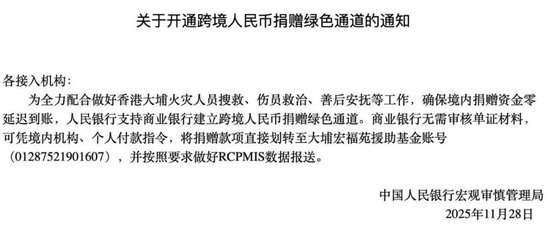
Core Viewpoint - Several major banks in China, including Industrial and Commercial Bank of China (ICBC), Agricultural Bank of China (ABC), Bank of China (BOC), China Construction Bank (CCB), and others, have collectively mobilized to provide financial support and aid for disaster relief following a significant fire incident in Hong Kong's Tai Po district, demonstrating a strong commitment to corporate social responsibility and community support [1][3][6][9][12][14][17][18]. Group 1: Donations and Financial Support - ICBC announced a donation of HKD 10 million to support disaster relief and reconstruction efforts, coordinating with its Hong Kong branches to provide emergency financial services and support for affected customers [3][12]. - ABC pledged HKD 10 million for fire rescue and post-disaster recovery, organizing volunteer teams and financial support for affected families [6][12]. - BOC committed HKD 20 million, establishing a dedicated donation account for public contributions and offering expedited banking services for affected clients [9][12]. - CCB also donated HKD 10 million, facilitating cross-border donations and providing emergency services for affected residents [12][14]. - Bank of Communications announced a donation of HKD 10 million, setting up emergency service stations and providing immediate cash support for affected customers [14][18]. Group 2: Collective Efforts from Other Banks - Other banks, including Shanghai Bank, Spdb Bank, and Minsheng Bank, collectively donated nearly HKD 100 million, with Spdb Bank and Minsheng Bank each contributing HKD 10 million and HKD 5 million respectively for emergency aid [17][18]. - Foreign banks such as HSBC and Hang Seng Bank jointly donated HKD 30 million, while Standard Chartered and DBS Bank each contributed HKD 10 million to support the affected residents [18].
央行、工行、农行、中行、建行、交行等集体出手
21世纪经济报道· 2025-11-29 06:51
Core Viewpoint - The article discusses the response of various banks in Hong Kong to a significant fire incident in Tai Po, which resulted in major casualties and damage. Multiple banks have pledged financial support and emergency services to assist in disaster relief and recovery efforts. Group 1: Bank Contributions - Industrial and Commercial Bank of China (ICBC) donated HKD 10 million for disaster relief and recovery efforts, mobilizing resources and forming a volunteer team to assist local government [3][5]. - Agricultural Bank of China also pledged HKD 10 million, coordinating with local organizations for direct aid to affected families and offering financial support for insurance claims [6]. - Bank of China announced a donation of HKD 20 million, establishing a special fund for public contributions and providing expedited banking services for affected customers [10][12]. - China Construction Bank contributed HKD 10 million, facilitating cross-border donations and enhancing customer service for those impacted [15]. - Bank of Communications committed HKD 10 million, setting up emergency service stations and providing immediate cash support to affected clients [21][23]. - Other banks, including Shanghai Bank and various foreign banks, collectively donated nearly HKD 100 million to support the relief efforts [25][26]. Group 2: Emergency Services and Support - ICBC implemented an emergency financial service mechanism, offering services like cash withdrawals without cards and loan extensions for affected customers [3][5]. - Agricultural Bank of China organized volunteer teams and established a green channel for insurance claims to expedite support for disaster victims [6]. - Bank of China set up a 24-hour hotline for customer assistance and simplified procedures for affected clients needing banking services [10][12]. - China Construction Bank opened a dedicated service counter for residents of the affected area and extended service hours to accommodate urgent needs [15]. - Bank of Communications provided essential supplies and set up priority service channels for residents to access emergency banking services [21][24].