ICBC(01398)

Search documents
贝莱德对工商银行的多头持仓比例增至5.09%
Xin Lang Cai Jing· 2026-01-29 09:12
据香港交易所披露,贝莱德对中国工商银行股份有限公司 - H股的多头持仓比例于2026年1月23日从 4.98%增至5.09%。 ...

工商银行召开2026年党建暨经营管理工作会议
Xin Lang Cai Jing· 2026-01-29 05:45
来源:中国工商银行 1月27日至28日,工商银行2026年党建暨经营管理工作会议在北京召开。会议以习近平新时代中国特色 社会主义思想为指导,深入学习贯彻党的二十大和二十届历次全会、省部级主要领导干部学习贯彻党的 二十届四中全会精神专题研讨班精神,落实中央经济工作会议、二十届中央纪委五次全会、全国金融系 统工作会议等部署,总结工作、分析形势、安排下阶段任务。党委书记、董事长廖林出席会议并讲话, 党委副书记、行长刘珺作经营分析报告。总行党委成员,董事会及高管层成员出席。 会议指出,2025年全行认真贯彻党中央决策部署,以中央巡视整改和深入贯彻中央八项规定精神学习教 育为促进,坚持党建引领、五化转型,交出了一份向新向优发展的年度答卷。"十四五"全行发展规划圆 满收官,中国特色世界一流现代金融机构建设迈出新步伐。 会议强调,要全面深刻准确领会和把握党的二十届四中全会作出的战略部署,制定实施好全行"十五 五"规划,打造一流银行、领军银行、清廉银行、现代银行。坚持"稳中求进、提质增效"及两个"更好统 筹",坚持正确的政绩观,坚持"防风险、强监管、促高质量发展"金融工作主线,持续做强主业、做优 质效、做大贡献。 一是提升防 ...
工行内蒙古分行携手中企云链落地内蒙古地区首单“链数”数字供应链融资业务
Xin Lang Cai Jing· 2026-01-29 02:13
Core Insights - The successful launch of the "Chain Number" digital supply chain financing business by the Industrial and Commercial Bank of China (ICBC) Inner Mongolia Branch in collaboration with the supply chain financial service platform Zhongqi Yunlian marks a significant advancement in supply chain financing and digital inclusive finance in the region [1][2] Group 1: Significance of the "Chain Number" Business - The "Chain Number" business fills a regional gap and sets a precedent for financial innovation, creating a new model for digital supply chain financing in Inner Mongolia [2] - It enriches the product system and enhances service capabilities, integrating into ICBC Inner Mongolia Branch's digital inclusive finance product lineup, which includes three major online product lines, significantly expanding service scenarios [2] - The collaboration effectively reduces overall financing costs in the supply chain and optimizes cash flow management for enterprises, supporting the stable supply chain of regional core enterprises and promoting upstream and downstream collaborative development [3] Group 2: Future Directions - The successful launch of the "Chain Number" business reflects the commitment of ICBC Inner Mongolia Branch to serve the real economy and promote the deep integration of financial technology with industry [3] - The bank aims to continue deepening the application of financial technology innovations and expanding the breadth and depth of digital supply chain financial services [3] - The goal is to build a more complete, efficient, and secure supply chain financial ecosystem, contributing to the stability and upgrading of key industrial chains in Inner Mongolia [3]
六大行迅速发布信用卡分期贴息“指南”
Jin Rong Shi Bao· 2026-01-29 01:11
Core Viewpoint - The new policy on credit card installment interest subsidies aims to enhance consumer spending by including credit card bill installment services in the subsidy scope, thereby reducing the financial burden on consumers and stimulating consumption potential [1][4]. Group 1: Policy Implementation - The Ministry of Finance, the People's Bank of China, and the National Financial Regulatory Administration issued a notification that includes credit card bill installment services in the subsidy scope with a uniform annual subsidy rate of 1% [1]. - Major state-owned banks and some joint-stock banks have quickly responded by releasing implementation details, simplifying processes, and enhancing risk control measures to ensure effective policy execution [2][3]. - The policy reflects a strong public demand for support in consumer financing, aligning with the principle of "people-centered" policy design [2]. Group 2: Consumer Benefits - The subsidy allows consumers to save approximately 270 yuan in interest over a year when using a 50,000 yuan credit card bill divided into 12 installments [4]. - The policy is expected to significantly alleviate financial pressure on large purchases such as home appliances, cars, and education, thus converting latent consumer demand into actual purchasing behavior [4][5]. - The annual cap for total subsidies has been raised to 3,000 yuan per borrower, with the removal of previous limits on single transaction subsidies [5]. Group 3: Bank Responses and Services - Six major banks have clarified that existing customers with signed agreements will automatically benefit from the new policy without needing to re-sign [2]. - Banks like Agricultural Bank and Postal Savings Bank have outlined the steps for new customers to apply for the credit card installment interest subsidy, emphasizing a simplified process [2][3]. - The banks have committed to not charging any fees for processing the subsidy applications, ensuring a cost-free experience for consumers [8]. Group 4: Market Impact and Growth Potential - The policy is anticipated to drive growth in credit card installment services, especially as consumer awareness increases leading up to the Spring Festival [6]. - Smaller financial institutions are also preparing to implement similar measures, which will help extend the benefits to lower-tier cities and meet diverse consumer needs [6]. - The inclusion of credit card installments in the subsidy program is seen as a crucial step in supporting consumption expansion and improving the quality of financial services [7].


智通ADR统计 | 1月29日
智通财经网· 2026-01-28 22:52
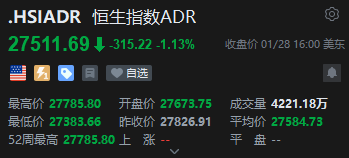
Market Overview - US stock indices showed mixed performance on Wednesday, with the Hang Seng Index ADR rising but closing lower compared to Hong Kong's market close, at 27,511.69 points, down 315.22 points or 1.13% [1] Major Blue-Chip Stocks - HSBC Holdings closed at HKD 135.752, down 1.27% from the Hong Kong market close [2] - Tencent Holdings closed at HKD 613.539, down 1.20% from the Hong Kong market close [2] Stock Performance Summary - Tencent Holdings: Latest price HKD 621.000, up 2.31%, ADR price HKD 613.539, down 1.20% [3] - Alibaba Group: Latest price HKD 173.500, up 2.12%, ADR price HKD 171.309, down 1.26% [3] - HSBC Holdings: Latest price HKD 137.500, up 2.23%, ADR price HKD 135.752, down 1.27% [3] - Xiaomi Group: Latest price HKD 36.320, up 2.14%, ADR price HKD 35.857, down 1.27% [3] - AIA Group: Latest price HKD 88.850, up 2.78%, ADR price HKD 87.888, down 1.08% [3] - Meituan: Latest price HKD 56.86, up 1.86%, ADR price HKD 97.328, down 1.04% [3] - BYD Company: Latest price HKD 102.800, up 4.58%, ADR price HKD 101.502, down 1.26% [3]






冯建龙,被开除党籍!通过民间借贷获取大额回报、违规收受大额钱款
券商中国· 2026-01-28 14:34
Core Viewpoint - The article discusses the disciplinary actions taken against several senior officials of state-owned banks in China, highlighting the ongoing crackdown on corruption within the banking sector, particularly focusing on the case of Feng Jianlong, a former senior executive of Agricultural Bank of China [1][2][3]. Summary by Sections Disciplinary Actions - Feng Jianlong, former chief expert and party secretary of Agricultural Bank of China Zhejiang branch, was expelled from the party and is under criminal investigation for serious violations of discipline and law [1]. - Since 2026, multiple senior officials from state-owned banks have faced similar disciplinary actions, including Wang Guobiao, Gao Qiang, and Chen Kunyong, all of whom were expelled from the party and public office [1][4]. Corruption Allegations - Feng Jianlong is accused of losing his ideals and beliefs, resisting organizational scrutiny, and engaging in superstitious activities. He violated central regulations by accepting banquets, misusing service vehicles, and seeking special treatment for himself and his family [2][3]. - He also allegedly engaged in illegal activities such as obtaining large returns through private lending, receiving substantial sums of money, and misusing his position for personal gain [3]. Broader Context of Corruption in Banking - The article notes that several other senior officials from the Zhejiang branch of state-owned banks have also been implicated in corruption, including Cheng Jun and Guo Xingan from Bank of China, and Shen Rongqin from Industrial and Commercial Bank of China [4][6]. - High Qiang's case is highlighted, where he was found to have lost his ideals, engaged in corrupt practices, and used his position to benefit others in loan approvals and financing [4][5]. Recent Developments - In 2023, several other senior officials from state-owned banks have been expelled for serious violations, including Chen Kunyong and Ge Chunyu, both of whom faced similar allegations of corruption and misconduct [6][7].


工商银行云南省分行原党委书记、行长郭伟接受纪律审查和监察调查
Bei Jing Shang Bao· 2026-01-28 13:13
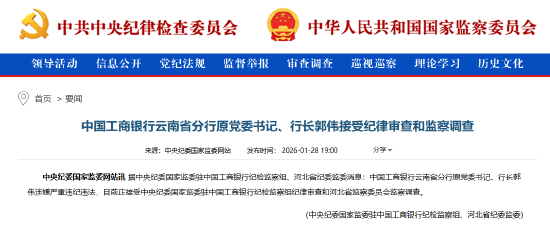
北京商报讯(记者 宋亦桐)1月28日,据中央纪委国家监委网站消息,据中央纪委国家监委驻中国工商 银行(601398)纪检监察组、河北省纪委监委消息:中国工商银行云南省分行原党委书记、行长郭伟涉 嫌严重违纪违法,目前正接受中央纪委国家监委驻中国工商银行纪检监察组纪律审查和河北省监察委员 会监察调查。 ...
中国工商银行云南省分行原党委书记、行长郭伟被查
Zhong Guo Xin Wen Wang· 2026-01-28 11:44
本文为转载内容,授权事宜请联系原著作权人 中新经纬版权所有,未经书面授权,任何单位及个人不得转载、摘编或以其它方式使用。 关注中新经纬微信公众号(微信搜索"中新经纬"或"jwview"),看更多精彩财经资讯。 中新网1月28日电 据中央纪委国家监委驻中国工商银行纪检监察组、河北省纪委监委消息,中国工商银 行云南省分行原党委书记、行长郭伟涉嫌严重违纪违法,目前正接受中央纪委国家监委驻中国工商银行 纪检监察组纪律审查和河北省监察委员会监察调查。 来源:中国新闻网 编辑:王永乐 中国工商银行云南省分行原党委书记、行长郭伟被查 广告等商务合作,请点击这里 ...
工商银行云南省分行原行长郭伟被查
Bei Jing Ri Bao Ke Hu Duan· 2026-01-28 11:35
据中央纪委国家监委驻中国工商银行纪检监察组、河北省纪委监委消息:中国工商银行云南省分行原党 委书记、行长郭伟涉嫌严重违纪违法,目前正接受中央纪委国家监委驻中国工商银行纪检监察组纪律审 查和河北省监察委员会监察调查。 来源:中央纪委国家监委网站 ...
工商银行云南省分行原党委书记、行长郭伟被查
Xin Lang Cai Jing· 2026-01-28 11:25
责任编辑:秦艺 1月28日金融一线消息,据中央纪委国家监委驻中国工商银行纪检监察组、河北省纪委监委消息:中国 工商银行云南省分行原党委书记、行长郭伟涉嫌严重违纪违法,目前正接受中央纪委国家监委驻中国工 商银行纪检监察组纪律审查和河北省监察委员会监察调查。 1月28日金融一线消息,据中央纪委国家监委驻中国工商银行纪检监察组、河北省纪委监委消息:中国 工商银行云南省分行原党委书记、行长郭伟涉嫌严重违纪违法,目前正接受中央纪委国家监委驻中国工 商银行纪检监察组纪律审查和河北省监察委员会监察调查。 责任编辑:秦艺 ...