PSBC(01658)

Search documents
事关个贷贴息,工行、农行、中行、建行、交行、邮储银行答复
Jin Rong Shi Bao· 2025-09-06 09:08
Core Points - The personal consumption loan interest subsidy policy was officially implemented on September 1, 2023, allowing residents to enjoy interest subsidies on loans used for consumption until August 31, 2026 [1] - Major banks are actively promoting this policy through their mobile banking apps and have established "subsidy zones" for customers [1] Group 1: Implementation Details - The subsidy applies to personal consumption loans from six major state-owned banks, twelve national joint-stock commercial banks, and five other lending institutions, specifically for loans that can be identified as used for consumption [1] - Agricultural Bank of China clarified that loans issued between September 1, 2025, and August 31, 2026, can qualify for the subsidy if used for consumption, and borrowers do not need to refinance existing loans [2] Group 2: Transaction Recognition - Transactions eligible for automatic recognition include POS transactions, QR code payments, online payments, and transfers to corresponding business accounts [3] - For transactions not automatically recognized, customers can upload receipts to the bank's app for manual recognition starting September 6, 2023 [3] Group 3: Service Agreement and Channels - Customers can sign the subsidy service agreement through the mobile banking app upon loan approval, regardless of when the loan was signed [4] - Postal Savings Bank allows customers to process subsidy applications through its app and branches, emphasizing that no third parties will be involved in the process [5] Group 4: Fees and Compliance - China Bank confirmed that no fees will be charged for processing the personal consumption loan subsidy [6] - Industrial and Commercial Bank of China stated that it will strictly adhere to market principles and legal regulations, prohibiting fraudulent activities to obtain subsidies, with serious consequences for violators [8]





险资入市全拆解:连续五个季度大幅增配股票,二季度整体增配红利,整体仍增配科技
Xin Lang Cai Jing· 2025-09-06 07:29
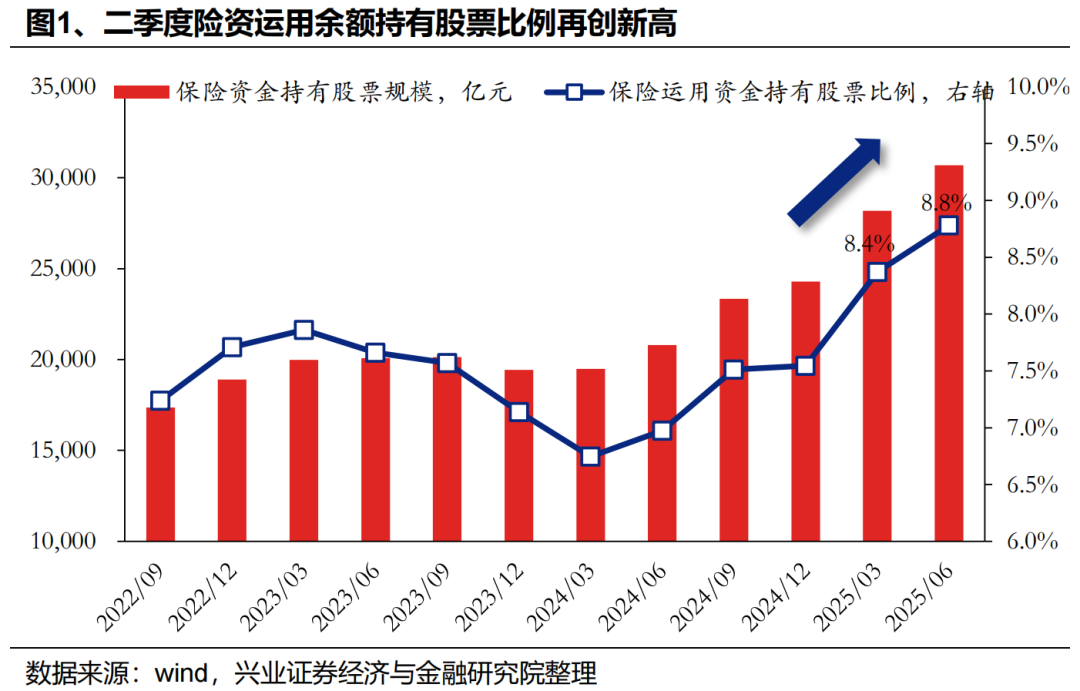
Group 1 - The performance evaluation methods for state-owned insurance companies have been continuously optimized since the beginning of the year, leading to an improved policy environment for insurance fund equity investments, which has accelerated the entry of insurance capital into the market [1] - In the second quarter, insurance companies further increased their stock allocations by approximately 200 billion yuan, with the proportion of stocks held rising by 0.4 percentage points to 8.8% compared to Q1 [1] - It is estimated that insurance capital will continue to increase allocations to A+H stocks by 300 to 400 billion yuan in the second half of the year, based on a 30% investment of new premium income [5] Group 2 - Insurance capital's participation in equity assets is gradually shifting from external management to direct investment, with a notable increase in stock holdings since Q4 2024, while fund holdings have decreased [8] - In the second quarter, insurance capital increased allocations to dividend-paying stocks while reducing holdings in energy sectors, with a focus on technology and high-end manufacturing [11] - The average dividend yield of the top 20 stocks increased to 3.80%, indicating a preference for high-dividend assets [13] Group 3 - Insurance capital has accelerated its stake acquisitions in listed companies, particularly in Hong Kong stocks, with 28 stake acquisitions recorded by August 31, surpassing the total for the previous year [16] - The preference for Hong Kong assets has made insurance capital a core driver of the rise in Hong Kong dividend assets [19] Group 4 - In the first half of 2025, insurance capital's holdings in ETFs saw a slowdown, with a total of 214.9 billion yuan held, reflecting a shift towards direct investments [23] - Despite the slowdown in total ETF allocations, there has been a significant internal structural adjustment, with increased allocations to TMT, manufacturing, and financial real estate sector ETFs [29] Group 5 - The five listed insurance companies in A-shares increased their stock holdings by 411.9 billion yuan in the first half of the year, representing a 28.7% increase [33] - The proportion of FVOCI stocks held by listed insurance companies has significantly increased, with a 62.2% rise in holdings [36]



多家银行高管发声!下半年息差形势如何应对?
券商中国· 2025-09-06 02:16
Core Viewpoint - The banking industry is facing ongoing pressure on net interest margins, but there are positive signals indicating potential stabilization through proactive asset-liability management and structural optimization [2][3]. Summary by Sections Net Interest Margin Trends - Among 42 A-share listed banks, 38 experienced a decline in net interest margin in the first half of 2025 compared to 2024, with only 3 showing improvement [3]. - Major state-owned banks reported net interest margins as follows: ICBC at 1.30% (down 13 basis points), CCB at 1.40% (down 14 basis points), ABC at 1.32% (down 13 basis points), BOC at 1.26% (down 18 basis points), PSBC at 1.70% (down 21 basis points), and CMB at 1.21% (down 8 basis points) [3]. - The decline in net interest margins is attributed to factors such as the continuous decrease in LPR rates, adjustments in existing mortgage rates, and the Fed's rate cuts, leading to asset yields declining faster than liability costs [3]. Future Outlook for Net Interest Margins - Bank executives anticipate that net interest margins may stabilize in the second half of 2025, despite ongoing downward pressure [5][6]. - ICBC's vice president noted that while net interest margins are expected to decline, the rate of decline is projected to slow down, supported by effective asset-liability management strategies [5]. - Agricultural Bank of China's president indicated that as deposits mature and interest rates adjust, the cost of liabilities is expected to decrease, potentially stabilizing net interest margins [6]. Strategies for Stabilizing Net Interest Margins - Banks are focusing on optimizing their business structures and enhancing pricing strategies to stabilize net interest margins [8]. - Huaxia Bank plans to improve asset quality and manage liabilities more effectively to support net interest margin stability [8]. - China Merchants Bank emphasizes the importance of external factors and plans to enhance asset-liability management to maintain reasonable net interest margins [8]. Proactive Management Initiatives - Banks are adopting a comprehensive approach to improve net interest margins, including optimizing asset-liability structures and enhancing customer engagement [9]. - The focus is on balancing various business lines and improving the efficiency of fund management to mitigate the impact of declining interest rates [9].

中国平安人寿保险股份有限公司增持邮储银行1238.1万股 每股作价约5.71港元
Zhi Tong Cai Jing· 2025-09-05 11:45
Group 1 - The core point of the article is that China Ping An Life Insurance Company has increased its stake in Postal Savings Bank of China by acquiring 12.381 million shares at a price of HKD 5.7094 per share, totaling approximately HKD 70.6881 million [1] - After the acquisition, China Ping An's total shareholding in Postal Savings Bank is approximately 3.18 billion shares, representing a holding percentage of 16.01% [1]

中国平安人寿保险股份有限公司增持邮储银行(01658)1238.1万股 每股作价约5.71港元
智通财经网· 2025-09-05 11:42
Group 1 - The core point of the article is that China Ping An Life Insurance Company has increased its stake in Postal Savings Bank of China by acquiring 12.381 million shares at a price of 5.7094 HKD per share, totaling approximately 70.6881 million HKD [1] - After the acquisition, China Ping An's total shareholding in Postal Savings Bank is approximately 3.18 billion shares, representing a holding percentage of 16.01% [1]

邮储银行(601658):2025年半年报点评:非息贡献增长,营收利润增速转正
Dongxing Securities· 2025-09-05 09:22
Investment Rating - The report maintains a "Strong Buy" rating for Postal Savings Bank of China (601658.SH) [9] Core Views - The bank's revenue and net profit growth turned positive in the first half of 2025, with revenue at CNY 179.45 billion and net profit at CNY 49.23 billion, reflecting year-on-year increases of 1.5% and 0.8% respectively [1] - Non-interest income significantly contributed to revenue growth, with a 25.2% year-on-year increase in other non-interest income, while net interest income saw a decline of 2.7% [2] - The bank's asset quality remains stable, with a non-performing loan (NPL) ratio of 0.92% as of June 2025, showing a slight increase from the previous quarter [5] Summary by Sections Financial Performance - In 1H25, the bank's revenue grew by 1.5% year-on-year, with a sequential improvement of 1.6 percentage points from 1Q25 [2] - The bank's net interest income decreased by 2.7% year-on-year, but the decline was less severe compared to previous periods [2] - Other non-interest income surged by 25.2%, driven by a recovery in the bond market and increased trading gains, with investment income rising by 64.6% [2] Loan Growth - As of June 2025, the bank's total assets and loans increased by 10.8% and 10.1% year-on-year, respectively, outpacing state-owned banks [3] - Corporate loans grew by 14.8%, while retail loans saw a modest increase of 1.9% [3] Interest Margin - The net interest margin (NIM) for 1H25 was 1.7%, down 17 basis points from 2024, with a year-on-year decline of 21 basis points [4] - The bank's deposit and interest-bearing liabilities interest rates decreased by 21 basis points compared to 2024, but the decline was less than the average of the five major banks [4] Asset Quality - The NPL ratio stood at 0.92% as of June 2025, with a slight increase of 1 basis point from the previous quarter [5] - The bank's provision coverage ratio was 260.4%, indicating a strong buffer against potential loan losses [5] Future Outlook - The report forecasts a net profit growth of 1.5%, 2.8%, and 3.8% for 2025, 2026, and 2027, respectively, with corresponding book value per share (BVPS) estimates of CNY 7.59, CNY 8.12, and CNY 8.20 [9][10]
国有大型银行板块9月5日跌2.12%,邮储银行领跌,主力资金净流出6.32亿元
Zheng Xing Xing Ye Ri Bao· 2025-09-05 08:56
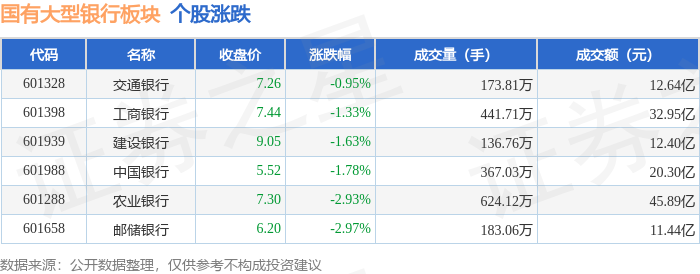
Core Viewpoint - The state-owned large banks sector experienced a decline of 2.12% on September 5, with Postal Savings Bank leading the drop, while the overall market indices showed an increase [1] Group 1: Market Performance - The Shanghai Composite Index closed at 3812.51, up 1.24% - The Shenzhen Component Index closed at 12590.56, up 3.89% [1] Group 2: Individual Bank Performance - Postal Savings Bank (601658) closed at 6.20, down 2.97% with a trading volume of 183.06 million and a turnover of 1.144 billion - Agricultural Bank of China (601288) closed at 7.30, down 2.93% with a trading volume of 624.12 million and a turnover of 4.589 billion - Industrial and Commercial Bank of China (601398) closed at 7.44, down 1.33% with a trading volume of 441.71 million and a turnover of 3.295 billion - China Construction Bank (601939) closed at 9.05, down 1.63% with a trading volume of 136.76 million and a turnover of 1.240 billion - Bank of China (601988) closed at 5.52, down 1.78% with a trading volume of 367.03 million and a turnover of 2.030 billion - Bank of Communications (601328) closed at 7.26, down 0.95% with a trading volume of 173.81 million and a turnover of 1.264 billion [1] Group 3: Fund Flow Analysis - The state-owned large banks sector saw a net outflow of 632 million from main funds, while retail funds experienced a net inflow of 71.03 million - The sector attracted a net inflow of 561 million from speculative funds [1][2] Group 4: Detailed Fund Flow for Individual Banks - Postal Savings Bank: Main funds net outflow of 32.03 million, speculative funds net inflow of 35.16 million, retail funds net outflow of 3.13 million - Industrial and Commercial Bank: Main funds net outflow of 54.24 million, speculative funds net inflow of 27.76 million, retail funds net inflow of 26.48 million - Bank of China: Main funds net outflow of 54.66 million, speculative funds net inflow of 101 million, retail funds net outflow of 46.28 million - China Construction Bank: Main funds net outflow of 95.08 million, speculative funds net inflow of 58.67 million, retail funds net inflow of 36.41 million - Bank of Communications: Main funds net outflow of 149 million, speculative funds net inflow of 116 million, retail funds net inflow of 33.23 million - Agricultural Bank: Main funds net outflow of 247 million, speculative funds net inflow of 223 million, retail funds net inflow of 24.33 million [2]

银行股午后震荡走弱
Di Yi Cai Jing· 2025-09-05 06:13
Group 1 - Agricultural Bank of China fell over 3% [1] - Postal Savings Bank, Jiangyin Bank, Citic Bank, and Huaxia Bank all dropped over 2% [1] - Bank of China, China Construction Bank, and Chongqing Bank also experienced declines [1]


上半年银行新增15万高净值客户,“科学家”正在成为新宠?
第一财经· 2025-09-05 05:18
Core Viewpoint - The high-net-worth client segment is a key focus for retail banking, with significant potential for value extraction. The private banking business is seen as a cornerstone for wealth management transformation, showcasing structural differentiation among banks [2][8]. Group 1: Private Banking Growth and Client Statistics - As of June 2025, 15 banks reported private banking data, with a total client base exceeding 1.63 million, an increase of nearly 150,000 clients, representing a growth rate of over 10% [2]. - The four major state-owned banks have crossed the 3 trillion yuan mark in Assets Under Management (AUM), with Agricultural Bank of China leading at 3.5 trillion yuan, followed by China Bank at 3.4 trillion yuan, and Construction Bank at 3.18 trillion yuan, which saw a 14.39% growth [4][5]. - Postal Savings Bank reported a client growth of over 21%, adding 7,200 clients to reach 41,400, marking the highest growth rate among state-owned banks [4]. Group 2: Performance of Joint-Stock Banks - Joint-stock banks displayed a mixed performance, with China Merchants Bank leading in client numbers at 182,700, an increase of 13,600 clients, representing an 8% growth [5]. - Ping An Bank was the only bank to report a decline in AUM, with a slight decrease of 0.5% to 1.97 trillion yuan, although it added 3,100 clients [5][9]. - CITIC Bank and Industrial Bank maintained steady growth, with AUMs of 1.28 trillion yuan and 1.05 trillion yuan, respectively, showing growth rates of 9.33% and 9.59% [6]. Group 3: Regional Banks and Competitive Landscape - Regional banks like Ningbo Bank and Beijing Bank exhibited strong growth, with AUM growth rates of 17.62% and 17.06%, respectively [7]. - The competitive landscape is characterized by a concentration of top-tier banks and differentiated competition, with smaller banks focusing on niche markets or specific industries [7][10]. Group 4: Changing Client Demographics and Service Models - The profile of private banking clients is shifting, with a growing emphasis on new wealth groups such as scientists and entrepreneurs, diverging from the traditional client base of business owners [9][10]. - Banks are redefining their private banking client categories based on their strengths, with a focus on family wealth transfer, pension finance, and enhanced offline services [10][11]. Group 5: Strategic Importance of Private Banking - Private banking is becoming a critical component of retail banking transformation, providing stability in asset scale and high value-added services, essential for optimizing client structures and stabilizing short-term performance [10][11].

用金融温度温暖老年人
Jin Rong Shi Bao· 2025-09-05 05:01
Core Insights - The article highlights the efforts of the People's Bank of China in Baiyin City to enhance financial services for the elderly population, referred to as the "silver-haired group" [2][6] - It emphasizes the implementation of a series of measures aimed at improving payment services and financial accessibility for senior citizens [4][5] Group 1: Service Initiatives - The Postal Savings Bank of China provided personalized service by sending staff to assist an elderly customer with a frozen bank account, demonstrating a commitment to customer care [1] - The People's Bank of China has established a green channel for elderly customers, ensuring they receive timely assistance and support [4][5] - Financial institutions are encouraged to implement "warm-hearted" service modes, including the use of mobile devices for on-site assistance [5] Group 2: Financial Product Engagement - Elderly individuals in Baiyin City have a high savings capacity, with a total deposit balance of 32.2% of the city's personal deposits, indicating significant financial potential [6] - The preference for low-risk financial products among the elderly is evident, with 33.47% of national bonds and 31.42% of wealth management products sold to this demographic [6] Group 3: Training and Awareness - Banks are conducting regular training for staff to enhance their ability to identify and respond to the needs of elderly customers, particularly in preventing financial fraud [9] - There is a focus on community outreach to raise awareness about financial scams targeting the elderly, ensuring their financial security [9] Group 4: Infrastructure and Accessibility - The People's Bank of China has guided financial institutions to improve accessibility for elderly clients, including the installation of barrier-free facilities and the provision of home service options [4][5] - The implementation of "warm-hearted" banking apps and self-service machines tailored for elderly users has been completed across 269 bank branches [5]