PSBC(01658)

Search documents
全国信用卡存量三年减少1亿张,不良贷款率攀升至2.40%
Cai Jing Wang· 2025-12-04 14:03
Core Insights - The credit card market in China is undergoing a significant contraction, with a reduction of 100 million cards over three years, reflecting a decline in consumer confidence and increased preventive savings [1][2] - As of the end of Q3 2023, the total number of credit cards and loan cards in circulation is 707 million, down from a peak of 807 million in June 2022, marking a continuous decline for 12 consecutive quarters [1] - The rise in credit card non-performing loan (NPL) rates to 2.40% as of mid-2023 indicates increasing asset quality pressures on banks, leading to a strategic shift in credit card issuance [1] Industry Trends - The ongoing reduction in credit card numbers is not a short-term fluctuation but a structural adjustment driven by stringent regulatory policies and insufficient consumer demand [1] - Banks are adopting differentiated strategies in card issuance, with some institutions like Postal Savings Bank and Bank of Communications reducing their card inventories, while others like China Merchants Bank and CITIC Bank are increasing their card issuance through targeted marketing [2] - Deloitte's report suggests a shift in the industry focus from quantity to quality in credit card issuance, indicating a more cautious approach by banks in response to market conditions [2]





邮储银行武陟县支行:多方合力筑牢反诈防线
Huan Qiu Wang· 2025-12-04 09:24
据悉,此次培训是武陟县邮银双方深化协同合作、践行社会责任的重要举措,也是构建反诈工作合力的 具体实践。培训中,武陟县反诈中心民警结合近年来高发的电信网络诈骗案例,聚焦"虚假投资理 财""冒充客服退款""冒充公检法"等常见诈骗类型,深入剖析了诈骗分子的作案手段、话术设计及诱导 逻辑。 来源:环球网 为进一步筑牢金融安全防线,提升金融从业者反诈履职能力与群众风险防范意识,近日,邮储银行武陟 县支行联合该县邮政分公司、县反诈中心,共同组织网点一线员工开展反诈宣传专题培训。 针对银行网点业务场景,工作人员重点讲解了开户审核、转账汇款、大额资金异动等环节的反诈防控要 点,指导员工如何快速识别可疑交易、拦截诈骗风险,并向客户开展有效的反诈提示。 下一步,邮银双方将持续强化与反诈中心的合作,通过张贴宣传海报、发放宣传手册、利用网点LED屏 滚动播放反诈标语等多种形式,向广大群众普及反诈知识,切实提升群众的识骗、防骗、拒骗能力,全 力守护群众的"钱袋子",为维护地方金融秩序稳定贡献邮银力量。(谢新平) ...
一财主播说 | 六家国有大行明年年初派发2000亿红包 工行派息超500亿 规模最大
Di Yi Cai Jing· 2025-12-04 06:59
六大国有行中期分红将陆续发放!邮储银行最新公告,将于2026年2月13日派发中期股息每10股1.23 元,合计派息约147.72亿元。除邮储银行外,其他五家国有银行也计划明年1月进行中期分红。其中, 工商银行拟每10股派1.414元(含税),派息约503.96亿元,派息规模最大,建行、农行派息规模超过 400亿元。六家国有银行合计派息规模约2046.57亿元。银行中期分红从"可选项"逐渐转变为"常规动 作",与近年来监管层持续倡导密不可分。业内认为,这既是银行响应监管号召、稳定投资者预期,也 折射出上市银行盈利稳健性与现金流的持续巩固。 ...


金融赋能康养:邮储银行医养结合贷款为老年人幸福生活“加码”
Qi Lu Wan Bao· 2025-12-04 06:24
据悉,项目建成后,将成为一所布局合理、服务完善、管理科学、环境优雅的高品质医养中心。届时老 年人可实现"住得安心、吃得舒心、玩得开心、健康有保障",子女也能放心,真正将其打造为老年人颐 养天年的"幸福之家",让老年人切实感受党和政府的关怀,共享社会发展成果。 养老产业发展,资金保障是关键。邮储银行济宁市分行在获悉该医养健康中心的项目信息后,迅速启动 服务响应机制,将金融支持落到实处。针对该项目"省内首笔" 的特殊性,省、市分行组建前中台敏捷 专班,通过现场调研,结合项目实际梳理政策疑问、评估风险收益,量身定制专业化综合金融服务方 案。 市分行指派经验丰富的客户经理现场驻点,协助支行整理申报材料、跟进审批流程,最大限度压缩业务 办理时间,推动贷款快速落地。 近日,邮储银行(601658)济宁市分行成功向当地某医养健康中心提升改造项目发放医养结合类养老产 业贷款。作为该行在山东省内发放的首笔此类专项贷款,目前已累计向项目投放贷款1.66亿元,不仅填 补了省内业务空白,更以可复制的金融服务模式,为全省养老产业信贷业务的推广提供了示范样本,为 康养产业发展注入强劲动能。 ...
六家国有大行将在2026年年初派发2000亿红包!
Zhong Guo Jing Ying Bao· 2025-12-04 04:56
Core Viewpoint - The announcement of mid-term dividends by Postal Savings Bank and other state-owned banks reflects a positive trend in the banking sector, indicating strong profitability and cash flow stability, as well as a response to regulatory encouragement for increased shareholder returns [1][2][3][4] Group 1: Dividend Announcements - Postal Savings Bank will distribute a mid-term dividend of 1.23 yuan per 10 shares, totaling approximately 14.772 billion yuan, which accounts for 30% of its net profit attributable to shareholders for the first half of 2025 [1] - Other five state-owned banks are also planning mid-term dividends in January 2026, with a total payout of approximately 204.657 billion yuan [1] - As of December 3, 2023, 14 out of 42 A-share listed banks have completed mid-term dividend distributions, with total cash dividends exceeding 260 billion yuan [2] Group 2: Regulatory Influence - The increase in the number and scale of mid-term dividends in 2025 compared to 2024 is attributed to the implementation of new regulations aimed at enhancing dividend predictability and stability [2][3] - The China Securities Regulatory Commission has issued guidelines to simplify mid-term dividend procedures and encourage companies to increase dividend frequency [3] Group 3: Profitability and Market Response - Despite challenges such as narrowing net interest margins, listed banks, particularly large state-owned banks, continue to show strong profitability and willingness to distribute dividends [3][4] - Some banks have increased their mid-term dividend payout ratios, with Shanghai Bank at 32.22% and Hu Nong Commercial Bank at 33.14%, reflecting a trend towards higher shareholder returns [3] Group 4: Future Outlook - The trend of increasing mid-term dividends is expected to continue, with more banks likely to join the practice, enhancing the attractiveness of bank stocks to investors [4] - The banking sector is characterized as a low-valuation, high-dividend sector, with many large banks achieving new stock price highs this year [4]

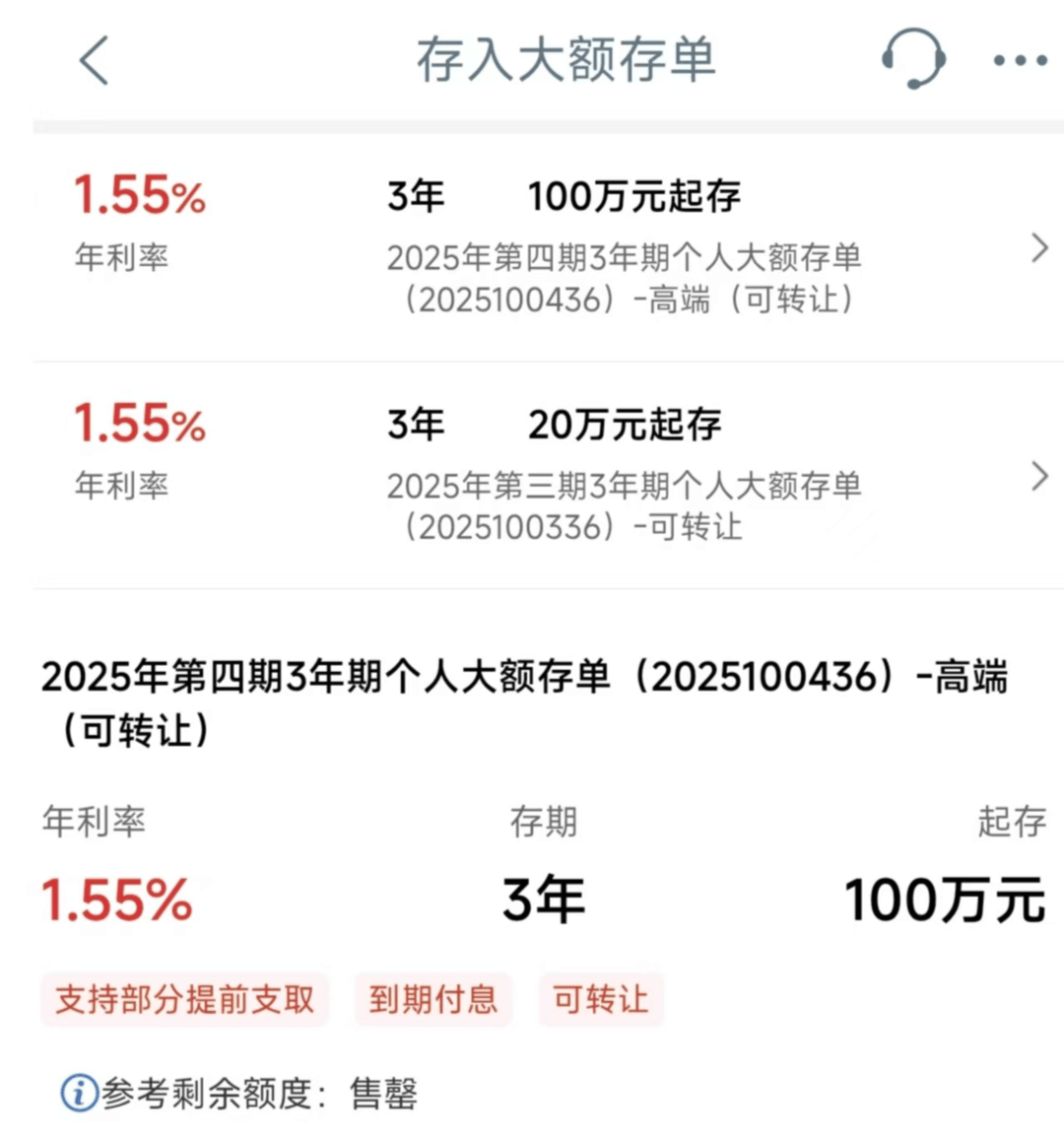
大额存单起存门槛升高,工行存100万与存20万利率相同,农行存500万利率1.55%
Sou Hu Cai Jing· 2025-12-04 03:59
Core Viewpoint - The latest issuance of 3-year large-denomination certificates of deposit (CDs) by Industrial and Commercial Bank of China (ICBC) has seen the minimum deposit requirement raised to 1 million yuan, with an interest rate of 1.55%, which is currently sold out [1][4]. Group 1: Large-Denomination CDs - The interest rate for the 3-year large-denomination CDs is set at 1.55% with a minimum deposit of 1 million yuan [2][3]. - Previously, ICBC offered a 3-year large-denomination CD with a minimum deposit of 200,000 yuan, also at an interest rate of 1.55% [1][4]. - Other banks, including China Construction Bank, Agricultural Bank of China, and Bank of China, are also offering 3-year large-denomination CDs with a minimum deposit of 200,000 yuan at the same interest rate of 1.55% [4]. Group 2: Market Dynamics and Strategies - The increase in the minimum deposit requirement for large-denomination CDs without a corresponding increase in interest rates reflects banks' proactive liability management strategies in a low-interest-rate environment [4]. - By raising the minimum deposit amount, banks are effectively tightening the supply of large-denomination CDs, aiming to optimize their liability structure and reduce reliance on high-cost deposits [4]. - The main advantages of large-denomination CDs over regular deposits, despite the current interest rate trends, include higher liquidity and flexibility, such as transferability and collateral options, making them suitable for large depositors with short-term capital needs [4].

烟台金融监管分局:辖区大型银行创新举措助推绿色低碳高质量发展
Qi Lu Wan Bao· 2025-12-04 02:09
2025年,是"绿水青山就是金山银山"理念提出20周年,是"双碳"目标提出5周年,也是中央金融工作会 议明确"绿色金融"等五篇大文章2周年。近年来,烟台金融监管分局紧紧围绕烟台市绿色低碳高质量发 展大局,深入贯彻落实国家及省市相关政策部署,坚持监管引领与服务实体相结合,引导辖区大型银行 切实发挥"头雁"作用,持续聚焦重点领域、优化金融服务、深化金融创新,为打造绿色低碳高质量发展 示范城市注入强劲动力。 引领信贷总量稳步增长 实现绿色规模"新突破" 烟台金融监管分局通过制定工作指引、开展季度监测、实施差异化监管等措施,引导大型银行持续加大 绿色信贷投放力度。截至2025年10月末,辖区大型银行绿色贷款余额突破1300亿元大关,较年初增幅达 20.8%,高于各项贷款平均增速9.73个百分点。在规模稳步增长的同时,信贷质量保持优异水平,绿色 贷款不良率仅为0.006%,远低于各项贷款平均水平。绿色贷款客户覆盖面显著扩大,存量户数突破1.65 万户,较年初增幅12.05%。绿色贷款占全部贷款比重提升至25.6%,较年初提高2.07个百分点,绿色金 融已成为信贷增长的重要引擎。 推动流程体系健全优化 构建绿色融资"新格 ...
首批3家全国性股份制银行AIC获准开业—— 促进我国投融资体系多元发展
Jing Ji Ri Bao· 2025-12-03 21:51
Core Insights - The recent approval of three financial asset investment companies (AICs) marks the establishment of the first batch of national joint-stock bank AICs in China, expanding the total number of bank-affiliated AICs to nine [1][2] Group 1: AIC Establishment and Function - The newly approved AICs include Xinyin Financial Asset Investment Co., Xinyin Financial Asset Investment Co., and Zhaoyin Financial Asset Investment Co., with registered capitals of 150 billion yuan and 100 billion yuan respectively [1] - AICs were initially designed for market-oriented debt-to-equity swaps, serving as a "risk isolation wall" and "asset restructuring expert" within the banking system, aimed at reducing corporate leverage and mitigating financial risks [1][3] - The role of AICs has evolved to become a major player in equity investment, particularly following recent policy expansions that have increased their investment scope and intensity [1] Group 2: Comparison Between AICs - The newly established AICs share common features with state-owned bank AICs, including core functions, regulatory frameworks, policy guidance, and operational models [2] - Differences exist in shareholder backgrounds, resource endowments, capital scales, and regional layouts, with state-owned AICs benefiting from larger asset scales and nationwide networks, focusing on large state-owned enterprises [2] - In contrast, joint-stock bank AICs have a slightly lower capital scale and are more concentrated in their initial focus, primarily serving private and innovative small and medium-sized enterprises [2] Group 3: Impact on the Economy - The entry of AICs is expected to significantly promote enterprise transformation and high-quality development by alleviating corporate debt burdens through debt-to-equity swaps, thereby facilitating technological research and product innovation [3] - AICs are positioned to support specialized and innovative enterprises, as well as technology-driven small and medium-sized enterprises, while also restructuring and revitalizing companies in debt distress through market-oriented and legal means [3]


大额存单概念正在淡化 稀缺额度锚定高端客户
Zhong Guo Zheng Quan Bao· 2025-12-03 20:28
Group 1 - The core viewpoint of the articles highlights the trend of major banks in China discontinuing five-year large denomination certificates of deposit (CDs), with many banks only offering shorter-term options or none at all [1][2] - Major banks have raised the minimum investment threshold for large denomination CDs, with some banks now requiring a minimum of 1 million yuan, indicating a shift in strategy to maintain high-end customer relationships [2][3] - The discontinuation of long-term large denomination CDs is seen as a method for banks to reduce high-cost liabilities and stabilize net interest margins amid declining market interest rates [3] Group 2 - The current offerings of large denomination CDs are limited, with banks like China Postal Savings Bank indicating that they have no CDs available for sale and may resume sales in January next year [2] - The interest rates for available large denomination CDs are relatively low, with rates around 1.40% to 1.55%, which may not attract high-end customers who prioritize security and exclusive services over interest rates [3] - Banks are expected to continue differentiating their deposit rates based on their liability structures and market conditions, as they face pressure to lower funding costs and maintain profitability [3]
百万门槛!六大行五年期大额存单消失,三年期也高不可攀?
Sou Hu Cai Jing· 2025-12-03 17:13
Core Viewpoint - The disappearance of long-term deposit products, particularly five-year large certificates of deposit (CDs), reflects the ongoing pressure on banks' net interest margins, leading to a reevaluation of their liability structures and product offerings [1][3][9] Group 1: Changes in Deposit Products - Major state-owned banks, including Industrial and Commercial Bank of China, Agricultural Bank of China, and others, have completely discontinued five-year large CDs, with some also reducing the availability of three-year products [3][5] - The current interest rate for a three-year large CD at Industrial and Commercial Bank is only 1.55%, with a minimum deposit requirement of 1 million yuan, contrasting sharply with the 50 yuan minimum for regular fixed deposits [5][17] - The trend of reducing long-term deposit products is not limited to large banks; some joint-stock banks and city commercial banks are also following suit, indicating a broader industry shift [3][7] Group 2: Impact on Customers - The increasing minimum deposit requirements for three-year products mean that large CDs are becoming exclusive to high-net-worth clients, moving away from their original target demographic of middle-class savers [5][11] - Ordinary depositors are facing challenges in asset allocation due to the scarcity of long-term deposit options, leading to a shift in savings behavior, with a notable decrease in the percentage of savers preferring to save more [13][17] - The current environment has prompted some depositors to seek higher returns or more diversified investment channels, reflecting a change in asset allocation strategies [13][15] Group 3: Industry Response - Banks are adjusting their product offerings in response to the pressure on net interest margins, with state-owned banks discontinuing five-year large CDs while smaller banks focus on shorter-term products [7][9] - The ongoing decline in loan rates and intense competition for deposits are squeezing banks' profit margins, necessitating a reevaluation of high-interest long-term deposit products [9][11] - Banks are increasingly using large CDs to attract high-quality new clients and as a stable asset for private banking clients, indicating a strategic shift in how these products are utilized [11][15]