CMBC(01988)

Search documents
8次甩卖、屡屡被罚、利润七连跌,民生银行怎么把日子越过越惨
Tai Mei Ti A P P· 2026-01-07 10:02
近期,民生银行因一张来自国家金融监督管理总局宁波监管局的220万元罚单,再次被推至舆论的风口 浪尖。同时,该行全年近8000万元的累计罚款、年底超过274亿元的信用卡不良资产"大甩卖",以及连 续七个季度同比下滑的净利润,勾勒出这家昔日"小微之王"在转型深水区挣扎求索的复杂图景。 2025 年,该行股价累计下跌 2.5%,截至1月7日发稿,收盘价跌至3.85元,较十年前的高位缩水超 60%;银登中心公开挂牌口径显示,该行全年狂甩超 274 亿元信用卡不良资产包,创下单一机构个贷不 良处置规模新纪录;年内收到的监管罚单金额累计达 7975.86 万元,合规风险持续暴露;前三季度归母 净利润同比下滑 6.38%,已连续七个季度负增长。 从1996年破冰而出的民营银行标杆,到如今股价徘徊于低位、资产质量承压、合规问题频发的"困难 生",民生银行正深陷多重困局。 业绩滑坡与合规漏洞下的困局 民生银行近年来的困境,最直观地体现在其核心财务数据的"失速"上。2025年前三季度,该行实现营业 收入1085.09亿元,虽同比增长6.74%,止住了自2021年以来的下滑趋势,但归属于股东的净利润却同比 下降6.38%,仅为28 ...

民生银行(01988) - 截至二零二五年十二月三十一日止股份发行人的证券变动月报表
2026-01-06 11:00
股份發行人及根據《上市規則》第十九B章上市的香港預託證券發行人的證券變動月報表 第 1 頁 共 11 頁 v 1.1.1 FF301 呈交日期: 2026年1月6日 I. 法定/註冊股本變動 | 1. 股份分類 | 普通股 | 股份類別 | H | | 於香港聯交所上市 (註1) | | 是 | | | --- | --- | --- | --- | --- | --- | --- | --- | --- | | 證券代號 (如上市) | 01988 | 說明 | H 股 | | | | | | | | | 法定/註冊股份數目 | | | 面值 | | 法定/註冊股本 | | | 上月底結存 | | | 8,320,295,289 | RMB | | 1 RMB | | 8,320,295,289 | | 增加 / 減少 (-) | | | 0 | | | RMB | | 0 | | 本月底結存 | | | 8,320,295,289 | RMB | | 1 RMB | | 8,320,295,289 | | 2. 股份分類 | 普通股 | 股份類別 | A | | 於香港聯交所上市 (註1) | | 否 | ...
中国民生银行荣获第十四届金融界“金智奖”杰出信用卡品牌价值奖
Jin Rong Jie Zi Xun· 2026-01-06 06:22
Group 1 - The "Qihang·2025 Financial Summit" was held in Beijing, focusing on the theme of "New Starting Point, New Momentum, New Journey," gathering hundreds of guests from various sectors to discuss development paths for the "14th Five-Year Plan" [1] - The "Golden Wisdom Award" was announced, with China Minsheng Bank receiving the "Outstanding Credit Card Brand Value Award" for its continuous efforts in brand building and value innovation [1][6] Group 2 - The "Golden Wisdom Award" aims to establish benchmarks for high-quality development, guiding enterprises to focus on their core business, promote innovation, and fulfill social responsibilities, covering over 8,000 companies in A-shares, Hong Kong stocks, and Chinese concept stocks [6] - The award for "Outstanding Credit Card Brand Value" emphasizes comprehensive brand strength, including market recognition, product service innovation, industry influence, and social responsibility [6] Group 3 - China Minsheng Bank adheres to its mission of "serving the public and caring for people's livelihoods," integrating national strategies with public service to enhance brand value through five major initiatives [7] - The bank is focusing on technological innovation to upgrade services, incorporating low-carbon concepts into products, offering customized services for public welfare finance, optimizing services for the elderly, and enhancing digital financial services [7] - Through these innovative measures, the bank's credit card services have evolved from a single payment tool to a "finance + service" ecosystem, achieving a systematic leap in brand value [7] - Looking ahead, China Minsheng Bank will continue to implement its five major initiatives, further optimizing its consumer finance service system and enhancing the effectiveness of services for the real economy [7]


银行今十条:个人信用修复变中介营销噱头;一个月内6家银行敲定首席合规官;周锋获批担任中原银行行长...
Jin Rong Jie· 2026-01-05 11:49
Group 1 - The China Interbank Market Dealers Association is increasing penalties for violations related to bond transaction record-keeping, as many institutions have failed to comply with regulations, hindering effective supervision and enforcement [1] - The Ministry of Commerce and nine other departments are encouraging financial institutions to increase support for green consumption loans, promoting collaboration between financial institutions and trade enterprises to expand the application scenarios for these loans [2] - Several small and medium-sized banks have suspended overseas debit card transactions due to rampant overseas card fraud, indicating a consensus in the industry to enhance risk control measures [3] Group 2 - The newly established financial asset investment companies, such as Xingyin Investment and Zhaoyin Investment, have quickly secured projects, with Xingyin Investment reporting over 6 billion yuan in investments within 45 days of operation, showcasing a divergence in project focus compared to state-owned banks [4] - The implementation of personal credit repair policies starting January 1, 2026, has led to the emergence of illegal intermediaries offering services to "clean" large overdue debts, charging fees ranging from 3,000 to 10,000 yuan [5] - A significant number of banks have appointed chief compliance officers in response to regulatory requirements, with multiple banks announcing such appointments within a month [6] Group 3 - Zhou Feng has been approved to serve as the president of Zhongyuan Bank, with his term starting from December 31, 2025, until the next board election [7] - The banking wealth management sector is expected to shift focus from scale expansion to stability in returns, with a projected 10% growth in market size for 2026, emphasizing a return to genuine stability [8] - The payment industry is undergoing a significant cleanup, with the recent cancellation of the payment license for Zhonggang Yintong, marking the 108th license to be revoked [9] - Wang Feng, the chairman of Bozhou Yaodu Rural Commercial Bank, is under investigation for serious violations of discipline and law, marking a notable case in the banking sector [10]



#8家银行APP仅1家展示持有收益率#上热搜 网友:冲着高收益率买理财,结果实际收益差一大截
Xin Lang Cai Jing· 2026-01-05 05:28
1月5日金融一线消息,#8家银行APP仅1家展示持有收益率#这一话题冲上热搜,引起网友热议。 1月5日金融一线消息,#8家银行APP仅1家展示持有收益率#这一话题冲上热搜,引起网友热议。 据媒体报道,近日,有记者实测了8家主要银行APP,了解其在客户持仓业绩展示上的具体情况。包括 工商银行、建设银行、招商银行、兴业银行、民生银行、微众银行、网商银行、上海银行。 实测发现,目前手机银行App的产品页面展示的一般为不同时间维度下的年化收益率,如成立以来、近 一年、近一月、近三月等。"哪个高展示哪个",也一度是行业最为常见的营销手段。 8家受测银行APP中,仅一家银行在持仓业绩展示中体现持有年化收益率这一数据,理财客户能够更为 直观地通过这一数据对比自己持仓产品详情页展示的过往收益与自己购买后的持仓收益。 对此,有网友表示:冲着高收益率买理财,结果实际收益差一大截。 还有网友表示:收益率藏着不少猫腻,普通投资者太难甄别了。 责任编辑:李琳琳 据媒体报道,近日,有记者实测了8家主要银行APP,了解其在客户持仓业绩展示上的具体情况。包括 工商银行、建设银行、招商银行、兴业银行、民生银行、微众银行、网商银行、上海银行。 ...



近30笔千万级罚单!2025年银行业罚单大盘点
证券时报· 2026-01-03 05:27
Core Viewpoint - In 2025, the Chinese banking industry is undergoing significant regulatory scrutiny characterized by "strict regulation, strong accountability, and zero tolerance," leading to a notable increase in both the quantity and severity of penalties imposed on banks [1]. Group 1: Regulatory Environment - The number of penalties exceeding 10 million yuan in the banking sector reached nearly 30, affecting various types of institutions including state-owned banks, policy banks, joint-stock banks, city commercial banks, private banks, and bank-affiliated wealth management subsidiaries [2]. - Regulatory focus has expanded beyond traditional areas like credit management to include corporate governance, related party transactions, anti-money laundering, data security, and wealth management business oversight [2][4]. Group 2: Major Penalties - Major state-owned banks such as Bank of China, Industrial and Commercial Bank of China, and Agricultural Bank of China received substantial fines, with Bank of China facing a fine of 97.9 million yuan for issues related to corporate governance and asset quality management [4]. - In December 2025, China Communications Bank was fined 68.07 million yuan for violating multiple regulations, including account management and anti-money laundering obligations [4][5]. Group 3: Compliance and Risk Management - The penalties highlight a trend of inadequate compliance and risk management across various banking operations, including loan management, interbank transactions, and wealth management [7][10]. - The regulatory environment has intensified scrutiny on compliance with anti-money laundering regulations, with significant fines imposed for failures in customer identity verification and transaction reporting [8][9]. Group 4: Emerging Business Areas - New banking business models, such as wealth management subsidiaries and direct banks, are also facing strict regulatory penalties, indicating that the regulatory environment is not limited to traditional banking practices [13]. - For instance, Jiaoyun Wealth Management was fined 17.5 million yuan for non-compliance in product information disclosure and post-investment management [13]. Group 5: Double Penalty System - The implementation of a "double penalty system" has become prevalent, where not only institutions are fined but also individual responsible parties face penalties, enhancing accountability within financial institutions [15]. - This system links the career prospects of involved personnel directly to the compliance performance of their institutions, thereby increasing regulatory pressure [15]. Group 6: Future Outlook - The ongoing trend of strict regulation and accountability is expected to continue, prompting banks to improve their internal governance structures and compliance management systems [16]. - The adjustments in business processes and increased technological investments are anticipated to have a profound impact on the operational models and competitive landscape of the banking industry [16].



重拳出击!近30笔千万级罚单!2025年银行业罚单大盘点
券商中国· 2026-01-03 03:33
Core Viewpoint - In 2025, the Chinese banking industry is undergoing significant regulatory scrutiny characterized by "strict regulation, strong accountability, and zero tolerance," leading to a notable increase in both the quantity and amount of penalties imposed on various banking institutions [1]. Regulatory Penalties Overview - The number of penalties exceeding ten million yuan has reached nearly 30, affecting a wide range of institutions including state-owned banks, policy banks, joint-stock banks, city commercial banks, private banks, and bank-affiliated wealth management subsidiaries [1]. - Penalties are not limited to traditional areas like credit management but also extend to corporate governance, related party transactions, anti-money laundering, data security, and wealth management [2]. Corporate Governance and Compliance - Major state-owned banks such as Bank of China, Industrial and Commercial Bank of China, and Agricultural Bank of China have received substantial fines for issues related to corporate governance and business management [3]. - The largest penalty of the year was imposed on Bank of China, amounting to 97.9 million yuan for various management issues [3]. - Regulatory focus has shifted to deeper issues such as the effectiveness of board responsibilities and the integrity of internal control processes [3]. Compliance and Anti-Money Laundering - There has been an intensified crackdown on compliance, particularly in the anti-money laundering sector, with significant fines imposed on banks for failing to adhere to basic financial management regulations [4]. - For instance, China Merchants Bank was fined 68.07 million yuan for violating 11 regulations related to account management and anti-money laundering [4]. Business Management Issues - The primary reasons for penalties in the banking sector include: - Inadequate management across various business areas such as loans, interbank transactions, and wealth management [6]. - Non-compliance with anti-money laundering responsibilities, including failure to identify customers and report suspicious transactions [7]. - Violations in foreign exchange and investment operations, including illegal currency transactions and improper investment disclosures [8]. - Insufficient implementation of regulatory requirements, leading to non-compliance in data reporting and employee management [9]. Emerging Business Areas - New banking business models, including wealth management subsidiaries and direct banks, have also faced penalties, indicating strict regulatory oversight in these emerging sectors [11]. - For example, a wealth management subsidiary was fined 17.5 million yuan for non-compliance in product information disclosure and post-investment management [12]. Double Penalty System - The implementation of a "double penalty system" has become a significant aspect of regulatory actions, where both institutions and responsible individuals face penalties [13]. - This system aims to link the career prospects of involved personnel directly to the compliance performance of their institutions, thereby enhancing accountability [14]. Summary of Penalties - A detailed overview of penalties reveals that various banks have faced significant fines for a range of compliance failures, with amounts often exceeding ten million yuan [15][16].


银行:银行2026年展望:稳中求进
2025-12-31 16:02
Summary of the Conference Call Transcript Industry Overview - The banking sector is entering a phase of high-quality development, with a focus on absolute and relative returns from bank stocks, driven by high dividend yields and asset quality [3][4][20]. Key Points Financial Performance Projections - Expected revenue growth for listed banks in 2026 and 2027 is +2.5% and +3.6% respectively, with net profit growth of +1.9% and +2.6% [4][20]. - Revenue and profit growth are anticipated to improve due to: 1. Narrowing net interest margin pressure 2. Quality-focused credit issuance amid weak demand [4][20]. 3. Stabilization of fee income growth after several years of fee reductions [4][20]. 4. Stable or improving net non-performing loan generation rates [4][11]. 5. Accelerated supply-side reforms leading to a reduction in the number of bank licenses, improving competition and operational landscape [4][11]. Customer Demand and Market Dynamics - The low-interest-rate environment has shifted customer demand, with government and state-owned enterprises becoming significant contributors to leverage, affecting the structure of new social financing [5][10]. - Regulatory policies are influencing the development of inclusive finance, focusing on risk compensation rather than merely increasing customer numbers [5][10]. Risk Factors - Risks associated with real estate developers and retail sectors are highlighted, with potential for greater-than-expected exposure [6][11]. Profitability and Valuation Adjustments - Adjustments to profitability forecasts for 2025 and 2026 have been made, with a focus on net interest income recovery and fee income growth [20][21]. - The expected net interest margin for 2026 is projected to be approximately 1.34%, a decrease of 6 basis points from 2025 [21][22]. - Fee income is expected to grow by 3.6% and 4.9% in 2026 and 2027 respectively, indicating a positive trend in non-interest income [21][22]. Asset Quality and Credit Costs - The net non-performing loan generation rate is expected to stabilize or slightly decline, with structural characteristics of retail and corporate lending continuing [11][21]. - Credit costs are projected to remain stable at around 0.58% for 2026 and 2027, reflecting the balance between corporate and household debt servicing capabilities [21][22]. Investment Recommendations - The report suggests a continued positive outlook for bank stocks, emphasizing the importance of dividend yield and asset quality in investment decisions [3][4][20]. Additional Insights - The banking sector is undergoing a transformation towards high-quality development, with a shift in focus from scale to quality, driven by macroeconomic pressures and regulatory changes [12][20]. - The reduction in the number of banking licenses over the past five years indicates successful risk management efforts within the sector [11][12]. - The report emphasizes the need for banks to adapt their strategies to maintain competitiveness in a changing regulatory and economic environment [12][20].

民生银行被罚220万元:相关贷款、投资业务管理不审慎等
Xin Lang Cai Jing· 2025-12-31 11:05
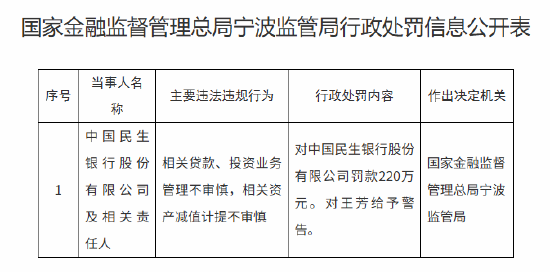
12月31日金融一线消息,据国家金融监督管理总局宁波监管局行政处罚信息公开表显示,中国民生银行 股份有限公司因相关贷款、投资业务管理不审慎,相关资产减值计提不审慎,被罚款220万元。同时, 相关责任人王芳被给予警告。 责任编辑:秦艺 12月31日金融一线消息,据国家金融监督管理总局宁波监管局行政处罚信息公开表显示,中国民生银行 股份有限公司因相关贷款、投资业务管理不审慎,相关资产减值计提不审慎,被罚款220万元。同时, 相关责任人王芳被给予警告。 责任编辑:秦艺 ...
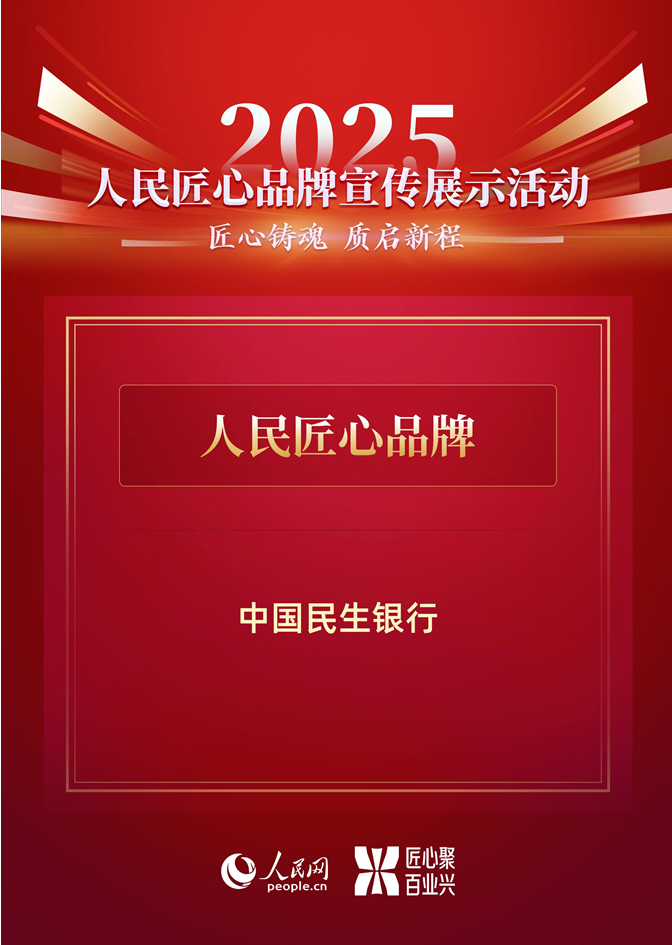
民生银行获评人民网“2025人民匠心品牌”
Jin Rong Jie Zi Xun· 2025-12-31 10:00
Core Viewpoint - China Minsheng Bank was awarded the "People's Artisan Brand" title at the "2025 People's Finance Forum" for its continuous innovation in financial services, stable operations, and social responsibility [1][3]. Group 1: Company Overview - China Minsheng Bank, established in January 1996, is the first national joint-stock commercial bank primarily initiated by private enterprises in China [3]. - The bank has total assets exceeding 7.7 trillion yuan and net assets over 680 billion yuan, with more than 2,400 branches and over 62,000 employees [3]. - It holds various financial licenses, including commercial banking, financial leasing, fund management, overseas investment banking, and bank wealth management [3]. Group 2: Strategic Focus - The bank focuses on being a bank for private enterprises, an agile and open bank, and a bank dedicated to customer service [3]. - It has developed distinct characteristics and competitive advantages in serving private enterprises, small and micro enterprises, community finance, and digital finance [3]. Group 3: Social Responsibility and Recognition - China Minsheng Bank has actively supported rural revitalization for 23 consecutive years, achieving the highest rating of "Good" in central targeted assistance assessments [4]. - The bank has engaged in cultural philanthropy for 18 years, operating six public art institutions and supporting national strategies and public services [4]. - It has received the MSCI ESG rating of "AAA" for two consecutive years from 2024 to 2025, which is the highest global rating [4]. - The recognition as a "People's Artisan Brand" is seen as both an honor and a responsibility, prompting the bank to continue building its brand with dedication and to contribute to sustainable economic and social development [4].