
CMBC(01988)

Search documents
深耕普惠金融沃土 做小微金融领军者
Jin Rong Shi Bao· 2026-01-28 01:02
Core Viewpoint - The article emphasizes the importance of inclusive finance as a requirement for commercial banks to serve the real economy and contribute to high-quality social development, highlighting China Minsheng Bank's commitment to small and micro enterprises over the past 18 years [2][3]. Group 1: Development of Inclusive Finance - China Minsheng Bank has focused on small and micro finance since 2008, providing services to over 20 million small enterprises, establishing itself as a leader in this sector [2][3]. - The bank's innovative approach began post-2008 financial crisis, introducing the "Shangdai Tong" loan product in 2009, which addressed the financing needs of small enterprises [3]. - By 2011, the bank expanded its services from single credit offerings to comprehensive financial services, significantly increasing its business scale and service quality [3]. Group 2: Digital Transformation and Service Innovation - With the rapid development of information technology, the bank has shifted its small micro finance services from offline to a hybrid online-offline model, utilizing big data and mobile internet [4]. - In 2021, the bank initiated a transformation of its small micro finance model, enhancing service channels and integrating personal and corporate services [4]. - The bank has developed a digital platform, the Minsheng Small Micro App, which supports various online services for small enterprises, including financial management and loan applications [12]. Group 3: Case Studies of Support for Small Enterprises - The article shares a success story of a small retail enterprise that grew from a family business to a regional brand with the support of China Minsheng Bank, highlighting the bank's role as a reliable financial partner [6][7]. - The bank provided timely financing solutions, including a 3.19 million yuan loan to support the opening of new stores, demonstrating its responsiveness to client needs [7]. - Another example includes the bank's support for a new type of elderly care enterprise, providing a 10 million yuan credit facility to enhance service quality and meet the growing demand in the aging population sector [9][10]. Group 4: Comprehensive Financial Services and Risk Management - China Minsheng Bank has established a comprehensive service ecosystem for small enterprises, integrating financing, account management, and cash management into a single service model [13]. - The bank has implemented an intelligent risk management system to enhance credit assessment and approval efficiency for small enterprises [14]. - The bank's focus on serving key customer groups includes innovative financial products tailored for technology-driven and export-oriented small enterprises, enhancing their access to financing [15][16].



银行股配置重构系列九:从主动基金 Q4 持仓看配置思路
Changjiang Securities· 2026-01-27 15:25
Investment Rating - The investment rating for the banking sector is "Positive" and is maintained [12] Core Insights - In Q4 2025, active funds did not significantly reduce their holdings in bank stocks, with a stable allocation ratio of 1.86% compared to the previous quarter. This reflects a general decline in market risk appetite. However, it is anticipated that the allocation ratio may decrease further in Q1 2026 due to a significant rebound in risk appetite and the relative underperformance of bank stocks at the beginning of the year [2][6] - The selection of individual stocks has shifted towards a focus on fundamental trends, with Ningbo Bank seeing the most significant increase in allocation due to improved asset quality and performance expectations. The bank has established a turning point in retail asset quality and is expected to lead the sector in performance [7][8] - The report suggests that the core investment strategy for 2026 should prioritize high-performing regional banks, particularly city commercial banks, as they are expected to maintain superior growth rates amid a stable credit structure [9] Summary by Sections Active Fund Holdings - As of Q4 2025, the allocation ratio of active public funds to bank stocks remained stable at 1.86%, indicating a recovery in market risk appetite. The allocation ratio is expected to hit a new low in Q1 2026 due to a resurgence in risk appetite and the underperformance of bank stocks [6][8] - City commercial banks experienced a reduction of approximately 1.7 billion in total holdings, but Ningbo Bank was notably increased by 860 million, reflecting a shift towards stocks with improving fundamentals [7][8] Stock Selection Trends - The focus on stock selection has shifted from high dividend yields to fundamental trends, with Ningbo Bank being the most significantly increased stock in Q4 2025. The bank's asset quality indicators have shown continuous improvement, and it is expected to see a growth in performance in 2026 [7][8] - Conversely, stocks like Chengdu Bank have been reduced significantly, reflecting concerns over performance volatility and ongoing adjustments in business structure [7] Market Dynamics - The banking sector has faced downward pressure due to capital outflows from active funds and index funds, leading to undervaluation in bank stocks. The report recommends seizing opportunities in quality city commercial banks at lower price levels [9][33] - The report highlights that the allocation strategy for 2026 should focus on high-quality city commercial banks, as they are expected to outperform in terms of earnings growth amid a stable credit environment [9]





民生银行首席经济学家温彬:把握存款搬家窗口期,银行理财有望再次迎来规模增长大年
Jin Rong Jie· 2026-01-27 08:59
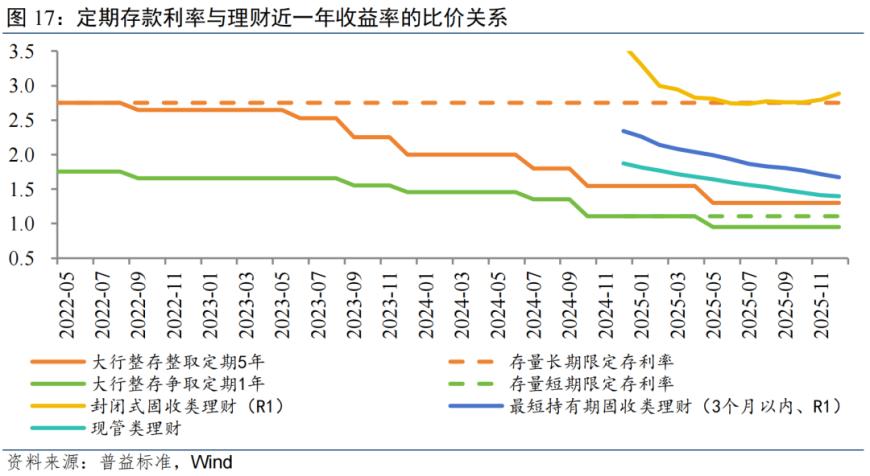
Group 1 - The core viewpoint of the article emphasizes the anticipated growth of the bank wealth management market in 2026, driven by the trend of deposit migration and the need for financial institutions to adapt to changing market conditions [3][4][5]. - In 2025, the wealth management market size is expected to reach 34 trillion yuan, showing a significant increase and outpacing public fund market growth [2]. - The structure of wealth management products is expected to further optimize, focusing on deposit replacement products, particularly short-term high liquidity fixed-income products and low-risk closed fixed-income products [5][6]. Group 2 - The average yield of current management wealth products is around 1.4%, while fixed-income products yield about 2.2%, maintaining a comparative advantage over current three-year fixed deposit rates [4]. - The investment strategy for bank wealth management is expected to continue with a low-volatility asset allocation approach, focusing on high-grade short- to medium-term credit bonds and maintaining a cautious stance on equity allocations [8][9]. - The overall wealth management yield is projected to exhibit a "weak fluctuation" pattern in 2026, influenced by economic fundamentals and policy environments, with a stable liability side expected to enhance the acceptance of wealth management yield levels [8][9].
民生银行发布贵金属业务市场风险提示
Cai Jing Wang· 2026-01-27 06:07
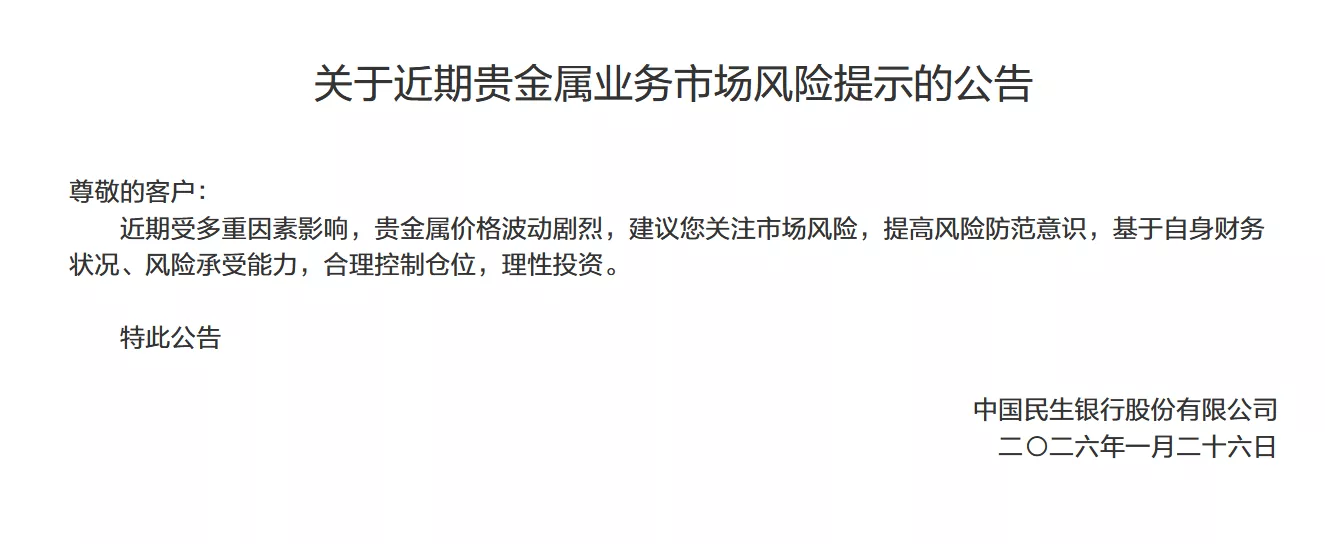
1月26日,民生银行发布关于近期贵金属业务市场风险提示的公告,近期受多重因素影响,贵金属价格波动剧烈,建议客户关注市场风险,提高风险防范意 识,基于自身财务状况、风险承受能力,合理控制仓位,理性投资。 (民生银行) ...
民生银行:科技金融筑翼 助硬核科技企业远航
Jin Rong Jie Zi Xun· 2026-01-27 02:41
Core Insights - The article highlights the significant advancements in China's hard technology sectors, particularly in commercial aerospace and semiconductor industries, emphasizing the critical role of timely financial support and professional services in overcoming development challenges [1][4]. Group 1: Commercial Aerospace Industry - The commercial aerospace sector is characterized by high technical barriers, high risks, high capital investment, and long return cycles, with rocket model development requiring billions of yuan and taking over three years with minimal commercial income [2]. - Minsheng Bank has established a "Five Vertical and One Horizontal" technology finance service system to address industry pain points, utilizing a digital platform to integrate multi-dimensional data for enterprise assessment [2]. - The bank's collaboration with Zhongke Aerospace led to a rapid approval process for a 500 million yuan credit line, supporting the successful launch of 75 satellites and the first liquid oxygen-methane rocket [2][3]. Group 2: Semiconductor Industry - Minsheng Bank has adapted its technology finance service capabilities to the semiconductor sector, focusing on long cycles, high investment, and light asset characteristics, providing tailored financial empowerment solutions [4]. - The bank employs a "Five-Dimensional Assessment System" to evaluate core value dimensions such as market prospects, patent value, team strength, ecosystem partnerships, and capital market recognition [4]. - Specific products like "Yichuang E-loan" offer efficient funding solutions, with online credit loans processed in as little as two working days [4][5]. Group 3: Customized Services and Regional Focus - Minsheng Bank provides customized services to semiconductor companies, including stock repurchase loans and integrated services for market expansion, exemplified by its support for Jiangsu Weidao Nano Technology [5]. - The bank's "Minsheng E-chain" and "de-nuclear" service models enable efficient financing for small and medium-sized enterprises in the supply chain, breaking reliance on core enterprise credit [5][6]. - The bank aims to deepen its technology finance layout, focusing on key regions and supporting critical technological breakthroughs to foster high-quality development in hard technology [6].
经营贷利率“贴地飞行” 中小银行有点吃不消
Zhong Guo Zheng Quan Bao· 2026-01-26 21:52
Core Viewpoint - The continuous decline in operating loan interest rates is driven by multiple factors, including policy guidance, market competition, and reduced funding costs, leading banks to focus on lending to quality small and micro enterprises [1][4]. Group 1: Loan Interest Rates - Several banks have reduced their operating loan interest rates, with some as low as 2.31%, a decrease of nearly 20 basis points from the previous month [1][2]. - The lowest rates for collateralized operating loans are reported between 2.31% and 2.55%, with some products potentially offering effective rates in the "1s" due to interest subsidies [2][4]. - The interest rate for first-time borrowers among small and micro enterprises can be reduced to the "1s" range due to a fiscal interest subsidy of 1% for the first year [2][3]. Group 2: Policy and Market Environment - The fiscal interest subsidy policy has been extended to the end of 2026, increasing the loan cap for eligible enterprises from 1 million to 10 million yuan [3]. - The subsidy now covers 11 sectors, including newly added digital, green, and retail consumption areas, alongside traditional sectors like hospitality and entertainment [3]. Group 3: Competition Among Banks - The competition for quality clients has intensified, with banks requiring higher standards for collateral, such as property location and age [5][7]. - Smaller banks are focusing on differentiating their client base and may offer lower rates or higher loan amounts to attract clients that do not meet the criteria of larger banks [7][8]. - The pressure to lower rates may lead to a compromise in risk management, with some banks potentially relaxing their standards to maintain competitiveness [7][8]. Group 4: Strategic Recommendations - Banks are encouraged to adopt differentiated pricing based on client creditworthiness and operational status, leveraging digital technology for risk control [8]. - There is a need for banks to diversify their business structure, focusing on wealth management and payment services to reduce reliance on net interest margins [8]. - Strengthening self-regulation and avoiding irrational price competition are essential for maintaining a balance between supporting the real economy and ensuring sustainable operations [8].


机制再造 产品进化 产融孵化 西安金融创新赋能新质生产力
Shang Hai Zheng Quan Bao· 2026-01-26 19:16
Group 1 - Xi'an has become China's fourth "National Science Center" and "Technology Innovation Center," showcasing strong research capabilities, a complete industrial chain, and an innovative ecosystem [1] - The story of Xi'an's Xianghui Electromechanical Company highlights how financial support can empower new productive forces, as the company overcame funding challenges to develop flight simulation products [1] - Minsheng Bank's Xi'an branch has established a dedicated approval team for innovative enterprises, creating specialized approval channels and models to support technology finance and inclusive finance strategies [2][3] Group 2 - Postal Savings Bank's Xi'an branch has tailored financial solutions for companies like Shaanxi Ruige Machinery Manufacturing, enhancing loan limits and providing comprehensive financial services through its "U Benefit Creation" system [3] - The bank has increased the loan limit for collateralized loans for small and micro enterprises from 30 million to 100 million yuan, reflecting a commitment to support local businesses [3] - The National Development Bank's Xi'an branch has provided a 500 million yuan credit plan to support long-term funding needs for advanced projects in the photonics industry, facilitating the acceleration of project construction [3] Group 3 - Zheshang Bank's Xi'an branch has launched customized financial products like "Aviation Enjoy Loan" to address the unique financing challenges faced by enterprises in the aviation sector, including long payment cycles [4][5] - Beijing Bank's Xi'an branch has utilized online credit loans to support promising startups, exemplified by its assistance to Shaanxi Feiyu Technology Trading Company, which faced liquidity issues [5] - The establishment of the Shaanxi Optoelectronics Pilot Institute demonstrates the importance of stable long-term funding for technology incubation, contributing to the development of a global photonics industry ecosystem [6] Group 4 - The integration of production and finance in various parks, such as the Xi'an Bank's tailored financial solutions for the photovoltaic industry, illustrates a proactive approach to meet core funding needs [7] - The bank's efforts include a comprehensive evaluation of business model feasibility and streamlined funding approval processes, facilitating efficient investment in fixed assets [7]


摩根大通对民生银行的多头持仓比例降至6.79%
Xin Lang Cai Jing· 2026-01-26 09:44
Group 1 - The core point of the article is that JPMorgan's long position in China Minmetals Bank Co., Ltd. H-shares decreased from 7.11% to 6.79% as of January 21, 2026 [1] Group 2 - The specific reduction in JPMorgan's holdings indicates a shift in investment strategy or market sentiment towards China Minmetals Bank [1] - The change in ownership percentage reflects broader trends in the banking sector and investor confidence in Chinese financial institutions [1] - Monitoring such changes in major institutional holdings can provide insights into potential investment opportunities or risks within the banking industry [1]

摩根大通(JPMorgan)对民生银行的多头持仓比例降至6.79%
Xin Lang Cai Jing· 2026-01-26 09:21
据香港交易所披露,摩根大通(JPMorgan)对中国民生银行股份有限公司 - H股的多头持仓比例于2026 年1月21日从7.11%降至6.79%。 ...
金融行业周报(2026、01、25):业绩比较基准新规正式落地,坚定保险中长期向好逻辑-20260125
Western Securities· 2026-01-25 10:30
Investment Rating - The report maintains a positive long-term outlook for the insurance sector, indicating a strong continuity in market performance despite recent fluctuations [2][12][16]. Core Insights - The financial sector experienced a mixed performance this week, with the non-bank financial index down by 1.45%, underperforming the CSI 300 index by 0.83 percentage points. The insurance sector saw a decline of 4.02%, while the brokerage sector decreased by 0.61% [1][10]. - The insurance sector's performance is driven by two main factors: policy support leading to economic recovery and liquidity easing combined with a strong stock market. The report suggests a shift from liquidity-driven growth to a focus on macro policy support and economic recovery expectations [2][13][16]. - The brokerage sector is expected to benefit from new regulations that enhance investment management quality, with a recommendation to focus on larger, undervalued firms and those involved in mergers and acquisitions [3][18]. - The banking sector is facing a slight decline, but there are signs of recovery in profitability for leading banks, with recommendations to focus on banks with high dividend yields and those expected to benefit from market conditions [19][21]. Summary by Sections Insurance Sector - The insurance sector's recent decline is attributed to short-term market sentiment and liquidity changes, but the long-term outlook remains positive due to strong support from both the liability and asset sides [2][12][16]. - Key recommendations include focusing on companies like China Pacific Insurance, China Ping An, China Life (H), and China Taiping, with a specific recommendation for New China Life [4][16]. Brokerage Sector - The brokerage sector's performance is slightly better than the overall market, with a focus on the new guidelines from the regulatory body that aim to improve fund management quality [3][17]. - Recommended firms include Guotai Junan, Huatai Securities, and others, particularly those with strong merger and acquisition prospects [4][18]. Banking Sector - The banking sector has shown a decline but is expected to stabilize, with recommendations to focus on banks with high earnings elasticity and strong dividend yields [19][21]. - Specific banks to watch include Hangzhou Bank, Ningbo Bank, and others, with a focus on those that have previously been undervalued [4][21].



