
KEYMED BIO(02162)

Search documents
港股康诺亚-B高开逾4%
Mei Ri Jing Ji Xin Wen· 2025-12-08 01:43
每经AI快讯,康诺亚-B(02162.HK)高开逾4%,截至发稿涨4.23%,报61.6港元,成交额132.44万港元。 (文章来源:每日经济新闻) ...

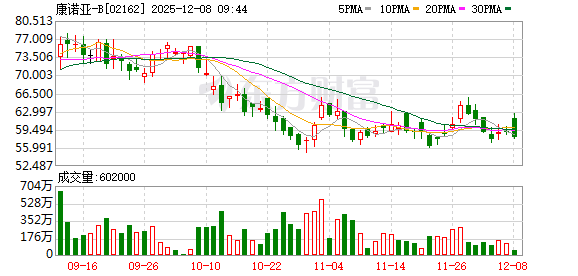
港股异动 | 康诺亚-B(02162)高开逾4% 司普奇拜单抗注射液纳入国家基本医疗保险药品目录
Zhi Tong Cai Jing· 2025-12-08 01:39
Core Viewpoint - 康诺亚-B's stock price increased by over 4% following the announcement of its drug 康悦达® being included in the National Basic Medical Insurance Drug List for 2025, effective from January 1, 2026 [1] Company Summary - 康诺亚-B's stock rose 4.23% to HKD 61.6 with a trading volume of HKD 1.3244 million [1] - The company announced that its self-developed Class 1 new drug 康悦达® (司普奇拜单抗 injection) has been included in the National Basic Medical Insurance Drug List [1] - 康悦达® is the first domestically developed and approved IL-4Rα humanized monoclonal antibody in China, targeting the dual blockade of IL-4/IL-13 signaling pathways to precisely inhibit the progression of type 2 inflammatory diseases [1] Drug Indications - 康悦达® has received approval for three indications: 1. Moderate to severe atopic dermatitis in adults inadequately controlled by topical medications 2. Chronic rhinosinusitis with nasal polyps inadequately controlled by corticosteroids and/or surgery 3. Moderate to severe seasonal allergic rhinitis in adults inadequately controlled by intranasal corticosteroids combined with antihistamines [1] - All three indications have been included in the updated National Basic Medical Insurance Drug List [1]
康诺亚-B高开逾4% 司普奇拜单抗注射液纳入国家基本医疗保险药品目录
Zhi Tong Cai Jing· 2025-12-08 01:37
Core Viewpoint - 康诺亚-B's stock price increased by over 4% following the announcement that its self-developed drug, 康悦达 (司普奇拜单抗), has been included in the National Basic Medical Insurance Drug List for 2025, effective from January 1, 2026 [1] Group 1: Company Developments - 康诺亚 announced that 康悦达 (司普奇拜单抗) is the first domestically developed IL-4Rα humanized monoclonal antibody approved for market, targeting type 2 inflammatory diseases through dual blockade of the IL-4/IL-13 signaling pathway [1] - 康悦达 has received approval for three indications: moderate to severe atopic dermatitis in adults inadequately controlled by topical medications, chronic rhinosinusitis with nasal polyps inadequately controlled by corticosteroids and/or surgery, and moderate to severe seasonal allergic rhinitis in adults inadequately controlled by nasal corticosteroids combined with antihistamines [1] Group 2: Market Impact - Following the announcement, 康诺亚-B's stock rose by 4.23%, reaching a price of 61.6 HKD, with a trading volume of 1.3244 million HKD [1]
康悦达纳入国家基本医疗保险药品目录
Huan Qiu Wang· 2025-12-07 13:17
Core Viewpoint - The company 康诺亚 has announced that its self-developed drug 康悦达 (Siplizumab Injection) has been included in the National Medical Insurance Drug List for 2025, effective from January 1, 2026, marking a significant milestone for the company and the industry [1] Group 1: Drug Development and Approval - 康悦达 is the first IL-4Rα antibody drug independently developed and approved for market in China [1] - The drug has received breakthrough therapy designation and priority review, supported by the national "13th Five-Year Plan" for major new drug creation [1] - 康悦达 has been approved for three indications: moderate to severe atopic dermatitis inadequately controlled by topical treatments, chronic sinusitis with nasal polyps inadequately controlled by corticosteroids and/or surgery, and moderate to severe seasonal allergic rhinitis inadequately controlled by nasal corticosteroids combined with antihistamines [1] Group 2: Strategic Vision and Commitment - The CEO of 康诺亚, Dr. Chen Bo, emphasized the company's commitment to "true innovation" and addressing unmet clinical needs [1] - The company aims to develop more globally competitive innovative drugs to benefit patients in China and worldwide, contributing to the improvement of public health and the high-quality development of the pharmaceutical industry [1]
康诺亚:康悦达纳入国家基本医疗保险药品目录
Bei Ke Cai Jing· 2025-12-07 11:28
Core Viewpoint - The company announced that its self-developed Class 1 new drug, Kangyueda (Supuqi Baidong Injection), has been included in the National Basic Medical Insurance, Maternity Insurance, and Work Injury Insurance Drug Directory (2025) [1] Group 1: Drug Approval and Indications - Kangyueda (Supuqi Baidong) has received approval for three indications: 1. Moderate to severe atopic dermatitis in adults inadequately controlled by topical medications or unsuitable for topical treatment 2. Chronic sinusitis with nasal polyps inadequately controlled by glucocorticoid treatment and/or surgery 3. Moderate to severe seasonal allergic rhinitis in adults with symptoms inadequately controlled by nasal glucocorticoids combined with antihistamines [1]
康诺亚康悦达纳入国家基本医疗保险药品目录
Ge Long Hui A P P· 2025-12-07 05:41
格隆汇12月7日|康诺亚宣布,公司自主研发的国家1类新药康悦达®(司普奇拜单抗注射液)纳入《国 家基本医疗保险、生育保险和工伤保险药品目录(2025年)》,该目录将自2026年1月1日起正式实施。 此次纳入新版国家基本医疗保险药品目录,康悦达®(司普奇拜单抗)在多个适应症上填补了治疗领域 空白和医保目录空白:它是国产首个治疗中重度特应性皮炎的生物制剂,带来更高治疗获益,打破了长 期以来进口药物的垄断, 为外用药控制不佳的患者带来靶向治疗新选择;同时,它也是国内首个治疗慢 性鼻窦炎伴鼻息肉的生物制剂、全球唯一治疗季节性过敏性鼻炎的IL-4Rα抗体药物,为传统治疗手段效 果不佳、存在未满足临床需求的患者提供了革新性的治疗方案。 ...
康诺亚(02162) - 截至二零二五年十一月三十日止月份之股份发行人的证券变动月报表
2025-12-01 10:05
FF301 股份發行人及根據《上市規則》第十九B章上市的香港預託證券發行人的證券變動月報表 截至月份: 2025年11月30日 狀態: 新提交 致:香港交易及結算所有限公司 I. 法定/註冊股本變動 | 1. 股份分類 | 普通股 | 股份類別 | 不適用 | | 於香港聯交所上市 (註1) | | 是 | | | --- | --- | --- | --- | --- | --- | --- | --- | --- | | 證券代號 (如上市) | 02162 | 說明 | | | | | | | | | | 法定/註冊股份數目 | | | 面值 | | 法定/註冊股本 | | | 上月底結存 | | | 500,000,000 | USD | | 0.0001 USD | | 50,000 | | 增加 / 減少 (-) | | | 0 | | | USD | | 0 | | 本月底結存 | | | 500,000,000 | USD | | 0.0001 USD | | 50,000 | 本月底法定/註冊股本總額: USD 50,000 第 1 頁 共 10 頁 v 1.1.1 FF301 公司名稱: ...
太平洋证券:首予康诺亚-B(02162)“买入”评级 重磅产品商业化加速 下一代自免双抗潜力大
智通财经网· 2025-12-01 03:25
Core Viewpoint - Pacific Securities initiates coverage on Connora-B (02162) with a "Buy" rating and a target price of HKD 82.07, highlighting the rapid growth of the atopic dermatitis drug market in China, driven by core products like Dupilumab and Dupilumab's accelerated market penetration [1] Industry Summary - The atopic dermatitis (AD) drug market in China is expected to grow rapidly, with a compound annual growth rate (CAGR) of approximately 22.6% from 2019 to 2024, and an anticipated CAGR of 18.6% from 2024 to 2030, reaching USD 4.3 billion by 2030 [1] - AD affects up to 20% of children and adolescents and 1-5% of adults globally, with 25% to 30% of patients experiencing moderate to severe symptoms [1] Company Summary - Connora's core product, Dupilumab (Dabizhuo), has become the fourth largest drug globally, with sales in China exceeding CNY 2.5 billion, and projected to grow to over CNY 2.5 billion in 2024, reflecting a growth rate of approximately 33% [1] - The company’s product, Dupilumab (Kangyueda), is in a rapid growth phase, with expected sales of approximately CNY 36 million in 2024 and CNY 170 million in the first half of 2025, driven by increasing medical demand for allergic diseases [2] - CM512, a long-acting TSLP x IL-13 dual antibody developed by Connora, shows promising potential with a half-life of 70 days, allowing for reduced dosing frequency and improved patient compliance [2] Clinical Research Summary - Phase I clinical trials for CM512 in treating adult moderate to severe AD achieved all primary endpoints, with 50% of patients in the 300mg group reaching EASI-75 at week 6, compared to 7% in the placebo group [3] - At week 12, the EASI-75 and EASI-90 response rates for the 300mg dose group were 58.3% and 41.7%, respectively, outperforming existing IL-4Rα monoclonal antibodies and JAK1 inhibitors [3] - Most treatment-emergent adverse events (TEAEs) during the study were mild to moderate, with no reports of serious adverse events leading to treatment delays or study withdrawals [3]

太平洋证券:首予康诺亚-B“买入”评级 重磅产品商业化加速 下一代自免双抗潜力大
Zhi Tong Cai Jing· 2025-12-01 03:24
Core Viewpoint - Pacific Securities initiates coverage on Kangnuo Ya-B (02162) with a "Buy" rating and a target price of HKD 82.07, highlighting the rapid growth of the atopic dermatitis drug market in China, driven by core products like Dupilumab and Siplizumab [1] Industry Overview - The atopic dermatitis (AD) market in China is expected to grow significantly, with a compound annual growth rate (CAGR) of approximately 22.6% from 2019 to 2024, and an anticipated CAGR of 18.6% from 2024 to 2030, reaching USD 4.3 billion by 2030 [1] - Globally, AD affects up to 20% of children and adolescents and 1-5% of adults, with 25% to 30% of patients experiencing moderate to severe symptoms [1] Company Insights - Dupilumab (Dabizhuo) is the fourth best-selling drug globally, with sales in China exceeding CNY 2.5 billion, growing at approximately 48% in 2023 and projected to grow by about 33% in 2024 [2] - Siplizumab (Kangyueda) is in a rapid growth phase, with projected sales of approximately CNY 36 million in 2024 and CNY 170 million in the first half of 2025, driven by increasing medical demand for allergic diseases [3] Product Development - CM512, a long-acting TSLP x IL-13 dual antibody developed by Kangnuo Ya, shows promising potential with a half-life of 70 days, allowing for reduced dosing frequency and improved patient compliance [4] - In Phase I clinical trials, CM512 achieved significant efficacy endpoints, with 50% of patients in the 300mg group reaching EASI-75 at week 6, compared to only 7% in the placebo group [4]
康诺亚-B涨超4% 机构看好CM512全球价值 司普奇拜单抗销售明年有望快速放量
Zhi Tong Cai Jing· 2025-11-25 03:50
Core Viewpoint - 康诺亚-B's CM512, the world's first long-acting TSLP x IL-13 dual blocker for treating moderate to severe atopic dermatitis (AD), has successfully met all endpoints in its Phase I clinical study, indicating strong potential in the market [1] Group 1: Company Developments - 康诺亚-B's stock rose by 4.08% to HKD 59.95, with a trading volume of HKD 31.28 million [1] - The company has reported that CM512's early clinical data shows a significantly better EASI-90 response compared to APOGEE's core asset APG777, while maintaining excellent safety and similar dosing frequency [1] Group 2: Market Context - The long-acting autoimmune treatment sector is currently experiencing significant growth, with APOGEE's market capitalization increasing by over 75% in the last two months, reaching USD 4.3 billion [1] - The commercial sales team for 康诺亚-B is expected to expand to around 400 people by the end of the year, focusing on hospital access and coverage, particularly in key hospitals for AD [1] Group 3: Future Outlook - Sales of 康诺亚-B's drug,司普奇拜单抗, are anticipated to see rapid growth by 2026, as the company prioritizes breakthrough scenarios in core hospitals [1] - The company is also considering the potential for limited price reductions for 司普奇拜单抗 due to high negotiation reductions last year and cost pressures [1]