GOLDWIND(02208)

Search documents
蓝箭航天IPO获受理,金风科技持有其4.14%股权被重估,风电龙头因一笔七年前投资市值逼近千亿
Xin Lang Cai Jing· 2026-01-07 05:08
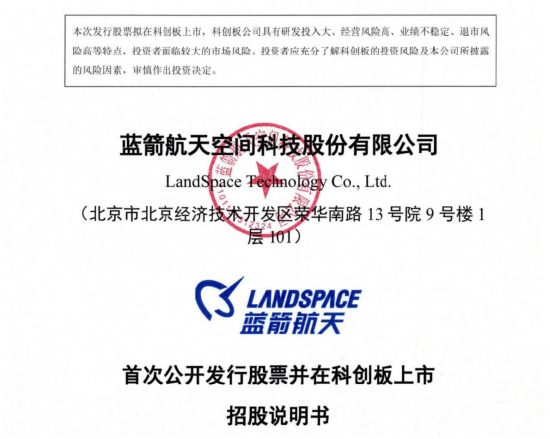
Core Viewpoint - The heat of commercial aerospace has been reignited at the beginning of 2026, particularly with the acceptance of Blue Arrow Aerospace's IPO application, marking a significant moment for the industry [3][16]. Group 1: Company Developments - Blue Arrow Aerospace has officially launched its IPO application on the Sci-Tech Innovation Board, aiming to become the "first stock in commercial aerospace" [3][16]. - Goldwind Technology, through its subsidiary Jianghan Asset, holds a 4.14% stake in Blue Arrow Aerospace, which has recently gained attention as its stock price surged, pushing its market capitalization above 100 billion yuan [5][18]. - On January 6, 2026, Goldwind Technology's stock hit a historical high of 24 yuan, with a total market value reaching 937.86 billion yuan, reflecting strong investor interest [6][19]. Group 2: Investment Insights - Goldwind Technology's investment in Blue Arrow Aerospace dates back to 2018 during the latter's B+ round financing, a time when commercial aerospace was not a frequent topic in capital markets [9][21]. - The estimated value of Goldwind's stake in Blue Arrow Aerospace has exceeded 800 million yuan based on the latter's valuation of 20 billion yuan [21]. - Goldwind's broader investment strategy spans multiple sectors, including new energy and manufacturing, with its equity investment value reaching 3.337 billion yuan as of mid-2025 [10][24]. Group 3: Market Reactions - The acceptance of Blue Arrow Aerospace's IPO has triggered a rally in the secondary market, with stocks related to commercial aerospace, including Goldwind Technology, experiencing significant price increases [9][27]. - The stock price of Goldwind Technology has been positively influenced by the overall market sentiment surrounding commercial aerospace, showcasing a butterfly effect from past investments [27].

风电整机专家交流
2026-01-07 03:05
Wind Power Industry Conference Summary Industry Overview - The wind power industry is showing signs of stabilization, with domestic markets benefiting from improved economic efficiency and overseas markets poised for significant profitability as they scale up. The overall trend in the industry is upward [1][3]. Key Insights - The overall delivery volume of wind power is expected to exceed 160 GW by 2026, with a significant increase from 110 GW in 2025. Supply chain constraints are driving up component prices, although the increase is expected to be less than last year [1][5]. - The valuation of wind power companies is generally around ten times earnings, indicating high investment value due to performance realization and future growth potential. Leading companies like Goldwind reaching a market capitalization of over 100 billion is a significant signal [1][4]. - The overseas market has a substantial impact on Chinese wind turbine manufacturers, with order volumes increasing by over 50% year-on-year. However, the conversion of orders to delivery and revenue is slow, with profitability expected to improve gradually over the next few years [1][6]. Financial Projections - The wind power industry is expected to enter an upward profit cycle lasting three to five years, with domestic manufacturing showing signs of stabilization and improvement in profitability by the second half of 2025 [3]. - By 2026, wind turbine prices are projected to increase by 10%-15% due to price control policies, with manufacturers' gross margins expected to rise by at least 5 percentage points [12]. Component Pricing and Supply Chain - The prices of key components such as castings and blades are expected to rise, with castings increasing by 14-15% and blades by 6-8%. However, some prices have stabilized or decreased compared to last year [5][7]. - The supply chain for components is under pressure due to rising delivery volumes, but there is insufficient upward price momentum for further increases [7][8]. Market Dynamics - The bidding volume for 2025 is expected to remain around 150-160 GW to support government delivery targets, with domestic delivery volumes projected to reach at least 110-120 GW in 2026 [2][20]. - The competitive landscape for domestic manufacturers in overseas markets varies, with leading companies like Goldwind and Envision performing well, while others face challenges in high-barrier markets like Europe and North America [22][29]. Future Outlook - The overseas market is expected to see significant growth, with annual new bidding volumes projected to reach 80-100 GW from 2026 to 2030, driven by emerging markets like India and increased demand in Europe [21]. - The domestic offshore wind power installation volume is uncertain, heavily influenced by geopolitical issues, with projections for 2026 ranging from 7-10 GW depending on the resolution of these issues [30]. Additional Considerations - The profitability of turbine manufacturers' power station sales has declined, with margins dropping from over 50% to around 35%. Companies are adapting by increasing project sizes to maintain profitability [26]. - Leading manufacturers are actively exploring hydrogen energy solutions, although these projects are still in early stages and not yet at large-scale production [27]. This summary encapsulates the key points from the wind power industry conference, highlighting the current state, financial outlook, and future trends within the sector.
个股异动 | 金风科技封住涨停 参股蓝箭航天为第六大股东
Shang Hai Zheng Quan Bao· 2026-01-07 01:57
来源:上海证券报·中国证券网 消息面上,近日,上交所官网显示,蓝箭航天科创板IPO获受理,正式冲刺"商业航天第一股",公司估 值200亿元。据蓝箭航天招股书,金风科技旗下江瀚资产持有蓝箭航天4.14%股权,为该公司第六大股 东。 上证报中国证券网讯(记者 何昕怡)1月6日午后,金风科技震荡拉高封住涨停,报24.00元/股。 ...
金风科技涨3.21%,成交额31.32亿元,主力资金净流出1.63亿元
Xin Lang Zheng Quan· 2026-01-07 01:46
Group 1 - The core viewpoint of the news is that Goldwind Technology has shown significant stock price increases and strong financial performance in recent months, indicating positive market sentiment and operational growth [1][2]. Group 2 - As of January 7, Goldwind Technology's stock price increased by 3.21% to 24.77 CNY per share, with a total market capitalization of 104.655 billion CNY [1]. - The company has experienced a year-to-date stock price increase of 21.42%, with notable gains of 14.36% over the last five trading days, 55.79% over the last twenty days, and 44.18% over the last sixty days [1]. - For the period from January to September 2025, Goldwind Technology achieved a revenue of 48.147 billion CNY, representing a year-on-year growth of 34.34%, and a net profit attributable to shareholders of 2.584 billion CNY, up 44.21% year-on-year [2]. - The company's main business revenue composition includes 76.58% from wind turbine and component sales, 11.12% from wind farm development, 10.15% from wind power services, and 2.16% from other sources [2]. - Goldwind Technology has distributed a total of 11.683 billion CNY in dividends since its A-share listing, with 1.521 billion CNY distributed over the past three years [3]. - As of September 30, 2025, the number of shareholders increased to 202,400, reflecting a 2.66% rise compared to the previous period [2].
1月6日南向资金净买入28.79亿港元
Zheng Quan Shi Bao Wang· 2026-01-06 14:32
Core Viewpoint - The Hang Seng Index rose by 1.38% on January 6, closing at 26,710.45 points, with a net inflow of HKD 2.879 billion through the southbound trading channel [1]. Group 1: Market Activity - The total trading volume for the southbound trading on January 6 was HKD 133.353 billion, with a net buying amount of HKD 2.879 billion [1]. - The Shanghai Stock Exchange's southbound trading had a total transaction amount of HKD 81.029 billion, with a net buying of HKD 0.975 billion, while the Shenzhen Stock Exchange had a transaction amount of HKD 52.324 billion and a net buying of HKD 1.903 billion [1]. Group 2: Active Stocks - In the Shanghai Stock Exchange's southbound trading, Alibaba-W had the highest transaction amount of HKD 50.49 billion, followed by SMIC and Tencent Holdings with transaction amounts of HKD 44.27 billion and HKD 41.10 billion, respectively [1]. - Alibaba-W recorded a net buying amount of HKD 20.61 billion, despite a closing price drop of 1.31% [1]. - China Mobile had the highest net selling amount of HKD 8.75 billion, with a closing price decrease of 0.12% [1]. Group 3: Shenzhen Stock Exchange Activity - In the Shenzhen Stock Exchange's southbound trading, Alibaba-W also led with a transaction amount of HKD 43.74 billion, followed by Tencent Holdings and SMIC with HKD 28.76 billion and HKD 20.96 billion, respectively [2]. - The highest net buying stock was Ping An Insurance, with a net buying amount of HKD 10.81 billion, and it closed up by 4.96% [2]. - Tencent Holdings experienced the highest net selling amount of HKD 8.15 billion, while its closing price increased by 1.28% [2].


港股通1月6日成交活跃股名单
Zheng Quan Shi Bao Wang· 2026-01-06 14:22
Group 1 - The Hang Seng Index rose by 1.38% on January 6, with southbound trading totaling HKD 133.35 billion, including HKD 68.12 billion in buying and HKD 65.24 billion in selling, resulting in a net buying amount of HKD 2.88 billion [1] - The southbound trading through Stock Connect (Shenzhen) had a total trading amount of HKD 52.32 billion, with net buying of HKD 1.90 billion, while the trading through Stock Connect (Shanghai) totaled HKD 81.03 billion, with net buying of HKD 0.98 billion [1] - Active stocks in southbound trading included Alibaba-W with a total trading amount of HKD 94.23 billion, Tencent Holdings with HKD 69.86 billion, and SMIC with HKD 65.23 billion [1] Group 2 - Among the stocks, China Ping An had a net buying amount of HKD 18.40 billion, closing with a price increase of 4.96%, while Alibaba-W had a net buying of HKD 16.19 billion [2] - Xiaomi Group-W, SMIC, and Alibaba-W were among the stocks with the highest consecutive net buying days, with 4 days for Xiaomi Group-W and SMIC, and 3 days for Alibaba-W [2] - The total trading amount for China Ping An was HKD 32.79 billion, with a net buying of HKD 18.40 billion, while Tencent Holdings had a total trading amount of HKD 69.86 billion with a net selling of HKD 8.04 billion [2]

智通港股通活跃成交|1月6日





智通财经网· 2026-01-06 11:04
Core Insights - On January 6, 2026, Alibaba-W (09988), SMIC (00981), and Tencent Holdings (00700) were the top three stocks by trading volume in the Southbound Stock Connect, with trading amounts of 5.049 billion, 4.427 billion, and 4.110 billion respectively [1] - In the Southbound Stock Connect for the Shenzhen-Hong Kong Stock Connect, Alibaba-W (09988), Tencent Holdings (00700), and SMIC (00981) also ranked as the top three, with trading amounts of 4.374 billion, 2.876 billion, and 2.096 billion respectively [1] Southbound Stock Connect Trading Activity - **Top Active Companies in Southbound Stock Connect (Shanghai-Hong Kong)** - Alibaba-W (09988): Trading amount of 5.049 billion, net buying of +2.061 billion [2] - SMIC (00981): Trading amount of 4.427 billion, net selling of -0.240 billion [2] - Tencent Holdings (00700): Trading amount of 4.110 billion, net buying of +11.255 million [2] - Xiaomi Group-W (01810): Trading amount of 2.244 billion, net buying of +0.485 billion [2] - China Ping An (02318): Trading amount of 1.693 billion, net buying of +0.760 billion [2] - **Top Active Companies in Southbound Stock Connect (Shenzhen-Hong Kong)** - Alibaba-W (09988): Trading amount of 4.374 billion, net selling of -0.442 billion [2] - Tencent Holdings (00700): Trading amount of 2.876 billion, net selling of -0.815 billion [2] - SMIC (00981): Trading amount of 2.096 billion, net buying of +0.262 billion [2] - Xiaomi Group-W (01810): Trading amount of 1.644 billion, net buying of +11.316 million [2] - China Ping An (02318): Trading amount of 1.586 billion, net buying of +1.081 billion [2]
港股收盤(01.06) | 恆指收漲1.38% 大金融股發力走高 有色、智駕概念走勢強勁
Zhi Tong Cai Jing· 2026-01-06 10:47
Market Overview - The Hong Kong stock market indices showed strong performance, with the Hang Seng Index rising by 1.38% to close at 26,710.45 points, and a total trading volume of HKD 291.76 billion [1] - The Hang Seng Tech Index increased by 1.46%, closing at 5,825.26 points, indicating a positive sentiment in the technology sector [1] Blue Chip Performance - China Hongqiao (01378) led the blue-chip stocks, rising by 6.14% to HKD 35.26, contributing 10.84 points to the Hang Seng Index [2] - Other notable performers included JD Health (06618) up 5.41%, Ping An Insurance (02318) up 4.96%, while Alibaba (09988) fell by 1.31% [2] Sector Highlights - The capital market is heating up, with financial stocks, particularly Chinese brokerage firms, showing significant gains. For instance, Jiufang Zhitu (09636) surged by 18.84% [3] - The non-ferrous metals sector performed strongly, with notable increases in Aluminum Corporation of China (02068) up 8.05% and Zhaojin Mining Industry (01818) up 7.29% [4] Commodity Trends - Commodities such as gold, silver, and copper have seen rising futures prices, driven by geopolitical tensions and supply constraints [5] - The aluminum market is particularly affected by supply threats, with prices expected to remain high due to production risks [5] Autonomous Driving Sector - The autonomous driving sector is gaining traction, with companies like Zhejiang Shibao (01057) rising by 21.53% following announcements from NVIDIA regarding advancements in self-driving technology [6] - NVIDIA's new AI platform is expected to stimulate demand for autonomous taxis, supporting global economic growth [6] Commercial Aerospace Developments - The commercial aerospace sector is experiencing growth, with companies like JunDa Co. (02865) rising by 8.01% due to recent developments in the industry [6] - The acceleration of the commercialization of space is anticipated to enhance the performance and valuation of related companies [6] Notable Stock Movements - Xindong Company (02400) increased by 6.04% after announcing a significant share buyback plan worth HKD 400 million [7] - Hesai Technology (02525) rose by 5.9% after being selected as a lidar partner for NVIDIA's platform and announcing plans to double production capacity [8] - Cathay Pacific (00293) faced pressure, declining by 2.6% due to a share placement by China National Aviation [9]

金风科技(002202) - H股公告
2026-01-06 10:45
FF305 翌日披露報表 (股份發行人 ── 已發行股份或庫存股份變動、股份購回及/或在場内出售庫存股份) 表格類別: 股票 狀態: 新提交 | 第一章節 | | | | | | | | --- | --- | --- | --- | --- | --- | --- | | 1. 股份分類 | 普通股 | 股份類別 H | | 於香港聯交所上市 | 是 | | | 證券代號 (如上市) | 02208 | H股 說明 | | | | | | A. 已發行股份或庫存股份變動 | | | | | | | | | | 已發行股份(不包括庫存股份)變動 | | 庫存股份變動 | | | | | 事件 | 已發行股份(不包括庫存股份)數 目 | 佔有關事件前的現有已發 行股份(不包括庫存股 份)數目百分比 (註3) | 庫存股份數目 | 每股發行/出售價 (註4) | 已發行股份總數 | | 於下列日期開始時的結存(註1) | 2025年12月31日 | 773,572,399 | | 0 | | 773,572,399 | | 1). 購回股份 (股份被持作庫存股份) | | | -10,000 0.001 % | ...
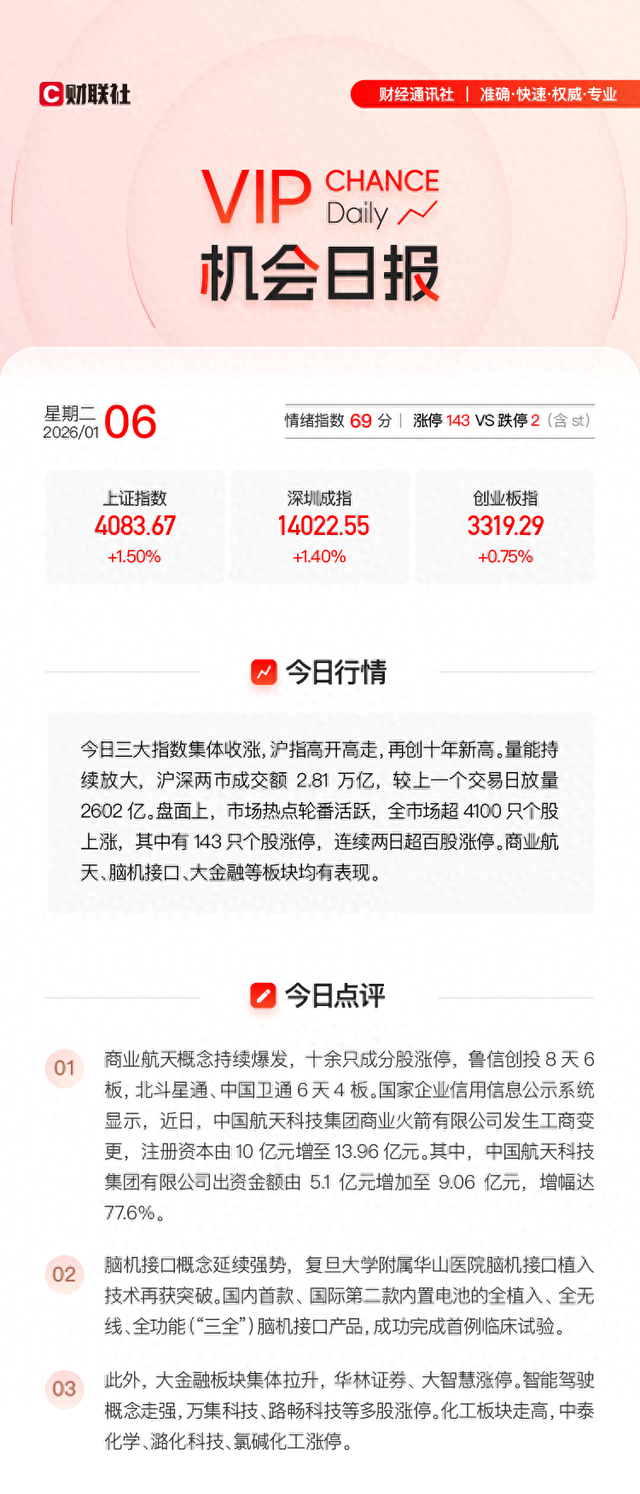
VIP机会日报沪指13连阳再创十年新高 商业航天持续爆发 Ta获主力资金青睐 解读后获连板
Xin Lang Cai Jing· 2026-01-06 10:11
Group 1: Commercial Aerospace - China Aerospace Science and Technology Corporation's commercial rocket subsidiary increased its registered capital from 1 billion to 1.396 billion yuan, with a 77.6% increase in investment from the parent company [5] - Blue Arrow Aerospace is aiming to become the first publicly listed commercial rocket company, with the commercial aerospace sector expected to enter a golden development period [9] - The low-orbit satellite internet in China is set to enter mass launch construction in the second half of 2025, with significant acceleration in industry development anticipated by 2026 [11] Group 2: Brain-Computer Interface - The first fully implanted, wireless, and fully functional brain-computer interface product in China has successfully completed its first clinical trial [20] - The brain-computer interface industry is expected to reach a market size of over 10 billion USD by 2030, with companies like Haige Communication and Xiangyu Medical seeing significant stock price increases [22] - Xiangyu Medical is focusing on non-invasive rehabilitation and exploring invasive technologies, with plans to cover over 1,000 top-tier hospitals by 2026 [24] Group 3: Financial Sector - The National Financial Regulatory Administration has lowered risk factors for long-term holding assets, which is expected to cultivate patient capital and support technological innovation [30] - The financial sector is experiencing strong performance, with stocks like Zhina Compass seeing a significant increase in value due to market expectations of a bull market [31] Group 4: Intelligent Driving - Nvidia plans to test a driverless taxi service by 2027, indicating advancements in autonomous driving technology [33] - The first batch of L3 autonomous vehicles in China has begun large-scale road operation, with companies like Wanjite Technology benefiting from this trend [34] - The automatic driving technology is moving towards mass production applications, with companies like Haoen Automotive seeing stock price increases [36]