
GUOQUAN FOOD(02517)

Search documents
锅圈发盈喜 预期2025年度取得净利润约4.43亿元至4.63亿元 同比增加约83.7%至92.0%
Zhi Tong Cai Jing· 2026-01-29 09:14
锅圈(02517)发布公告,预期本集团2025年度(截至2025年12月31日止年度)取得收入约人民币77.5亿元至 人民币78.5亿元,较截至2024年12月31日止年度(2024年度)的收入人民币64.7亿元上升约19.8%至 21.3%。预期本集团2025年度取得净利润约人民币4.43亿元至人民币4.63亿元,较截至2024年度的净利 润人民币2.41亿元上升约83.7%至92.0%。预期本集团2025年度取得核心经营利润(非国际财务报告准则 计量)约人民币4.5亿元至人民币4.7亿元,较截至2024年度的核心经营利润人民币3.11亿元上升约44.8% 至51.2%。 董事会认为,本集团2025年度收入、净利润及核心经营利润上升的主要原因为本集团通过持续大力开拓 乡镇市场,并稳步拓展其他地区的市场,截至2025年12月31日的门店数量达到11566家,较2024年12月 31日的门店数量增长了1416家。随着规模扩张及店均收入的增长,叠加运营效率的优化,共同驱动利润 率及核心经营利润率的增长。本集团坚定社区央厨战略,通过多渠道多场景,线上线下(300959)相结 合,实现了即时零售门店网络的扩张和门店经 ...
锅圈(02517)发盈喜 预期2025年度取得净利润约4.43亿元至4.63亿元 同比增加约83.7%至92.0%
智通财经网· 2026-01-29 09:10
Core Viewpoint - The company expects significant growth in revenue and profit for the fiscal year 2025, driven by market expansion and operational efficiency improvements [1][2] Financial Projections - The company anticipates revenue for the fiscal year 2025 to be approximately RMB 77.5 billion to RMB 78.5 billion, representing an increase of about 19.8% to 21.3% compared to RMB 64.7 billion for the fiscal year 2024 [1] - The expected net profit for 2025 is projected to be around RMB 4.43 billion to RMB 4.63 billion, which is an increase of approximately 83.7% to 92.0% from RMB 2.41 billion in 2024 [1] - Core operating profit (non-IFRS measure) is expected to be about RMB 4.5 billion to RMB 4.7 billion, reflecting an increase of approximately 44.8% to 51.2% from RMB 3.11 billion in 2024 [1] Growth Drivers - The primary reasons for the anticipated growth in revenue, net profit, and core operating profit include the company's ongoing efforts to expand into rural markets and steadily develop other regional markets [2] - The number of stores is expected to reach 11,566 by December 31, 2025, an increase of 1,416 stores compared to December 31, 2024 [2] - The growth in store count, combined with increased revenue per store and improved operational efficiency, is expected to drive profit margins and core operating profit margins higher [2] - The company is committed to its community central kitchen strategy, utilizing a multi-channel and multi-scenario approach that integrates online and offline operations to enhance the instant retail store network and improve store operational efficiency [2]
锅圈(02517) - 正面盈利预告
2026-01-29 09:00
香港交易及結算所有限公司及香港聯合交易所有限公司對本公告的內容概不負責,對其準確性 或完整性亦不發表任何聲明,並明確表示,概不對因本公告全部或任何部份內容而產生或因倚 賴該等內容而引致的任何損失承擔任何責任。 GUOQUAN FOOD (SHANGHAI) CO., LTD. 鍋圈食品(上海)股份有限公司 (於中華人民共和國註冊成立的股份有限公司) (股份代號:2517) 正面盈利預告 本公告乃由鍋圈食品(上海)股份有限公司(「本公司」,連同其附屬公司統稱「本 集團」)根據香港聯合交易所有限公司證券上市規則(「上市規則」)第13.09條及香 港法例第571章證券及期貨條例第XIVA部項下內幕消息條文(定義見上市規則)刊 發。 本公司董事會(「董事會」)謹此知會本公司股東(「股東」)及潛在投資者,根據本 集團截至2025年12月31日止年度(「2025年度」)未經審核之綜合管理賬目及現時 可得資料所作出之初步評估,預期本集團2025年度錄得收入約人民幣7,750百萬元 至人民幣7,850百萬元,較截至2024年12月31日止年度(「2024年度」)之收入人民 幣6,469.8百萬元上升約19.8%至21.3%。 ...
锅圈食汇再度写入河南省政府工作报告,门店已突破11500家
Sou Hu Wang· 2026-01-27 02:34
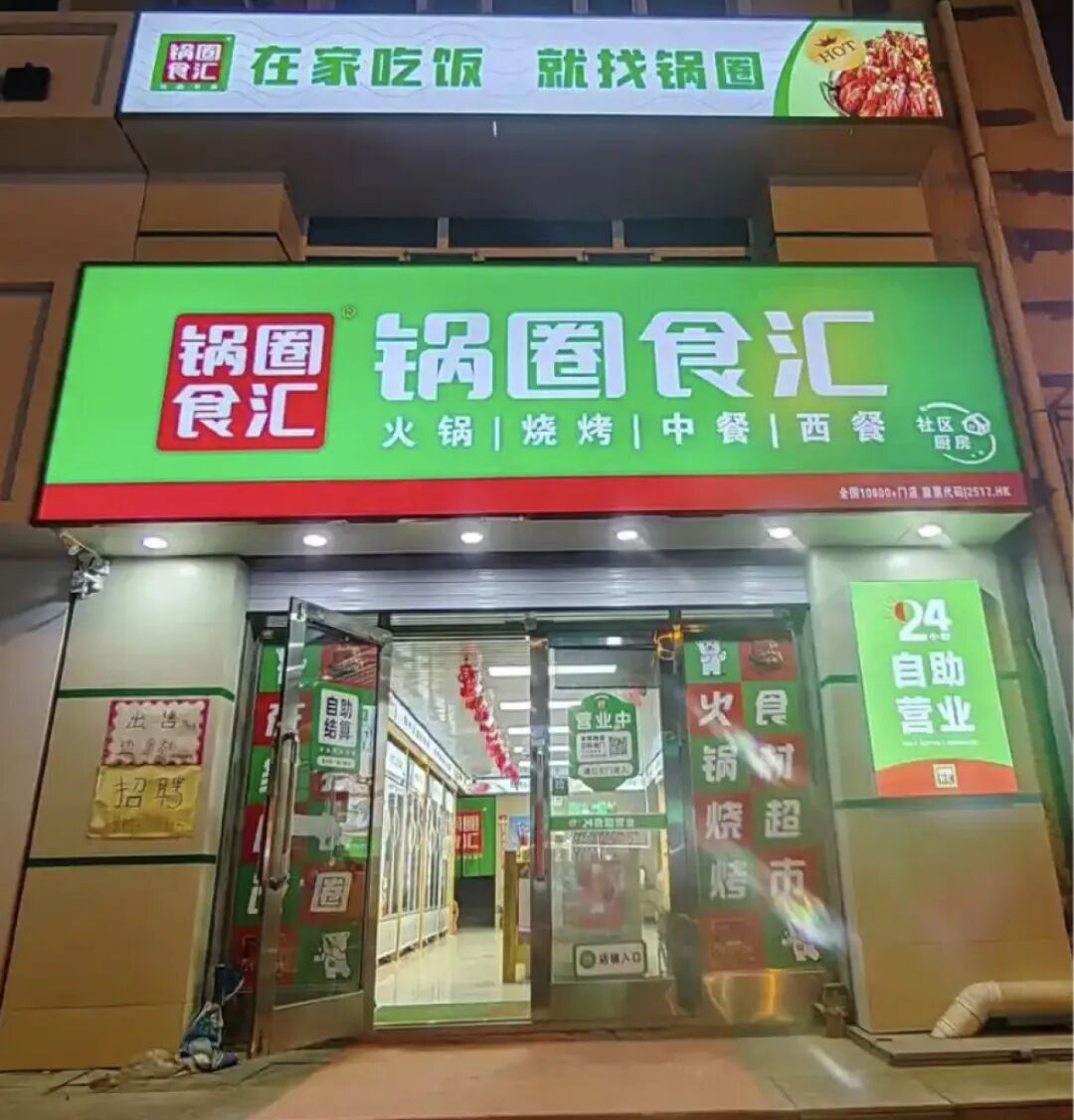
Group 1 - The core viewpoint of the article highlights the recognition of Guoquan Shihui in the Henan Provincial Government Work Report, emphasizing its role as a representative of new consumption and its innovative business model [2][3]. - Guoquan Shihui is identified as a leading one-stop meal product brand in China, offering a diverse range of products including hot pot, barbecue, beverages, single-serving meals, ready-to-cook packages, fresh food, Western cuisine, and snacks [3]. - By the end of 2025, Guoquan Shihui is projected to have over 11,500 stores nationwide and more than 60 million members, indicating its significant market presence and influence [3]. Group 2 - The report mentions the vigorous growth of the private economy in Henan, with 3.7 million new business entities established, highlighting the overall economic dynamism in the region [2]. - Key enterprises such as Muyuan, Yutong, and Hualan are noted for their strong performance, alongside emerging companies like Guoquan Shihui, which signifies a shift towards new business models in the province [2].

东吴证券:维持锅圈“买入”评级 小炒店落地再增催化
Zhi Tong Cai Jing· 2026-01-26 02:42
Group 1 - The core viewpoint of Dongwu Securities maintains a "buy" rating for Guoquan (02517), highlighting a strong start to the year with continued positive same-store trends [1] - The company is expected to achieve a net profit attributable to shareholders of 4.5 billion, 6.0 billion, and 7.6 billion yuan for 2025-2027, reflecting year-on-year growth of 94%, 34%, and 27% respectively, with corresponding PE ratios of 24, 18, and 14X [1] - The company is expanding its store formats and enhancing its scene-based capabilities, aiming for a "one-time area expansion leading to threefold performance increase" through product category expansion and flexible supply chain management [1] Group 2 - The new business model "Guoquan Xiaochao" has been launched, which is expected to open new market opportunities by utilizing a standardized supply chain and smart cooking robots, allowing for quick meal preparation [2] - This initiative is seen as a significant extension of the company's "community central kitchen" strategy, enriching the consumption scenarios for family meals and serving as a key driver for exploring a second growth curve [2]

东吴证券:维持锅圈(02517)“买入”评级 小炒店落地再增催化
智通财经网· 2026-01-26 02:38
Group 1 - The core viewpoint of Dongwu Securities maintains a "buy" rating for Guoquan (02517), highlighting a strong performance during the New Year and continued positive trends in same-store sales [1] - The company is expected to achieve net profits of 450 million, 600 million, and 760 million yuan for the years 2025, 2026, and 2027 respectively, reflecting year-on-year growth of 94%, 34%, and 27% [1] - The price-to-earnings ratio (PE) is projected to be 24, 18, and 14 times for the years 2025, 2026, and 2027 [1] Group 2 - The company is expanding its store formats and enhancing its scene-based capabilities, aiming for a strategy of "doubling the area and tripling the performance" through store renovations [1] - The introduction of high-frequency product categories such as fried food and beverages is expected to drive sales of lower-frequency hot pot ingredients [1] - The new "Guoquan Xiaochao" business model is expected to open new market opportunities, utilizing standardized supply chains and smart cooking robots to enhance efficiency and reduce costs [2] - This new model is seen as a key part of the company's "community central kitchen" strategy, enriching the consumption scenarios for family meals and serving as a critical driver for exploring a second growth curve [2]
锅圈:门店业态拓宽,小炒店落地再增催化-20260125
Soochow Securities· 2026-01-25 00:24
Investment Rating - The investment rating for the company is "Buy" (maintained) [1] Core Insights - The company has successfully expanded its store formats, with the introduction of "锅圈小炒" (small stir-fry restaurants) expected to create new growth opportunities. This new format utilizes a standardized supply chain and smart cooking robots, allowing for quick meal preparation and competitive pricing compared to takeout [7] - The company has demonstrated strong same-store sales growth, even in the face of high comparatives, indicating effective product innovation and refined membership management. The management's deep involvement in store operations and flexible supply chain management has been highlighted as a previously underestimated capability [7] - The financial forecasts have been revised upwards due to anticipated better performance in store openings and same-store revenue. The projected net profits for 2025-2027 are 4.5 billion, 6.0 billion, and 7.6 billion RMB, respectively, reflecting year-on-year growth rates of 94%, 34%, and 27% [7] Financial Summary - Total revenue is projected to grow from 6,100 million RMB in 2023 to 10,916 million RMB in 2027, with a compound annual growth rate (CAGR) of approximately 19.06% [1] - The net profit attributable to the parent company is expected to increase from 239.64 million RMB in 2023 to 755.98 million RMB in 2027, with significant growth in the coming years [1] - The earnings per share (EPS) is forecasted to rise from 0.09 RMB in 2023 to 0.28 RMB in 2027, indicating a strong improvement in profitability [1]
35家港股公司出手回购(1月22日)





Zheng Quan Shi Bao Wang· 2026-01-23 01:52
Summary of Key Points Core Viewpoint - On January 22, 35 Hong Kong-listed companies conducted share buybacks, totaling 17.519 million shares and an aggregate amount of HKD 3.81 billion [1]. Group 1: Company Buyback Details - Xiaomi Group-W repurchased 5.7138 million shares for HKD 201.73 million, with a highest price of HKD 35.240 and a lowest price of HKD 34.920, bringing its total buyback amount for the year to HKD 22.50 billion [1]. - Sunny Optical Technology repurchased 1.25 million shares for HKD 79.26 million, with a highest price of HKD 63.850 and a lowest price of HKD 62.450, totaling HKD 7.65 billion in buybacks for the year [1]. - Kuaishou-W repurchased 380,000 shares for HKD 29.97 million, with a highest price of HKD 79.150 and a lowest price of HKD 78.550, accumulating HKD 89.88 million in buybacks for the year [1]. Group 2: Buyback Amount Rankings - The highest buyback amount on January 22 was from Xiaomi Group-W at HKD 201.73 million, followed by Sunny Optical Technology at HKD 79.26 million, and Kuaishou-W among the top [1]. - In terms of buyback volume, Xiaomi Group-W led with 5.7138 million shares, followed by Sunny Optical Technology with 1.25 million shares and Guoquan with 1.198 million shares [1]. Group 3: Additional Company Buyback Information - China Resources Gas repurchased 947,600 shares for HKD 20.66 million, with a highest price of HKD 22.000 and a lowest price of HKD 21.560 [1]. - Xiansheng Pharmaceutical repurchased 862,000 shares for HKD 10.04 million, with a highest price of HKD 11.680 and a lowest price of HKD 11.570 [1]. - Geely Automobile repurchased 571,000 shares for HKD 9.49 million, with a highest price of HKD 16.740 and a lowest price of HKD 16.580 [1].
锅圈1月22日斥资499.49万港元回购119.8万股
Zhi Tong Cai Jing· 2026-01-22 11:25
Group 1 - The company, Guoquan (02517), announced a share buyback plan on January 22, 2026, involving an expenditure of HKD 4.9949 million to repurchase 1.198 million shares [1] - The buyback price per share ranges from HKD 4.10 to HKD 4.22 [1]
锅圈(02517)1月22日斥资499.49万港元回购119.8万股
智通财经网· 2026-01-22 11:23
Group 1 - The company, Guoquan (02517), announced a share buyback plan, intending to repurchase 1.198 million shares at a total cost of HKD 4.9949 million [1] - The buyback price range is set between HKD 4.10 and HKD 4.22 per share [1]